Best ZoomInfo Alternatives for Recruiters in 2026
A recruiter-first comparison of ZoomInfo alternatives in 2026 - Boilr, Apollo, Lusha, Cognism, Kaspr, Clay, and Sales Navigator - with a clear case for signal-led agency BD.
TL;DR
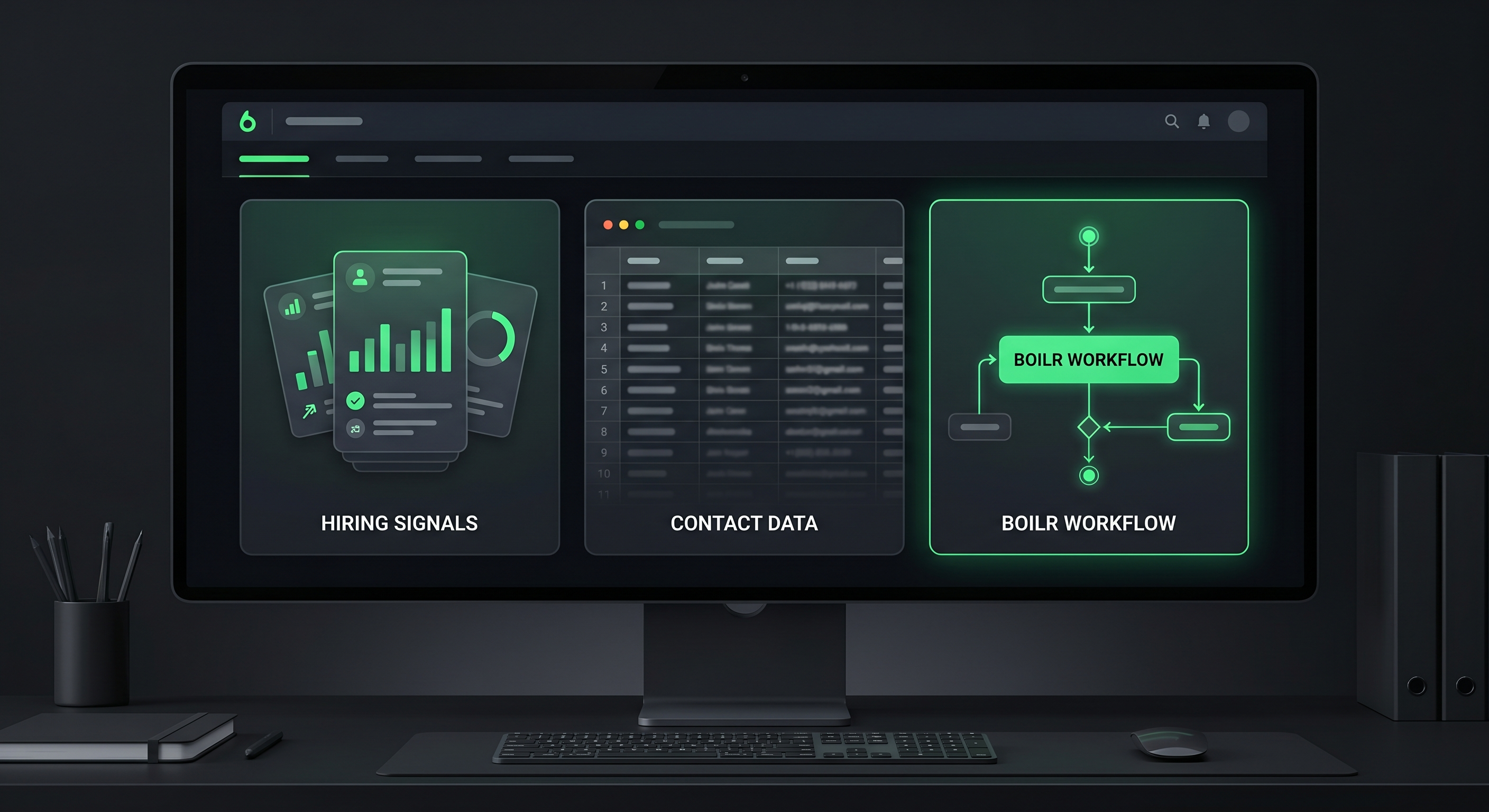
The best ZoomInfo alternative for recruiters in 2026 is Boilr if your goal is to win agency clients, not just reveal contact details. ZoomInfo-style tools answer "who is this person?" Boilr answers "which company is hiring, why now, and who should I contact first?"
- Best overall for recruiter BD - Boilr, because it combines Discovery, Signals, account context, and hiring manager routes.
- Best pure database replacement - Apollo or Lusha, if your team already knows the target accounts.
- Best workflow builder - Clay, if you have ops capacity to maintain enrichment logic.
Why Recruiters Switch From ZoomInfo
Recruiters do not usually leave ZoomInfo because the database is useless. They leave when they realise a bigger database does not fix weak timing.
- Static contact data - A contact can be accurate and still be irrelevant if the company has no hiring pressure.
- Generic intent - Website visits and category intent rarely map cleanly to recruiter need.
- Low account confidence - Recruiters still need to check jobs, role mix, funding, leadership changes, and recruiter history manually.
- Weak outreach angles - "I found your details" is not a reason to take a recruiter call.
- Cost pressure - Agencies with small BD teams often pay for more database than they can work properly.
| Old workflow | Problem | Better recruiter workflow |
|---|---|---|
| Build a list from firmographics | Many accounts are cold | Start from hiring signals |
| Enrich contacts | Contact may not own hiring | Map the hiring manager and TA path |
| Send generic pitch | Low relevance | Reference the specific role pressure |
What To Look For In A Recruiter-Specific Alternative
A good ZoomInfo alternative for recruiters must do more than return emails and phone numbers.
- Hiring signal detection - The tool should spot companies posting relevant jobs, expanding teams, raising capital, or changing leadership.
- ICP matching - It should filter out companies that are hiring but not right for your desk.
- Decision-maker mapping - It should identify the likely hiring manager, TA owner, or functional budget holder.
- Context for outreach - It should explain why the account is worth contacting now.
- Contact enrichment - It should still help you reach the person once the account is qualified.
Simple test: If the tool cannot help a recruiter write a more relevant first sentence, it is only a database. If it can explain the hiring moment, it is recruitment intelligence.
Scoring Model: How Recruiters Should Judge ZoomInfo Alternatives
Most comparison pages score tools like a sales operations team would: database size, enrichment fields, integrations, pricing, and sequencing. Recruiters should score differently because the cost of bad targeting is not only a bounced email. It is a wasted BD hour, a weak pitch, and another account your competitor may reach with better timing.
Use this scoring model before you buy anything. It is simple enough for an agency founder to run in one afternoon and practical enough for a BD lead to use during a vendor trial.
| Criterion | Why it matters for recruiters | What good looks like |
|---|---|---|
| Account timing | Recruiters need a reason to contact the company now. | Signals such as jobs, funding, leadership moves, expansion, new hires, and recruiter history. |
| ICP fit | Hiring companies are not always good agency prospects. | Filters for sector, geography, role family, headcount, and desk fit. |
| Stakeholder path | One account can have several possible buyers. | Clear routes to TA, people leaders, and functional hiring managers. |
| Message quality | A contact without context creates generic outreach. | The recruiter can write a first line based on a visible business event. |
| Workflow fit | Recruiters need repeatable weekly action, not another research tab. | Saved searches, clear prioritisation, and a route from signal to outreach. |
| Contact confidence | The final step still needs accurate contact data. | Useful enrichment, LinkedIn validation, and sensible data handling. |
When you score tools this way, Boilr usually wins for recruitment agencies because it covers the upstream work that generic databases leave to the recruiter. Apollo, Lusha, Kaspr, Cognism, and Sales Navigator still have roles, but they are more valuable when the account has already been qualified through Discovery and prioritised through Signals.
Trial exercise: Take 25 target companies from each tool. For every company, ask: why this account, why now, who owns the hiring problem, and what would I say in the first sentence? The tool that gives the clearest answers is the better recruitment BD platform.
Best ZoomInfo Alternatives For Recruiters In 2026
Here is the short list, ranked by how well each tool fits recruitment-agency BD.
| Tool | Best for | Recruiter BD note |
|---|---|---|
| Boilr | Recruitment agencies that need hiring intent, account context, and decision-maker routes | Best all-round alternative for recruiter BD because it starts with companies that are hiring, not static contact lists. |
| Apollo | Teams that mainly need a broad B2B database and sequencing | Strong contact volume, but recruiters still need separate signal research. |
| Lusha | Quick contact reveals and simple prospecting workflows | Useful once the target person is known. Less useful for deciding which accounts to chase. |
| Cognism | Revenue teams that prioritise compliant B2B data in Europe | Good data and compliance story, but not recruitment-agency native. |
| Kaspr | LinkedIn-heavy recruiters who want fast enrichment | Works well as a contact layer beside LinkedIn and Sales Navigator. |
| Clay | Ops-heavy teams building custom enrichment workflows | Flexible, but needs setup and ownership from someone technical or RevOps-minded. |
| LinkedIn Sales Navigator | Manual relationship mapping and account browsing | Useful for research, but still leaves timing and qualification to the recruiter. |
Boilr versus database-first tools
Pros
- Signal-first - starts with companies showing hiring demand.
- Recruiter-native - built around agency BD workflows.
- Better first sentence - outreach can reference a real hiring moment.
- Less list waste - ICP filters remove bad-fit accounts earlier.
Cons
- Not a giant generic database - if all you want is volume, use Apollo or ZoomInfo.
- Best for agencies - in-house sales teams may need broader GTM data.
- Newer category - some teams need to adjust from list-led BD to signal-led BD.
Detailed Comparison: What Each Tool Actually Replaces
The phrase "ZoomInfo alternative" can mean several different things. Some recruiters mean a cheaper database. Some mean better phone numbers. Some mean a way to discover companies before competitors notice the same jobs. Those are different buying decisions.
For recruitment agencies, the best alternative is usually the tool that improves the whole business development motion: account selection, signal validation, decision-maker mapping, outreach context, and follow-up priority. That is why Boilr belongs at the top of the list for agency BD, even though tools like Apollo, Lusha, Kaspr, Cognism, and Clay can be useful in narrower parts of the workflow.
1. Boilr: best for signal-led recruitment business development
Boilr is the best fit when recruiters want to know which companies are worth chasing this week. Boilr Discovery helps agencies find ICP-fit companies, while Boilr Signals adds timing: funding, leadership change, expansion, job velocity, new projects, recruiter history, and other moments that suggest a company may need external support.
That distinction matters. A recruiter does not win a client just because they found a Head of Engineering email. They win because they contact the right company with a useful point of view at the right moment. Boilr gives the recruiter that story before the first message is written.
- Use Boilr when your agency wants fewer dead lists and more accounts with visible hiring pressure.
- Do not use Boilr only as a one-off email finder. It is strongest when used as the source of weekly BD targets.
- Best internal links to use next - funding rounds, executive moves, expansion signals, and recruiter history.
2. Apollo: best when you already know the accounts
Apollo is a strong broad-market database and outbound platform. It makes sense when a team already has a named account list and mainly needs to enrich people, build segments, and run sequences. Recruiters can use Apollo effectively, but it does not remove the need to decide which companies are actually hiring in your niche.
A common agency mistake is to use Apollo as the starting point and then hope volume creates meetings. A better workflow is to use Boilr to build the account list, validate the hiring reason, then use a database or enrichment tool where it adds value.
3. Lusha and Kaspr: best as fast enrichment layers
Lusha and Kaspr are useful when the recruiter has already found the right person. Kaspr is especially natural for LinkedIn-heavy workflows, while Lusha is straightforward for contact reveals and smaller prospecting tasks. The limitation is strategic: neither tool should be your entire BD system if the hard problem is finding the right account, not just the right email.
For agencies, the ideal sequence is simple: find the hiring moment, map the stakeholder, enrich the contact, then send a message that references the signal. If enrichment comes first, the recruiter often ends up with large lists of people who have no urgent reason to reply.
4. Cognism: best for compliance-sensitive revenue teams
Cognism is often attractive for teams that care about European coverage, compliance posture, and verified B2B contact data. For recruitment agencies operating in Europe or the UK, that can matter. The trade-off is that Cognism is still a general sales intelligence platform. It can help you reach people, but it does not automatically interpret hiring pressure the way a recruitment-intelligence workflow should.
5. Clay: best for technical GTM operators
Clay is powerful when a team wants to combine many data sources, write custom enrichment logic, and automate research. It is flexible, but flexibility creates ownership. Someone has to design the table, monitor credits, test waterfall rules, maintain prompts, and decide which signals should trigger action.
That can work for a mature agency with a founder or ops lead who enjoys building systems. It is less ideal for recruiters who need a packaged workflow that helps them work better tomorrow morning.
6. LinkedIn Sales Navigator: best for human review and relationship context
Sales Navigator remains useful because LinkedIn is where many recruiters verify people, roles, mutual connections, and career moves. It should not be confused with a complete recruitment BD platform. Sales Navigator is excellent for browsing and checking, but recruiters still need a system for deciding which accounts deserve that research time.
Practical stack recommendation: For most agencies: use Boilr for account discovery and signals, LinkedIn for human validation, and one enrichment tool for contact details. That is leaner than trying to make a generic database do every job.
Why Boilr Fits Recruiters Better Than A Generic Database
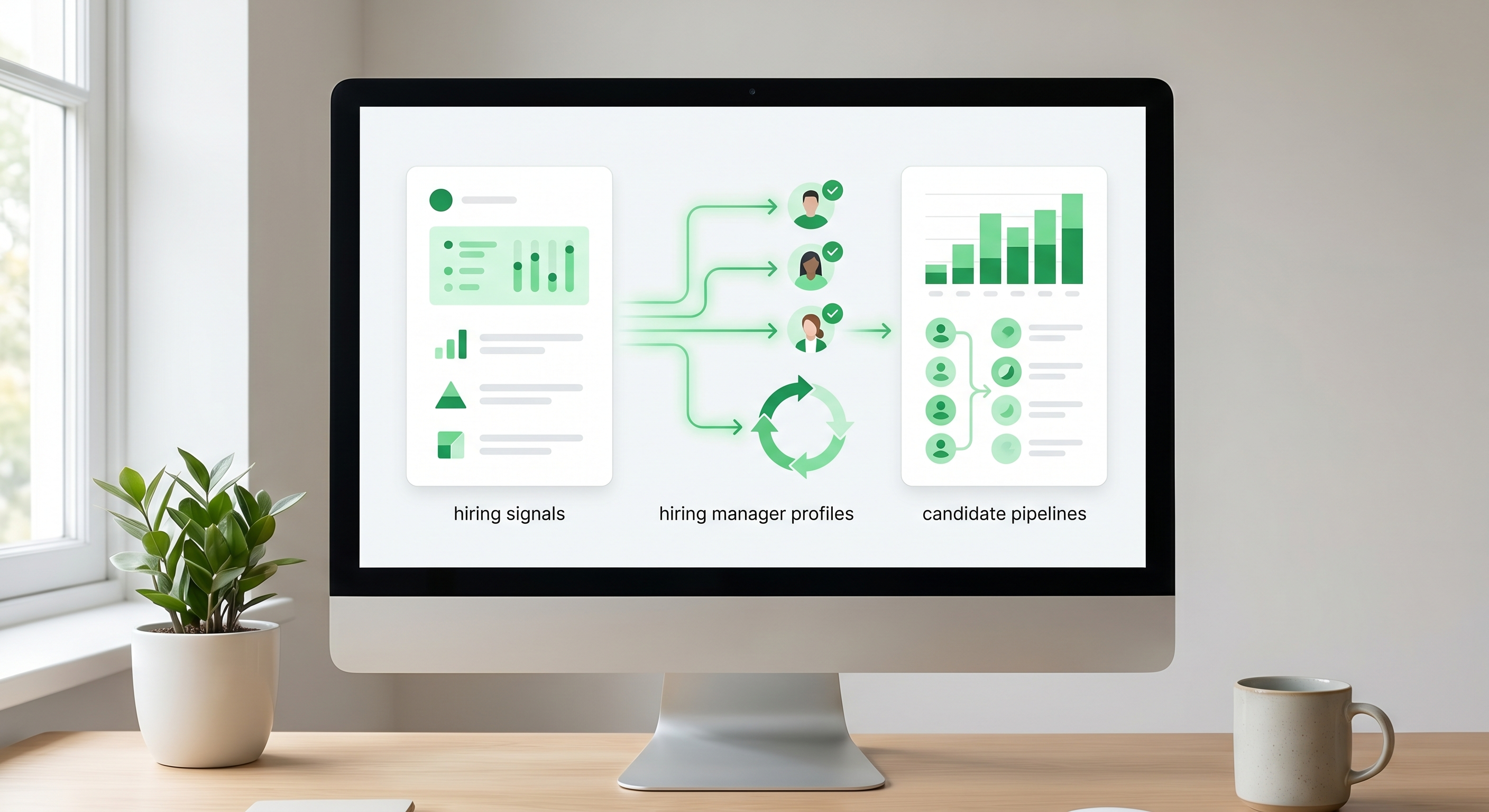
Boilr is strongest when a recruiter needs to decide where to spend BD time. The platform combines account discovery, hiring signals, role context, and decision-maker routes.
- Discovery - finds companies matching your desk, market, role families, and geography.
- Signals - spots funding rounds, executive moves, expansion, job velocity, and recruiter-history moments.
- Hiring manager context - helps identify who owns the hiring problem.
- Lead scoring - prioritises accounts by recruiter-need likelihood.
- Product links - works naturally with the wider Boilr business development workflow.
Boilr Pages To Use With This Workflow
If you are replacing ZoomInfo because you want better recruitment BD, do not stop at one comparison page. Build the workflow around the Boilr pages that match how recruiters actually decide where to spend time.
- Boilr Discovery - Find ICP-fit companies before you waste time enriching the wrong accounts.
- Boilr Signals - Prioritise accounts by funding, growth, job velocity, leadership change, and other timing cues.
- Funding Rounds - Spot companies that may need to build teams after new capital.
- Executive Moves - Find leadership changes that often create new hiring priorities.
- Expansion Signals - Track companies opening new markets, offices, functions, or product lines.
- Recruiter History - Understand whether a company has used recruiters before and how that should shape outreach.
The blog library also supports the same journey. Read How To Identify Hiring Signals for the signal taxonomy, Best BD Tools For Recruitment Agencies for stack design, LinkedIn Recruiter Alternatives for sourcing context, and Best Apollo Alternatives For Recruiters if you are comparing database-first tools.
Decision Framework
Choose based on the problem you are actually solving.
| If your team needs... | Choose... | Why |
|---|---|---|
| Better account timing | Boilr | It starts from hiring signals and ICP fit. |
| A broad B2B database | Apollo or ZoomInfo | They cover generic contact volume. |
| LinkedIn enrichment | Kaspr or Lusha | They are lightweight contact reveal layers. |
| Custom data workflows | Clay | It lets ops teams combine many data sources. |
30-Day Implementation Plan For Agencies
A ZoomInfo replacement only matters if it changes weekly recruiter behaviour. Use this simple 30-day plan to move from list-led prospecting to signal-led BD.
Week 1: define the account rules
Choose the desk, geography, role families, company size, and exclusion criteria. In Boilr Discovery, this becomes the foundation for cleaner account selection.
Week 2: choose the signal triggers
Pick three to five signals that actually matter for your desk, such as funding rounds, executive moves, expansion, new hires, recruiter history, or job velocity. Avoid tracking every possible signal if the team cannot action them.
Week 3: write signal-specific outreach
Create message angles for each signal. A funding-round email should not sound like an executive-move email. The signal gives the recruiter permission to be specific.
Week 4: measure meetings, not list size
Track accounts reviewed, qualified signals, first messages, replies, booked meetings, and briefs opened. If a database increases contacts but not conversations, it is not improving BD.
The main metric is not how many contacts the tool contains. The main metric is how often a recruiter can open the platform, find a credible reason to contact an account, and book a relevant hiring conversation.
Common Mistakes When Replacing ZoomInfo
Switching tools will not fix a broken BD process by itself. The agencies that get the best results use the tool change to improve the operating rhythm.
Mistake 1: comparing only contact volume
More contacts can make the pipeline look busy while reducing focus. Recruitment BD is not a volume-only game. If a recruiter sends 200 generic messages to companies with no visible hiring pressure, the database has made the wrong behaviour easier. Compare how many qualified conversations the tool creates, not how many rows it exports.
Mistake 2: treating intent data as hiring intent
Generic B2B intent often tells sales teams that a company may be researching a category. Recruiters need a different kind of intent: jobs, team expansion, leadership change, funding, new projects, restructures, and recruiter buying behaviour. That is why Boilr Signals and the signal pages are more useful for agencies than broad category intent alone.
Mistake 3: sending one message to every stakeholder
The CFO, VP Engineering, Head of Talent, and Founder do not care about the same angle. A functional manager cares about delivery risk. TA cares about pipeline capacity and vendor quality. A founder may care about speed and growth plan execution. The source data should shape the message.
Mistake 4: ignoring existing Boilr playbooks
Use the supporting blog library. How To Identify Hiring Signals explains what to look for. Recruitment BD Pipeline Guide explains how to organise the workflow. Cold Calling Vs Hiring Signals explains why timing changes outreach. Quality Vs Quantity Recruitment Leads explains why fewer better accounts often beat larger lists.
Mistake 5: not defining the weekly output
Before buying a replacement, define what should happen each week: 50 accounts reviewed, 20 qualified signal-led accounts, 10 decision-maker routes, 40 personalised first touches, and five meaningful conversations. Your numbers may differ, but the principle is fixed. A tool should create a reliable cadence, not another place to browse.
Use Cases: Which Alternative Fits Which Recruitment Agency?
A retained executive-search firm, a perm technology agency, and a high-volume commercial desk should not evaluate ZoomInfo alternatives in the same way. The right answer depends on deal size, desk focus, sales motion, and how much research time recruiters can realistically spend.
Small specialist agency
Choose Boilr first. A small team cannot afford to work broad lists. It needs Discovery to narrow the market and Signals to decide who deserves outreach this week.
High-volume outbound team
Use Boilr to prioritise account lists, then Apollo, Lusha, or Kaspr for enrichment where needed. This keeps volume tied to relevance rather than letting database exports define the strategy.
Founder-led agency
The founder usually needs fast judgement, not more admin. Boilr is valuable because it turns market movement into a shortlist of accounts, with enough context to write credible outreach quickly.
Ops-heavy agency
If you have RevOps or data capacity, Clay can sit beside Boilr for custom enrichment and routing. Boilr remains the cleaner starting point for recruitment-specific signals.
This is also why the best replacement decision is rarely binary. Agencies can keep a contact layer, but they should stop treating the contact layer as the strategy. The strategy is choosing the right companies at the right moment, then contacting the right people with enough evidence to be useful.
For a broader stack view, read Best Recruitment Platform For Agencies, Best Recruiter Platform Features, and How Recruitment Agencies Build A BD System.
Final buying checklist for agency founders
Before signing a ZoomInfo replacement, ask the vendor to show three real workflows: how a recruiter finds an ICP-fit account, how the platform explains the hiring moment, and how the recruiter identifies the first stakeholder to contact. If the demo jumps straight to exporting contacts, it is probably a database-first workflow.
Also ask how the tool supports weekly discipline. Can the team build a saved view for each desk? Can they separate funding, expansion, executive moves, job velocity, and recruiter-history signals? Can managers review which signals created replies? These details matter because recruitment BD improves when the team learns which timing cues work in its market.
Boilr is strongest here because it makes the account, signal, and stakeholder route part of the same motion. A contact database can still help at the end, but Discovery and Signals should define where the recruiter starts.
FAQ
What is the best ZoomInfo alternative for recruiters?
Boilr is the strongest option when the goal is recruitment business development, not just contact lookup. It helps agencies find companies with hiring intent, understand the reason to reach out, and identify relevant hiring managers. Generic databases can still help with enrichment, but they rarely solve timing.
Is ZoomInfo useful for recruitment agencies?
Yes, ZoomInfo can help agencies find company and contact data. The limitation is that contact data alone does not tell a recruiter which company has an urgent hiring problem. Agencies usually need hiring signals, job activity, and account context before enrichment becomes valuable.
Why do recruiters look for ZoomInfo alternatives?
Recruiters look beyond ZoomInfo when they want better recruitment-specific targeting. They need to know who is hiring, which role families are active, which manager owns the problem, and why now is the right time to reach out. A generic sales database does not always answer those questions.
Should recruiters use Apollo or Boilr?
Use Apollo if you already know the exact account and mainly need a database plus sequencing. Use Boilr if you need the account discovery layer first. Boilr is stronger for signal-led recruitment BD because it helps decide who to contact, why to contact them, and when to move.
Is Lusha a good ZoomInfo alternative for recruiters?
Lusha is useful for simple contact enrichment. It is a good add-on when recruiters already have a named person or LinkedIn profile. It is not a complete recruitment BD system because it does not start with hiring demand or ICP-fit account discovery.
Can Clay replace ZoomInfo for recruitment teams?
Clay can replace parts of ZoomInfo for teams that want custom enrichment workflows. It is best when someone owns the data workflow and can connect multiple providers. Many recruitment agencies prefer a more packaged workflow because recruiters do not want to maintain enrichment logic.
What data matters most for recruiter BD?
Hiring activity, role mix, funding, leadership moves, expansion signals, recruiter history, and decision-maker relevance matter more than raw contact volume. A recruiter can have thousands of contacts and still miss the right account. Signal quality usually beats database size.
What is the difference between sales intelligence and recruitment intelligence?
Sales intelligence focuses on generic buyer contact data, firmographics, and intent. Recruitment intelligence focuses on hiring demand, job changes, hiring manager context, and role pressure. Boilr sits in the second category.
Do recruiters still need LinkedIn with Boilr?
Most agencies still use LinkedIn for relationship checking and profile review. Boilr does not remove the need for human judgement. It gives recruiters a better starting list and a clearer reason to reach out.
What should small agencies choose instead of ZoomInfo?
Small agencies should avoid paying for more database than they can work. A signal-led tool like Boilr often fits better because it reduces wasted prospecting and points recruiters toward accounts with live hiring demand. Contact enrichment can be added afterwards.
How should agencies compare ZoomInfo alternatives?
Compare tools on account discovery, signal quality, contact accuracy, GDPR posture, integrations, and time-to-first-meeting. Do not compare only database size. The best tool is the one that helps recruiters book relevant hiring conversations.
Does Boilr replace ZoomInfo completely?
For many recruiter BD workflows, yes. Boilr can replace the account discovery and prioritisation work that recruiters often try to do with a database. Some teams may still keep a separate enrichment tool for edge cases or international contact coverage.
Sources
- ZoomInfo platform
- Apollo platform
- Lusha pricing and platform information
- Kaspr LinkedIn contact data
- Clay enrichment platform
- Boilr Discovery
- Boilr Signals
- Boilr business development resources
- Boilr funding rounds signal page
- Boilr executive moves signal page
- Boilr expansion signal page
- Boilr recruiter history signal page
- LinkedIn Sales Navigator overview
- Cognism sales intelligence platform
- Lusha pricing and credits
- TheirStack job search documentation