Best Apollo Alternatives for Recruiters in 2026: 7 Tools We Tested
Recruiters do not need a bigger generic prospecting database nearly as often as they need better timing, cleaner hiring-manager context, and a faster route from signal to first conversation.
TL;DR
The best Apollo alternative for recruiters in 2026 is Boilr, because recruiter BD is usually a timing problem before it is a sequencing problem. Apollo is good at broad sales prospecting and paid-contact volume, but recruiter teams often need direct-employer discovery, hiring signals, hiring-manager mapping, and CRM-ready handoff before another credit-based export button becomes useful.[5][6][8]
After Boilr, the strongest options depend on what kind of desk you run: Vente AI for job-led lead feeds, SourceBreaker for broader recruitment automation, Paiger for direct-vacancy discovery and outreach support, Cognism for EMEA data quality, Sales Navigator for relationship-led account research, and Clay for custom workflow builders. LinkedIn reports that recruiters already using or testing generative AI save around 20% of their work week on average, while Bullhorn found firms using AI to screen candidates were materially more likely to place candidates faster.[1][2] The point is not just to automate more. The point is to automate the right part of recruiter business development.
Why recruiters start looking beyond Apollo
Apollo is easy to understand because it packages contact data, sequencing, and a recognisable outbound workflow into one place. For SaaS sales teams, that can be enough. For recruiters, though, the real question usually lands earlier in the chain. The team is not asking, “How do we send more sequences?” It is asking, “Which accounts have a real hiring problem right now, who owns it, and how quickly can we get that context into our desk workflow?” That is a different buying job, and it explains why recruiters keep searching for Apollo alternatives.
The mismatch becomes obvious when you look at how recruiter business development actually works. A consultant has maybe ninety minutes between delivery work, candidate calls, and client updates to find live opportunities. If the tool starts with a giant list of contacts and asks the recruiter to work out relevance afterwards, the workflow creates more judgement work than it removes. That is why so many recruiter teams drift back to LinkedIn, job boards, spreadsheets, and half-remembered market intuition even after buying a shiny prospecting platform. The software helped with names, but not enough with timing.
The market shift around AI makes this gap more urgent, not less. LinkedIn’s 2025 recruiting research found that 37% of organisations are actively integrating or experimenting with generative AI in hiring, up from 27% the year before, and teams already using it report time savings of about one full day per week on average.[1] That means buyers are no longer impressed by generic “AI inside” claims. Recruiters want tools that save time in the exact places where the desk bleeds it: finding the right company, spotting the right moment, and getting the right person into the CRM without a copy-paste mess.
Bullhorn’s 2025 staffing research points in the same direction. Firms using AI to screen candidates were 86% more likely to place candidates in less than 20 days, and respondents predicted AI could save 17 hours per recruiter per week, including 4.5 hours on searching alone.[2] Those numbers matter because the first commercial win from better recruiter tooling is rarely a prettier dashboard. It is a shorter path to a live brief, a stronger first meeting, or a consultant who stops burning their morning assembling a list that no one trusts by lunchtime.
There is also a buyer-behaviour shift hiding underneath the software comparison. HubSpot’s research shows buyers increasingly prefer to research tools independently, with 75% preferring to gather product information on their own and 57% saying they purchased a tool in the last year without meeting the vendor sales team.[4] For recruiter software content, that means the winning article is not the one that screams loudest. It is the one that tells the truth about where Apollo fits, where it does not, and which workflow each alternative actually improves.
What recruiters actually need from an Apollo alternative
The fastest way to waste budget in this category is to evaluate recruiter tools like generic sales tools. Recruiters are not trying to book meetings from a list of every company with 50 to 500 employees and a Head of Talent. They are trying to spot accounts with credible need, understand the hiring context quickly, and act before every other agency on the market sees the same opening. If your evaluation framework does not start there, the buying decision drifts toward volume over relevance.
The first criterion is direct-employer discovery. A recruiter tool should help the desk find employers that actually fit the patch, niche, and geography it works, without flooding the feed with agency ads, irrelevant functions, or giant enterprise noise that will never become a client. That is why recruiter-first tools like Boilr, Vente AI, SourceBreaker, and Paiger feel different from Apollo the moment a consultant opens them. The product is trying to narrow the market before the recruiter spends effort, not after.
The second criterion is timing intelligence. A broad database can tell you who exists; a good recruiter platform helps explain why now might matter. Boilr’s Signals product is explicit about this by tracking funding, leadership changes, hiring bursts, expansion signals, and recruiter history, then filtering them against the desk ICP before surfacing an account.[8] That matters because a recruiter is rarely beaten by someone who has a better list of random contacts. They are beaten by someone who notices intent earlier and speaks to it more clearly.
The third criterion is hiring-manager mapping and usable enrichment. Many tools promise “decision-maker data”, but the recruiter use case is more specific. You need the person who owns the pain, influences the search, or can make an introduction internally. That is different from grabbing whichever Talent Acquisition Manager appears in a contact database. Tools that move recruiters closer to the likely owner of the problem reduce not just bounce rates but message waste, because the outreach starts with sharper context.
- Timing beats volume — The best recruiter prospecting tools tell you why an account matters now, not simply that it exists.
- Map the real owner — Recruiters need the likely hiring owner or influencer, not a random contact export with the right department label.
- Less admin, more action — If the data dies in a spreadsheet or takes six clicks to reach the CRM, adoption falls quickly.
- Usable data over more data — A smaller set of well-filtered, context-rich leads usually beats a larger, noisier database for agency BD.
The fourth and fifth criteria are workflow handoff and commercial clarity. Recruiters do not forgive tools that create hidden labour. If a platform finds interesting companies but cannot push a clean record into the CRM or ATS, the output becomes another side project. If the pricing looks cheap until credits burn on irrelevant data, the tool becomes politically expensive inside the team even before finance notices. That is why our ranking puts recruiter workflow fit ahead of broad sales features every time.
The 7 best Apollo alternatives for recruiters in 2026
We evaluated these tools against the recruiter workflow rather than the generic SDR workflow. That means we weighted signal quality, job-led discovery, hiring-manager context, ease of moving insight into the CRM, and commercial clarity more heavily than built-in diallers or bulk sequence features. Broad outbound teams might rank the list differently. Recruitment agencies should not.
We also tried to be fair to Apollo. Its public pricing starts at low self-serve tiers and climbs through per-user plans with more credits, AI features, and calling features as you scale.[5] That is attractive when your core problem is outbound volume. But when the team’s bottleneck is finding earlier, better-fit opportunities, Apollo often feels like a strong second-half tool attached to a weaker first-half workflow for recruiters.
| Rank | Tool | Best for | Pricing | Why recruiters switch |
|---|---|---|---|---|
| #1 | Boilr | Recruitment agencies that want signal-led prospecting, fit scoring, and hiring-manager context in one workflow | Sales-led / demo-based | Recruiter ICP filtering, hiring signals, decision-maker lookup, AI scoring, CRM/ATS handoff |
| #2 | Vente AI | Recruiters who want automated job-led opportunity feeds with CRM push | From £199/month | Job-led discovery, hiring stress data, direct hiring-manager focus, transparent pricing |
| #3 | SourceBreaker | Agencies that want AI recruitment automation across candidate and client discovery | Custom quote / demo-led | Vacancy and event tracking, market mapping, candidate-to-client matching |
| #4 | Paiger | Small teams wanting direct-employer vacancy discovery plus outreach support | From $250/month | Direct-vacancy focus, company intel, hiring-manager contacts, message support |
| #5 | Cognism | Recruiters whose biggest issue is EMEA contact quality and compliance | Custom quote | Phone-verified mobiles, GDPR-first positioning, intent and trigger data |
| #6 | LinkedIn Sales Navigator | Teams that do relationship-led account research on LinkedIn | From US$119.99 per month per licence | Account research, stakeholder mapping, familiar interface, strong networking context |
| #7 | Clay | Ops-heavy teams that want to build their own enrichment and automation workflows | Credit-based plans starting from public self-serve pricing | Flexibility, enrichment breadth, custom workflow design |
1. Boilr is the best Apollo alternative for most recruitment agencies because it starts where recruiter business development actually starts: which accounts match the ICP, which signals suggest genuine hiring movement, who likely owns the hiring pain, and what should the team work today.[6][7][8] A small technology desk, for example, can wake up to filtered signals about engineering hiring, leadership changes, and expansion movements instead of starting the day with a blank search box. That is a better commercial starting point than exporting another batch of “Head of Talent” contacts from a giant horizontal database and hoping one of them happens to be under pressure.
2. Vente AI is the clearest option for recruiters who want job-led leads on autopilot. Its public product pages emphasise daily leads, hiring-manager contacts, hiring-stress analysis, and CRM push, with pricing that starts from £199 per month and scales with lead volume.[10][11] A contingent recruiter working a tight UK market could find that attractive because the value is obvious fast: fewer agency ads, more live employers, and less manual list assembly. The trade-off is that the product is narrower than a broader intelligence system, which means some teams outgrow it as their motion gets more layered.
3. SourceBreaker remains a strong name in the recruiter-specific category because it explicitly positions itself around AI recruitment automation, vacancy and event tracking, and better candidate or client matching from existing resources.[12] An agency with both candidate-rich and client-rich workflows may like that wider surface area because the tool can support more than one commercial route. The caveat is that pricing is less transparent publicly and the evaluation process is more sales-led, which can make it harder for smaller buyers to compare it quickly against self-serve or semi-transparent tools.
4. Paiger is especially interesting for small teams that want direct-employer vacancy discovery plus company intelligence and personalised outreach help in one place. Its site is unusually direct about the recruiter pain: too many wasted mornings, too few quality leads, and too much same-sounding outreach.[13] Public pricing starts at $250 per month and scales by user count, which at least gives buyers clearer early-stage budgeting than many sales-led alternatives.[14] The likely fit here is the owner-led or team-lead-led desk that wants quick commercial lift without building a more technical system.
5. Cognism is the best Apollo alternative on this list when the buyer’s most painful problem is international contact quality, especially in Europe. Its positioning leans hard into EMEA strength, phone-verified mobile numbers, compliance, intent data, and signal-driven prioritisation, with quote-based pricing packages built around team size and workflow needs.[18][19] A life-sciences desk selling into German, French, and UK clients might care deeply about that. But because Cognism is still a wider GTM product, recruiter teams should ask whether they are mainly fixing a data quality issue or a timing issue. The answer changes the ranking.
6. LinkedIn Sales Navigator is the familiar choice for recruiters who prefer account research and stakeholder mapping inside a network they already use every day. Public pricing starts from US$119.99 per month per licence for Core and climbs for Advanced tiers, which is more transparent than some enterprise alternatives.[17] Its weakness is not that it lacks value. It is that the recruiter still has to do a lot of manual work around signal collection, enrichment, prioritisation, and record movement. If your team already has a disciplined desk workflow and wants a research layer, Sales Navigator can be enough. If the team needs the workflow itself to improve, it usually is not.
7. Clay is the smartest option for recruiter teams with an operator mindset, internal ops support, or unusually specific enrichment logic. Clay’s strength is flexibility: it can assemble workflows across many data providers, enrichment sources, and automations rather than forcing one predefined motion.[15][16] The reason it ranks lower for most recruiters is not capability. It is time-to-value. A founder who enjoys process design may love it; a consultant who just wants tomorrow morning’s best accounts usually will not.
How we tested these Apollo alternatives
“We tested” can mean anything from a five-minute homepage skim to a full six-week rollout, so it is worth being precise. For this article, we tested each option against the recruiter use case using the public product pages, pricing pages, workflow descriptions, buyer journeys, positioning language, and where available the operating details each vendor emphasises in its own materials. We also compared the way leading Apollo-alternative listicles framed the market, because those articles reveal what buyers are commonly told to care about and, just as importantly, what recruiter-specific issues often get ignored.[20][21][22]
The test criteria were deliberately recruiter-first. We looked at whether the tool starts with direct-employer discovery or generic contact volume, whether it surfaces timing signals that would help a recruiter reach out earlier, whether it helps identify the likely hiring owner, how clearly it explains pricing and plan structure, and whether the product language suggests a realistic workflow into CRM or ATS systems. That is a stricter and more relevant standard for agencies than simply counting contacts, direct dials, or AI features. Recruiters win with better judgement and faster action, not with the biggest export button.
We also weighted time-to-value very heavily. A tool can be incredibly capable and still be the wrong choice for a recruitment desk if it needs weeks of setup, admin ownership, or unusually disciplined ops behaviour to show value. Clay is the clearest example of this. For the right team it can be brilliant, but a busy contingent desk may never operationalise half of what makes it impressive. By contrast, tools such as Vente AI or Paiger score well because a user can understand the output quickly and connect it to day-to-day desk behaviour with minimal translation.
Another part of the test was tone and positioning. This sounds softer than it is. When a product speaks in the language of recruiters, it usually reflects product choices underneath: lead lists are filtered around vacancies or signals, company context is presented in a recruitment frame, and the promise is tied to booked meetings, mandates, or placements rather than “pipeline generation” in the abstract. That is one reason Boilr, Vente AI, SourceBreaker, and Paiger all read more naturally for agency buyers than generic Apollo competitors built mainly for SDR or RevOps teams.
Finally, we judged each tool against a simple buyer reality: if a recruitment founder had to make a decision this quarter and needed the software to improve behaviour on the desk within the first month, would this be a sensible choice? That question is ruthless in a useful way. It favours clear workflow fit over feature theatre, which is exactly why Boilr stays ahead in this ranking. It is not trying to be the most generic prospecting platform on the internet. It is trying to help recruitment agencies find and work better opportunities earlier.
Why signal-led prospecting beats database-led prospecting for recruiters
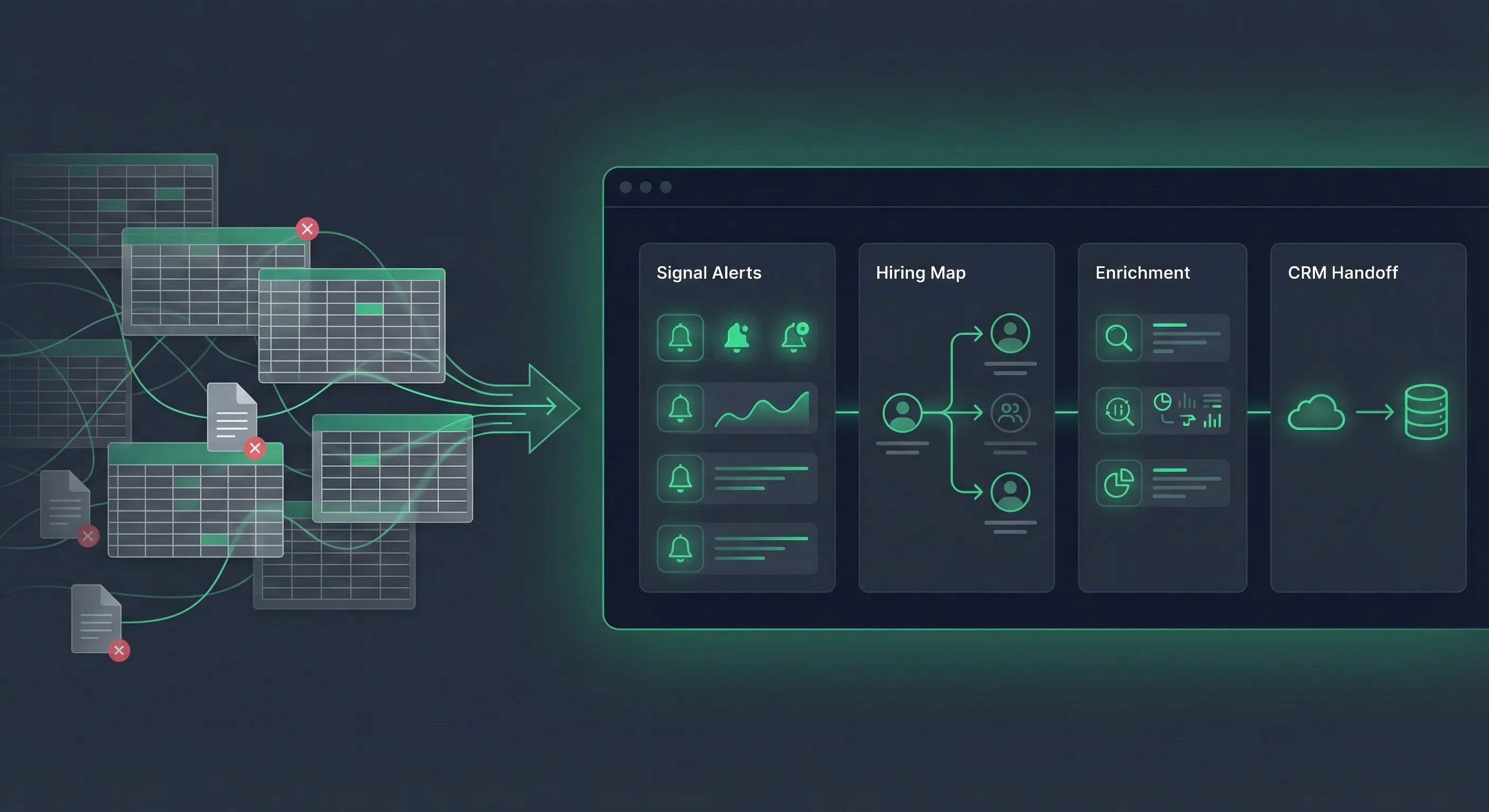
Most Apollo alternative articles still evaluate tools as if the central problem is database size. That is understandable because it is easy to compare row counts, direct dial coverage, and per-seat pricing. It is also the wrong lens for agency business development. Recruiter success depends more on whether the team speaks to the right company at the right moment than whether the tool can export ten thousand extra contacts from accounts that are not changing.
Imagine two desks working the same market. Desk A uses Apollo-style database prospecting. It builds a list of 200 accounts, exports contacts, sends outreach, and slowly works out which firms are actually under pressure. Desk B uses a signal-led tool. It starts with companies showing hiring bursts, recruiter history, funding, or leadership change, then maps the likely hiring owner and pushes only the top slice into the CRM. Desk A has more names. Desk B has more reason to be in the inbox. In practice, that second desk usually books cleaner conversations because its outreach is anchored in something observable.
The external market data supports that emphasis on timing and relevance. HubSpot’s 2025 State of Sales report shows that buyers are more informed, more selective, and more responsive when the message feels connected to real value rather than generic activity, while 84% of respondents said AI saves time and 82% said it surfaces better insights from data.[3] Although that report is sales-focused, the operational lesson translates directly to recruiter BD. The edge is not blind automation. It is better prioritisation.
You can see the recruiter version of this principle in content already live on the Boilr blog. The guides on which hiring signals actually lead to meetings, how recruiters find hiring teams before the brief goes live, and how recruiters build better lead lists without wasting hours all point to the same commercial truth: timing reduces wasted effort upstream, which makes every downstream activity sharper. A tool that improves timing therefore has leverage on the whole desk, not just one micro-step.
That is the main reason Boilr finishes first in this comparison. It does not ask recruiters to behave like generic SDRs with recruiter logos. It starts with discovery, signal quality, fit filtering, and contactability, then moves the result into action.[6][7][8] For this use case, that is a better product architecture than beginning with volume and hoping the desk creates meaning later.
How to choose the right Apollo alternative for your desk
If you are serious about replacing Apollo, do not start by booking seven demos and comparing whoever had the slickest AE. Start with your actual desk model. A founder-led agency with three consultants, an enterprise search practice, and a high-volume contingent desk are not buying the same product even if they all type “Apollo alternatives” into Google. Good buying starts with the job the tool needs to do inside the week, not the category label on the homepage.
Step 1: define the broken step in the current workflow. If the team already knows the right accounts and simply lacks better mobile numbers, Cognism or a data-led alternative may be enough. If the team cannot reliably tell which employers are worth working today, look at Boilr, Vente AI, or SourceBreaker first. If the team wants total flexibility and has an operator to build around it, Clay enters the conversation. The point is to stop pretending all prospecting pain is one pain.
Step 2: run a live brief through each shortlisted tool. Use one desk, one geography, one function, and one realistic target account shape. Ask each tool to surface twenty companies the desk should work this week, explain why they matter now, show the likely hiring owner, and push a sample set into the CRM or ATS. This is the fastest way to separate “nice demo” software from “useful on Tuesday morning” software. A boutique software engineering desk in Manchester will learn more from that test in one hour than from a month of abstract feature comparison.
| Criterion | What to ask | Why it matters |
|---|---|---|
| Direct-employer discovery | Does the tool help you find real employers with active demand, not just contacts in a broad database? | Recruiter BD gets stronger when the market view starts with opportunity, not just names. |
| Timing signals | Can it surface hiring intent, pressure, leadership moves, or relevant market events at the right moment? | Timing usually matters more than another thousand cold accounts. |
| Hiring-manager mapping | Does the tool help identify the likely owner of the hiring problem, not just an HR inbox? | A recruiter needs the person who can authorise help or influence urgency. |
| Workflow handoff | Can a recruiter move from signal to shortlist to CRM or ATS with minimal copy-paste? | Workflow friction kills adoption faster than weak positioning ever will. |
| Commercial clarity | Is pricing understandable enough that the team can predict value before the credits vanish? | Recruiters hate tools that feel cheap on the first day and expensive after the first month. |
Step 3: measure admin, not just output. Two tools might both surface fifteen good accounts, but one may take forty-five minutes of filtering, exporting, cleaning, and note-writing before a recruiter can act. That hidden labour is exactly what kills adoption. LinkedIn’s data that AI frees significant recruiter time is useful here because it tells buyers what to value: reclaimed hours, not just prettier dashboards.[1] The winning tool is the one your least process-obsessed consultant still uses when the desk gets busy.
Step 4: check pricing behaviour under real usage. Apollo-style credit models can look attractive until teams burn credits on poor-fit records, duplicate work, or contacts that never should have entered the workflow. Vente AI and Paiger make a point of clearer public pricing.[11][14] Cognism and SourceBreaker are more sales-led. Boilr sits in the middle as a product that is clearly designed around outcome and workflow, not a self-serve commodity list product.[6][9] The correct question is not “Which is cheapest?” It is “Which creates the least expensive path to a useful desk habit?”
Step 5: choose the tool that fits your operating model today, not the stack fantasy you might have in eighteen months. Many recruiter buyers talk themselves into a more complex platform because they admire what it could do with perfect ops discipline. Then the real desk shows up on Monday and ignores it. If you need sharper accounts tomorrow morning, bias toward clarity and workflow fit. If you already run a disciplined data operation, bias toward flexibility. This sounds obvious, but it is where most software regret begins.
How Boilr fits recruiter workflows better than Apollo
Boilr works better than Apollo for recruiter business development because it is opinionated about the workflow recruiters actually need. The homepage language is direct: the platform scans, enriches, and delivers qualified leads so the team can focus on conversations rather than research, while tracking hiring signals, verified contact details, and AI scores in one place.[6] That may sound like standard SaaS positioning at first glance, but the product design underneath it matters. It starts with hiring movement and fit, not with a generic sales engagement stack.
Start with Discovery. Boilr’s Discovery page is built around the complaint every recruitment founder has heard from their own team: you cannot force recruiters to manually research leads all day and expect adoption.[7] The product promises new qualified leads every morning, identifies the likely hiring manager, filters signals against the ICP in real time, and applies AI scoring to grade which leads deserve focus. That is important because it collapses what is usually a messy multi-tool sequence into one decision flow. A recruiter does not have to start with a blank company search, cross-check job data, guess at relevance, hunt LinkedIn, and then move the result manually into another system.
In practice, that changes how a desk starts the day. Picture a five-person technology recruitment agency that specialises in data and AI hiring. With Apollo, one consultant may spend the morning building lists around funded companies or target titles, then still need to decide which accounts have real urgency. With Boilr Discovery, the starting point is already narrowed: companies that match the agency’s niche, have visible hiring movement, and can be prioritised by fit score.[7] That does not just save time. It reduces debate about what “good” looks like, which is one of the quiet reasons teams fall back into inconsistent prospecting habits.
Then comes Signals, which is the strongest part of the Boilr story versus Apollo. Boilr explicitly monitors the internet for real-time hiring signals, lets teams configure custom alert rules by desk or market, filters the noise automatically, and refreshes those signals every hour across thousands of sources.[8] The site is clear about why that matters: companies that raise funding often allocate significant capital to hiring, new functional leaders trigger headcount plans, recruiter history predicts agency openness, and expansion events create visible pressure. Recruiters already behave as if these patterns matter. Boilr turns that intuition into a system.
This is exactly where Apollo feels generic by comparison. Apollo can help you reach a contact once you know the account matters, and its sequence tooling is genuinely useful for teams running consistent outbound plays.[5] But recruiter teams are often not short on the ability to send. They are short on confidence that the account deserves a send at all. When the software helps answer that question upstream, outreach quality improves downstream almost automatically.
Boilr also seems to understand that recruiter teams do not want to become data operators to get value. The homepage and business-development page both emphasise qualified daily output, verified contact data, AI scoring, and CRM or ATS movement rather than asking the user to assemble those parts themselves.[6][9] That is a material distinction versus Clay, where the power lies in flexibility, or Sales Navigator, where the strength is context but the admin remains on the recruiter. Boilr’s advantage is not that it does every possible thing. It is that it does the right things in the right order for agencies.
Another useful difference is how Boilr frames contacts in context. The site does not merely say “we have verified emails and phone numbers.” It connects those details to the workflow of moving from signal to outreach quickly.[6] That matters for recruiter teams because raw contact accuracy without commercial context still leaves the consultant writing a generic message. When contactability is layered on top of fit and timing, the first message becomes more specific: “You have just hired a VP of Data and posted three machine-learning roles in two weeks; here is where we can help.” That is a better recruiter opening than “Noticed you are growing, keen to connect.”
The workflow gain becomes even clearer when you think about team management. Agency leaders are usually trying to create more consistent prospecting across consultants with different levels of commercial discipline. A system that delivers filtered daily opportunities and supports a shared sourcing methodology is much easier to coach than a system that relies on every consultant building their own search logic from scratch.[7] That is why Boilr fits neatly alongside guides like the best business development tools for recruitment agencies and the best recruiter platform features for 2026. It is not just a point solution. It supports an operating model.
There is also a subtle but important commercial benefit to Boilr’s positioning. Recruiters need tools that help them look sharper in front of hiring managers, not merely busier. When a recruiter can speak about hiring signals, role clusters, leadership changes, or expansion trends before the brief formally lands, they sound like someone reading the market rather than someone chasing every role after publication. That difference is where agency credibility gets built. Apollo can support outreach volume. Boilr supports a more credible reason to reach out in the first place.
Put simply: if your team already has the perfect target account list and only needs a generic outbound engine, Apollo may still be fine. If your team needs to discover better opportunities, filter them faster, understand why they matter, identify the likely hiring owner, and move the result into the workflow with less admin, Boilr is the better fit. For recruiter business development, that is the more common and more valuable problem to solve.
Decision framework: which Apollo alternative should you pick?
If you have read this far, the shortlist is probably clear. The last job is matching the product to the desk model honestly. Too many buying decisions fail because the leadership team picks the tool they admire rather than the one the consultants will actually use. A practical decision framework keeps the choice grounded in how the team behaves when the week gets busy.
| If this sounds like you | Pick | Why |
|---|---|---|
| You want the strongest recruiter-first alternative to Apollo with signals, scoring, contacts, and workflow handoff in one place. | Boilr | It solves the earlier, more valuable part of recruiter BD instead of just the contact-export step. |
| You mainly want automated job-led leads and clear pricing fast. | Vente AI | Strong for direct job signals and CRM push without a lot of setup overhead. |
| You want a wider recruitment automation layer across client and candidate workflows. | SourceBreaker | Broad recruiter automation story with matching and market-mapping value. |
| You run a small desk and want direct-employer opportunities plus message help. | Paiger | Clearer time-to-value for founder-led or lean teams that need momentum now. |
| Your main pain is better EMEA mobiles and more compliant contact data. | Cognism | Data quality and regional coverage matter more to you than recruiter-specific signal workflows. |
| You already live in LinkedIn and want better stakeholder research more than automation. | Sales Navigator | Great for relationship mapping, but expect more manual work around the edges. |
| You have an ops mindset and want to build a highly customised enrichment machine. | Clay | Very powerful, but the team has to earn the value through setup and governance. |
The fair conclusion is not that Apollo is bad. It is that Apollo is usually better for a different motion. Recruiters do not win because they can send more generic outbound from a massive database. They win because they spot demand earlier, frame it better, and reach the person most likely to care. When you buy a tool around that principle, the whole desk gets cleaner. When you buy around list size alone, the team often gets busier without getting sharper.
That is why Boilr comes out on top in this comparison. It is the tool on this list that most directly matches the recruiter’s actual commercial workflow, from discovery to signals to scored opportunities and CRM-ready action. For recruiters evaluating Apollo alternatives in 2026, that is the most useful thing a tool can do.
A 30-day switch plan for recruitment agencies leaving Apollo
Picking a better tool is only half the job. The other half is making sure the switch actually changes recruiter behaviour. Too many agencies replace one prospecting platform with another, upload a few users, run two enthusiastic training sessions, and then quietly drift back into old habits by week three. If you are moving away from Apollo, treat the first month as a workflow redesign, not just a software migration.
Days 1-7: define one live desk pilot. Choose a single niche, geography, and account profile. Import the ICP into the new tool, agree the exact signals or filters that matter, and decide what “good” looks like: booked meetings, qualified conversations, new opportunities created, or simply fewer wasted leads. This is where Boilr has an advantage because Discovery and Signals are already framed around that recruiter-first operating model.[7][8]
Days 8-14: force the team to work only from the new output for one block each day. This matters because recruiters will otherwise compare a new system against the comfort of their old habits and never give the tool a clean chance. A ninety-minute daily block is usually enough. The desk should review the surfaced opportunities, check the hiring-manager context, push the shortlist into the CRM, and send the first outreach from that controlled set. If the workflow feels clumsy here, it will feel worse under real pressure later.
Days 15-21: inspect signal quality and admin load. Do not just ask whether the tool found leads. Ask whether the team trusted those leads, whether the reasons for prioritisation were clear, and how much manual clean-up sat between insight and action. This is the stage where many agencies realise they did not really need more contacts; they needed fewer, better-qualified accounts. It is also where recruiter-first tools start to separate from generic outbound tools because the value is visible in decision quality, not just contact counts.
Days 22-30: codify the operating rhythm. Once the winning pattern is clear, make it part of the desk cadence: daily opportunity review, weekly signal review, manager inspection of CRM push quality, and a short retrospective on which surfaced accounts actually converted into meaningful conversations. If the software never becomes part of team rhythm, it stays a tool people demo and forget. If it enters the rhythm, it becomes infrastructure. That is when the investment starts compounding.
- Do this — Pilot one live desk, one ICP, one clear commercial metric, and one daily usage block.
- Do this — Measure time saved, confidence in prioritisation, and CRM-ready output, not just raw lead count.
- Avoid this — Buying for future complexity when the team mainly needs cleaner prospecting next week.
- Avoid this — Letting recruiters bounce back to old search habits before the new workflow has been tested properly.
For most agencies, that switch plan will lead back to the same conclusion as the comparison itself. If the team needs a generic outbound engine, Apollo or a data-heavy alternative can still work. If the team needs clearer opportunity discovery, stronger timing, and better recruiter adoption, Boilr gives you the best chance of making the switch stick. That is the difference between replacing software and actually improving business development.
FAQ
What is the best Apollo alternative for recruiters in 2026?
For recruiter business development specifically, Boilr is the strongest Apollo alternative because it is built around hiring signals, recruiter ICPs, hiring-manager mapping, lead scoring, and CRM-ready handoff. Apollo is still useful for generic outbound, but recruiter teams usually need timing and fit before they need another big contact list. That is where Boilr has the cleaner workflow.
Why do recruiters look for Apollo alternatives?
Most recruiters do not struggle because they lack a big enough contact database. They struggle because they are too early, too late, or speaking to the wrong person inside the account. Apollo can help with list building and sequencing, but recruiter teams often want tools that surface hiring intent, filter direct-employer opportunities, and map the actual hiring manager faster.
Is Apollo good for recruitment agencies?
Apollo can be useful for agencies that already know their target accounts and mainly want more contact coverage plus built-in sequencing. The issue is that its workflow is designed for broad B2B sales motion rather than recruiter timing. Agencies that want job-led discovery, hiring stress signals, and recruiter-specific prioritisation usually outgrow it.
What should recruiters look for instead of Apollo?
The important criteria are signal quality, ICP filtering, direct-employer discovery, hiring-manager identification, contact enrichment, CRM or ATS handoff, and price clarity. In other words, recruiters should evaluate whether the tool makes the first half of business development faster and sharper, not just the email step. A larger database is helpful only if it improves that full workflow.
Which Apollo alternative is best for small recruitment teams?
Small teams usually benefit most from a tool that reduces manual research immediately. Paiger and Vente AI both appeal to lean teams because the value is clear fast, while Boilr works especially well when the team wants better-fit signals, scoring, and daily prospecting output without building a complicated ops stack. Clay is powerful, but it tends to suit teams with more technical ownership.
Which Apollo alternative is best for EMEA recruiters?
Cognism is one of the stronger options when phone-verified contact data and EMEA coverage are the main priorities. That said, recruiters still need to pair data quality with timing. If the bigger issue is deciding which accounts matter now rather than finding more numbers, Boilr or a recruiter-first signal tool will usually create more commercial value.
Which Apollo alternative is best for job-led prospecting?
Vente AI and Boilr are both strong for job-led prospecting because they start with market movement rather than a static list. Vente leans into automated job leads and hiring-stress workflows, while Boilr adds deeper signal monitoring, ICP filtering, AI scoring, and recruiter-specific prioritisation. That makes Boilr the broader operating system for signal-led BD.
Is LinkedIn Sales Navigator a better Apollo alternative for recruiters?
Sales Navigator is better than Apollo for relationship-led account research and multi-threading on LinkedIn, but it is not a complete recruiter prospecting system on its own. It helps you understand people and accounts, yet it still leaves a lot of manual work around signal capture, enrichment, and workflow handoff. Many recruiters use it alongside a more purpose-built platform rather than instead of one.
Is Clay a good Apollo alternative for recruiters?
Clay is a strong alternative if you have someone who enjoys building workflows, enrichment logic, and custom automations. It is less attractive for a busy recruitment desk that wants useful output by tomorrow morning. The trade-off is flexibility versus time-to-value, and recruiter teams need to be honest about which one matters more.
Do recruiters need buying intent data or hiring signals?
Recruiters usually gain more from hiring signals than from generic buying intent. Buying intent may show interest in software, while hiring signals point to active team change, role demand, leadership movement, and pressure inside the function. Those events are much closer to the moment when agency support becomes relevant.
Should recruiters backlink to competitor tools in comparison content?
Yes, but sparingly and with purpose. Official product pages and pricing pages are useful for verifying features and commercial facts, while independent industry reports should carry the heavier analytical claims. The goal is credibility, not sending readers away at every paragraph.
How many tools should a recruitment agency test before switching from Apollo?
In practice, three is usually enough if you compare them properly. Pick one recruiter-first signal platform, one data-first platform, and one workflow-heavy alternative, then judge them against the same live brief. That forces a sharper decision than collecting six demos and remembering none of them clearly.
Sources
- LinkedIn - Future of Recruiting 2025
- Bullhorn - GRID 2025 Industry Trends Report
- HubSpot - 2025 State of Sales Report
- HubSpot - B2B Buyers: The Latest Stats Salespeople Must Know
- Apollo - Pricing
- Boilr - Homepage
- Boilr - Discovery
- Boilr - Signals
- Boilr - Business Development
- Vente AI - Homepage
- Vente AI - Pricing
- SourceBreaker - Homepage
- Paiger - Homepage
- Paiger - Pricing
- Clay - Homepage
- Clay - Pricing
- LinkedIn Sales Navigator - Compare Plans
- Cognism - Homepage
- Cognism - Pricing
- Salesmotion - Best Apollo.io Alternatives in 2026
- Cognism - Apollo Competitors
- ListKit - Apollo Alternatives