Juicebox Alternatives for Recruitment Agencies in 2026
Juicebox is a strong AI sourcing product. But for recruitment agencies, the better question is not always "which tool finds candidates fastest?" Sometimes it is "which company should we call before anyone else knows they are hiring?"

TL;DR
Juicebox is best when you need AI candidate sourcing. Boilr is best when you need better recruitment-agency BD: which companies are showing hiring intent, which accounts match your ICP, who the hiring manager is, and what reason your consultant has to call today. If your desk has a candidate shortage, compare sourcing tools. If your desk has a client-opportunity shortage, start with hiring signals.
Why recruitment agencies compare Juicebox alternatives
Juicebox has made AI sourcing easier to understand: describe a candidate in plain English, search a large profile pool, score fit, and move into outreach. That is valuable, but it only covers one side of the agency business.
- Candidate search is not client acquisition - a beautiful shortlist does not matter if the company was never likely to buy from your agency.
- More sourcing speed can hide weak targeting - recruiters can build candidate pools faster for accounts that still have no budget, urgency, or agency appetite.
- Agency BD depends on timing - the best outreach usually lands before the role is visible everywhere and before ten other firms pitch the same hiring manager.
- Hiring signals create a reason to call - funding, leadership changes, expansion, repeated role clusters, and career-page movement make outreach specific.
- Existing ATS tools still matter - most agencies do not want to rebuild their whole stack just to add a better sourcing or BD workflow.
- The buying question is category-fit - first decide whether you need a demand layer, a sourcing layer, a CRM layer, or a system of record.
| Question | Sourcing answer | BD answer |
|---|---|---|
| Who fits this role? | Juicebox, hireEZ, SeekOut, LinkedIn | Not the primary job |
| Who is likely to hire soon? | Usually manual research | Boilr hiring signals |
| Who should we call today? | Depends on recruiter judgement | ICP score, signal, and contact context |
| What should outreach say? | Candidate-led pitch | Signal-led reason to speak |
That is why this comparison includes sourcing tools and BD tools together, but does not pretend they are the same category.
Quick verdict: what to choose instead of Juicebox
Start with the business problem. The wrong purchase happens when an agency buys a candidate search tool to fix BD, or buys a CRM replacement when all it needed was cleaner market timing.
| Scenario | Choose | Why |
|---|---|---|
| Your team has candidates but not enough live client conversations | Boilr | The bottleneck is demand discovery, not candidate search. You need accounts with hiring movement, decision-maker context, and a reason to call. |
| Your team has signed roles but cannot find enough qualified people | Juicebox, hireEZ, SeekOut, or LinkedIn Recruiter | The bottleneck is candidate discovery. You need more profile coverage, better search expansion, and faster shortlist creation. |
| Your ATS is painful and recruiters avoid it | Loxo, Gem, Bullhorn, Recruit CRM, or another core system | Fix the system of record before adding another layer. Adoption failure will break every workflow sitting on top of it. |
| Your agency has a working ATS and wants more BD consistency | Boilr beside the existing stack | A specialist demand layer gives recruiters qualified accounts without forcing a platform migration. |
| Your recruiters overuse LinkedIn and reply rates are dropping | A split stack: Boilr for account timing, sourcing tools for candidate search | Better account timing improves the story; better candidate search improves delivery. Treat them as different jobs. |
Most agencies do not lose deals because they cannot find one more candidate. They lose because they reach the account too late, with no signal, no context, and no reason the hiring manager should care today.
- Felix Hermann, Cofounder @ Boilr
Boilr's Discovery and Signals pages describe this as a monitoring and qualification problem: scan thousands of sources, score fit, find the right contact, and deliver the opportunity to the recruiter.
The best Juicebox alternatives compared
The table below is the short version. The rest of the article explains the trade-offs in plain agency terms.
| Tool | Category | Best for | Strong at | Watch out |
|---|---|---|---|---|
| Boilr | BD-first hiring-signal intelligence | Agencies that already have candidate tools and need better client timing, account selection, and hiring-manager context. | Detecting demand, filtering by ICP, finding contacts, and alerting desks before everyone sees the same open job. | It is not trying to replace a candidate database or ATS. |
| LinkedIn Recruiter | Professional network search | Teams that need the widest familiar candidate search workflow and still rely heavily on InMail. | Candidate reach, network data, saved searches, and recruiter adoption. | Expensive, noisy, and not a client-demand engine for agencies. |
| hireEZ | Outbound sourcing platform | Recruiting teams that need AI sourcing, rediscovery, enrichment, and outbound execution. | Finding candidates across sources and helping recruiters build shortlists faster. | Mostly candidate-side; it does not decide which companies are worth prospecting. |
| SeekOut | Talent intelligence and sourcing | Enterprise or specialist teams that need deep technical, diversity, healthcare, or expert talent search. | Advanced people search, talent intelligence, and large-company sourcing workflows. | More useful after the mandate exists than before the client opportunity is won. |
| Gem | Recruiting CRM and full-funnel AI | In-house teams that want sourcing, CRM, scheduling, analytics, and hiring context in one place. | Full-funnel recruiting workflow, nurture, analytics, and ATS-like context. | Can be too broad if an agency only wants a lightweight BD or sourcing layer. |
| Loxo | Agency ATS, CRM, sourcing, and outreach | Agencies that want a broader platform rather than a single sourcing point solution. | Combining ATS, CRM, sourcing, contact data, and outreach in one agency-oriented system. | Overlap is high if your current ATS already works. |
| Fetcher | Sourcing and candidate outreach | Teams that want help producing candidate pipelines with less manual search work. | Candidate delivery, sourcing support, and outreach assistance. | Less relevant when the agency's bigger problem is winning new client conversations. |
Boilr: Best Juicebox alternative when your real problem is winning recruitment clients, not finding more candidates.
- Choose it when - you already have an ATS, LinkedIn, or sourcing tool, but your recruiters still start BD from stale lists and manual research.
- It changes the workflow - consultants begin with hiring demand, account fit, and buyer context, then decide whether candidate search is worth running.
- It pairs with Juicebox - Boilr can identify the company and role-family signal; Juicebox can help build candidate supply once the target market is clear.
- It suits agencies - the product is built around recruitment-agency BD rather than generic HR software or internal talent acquisition.
Pros
- Demand-first - starts from companies likely to hire instead of asking recruiters to guess where candidate work might convert.
- Agency-specific - built for recruitment businesses that need new clients, hiring managers, and timing signals.
- Low migration pain - sits beside the ATS and candidate tools rather than replacing the whole stack.
- Useful before a mandate - helps recruiters reach accounts before open roles become obvious to competitors.
- Concrete outreach context - signals give consultants a reason to call beyond a generic capability pitch.
Cons
- Not a candidate database - you still need LinkedIn, Juicebox, hireEZ, SeekOut, your ATS, or recruiter networks for candidate discovery.
- Needs BD discipline - a strong signal feed only matters if recruiters work it consistently.
- Newer category - some buyers are more familiar with ATS, CRM, and sourcing tools than hiring-signal intelligence.
- Best for agencies - in-house TA teams may prefer products built around requisition management rather than client acquisition.
Juicebox: Best when the bottleneck is candidate sourcing speed and the recruiter wants natural-language people search.
- Choose it when - you have roles or hiring plans and need faster profile discovery, search expansion, scoring, and outreach.
- It changes the workflow - recruiters can describe a candidate profile in plain English and create ranked lists faster than manual Boolean work.
- It layers onto ATS tools - Juicebox is strongest as a sourcing and outreach layer, not as the only system of record.
- It suits technical hiring - the product messaging and reviews often point to engineering, data, and hard-to-find talent use cases.
Pros
- Natural-language search - reduces the Boolean barrier and helps recruiters test talent-market hypotheses quickly.
- Large profile pool - Juicebox markets global search across hundreds of millions of profiles from many sources.
- Candidate fit scoring - gives recruiters a first-pass ranking layer before manual review.
- Outreach workflow - supports contact discovery and messaging workflows around sourced candidates.
- Fast setup - positioned as a quick-start product rather than a heavy implementation.
Cons
- Candidate-side focus - it does not solve which companies an agency should prospect this week.
- Point-solution handoffs - candidate activity may still need to move into another ATS, CRM, or reporting workflow.
- Automation risk - autonomous outreach needs careful guardrails so message quality and recruiter judgement do not drop.
- Data coverage variance - profile freshness and reach can vary by region, niche, and candidate market.
LinkedIn Recruiter: Best default when the team still depends on LinkedIn reach and familiar recruiter workflows.
- Choose it when - the desk's candidate market lives on LinkedIn and recruiters need network access more than a new AI workflow.
- It changes the workflow - it gives recruiters a known search and messaging environment that most consultants already understand.
- It pairs with Boilr - Boilr can tell the desk which accounts are moving; LinkedIn can help find candidate and buyer context.
Pros
- Network reach - LinkedIn remains the default professional graph for many markets.
- Recruiter familiarity - adoption is easier because most consultants already understand the environment.
- Profile context - career history, mutual connections, and company pages help recruiters research people quickly.
- Saved search habits - recruiters can build repeatable searches around target companies and roles.
Cons
- High competition - the same candidates and hiring managers are heavily messaged by other recruiters.
- Cost pressure - LinkedIn Recruiter can be expensive for smaller agencies.
- Not BD intelligence - it does not independently monitor hiring events, score ICP fit, or tell the agency why an account is ready now.
hireEZ: Best for teams that need outbound sourcing horsepower across databases and rediscovery workflows.
- Choose it when - delivery teams need better candidate discovery, enrichment, and outreach rather than more client leads.
- It changes the workflow - recruiters can search across sources, rediscover known profiles, and coordinate outbound more efficiently.
- It pairs with Boilr - Boilr can prioritise account demand; hireEZ can support candidate supply once a role hypothesis is worth testing.
Pros
- Sourcing depth - built around outbound candidate discovery and recruiter productivity.
- Rediscovery - useful when the agency has historical candidate data but poor reuse.
- Workflow support - helps teams move from search to outreach faster.
- Good specialist fit - stronger when candidate shortage is the measurable bottleneck.
Cons
- BD gap - it does not replace a client-prospecting system.
- Another layer - agencies need to manage overlap with ATS, CRM, and outreach tools.
- Demand still manual - consultants still need to know which companies and hiring teams deserve the search.
SeekOut: Best for enterprise teams and specialist markets where deep talent intelligence matters more than simple search.
- Choose it when - technical, healthcare, expert, diversity, or enterprise sourcing complexity is the main issue.
- It changes the workflow - teams can access richer people data and market intelligence around difficult search categories.
- It pairs with Boilr - Boilr can flag the commercial opportunity; SeekOut can deepen candidate research once the opportunity is real.
Pros
- Specialist search - useful for harder technical and expert markets.
- Enterprise fit - better suited to larger teams with mature sourcing operations.
- Market intelligence - stronger where talent mapping matters as much as individual profile search.
- Diversity workflows - often evaluated by teams with explicit representation goals.
Cons
- Not agency BD-first - the product center of gravity is talent intelligence, not client acquisition.
- Potential complexity - may be heavier than a boutique agency needs.
- Mandate dependency - most value appears after the search need is already clear.
Gem: Best when the team wants a recruiting CRM and full-funnel hiring workflow rather than a point sourcing product.
- Choose it when - in-house teams need CRM, nurture, sourcing, scheduling, analytics, and pipeline context in one environment.
- It changes the workflow - recruiting activity, candidate history, outreach, and analytics become part of one operating system.
- Agency caveat - agencies should check whether the platform's strengths fit client acquisition, delivery, or both.
Pros
- Full-funnel context - strongest where hiring workflows need one source of truth.
- Nurture depth - useful for ongoing candidate relationship management.
- Analytics - helps teams understand funnel health beyond one search.
- Operational maturity - attractive when leadership wants more structure and reporting.
Cons
- Broad scope - may be too much if the agency only needs hiring-signal BD.
- Implementation weight - broader systems need more rollout discipline.
- Client-acquisition mismatch - a TA-oriented full-funnel system may not solve agency new-business timing.
Loxo: Best when an agency wants ATS, CRM, sourcing, contact data, and outreach in a broader platform.
- Choose it when - the agency is open to changing the core operating system, not just adding a sourcing or BD layer.
- It changes the workflow - Loxo can centralise more of the recruiter day across candidate search and CRM activities.
- Agency caveat - if the current ATS works, the overlap may be larger than the benefit.
Pros
- Agency orientation - designed with recruitment firms and staffing workflows in mind.
- Broad toolkit - combines multiple capabilities that separate products often split.
- Candidate and CRM coverage - useful when the agency wants fewer systems.
- Potential consolidation - can reduce tool sprawl if the team commits to the platform.
Cons
- Replacement decision - it may be more platform change than a team wants.
- Overlap risk - agencies with Bullhorn, Vincere, Recruit CRM, or another ATS may duplicate workflows.
- BD specificity - broad platforms are not always as sharp as a specialist hiring-signal layer for client timing.
Where Boilr fits in the Juicebox alternatives shortlist
Boilr belongs in the shortlist when the agency already has candidate-side tooling but still depends on manual BD research. It is not trying to be a prettier Boolean search box. It is trying to make the desk earlier, sharper, and more specific.
- Hiring-signal detection - monitors career pages, funding, news, leadership changes, expansion signals, and other movement so recruiters do not wait for job-board saturation.
- ICP matching - filters signals against roles, seniority, geography, technology, industry, and desk focus so the feed does not become another noisy database.
- Intent scoring - grades opportunities by fit and timing so consultants can separate a live reason to call from a nice-to-have prospect.
- Hiring-manager discovery - identifies relevant decision-makers and contact routes, which matters because a signal without a buyer is still unfinished work.
- Daily alerts - sends useful movement to Slack, email, or CRM rather than forcing recruiters to rebuild searches across tabs every morning.
- Industry-specific signals - adapts the signal lens for technology, finance, healthcare, engineering, sales, legal, construction, energy, and other recruitment niches.
- CRM-ready workflow - supports export and handoff, so Boilr can sit beside the existing agency stack instead of demanding a rip-and-replace.
- BD accountability - gives managers a shared view of which signals were worked, which accounts were ignored, and which markets are heating up.
- Market discovery - helps agencies map new companies under the radar, especially smaller or niche accounts that do not always appear in obvious databases.
| Feature | Juicebox | Boilr |
|---|---|---|
| Primary workflow | Find candidates with natural-language search and AI sourcing. | Find companies showing hiring demand and match them to your agency ICP. |
| Main user question | Who could fit this role? | Which company should we call now, and why would they care? |
| Best output | Ranked candidate profiles, outreach, and sourcing workflows. | Qualified account signals, hiring-manager contacts, scores, and alerts. |
| Agency BD fit | Indirect. Helps if candidate supply supports a BD wedge. | Direct. Built around recruitment-agency prospecting and hiring-signal timing. |
| ATS relationship | Pushes candidates into ATS/CRM workflows. | Pushes lead and contact intelligence into the agency's sales workflow. |
| Risk if misused | More candidates for weak or unqualified client opportunities. | More account intelligence than the team can action without a BD rhythm. |
We covered this same demand-first logic in the demand-led candidate search workflow: candidate work becomes stronger when the account reason is already clear.
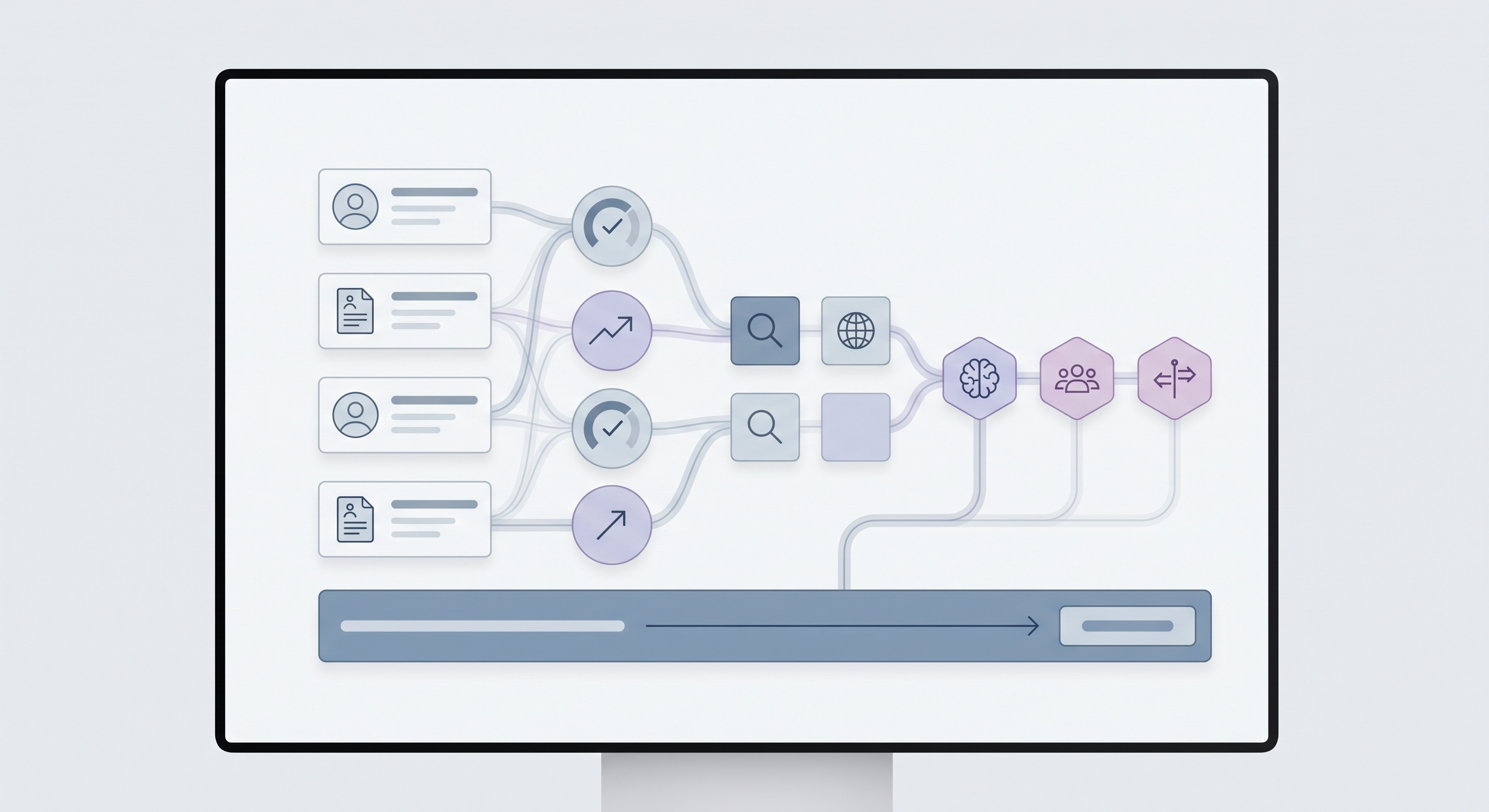
Decision framework for agency founders and desk leaders
The simplest way to avoid a bad purchase is to name the layer before booking demos. Each layer should have one job.
| Layer | Job | Example tools | Success metric |
|---|---|---|---|
| Demand layer | Find companies likely to hire and explain why now. | Boilr | Qualified meetings, accepted target accounts, signal-to-call rate. |
| Candidate search layer | Find people who match a role or market hypothesis. | Juicebox, hireEZ, SeekOut, LinkedIn Recruiter | Relevant shortlist rate, review time saved, reply quality. |
| System of record | Store candidate, client, job, and placement workflow. | Bullhorn, Vincere, Recruit CRM, Loxo | Recruiter adoption, data completeness, pipeline reporting. |
| Outreach layer | Send, track, and improve outbound messages. | SourceWhale, Gem, Lemlist, native platform tools | Reply rate, booked meetings, sequence quality. |
- If the team lacks prospects - prioritise Boilr because hiring-signal BD is closer to revenue creation.
- If the team lacks candidates - prioritise Juicebox or another sourcing tool because delivery capacity is the blocker.
- If the team lacks discipline - fix process and system-of-record adoption before adding more data.
- If the team lacks differentiation - use signals to shape a sharper market story before writing more outreach.
- If the team lacks reporting - define one CRM source of truth before layering search and signal tools.
The same pattern appears in our Loxo alternatives comparison and LinkedIn Recruiter alternatives guide: the category label matters more than the feature list.
A 30-day test plan for Juicebox alternatives
Do not evaluate tools through demos alone. Put them against live work and measure the outcome each product claims to improve.
- Define the bottleneck - write down whether the problem is too few clients, too few candidates, poor ATS adoption, weak outreach, or poor market timing.
- Pick two live desks - test with recruiters who already have a market, not with a theoretical sandbox nobody will use.
- Run a 25-account demand test - use Boilr to surface qualified accounts, signals, decision-makers, and outreach reasons for one market.
- Run a 25-search candidate test - use Juicebox or a sourcing alternative on live role hypotheses and compare candidate relevance, review time, and outreach quality.
- Measure meetings and shortlists separately - do not judge BD software by candidate volume or sourcing software by client meetings.
- Review recruiter behaviour - the winning tool is the one consultants use on busy days, not the one with the best demo.
- Decide the stack role - label each product as system of record, demand layer, candidate search layer, outreach layer, or reporting layer.
- Expand only after proof - roll out to more desks once the pilot shows better meetings, better shortlists, or clear time saved.
Pilot checklist
- BD metric - did the tool create more qualified hiring-manager conversations?
- Sourcing metric - did the tool create better candidate shortlists faster?
- Adoption metric - did recruiters use it without manager chasing?
- Stack metric - did it reduce manual work or create another handoff?
If the signal side is weak, our hiring-signals guide goes deeper on which events create meetings; if the outreach side is weak, the recruiter prompt examples help turn context into sharper messages.
FAQ
These are the questions recruiters, agency founders, and BD leaders usually ask when Juicebox is on the shortlist.
What is the best Juicebox alternative for recruitment agencies?
The best Juicebox alternative depends on the bottleneck. If the agency needs better candidate sourcing, compare hireEZ, SeekOut, LinkedIn Recruiter, Fetcher, Loxo, and Gem. If the agency already has candidate tools but needs better client timing and hiring-manager context, Boilr is the better alternative because it starts from hiring demand rather than profile search.
Is Boilr a direct replacement for Juicebox?
No. Boilr is not a candidate database or AI people-search product. It is a recruitment intelligence layer for agencies that need to find companies showing hiring intent, match those accounts to their ICP, and reach the right decision-makers before competitors pile in.
Can an agency use Boilr and Juicebox together?
Yes, and that is often the cleanest stack. Boilr can show which accounts and role families are worth actioning, while Juicebox can help build candidate lists once the market hypothesis is clear. That keeps BD and sourcing as separate jobs instead of forcing one product to do both.
When should I choose Juicebox instead of Boilr?
Choose Juicebox when you already know the role, target candidate profile, and hiring need, but your team needs faster candidate discovery. It is strongest when the problem is search speed, profile coverage, and shortlist creation. It is weaker when the problem is agency client acquisition.
When should I choose Boilr instead of Juicebox?
Choose Boilr when recruiters keep asking which companies to call, which accounts are moving, and which hiring managers have a reason to listen. Boilr is built around demand signals, ICP fit, contacts, and alerts. That makes it a better fit for agency BD than for candidate search.
What is the difference between candidate sourcing software and recruitment BD software?
Candidate sourcing software helps recruiters find people who might fit a role. Recruitment BD software helps agencies find companies likely to need hiring support. The first improves delivery; the second improves pipeline creation and timing.
Is LinkedIn Recruiter still a good Juicebox alternative?
LinkedIn Recruiter is still useful because many candidate and buyer conversations start on LinkedIn. It is familiar, broad, and deeply embedded in recruiter behaviour. The downside is that it is expensive, crowded, and does not automatically detect external hiring signals for agency BD.
Is hireEZ better than Juicebox?
hireEZ can be better when a team needs a mature outbound sourcing platform with rediscovery, enrichment, and recruiter productivity workflows. Juicebox can be more attractive when natural-language search and fast AI sourcing are the core buying reasons. Neither product solves the agency question of which client accounts are likely to buy now.
Is SeekOut a good option for recruitment agencies?
SeekOut is strong for specialist and enterprise sourcing use cases, especially where talent intelligence matters. Recruitment agencies should evaluate it when candidate discovery depth is the constraint. If the bigger constraint is finding new hiring companies, a BD signal tool is closer to the problem.
Should my agency buy an all-in-one platform like Loxo instead?
Buy an all-in-one platform when your ATS, CRM, sourcing, and outreach workflows are broken enough to justify a larger migration. If the ATS already works, an all-in-one replacement can create more change than value. In that case, a specialist layer for demand signals or candidate sourcing is usually easier to prove.
How should agencies evaluate Juicebox alternatives?
Start by naming the workflow category: system of record, demand layer, candidate search layer, outreach layer, or analytics layer. Then test each product on a live desk with real accounts or searches. Measure meetings for BD tools and shortlist quality for sourcing tools.
What internal links should recruiters look at before choosing?
Recruiters should separate hiring-signal strategy, LinkedIn alternatives, Loxo alternatives, and demand-led candidate search. Those are related but not identical decisions. A clean stack usually has one tool for account timing, one for candidate search, and one system of record.
Does AI sourcing replace recruiter judgement?
No. AI sourcing can widen search, suggest adjacent titles, rank profiles, and draft outreach. Recruiters still judge motivation, salary reality, manager fit, timing, and whether the client opportunity is real enough to justify the work.
Sources
Product claims are based on official pages where possible, with current 2026 review and comparison pages used for category framing.
- Boilr homepage - recruitment intelligence, hiring signals, lead enrichment, ICP scoring, CRM export
- Boilr Discovery - 10,000+ sources, daily qualified leads, hiring-manager contact context
- Boilr Signals - real-time alerts, ICP scoring, Slack/email/CRM delivery, signal types
- Boilr Industries - industry-specific hiring signals and verified decision-maker details
- Juicebox AI Recruiting - PeopleGPT, multi-source AI search, fit scoring, agents, ATS/CRM integrations
- Juicebox Top Recruiting Apps - PeopleGPT, 800M+ profiles, pricing tiers, agents add-on
- SelectSoftware Reviews - Juicebox review, pricing, pros, cons, and alternatives
- Gem comparison - Juicebox as sourcing/outreach point solution versus full-funnel platform
- LinkedIn Recruiter product page
- hireEZ product site
- SeekOut product site
- Loxo product site