Funding Rounds for Recruiters: Which Companies Are Actually Worth Chasing?
A recruiter-first guide to using funding rounds properly, separating noisy announcements from genuine hiring demand, and stacking signals to win better meetings.
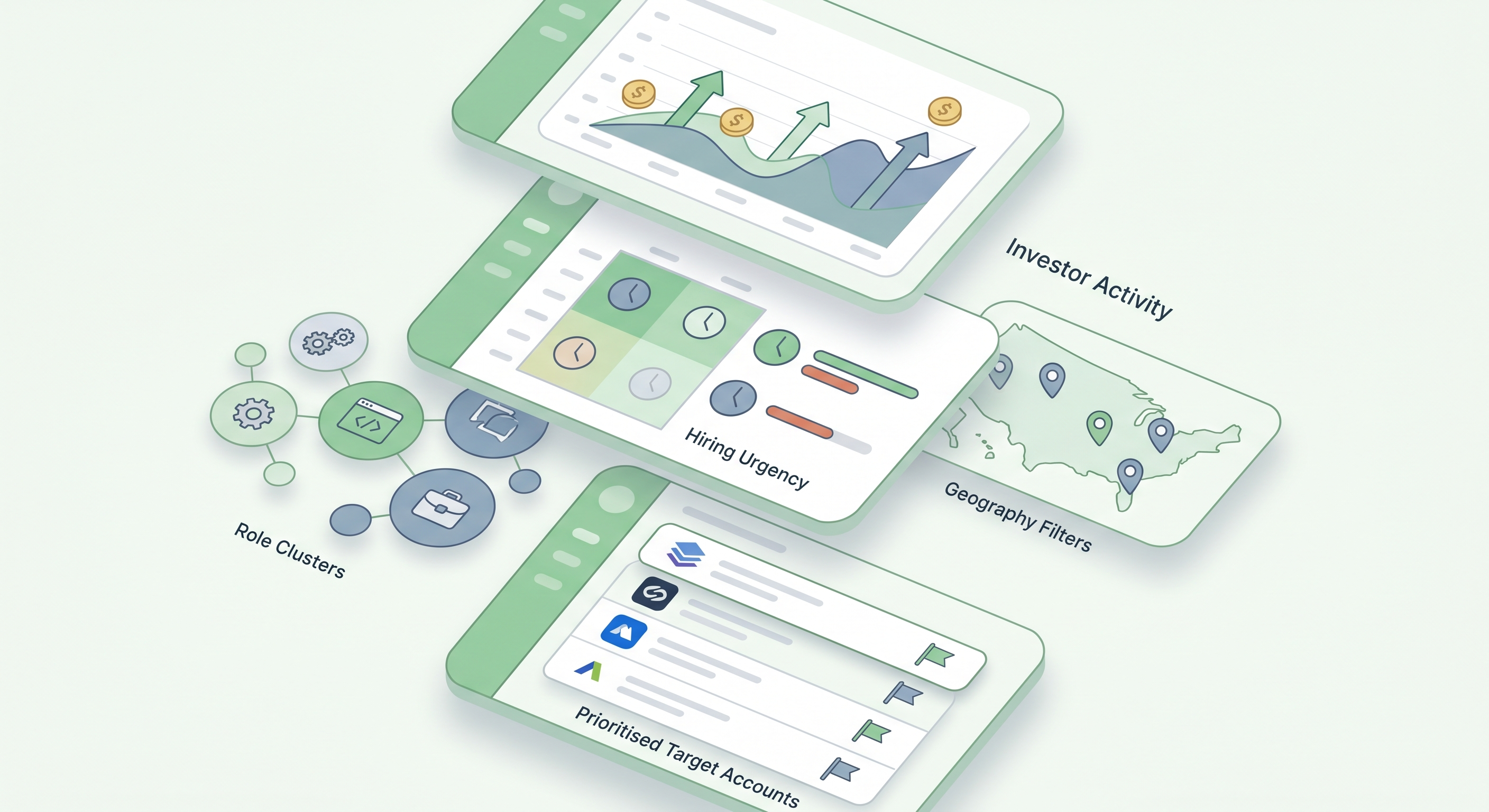
Recruiters love a funding headline because it looks like a shortcut. A company raises money, the alert lands, and the desk assumes there must be hiring work behind it. Sometimes that is right. Quite often it is not.
The useful question is not whether a company raised. The useful question is whether the raise changed hiring behaviour in a way that creates an opening for your desk. That is the same qualification discipline we broke down in our hiring-intent checklist, but funding rounds need their own filter because they sit right at the edge between promise and reality.
TL;DR
- Funding is context, not proof - a raise tells you budget may exist, not that your agency should call first.
- Signal stacks beat single alerts - funding plus role clusters, leadership change, or expansion is where meetings start to look real.
- Series A and B usually beat giant headlines - these stages often combine urgency with less settled hiring process.
- Bridge rounds need caution - they can mean extension, not acceleration.
- Boilr fits before outreach - it helps recruiters decide which funded accounts deserve time today and which ones should stay off the queue.
Why funding rounds trick recruiters
Funding rounds feel precise because they are public, timestamped, and easy to share around the desk. The problem is that they get treated like a buying signal when they are really a budget signal. Those are not the same thing.
If you chase the headline alone, you end up doing busy research on accounts that can now hire in theory but are not yet hiring in your niche, not yet agency-ready, or not yet ready to speak. That is why so many recruiters feel that funding-led prospecting works brilliantly in one month and wastes half a week in the next.
The five traps hidden inside a clean funding alert
- Budget trap - fresh capital can be aimed at product, runway, debt cleanup, or market entry rather than immediate headcount. A recruiter who hears "cash raised" and translates it straight into "open mandate" skips the hard part too early.
- Timing trap - some companies raise before the hiring plan is finished. Carta notes that founders need to turn a raise into a deliberate hiring plan, not just a burst of offers, which means the recruiter's timing window depends on what changed after the round, not just the announcement date.
- Stage trap - a seed round, a Series B, and a bridge extension can all produce totally different buying behaviour even when the headline looks equally exciting on LinkedIn.
- Function trap - a funded company may be growing sales, while your desk covers data and engineering. The company can be genuinely active and still be a poor call for you this week.
- Access trap - the round may be real, the need may be real, and the account may still be hard to break because the internal talent leader, hiring manager, or incumbent supplier path is already settled.
- Investor trap - not every round signals the same growth expectation. A new institutional lead investor often creates a different pressure profile from an insider extension or a flat rescue round.
- Headline trap - the bigger the number, the more the market overreacts. Tom Tunguz's analysis is the useful corrective here: higher funding does not reliably mean faster hiring once you control for the starting conditions of the company.
- Desk-behaviour trap - funding alerts are easy to forward, so they create a false sense of pipeline movement. The desk feels active because it found news, not because it found a buyer.
One stat worth remembering: Crunchbase reported that global venture funding reached $314 billion in 2025 and deal count set a new record. That matters for one reason: funding headlines are more common now, so the signal has become noisier. More alerts on your desk does not mean more qualified meetings. It means your filter has to get better. Source
| What recruiters often assume | What the signal actually says | What you still need to know |
|---|---|---|
| They raised, so they are hiring fast | They have more financial room and more pressure to use it well | Which function, what urgency, and whether the buyer is agency-ready now |
| Big round equals big recruiter opportunity | Large rounds can fund long plans, platform work, or existing internal hiring muscle | Whether the business has live role clusters and a visible hiring owner |
| Every funded startup is worth a call | Some funded companies are a fit; some are simply interesting news | ICP fit, geography, stage, market, and your route to the hiring leader |
| The announcement date is the trigger | The trigger is what changes after the round in roles, leadership, or expansion | Whether the round created a real short-term hiring problem you can help solve |
If you already track signals beyond funding, this will feel familiar. The broader scoring logic is the same one behind our guide to which hiring signals actually lead to meetings. The difference here is that funding alerts create more false confidence than most other signals, so the discipline has to be tighter.
When funding rounds actually matter
Funding rounds matter most when they change execution pressure. Recruiters win when a company has to add capability quickly, not just when a company has improved its bank balance.
The useful way to read a round is to ask, "What team shape becomes more likely now?" That question leads you towards stage, function, geography, and decision-maker visibility instead of empty congratulations.
Why the stage matters more than the headline number
- Seed and early growth - teams are still lean, which means every hire changes execution. Carta notes that companies stay lean longer and that the median time between rounds has stretched, so each hire after funding tends to be more deliberate.
- Series A - this is often where the business proves what deserves scale. If the company starts hiring an Engineering Manager, RevOps lead, Product Marketing Manager, or first People partner, the desk has more signal than the raise alone.
- Series B - management layers appear, functions split, and urgency gets sharper. That combination is one reason specialist agencies often do well here.
- Late stage - the company may hire in bigger numbers, but the buyer path can be harder because process is more established.
- Bridge or extension rounds - these can still produce hiring, but they often need stronger stacked signals because the capital may be preserving options rather than opening them.
- Investor profile - a new lead investor can shift operating pressure quickly, while a soft insider extension may not change behaviour much at all.
| Funding stage | What it often signals | Agency opportunity | Watch-out |
|---|---|---|---|
| Pre-seed and Seed | First hiring plan, first specialist managers, first recruiter or People lead | Selective but strong when the company is entering a new function or geography | Tiny teams, founder-led hiring, and limited agency budget can make this stage noisy |
| Series A | Product-market fit is clearer, leadership hiring starts, and role clusters often appear | Usually the cleanest point for specialist recruiters if the team is hiring in your niche | A headline round without clustered openings often means planning, not active demand |
| Series B | Department build-out, management layers, expansion hiring, and pressure to execute fast | Often the best stage for agencies selling speed, specialist access, or market knowledge | Internal talent teams and existing PSLs are more common, so positioning matters |
| Series C and later | Structured headcount plans, international growth, and sharper reporting lines | Good for retained, leadership, or hard-to-fill work rather than random contingency outreach | Procurement, existing suppliers, and heavier process can slow access |
| Bridge, extension, or inside round | Runway protection, time-buying, or investor support without a full growth reset | Only attractive when stacked with clear hiring evidence in your function | High risk if you chase the funding headline alone |
The signs that make a funded account worth real attention
- Role clustering - three to eight roles in the same function tell you much more than a single isolated vacancy. Clusters suggest team design, not one-off replacement hiring.
- New functional leadership - a new VP Engineering, CRO, or Head of Product often creates a short period where external market input is genuinely useful. This is similar to the pattern we covered in our early-intent guide on finding hiring teams before the brief goes live.
- First People or Talent hire - when a company is hiring its first internal talent or people operator, it often means hiring is becoming large enough to hurt.
- Geographic expansion - a move into the UK, Germany, France, or a new US region can create local-hiring questions that internal teams do not answer well yet.
- Category fit - the company sits inside a market your desk understands, so your first message can carry useful context rather than generic agency language.
- Buyer visibility - you can identify who owns the team build. Without that, the raise stays interesting but difficult to act on.
- Hiring velocity change - the funded company has visibly changed pace, not just posted one evergreen role. This is where the signal stops being a headline and starts behaving like demand.
- Market story you can speak to - you know what talent friction usually appears at that stage, which lets your outreach sound like a useful diagnosis rather than a generic pitch.
Why this matters in practice: Carta notes that founders are spacing fundraising rounds further apart, with the median gap rising from 15 months in 2021 to 24 months in 2024. That makes post-raise hiring choices more deliberate. In recruiter terms, it means every new role after funding carries more signal than it did in the spray-and-grow years. Source
Scenario 1 - Good Series A
A developer tools startup raises a Series A, announces a London go-to-market push, hires a VP Sales, and posts four commercial roles inside two weeks. That is not just funding. It is a buyer opening.
Scenario 2 - Better than the bigger headline
A $12M raise with a new Product leader and three data roles can be a better call than a $90M late-stage round with one evergreen Senior Engineer post and a mature internal talent team.
Scenario 3 - First People hire
A fintech raises and starts hiring its first People partner at around twenty staff. That does not guarantee agency spend, but it often means the hiring load has become operationally painful.
Scenario 4 - Expansion with fit
A US climate startup announces European expansion after funding and opens roles in Berlin in the exact niche your desk covers. The geography plus niche fit matter more than the headline amount.
So yes, funding rounds matter. They just matter for the shape of the next conversation, not as a lazy replacement for qualification. If your desk wants more hidden-client discovery overall, that broader discovery system is what we covered in our guide to finding recruitment clients you do not already know.
Which funding rounds are weak
A weak funding signal is not fake. It is simply a poor trigger for agency effort today. This is the distinction that keeps signal-led prospecting honest.
The biggest waste pattern on most desks is not calling the wrong account. It is researching the right kind of account before there is enough evidence that the hiring pain has become real.
Eight red flags that make a funding alert lower priority
- Inside extension language - words like "extension", "insider support", or "runway extension" often mean caution, not acceleration.
- No functional cluster - the company may be hiring, but if there is no pattern in your market, there is not enough reason to jump the queue.
- No visible team owner - if you cannot map the likely hiring manager or team leader, the outreach path stays vague and usually weakens the first conversation.
- Layoffs or cost controls in the same quarter - companies can still hire after reductions, but the buying logic changes and becomes more selective.
- Mature internal talent build - if the funded company already has a well-shaped talent team and no sign of niche gaps, random outreach tends to bounce off process.
- Very broad functional spread - one sales role, one finance role, one designer, and one customer success role often suggest planning or cleanup rather than a team build that needs outside help.
- Investor milestone but not hiring milestone - some rounds are about market signalling, cap-table management, or platform credibility more than immediate team growth.
- Your desk has weak category fit - even strong signals become weak if your value to that buyer is generic.
Funding-led manual prospecting
Pros
- Simple starting point - Funding news is public and easy to share, so the desk can build a watchlist fast.
- Clear timestamp - A round gives you a concrete moment to organise outreach around rather than vague market noise.
- Good for account discovery - It surfaces companies you may not have tracked before, especially in niche venture ecosystems.
- Works well with specialist desks - If you cover one function deeply, a funding round can quickly tell you where the next likely build-out may happen.
Cons
- Headline bias - Recruiters overvalue big numbers and under-check hiring reality.
- Research drag - Manual validation eats time before you even know if the account belongs on the call list.
- Weak buyer certainty - Funding alerts rarely tell you who owns the team build or whether agencies are wanted.
- Easy to copy - Every recruiter sees the same funding headline, so undifferentiated outreach gets crowded quickly.
Scenario 5 - Bridge round
A company announces fresh financing, but the release makes clear the capital extends runway while the business focuses on efficiency. No role cluster appears. That is news, not a same-day BD target.
Scenario 6 - Internal talent wall
A late-stage company raises and opens six roles, but already has a VP Talent, Talent Ops, and specialist internal recruiters. You may still win work, but your opening angle has to be niche or overflow, not generic speed.
Scenario 7 - Wrong function
A cyber startup raises and begins adding sales reps across the US. If your desk covers product design in Germany, the signal is real but belongs to someone else.
Scenario 8 - Too broad to be urgent
One role appears in finance, one in operations, one in product, and one in support. That can mean growth, but it does not yet tell you there is a concentrated problem your agency is built to solve.
BLS data on business employment dynamics is helpful context here. Smaller and younger firms drive meaningful job creation, but they also show heavier swings in job destruction than mature large firms. In recruiter terms, young companies can become excellent buyers quickly, but the volatility means you need more proof before you invest hours of desk time. Source
The signal-stacking framework
The best funded accounts are rarely the ones with the loudest press release. They are the ones where several small signs point in the same direction.
A funding round gets you into the right neighbourhood. Signal stacking tells you which door to knock on first. This is where funding becomes genuinely useful for recruiter BD rather than just another tab in the browser.
What strong stacks look like
- Funding plus role concentration - a company that raises and then posts six engineering roles is easier to qualify than a company that raises and posts one generalist role. Concentration suggests team design and execution pressure.
- Funding plus fresh leadership - new managers and VPs often reshape headcount faster than legacy leaders because they are hired to move the function, not to preserve the old plan.
- Funding plus market entry - entering a new geography or customer segment tends to produce sharper hiring needs and weaker incumbent supplier lock-in.
- Funding plus hiring-manager visibility - once you know who owns the build, your first message becomes specific enough to feel useful.
- Funding plus ICP match - the company fits your desk by stage, function, and geography, which lets you speak in the buyer's language from line one.
- Funding plus buyer friction - the strongest setups often include hiring pain that internal teams are already feeling, such as speed, scarcity, or a weak local network.
| Signal stack | What it usually means | Priority |
|---|---|---|
| Funding round + 6-10 live openings in one function | Budget and urgency are both visible, which raises the odds of agency need | High |
| Funding round + new VP or Director hire | A new leader often needs to build a team quickly and is still shaping supplier choices | High |
| Funding round + UK or EU expansion announcement | New market entry creates hiring work, local knowledge gaps, and less settled talent process | High |
| Funding round + role cluster but no hiring manager change | Still good, but you need a clearer route into the account and stronger proof of fit | Medium |
| Funding round with zero role cluster and no leadership change | More likely a planning signal than an agency-buying signal | Low |
| Bridge round + layoffs or cost controls | The company may still hire, but the timing and buyer appetite are weak | Very low |
“The mistake is treating a fundraise like a mandate. Money tells you a company can hire. It does not tell you they need your agency. The real signal is the stack around the round - function, urgency, geography, and who just got hired to build the team.”
- Felix Hermann, Cofounder @ Boilr
Scenario 9 - The best kind of funded account
A data infrastructure startup raises, hires a new VP Engineering, and opens four backend roles plus an EM search in one city. That is a strong stack because budget, owner, and role concentration all line up.
Scenario 10 - The noisy kind
A B2B software company raises but posts a scattered mix of finance, office, and support roles across three countries. It may still be worth tracking, but it does not deserve the same-day call block.
Once you think in stacks, the outreach gets better automatically. You stop emailing to say you saw the news and start writing to say what the news probably means. That same logic is why Boilr Signals is more useful than a bare funding alert and why Boilr Discovery matters before you touch the first message.
The timing window after a raise
Funding-led prospecting is mostly a timing problem. Too early and you are contacting a company before the team shape is real. Too late and the internal process or incumbent suppliers have already formed around the hiring plan.
The sweet spot is usually the period after the raise has created direction but before the whole market has piled in. That window is shorter than many recruiters think.
A practical 90-day view
- Days 0-7 - log the account, check stage, review investor context, and decide whether the company even belongs in your niche. Do not send a lazy congratulations note just because the alert is fresh.
- Days 7-21 - look for the first meaningful role cluster, leadership change, or expansion motion. This is often the best first-contact window if the stack is already forming.
- Days 21-45 - if roles are live and the owner is visible, move into sharper outreach. At this stage, the conversation can be framed around what that team build will struggle with in your market.
- Days 45-60 - useful if the buyer has now become clear, but you are already moving from early-intent advantage into broader-market visibility.
- Days 60-90 - still workable, especially for specialist desks, but the funding round has stopped being early information. Now the live hiring pattern matters more than the raise itself.
- After 90 days - the account may still be good, but it is no longer really a funding-led play. It has become a standard hiring-intent or expansion-intent play.
Funding-signal checklist:
- Check the stage - seed, Series A, Series B, late stage, or extension.
- Check the function - where does the round appear to be creating headcount pressure?
- Check the owner - who now seems likely to own the build?
- Check the change - what visibly shifted after the raise?
- Check your right to win - what does your desk know that this buyer would actually care about?

The recruiter who waits for perfect proof usually arrives too late. The recruiter who acts on the headline alone usually acts too early. The work is in the middle, where the first real hiring behaviours begin to surface and you can still offer something the market has not already repeated ten times.
A practical funding-signal workflow
If you want funding rounds to produce meetings rather than list growth, the workflow has to be simple enough that a busy desk will actually run it. The point is not to create a beautiful research ritual. The point is to decide faster who deserves attention.
The steps below work well whether you run them manually or through a signal-led system. The difference is speed and consistency.
Seven steps that keep the signal useful
- Start with ICP fit - before researching the round itself, decide whether the company belongs in your market. If the category, stage, geography, or function are wrong, stop there.
- Classify the round - new growth money, extension, bridge, insider support, or late-stage scale capital. Recruiters lose time when every raise gets treated as if it carries the same operating pressure.
- Find the likely team build - look for role clusters, newly hired leaders, expansion moves, and any first-in-function signs. The real output of the round is not money. It is usually team shape.
- Map the buyer - name the likely owner of the build and the person who feels the hiring friction. Without this, your first message stays generic and weak.
- Score urgency - ask how painful the next 90 days are likely to be if that team cannot hire fast or hire well. Scarcity and timing are what create conversations.
- Choose the angle - market knowledge, role scarcity, speed, local network, or team-design pattern. Your angle should come from the signal stack, not from the fact that you are a recruiter.
- Set the follow-up rhythm - if the account is good but early, schedule follow-up around fresh evidence. The discipline here matters, which is why the practical cadence in our recruiter follow-up guide still applies.
A one-screen version of the workflow: Fundraise alert - good. Now answer four things before outreach.
- Fit - does the company belong in my desk?
- Change - what shifted after the raise?
- Owner - who is most likely to own the build?
- Pain - what would make this buyer talk to an outside recruiter now?
Scenario 11 - Strong workflow outcome
A Series B cloud-security company fits your UK engineering desk, adds a new Head of Platform, and posts five backend roles in ten days. The workflow says "prioritise now" because fit, change, owner, and pain all line up.
Scenario 12 - Good account, wrong week
A funded company fits your market but shows no role cluster yet. The right move is not to force the pitch. It is to track it and wait for the first visible hiring pattern or leadership signal.
Once the desk can run this without friction, funding rounds become genuinely useful. Not because they are magic, but because they are now feeding a system instead of feeding optimism.
Boilr in context
Boilr is not useful here because it knows what funding rounds are. Plenty of tools know that. It is useful because it helps recruiters decide which funding rounds belong on today's call list and which ones should stay in the background until the evidence gets better.
In other words, it sits before the outreach. It handles the part most desks do inconsistently when they are busy: filtering, stacking, and prioritising.
How the product compares with the status quo
| Approach | Signal source | Timing | Qualification | Output |
|---|---|---|---|---|
| Manual funding-news prospecting | Newsletters, LinkedIn posts, investor feeds, spreadsheets | Slow and patchy | Depends on the recruiter's own follow-up research | Headline awareness, but not a ranked call list |
| Funding database only | Round announcements and company data | Good for alerts, weak for real hiring urgency | Usually stops at the company level | Useful list building, but still a lot of manual work |
| LinkedIn plus manual checks | Roles, people changes, and search filters | Better after the hiring has already become visible | Can be good, but it takes time and depends on the recruiter | Strong for contact research, weak for early demand detection |
| Boilr | Funding, role clusters, leadership moves, expansion, hiring velocity, and ICP filtering | Built for earlier prioritisation | Scores fit and intent together, not one signal in isolation | A cleaner ranked queue with context and decision-maker paths |
Eight product capabilities that matter in a funding-led workflow
- Funding signal capture - Boilr monitors funding announcements alongside other account-level events instead of forcing the desk to track them in a side spreadsheet.
- Stacked signal context - the useful question is what happened around the round, not just that a round happened. Boilr puts funding next to hiring, expansion, and leadership signals so the desk can read the account properly.
- ICP filtering - role, seniority, geography, tech stack, and company profile filters help recruiters avoid spending hours on funded companies that were never right for the desk in the first place.
- Intent scoring - instead of treating all raises equally, the platform scores accounts by fit and activity so the queue starts to reflect buying likelihood rather than headline excitement.
- Decision-maker identification - a funding round is much more useful when it is attached to the likely owner of the team build and not left floating as company-level news.
- Morning-feed workflow - signals land in a format recruiters can act on quickly, which matters because the value of these accounts drops when research becomes a half-day exercise.
- Discovery beyond known accounts - the same workflow that surfaces funded companies also finds adjacent hidden clients, which is one reason it fits naturally with Boilr Discovery and not just the alert layer.
- Cleaner outreach inputs - when the desk already knows stage, likely function, recent change, and buyer path, the first message becomes sharper and far less generic.
Boilr
Pros
- Signal stacking - Combines funding with hiring, leadership, and expansion context instead of leaving the recruiter to stitch the story together manually.
- Desk-level fit - ICP filters reduce noise so the team sees fewer funded companies that look interesting but are wrong for the market.
- Decision-maker visibility - Moves faster from company-level news to buyer-level action.
- Earlier prioritisation - Useful before the market has fully caught up to the hiring move.
- Recruiter-native output - The product is built around who to call and why, not just around reporting that something happened.
Cons
- Not a generic sales stack - Teams looking for a broad outbound suite rather than recruiter-specific signal scoring may want other tools in the wider stack too.
- Requires a clear ICP - The cleaner your niche and target profile, the more useful the prioritisation becomes.
- Newer category - Some teams still need to be taught why a signal-led approach beats pure list building or social-first prospecting.
The pitch here is not "Boilr is the best because it uses AI". The pitch is much simpler. If your desk already knows funding rounds can be useful but keeps wasting time on the wrong ones, the product helps enforce the filter consistently.
A decision framework for recruiters
The final question is not whether funding rounds work. They do. The final question is when they deserve to outrank other signals on your desk.
This comparison is a useful way to make that call without turning every account review into a debate. It also keeps funding in its proper place - valuable, but not automatically first.
Which signal should lead the queue?
| Signal | Main strength | Best for | Main weakness |
|---|---|---|---|
| Funding rounds | Shows fresh budget, investor confidence, and possible team build-out | VC-backed or growth-stage accounts where timing matters | Money alone does not prove an open mandate |
| Leadership changes | New leaders create team-shape decisions and often move faster than old org charts | Management, GTM, product, engineering, and build-out work | A new leader without open roles can still be too early |
| Hiring velocity | Shows active demand in the function you serve | Agencies selling speed, niche access, or hard-to-fill talent pools | Late-stage signal if you only notice it once the roles are everywhere |
| Expansion signals | New offices, regions, or product lines often force fresh hiring | Cross-border hiring and specialist market knowledge | Announcements can land before the hiring manager is ready to talk |
A simple rule set for busy desks
- Call immediately - funding plus concentrated hiring in your function plus a visible buyer.
- Research today, call soon - funding plus leadership change or expansion, but role concentration still forming.
- Track but do not chase - funding with fit but no visible change yet.
- Deprioritise - bridge or efficiency round, no clear cluster, weak buyer path, or poor desk fit.
- Escalate if niche is scarce - even a medium signal can jump the queue if the market is hard and your desk has genuine specialist access.
Funding databases on their own
Pros
- Strong coverage - They are useful for seeing which companies raised and for building market awareness quickly.
- Good watchlists - They help organise accounts by stage, investor, and geography.
- Clear account discovery - Especially useful for finding companies that are not already in your CRM.
- Helpful investor context - Lead investor names and round history can sharpen your account picture.
Cons
- Weak hiring proof - They tell you the round happened, not whether the hiring pain is real right now.
- Manual stitching - The recruiter still has to connect the round to roles, owners, and buyer urgency.
- No natural queue - Without signal stacking, the desk still ends up prioritising by instinct or excitement.
If you build your desk around this logic, funding rounds stop being a distraction and start becoming one more clean input into a signal-led system. That is also the bridge into the wider outbound machine we laid out in our recruiter outbound playbook.
FAQ
These are the questions recruiters ask most often when they start treating funding rounds as a real BD input instead of a vague good-news alert.
Are funding rounds a good signal for recruiters?
Yes, but only when you treat them as a starting point rather than a conclusion. A raise tells you the company may have fresh budget and fresh pressure to deliver, which matters. It does not tell you whether that team will use agencies, whether they will hire in your function, or whether the buyer is ready now. The winning move is to stack the round with role clusters, leadership change, geography, and fit to your desk.
Which funding stage is usually best for agency recruiters?
Series A and Series B are often the cleanest stages because teams are big enough to need hiring support but not always mature enough to have every process locked down. Seed can work if you are highly specialised and the company is making a first critical hire. Later-stage rounds can still be good, but supplier lists, procurement, and internal talent teams are usually more established.
Does a bigger round always mean better recruiter opportunity?
No. That is the exact mistake this article is trying to remove. Tom Tunguz's analysis shows higher funding does not reliably translate into faster headcount growth on its own. A smaller round attached to a clear role cluster and a new functional leader can be a far better prospect than a giant headline round attached to cost discipline and no visible hiring demand.
How soon after a funding round should recruiters reach out?
Usually within the first 7-21 days, but only after checking what changed around the raise. In that early window, leadership teams are still setting hiring plans, and buyers are more open to useful market input. If you wait until the company has posted roles for six weeks, you are competing with every other recruiter who saw the same announcement and every internal process that has already formed around it.
What should recruiters look for besides the funding headline?
Look for stacked evidence. Role clusters in one function, a new VP or Director, entry into a new geography, investor type, a first People or Talent hire, and a hiring manager you can clearly identify all improve the signal. If you only have the round itself, you have context, not qualification.
Are bridge rounds worth chasing?
Sometimes, but the bar should be much higher. Bridge rounds, extensions, and insider-led financings can simply buy time rather than open a growth chapter. If the company is also adding roles in your function, replacing a leader, or entering a new market, the opportunity can still be real. Without that stack, bridge rounds usually create more wasted research than booked meetings.
How do recruiters know if a funded company already has agencies on the account?
You rarely know with certainty from the funding announcement alone. That is why multi-threading matters. Check whether they already have an internal talent leader, how mature the team is, whether the hiring manager is newly arrived, and whether the company has obvious urgency in a hard-to-fill area. Even if agencies are already involved, a sharp, signal-led angle can still win a niche or overflow conversation.
Is this only useful for tech recruiters?
No, but it is strongest in markets where funding news is public and team build-outs are visible. Tech, SaaS, fintech, healthtech, climate, and venture-backed services are obvious fits. The same logic still works in other markets if you have equivalent financing, expansion, or leadership signals that tell you budget and urgency have changed.
What is the best outreach angle after a funding round?
Do not congratulate them and then pitch generically. Start with the practical implication of the raise. Mention the function that looks likely to move, the market you cover, and the kind of hiring friction you see at that stage. Buyers respond better to 'here is what this means for your engineering team in the next 90 days' than to 'saw your exciting news and thought I would reach out'.
How should recruiters prioritise multiple funded companies at once?
Score them by fit, timing, buyer visibility, and evidence of hiring change. A perfect funding headline in the wrong niche should lose to a smaller round in your core market with a live role cluster and a new hiring leader. The queue should be built around who is most likely to take a useful conversation now, not around which company raised the biggest amount.
Can ChatGPT replace this research process?
It can help with summaries, messaging, and first-pass analysis, but it cannot create fresh signal coverage by itself. Large language models are only as good as the current evidence you feed them. If the signal layer is stale or incomplete, the output still sounds polished while pushing you towards the wrong accounts. That is why recruiter-specific signal tools and current-source workflows still matter.
Where does Boilr fit in a funding-led workflow?
Boilr sits before the outreach step. It helps recruiters spot the right accounts earlier, filter them against an ICP, add stacked signals around the round, and route them towards the right buyer. Instead of treating funding as the whole story, it helps you decide which rounds deserve attention and which ones should stay off today's call list.
Sources
We used these sources for the funding, hiring, and product-context points in this article.
- Crunchbase News - Global Venture Funding In 2025 Surged As Startup Deals And Valuations Set All-Time Record - Used for the wider funding backdrop and the point that funding headlines are becoming more common, not more decisive on their own.
- Tom Tunguz - Busting the Myth: Higher Funding Doesn't Mean Faster Hiring in Startups - Used for the core argument that funding size alone is a weak predictor of hiring velocity.
- Carta - Building a hiring plan for your next fundraise - Used for startup hiring-plan realities, longer gaps between rounds, and the fact that lean teams still need deliberate hiring choices after a raise.
- U.S. Bureau of Labor Statistics - Business Employment Dynamics by Age and Size of Firms - Used for the point that smaller and younger firms drive significant job creation but also carry more volatility.
- Boilr Signals - Used for product-specific claims about signal coverage, scoring, and alert delivery.
- Boilr Discovery - Used for product-specific claims about ICP filtering, decision-maker research, and lead discovery.