How Modern Recruiters Reduce Time-to-Hire (2026)
Slash time-to-hire from 44 to 25 days. Discover how modern recruiters use signal intelligence and AI to speed up the hiring process in this 2026 guide.
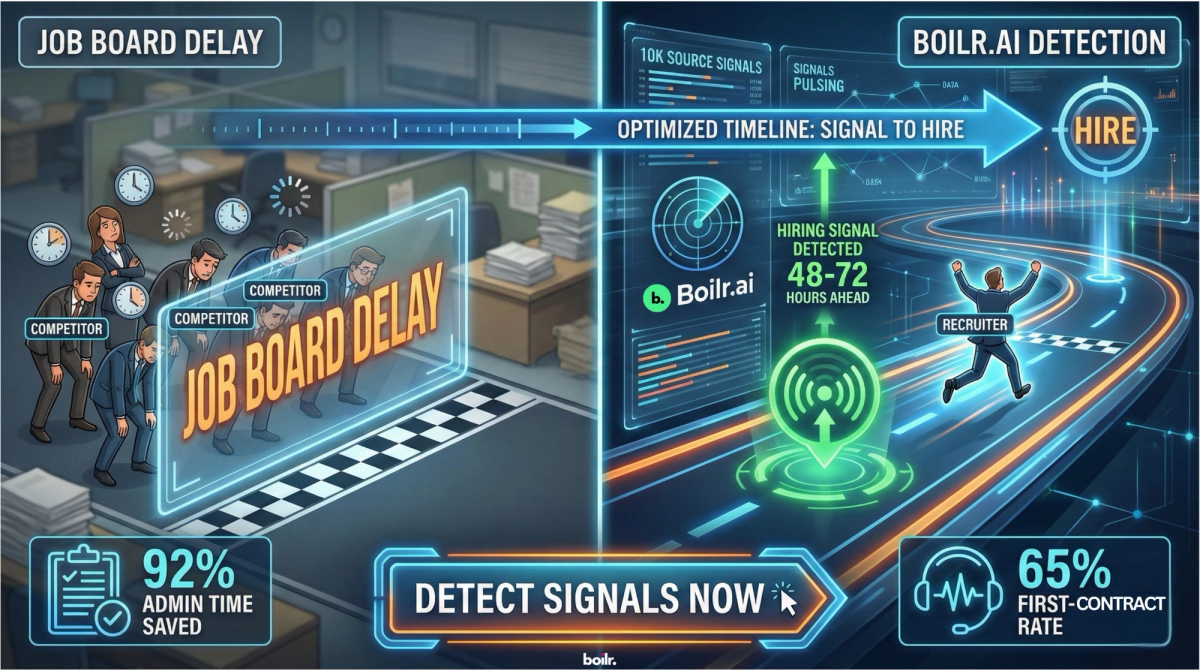
Modern recruiters struggle with average time to hire hovering at 38-44 days globally. Agencies lose deals when 50-85% of roles fill via networks before public postings.
This guide breaks down speed to hire strategies tailored for recruitment agencies. You'll learn proven workflows, AI signal intelligence tactics, and real-world examples to reduce time to hire from weeks to days.
What is Speed to Hire?
Speed to hire measures the full cycle from identifying a hiring need to offer acceptance. For recruitment agencies, it starts at client discovery (job req or hiring signal) and ends when your placed candidate starts.
Industry benchmarks show 42 days average worldwide. Tech roles hit 50+ days due to competition; agencies can target 25-35 days with proactive systems.
Why prioritize? Each day of delay costs employers $500-1,000 in productivity gaps, per SHRM estimates, and agencies lose to faster competitors.
Why Recruitment Agencies Lag on Time to Hire
Agencies react to job boards and LinkedIn postings where 3-5 rivals have already pitched. PSL (Preferred Supplier List) contracts favor incumbents, leaving independents chasing scraps.
Key bottlenecks:
- Signal delay: Roles appear publicly after internal decisions, missing 70% of "hidden" opportunities filled via referrals.
- Manual prospecting: 13+ hours weekly scanning news, funding sites, career pages.
- Generic outreach: Low 20-30% first-contact rates without context.
2026 shifts this: AI recruiting tools cut sourcing time 50-80% via predictive signals.
Core Strategies to Reduce Time to Hire
Focus on three phases: signal detection, rapid outreach, pipeline acceleration.
- Automate signal detection: Monitor funding, expansions, org changes before postings.
- ICP (Ideal Customer Profile) filtering: Target industries/sizes/locations to avoid noise - e.g., Series A tech firms in UK/EU.
- Contextual pitches: Use "why now" intel for 2x response rates.
ATS integration: Feed leads into Bullhorn/Vincere instantly. - Team velocity: Assign alerts to specialists (tech recruiters get engineering signals).
Agencies implementing these see 30-40% time-to-hire drops.
Signal Intelligence: The 2026 Game-Changer
AI signal intelligence scans thousands of sources—funding announcements, GitHub commits, LinkedIn org charts, press releases—for hiring intent 24-72 hours early.
Four signal types:
- Expansion: New offices signal 20-50 roles (ops, IT, admin).
- Funding: Series A/B triggers engineering/GTM (Go-to-Market: sales/marketing) hires.
- Velocity: 10+ headcount in 30 days flags scaling.
- Leadership: New VP hires team (e.g., 4 seniors + managers).
Tools like Boilr.ai exemplify this: Monitors 10,000 sources, ICP-filters leads with manager contacts and context, cutting admin from 13 to 1 hour weekly.
Balanced Tool Comparison for Agencies
No single tool solves everything. Here's how top options stack for reducing time to hire:
Integrate: Use signals (Boilr.ai) to feed ATS (Bullhorn) and automation (SourceWhale).
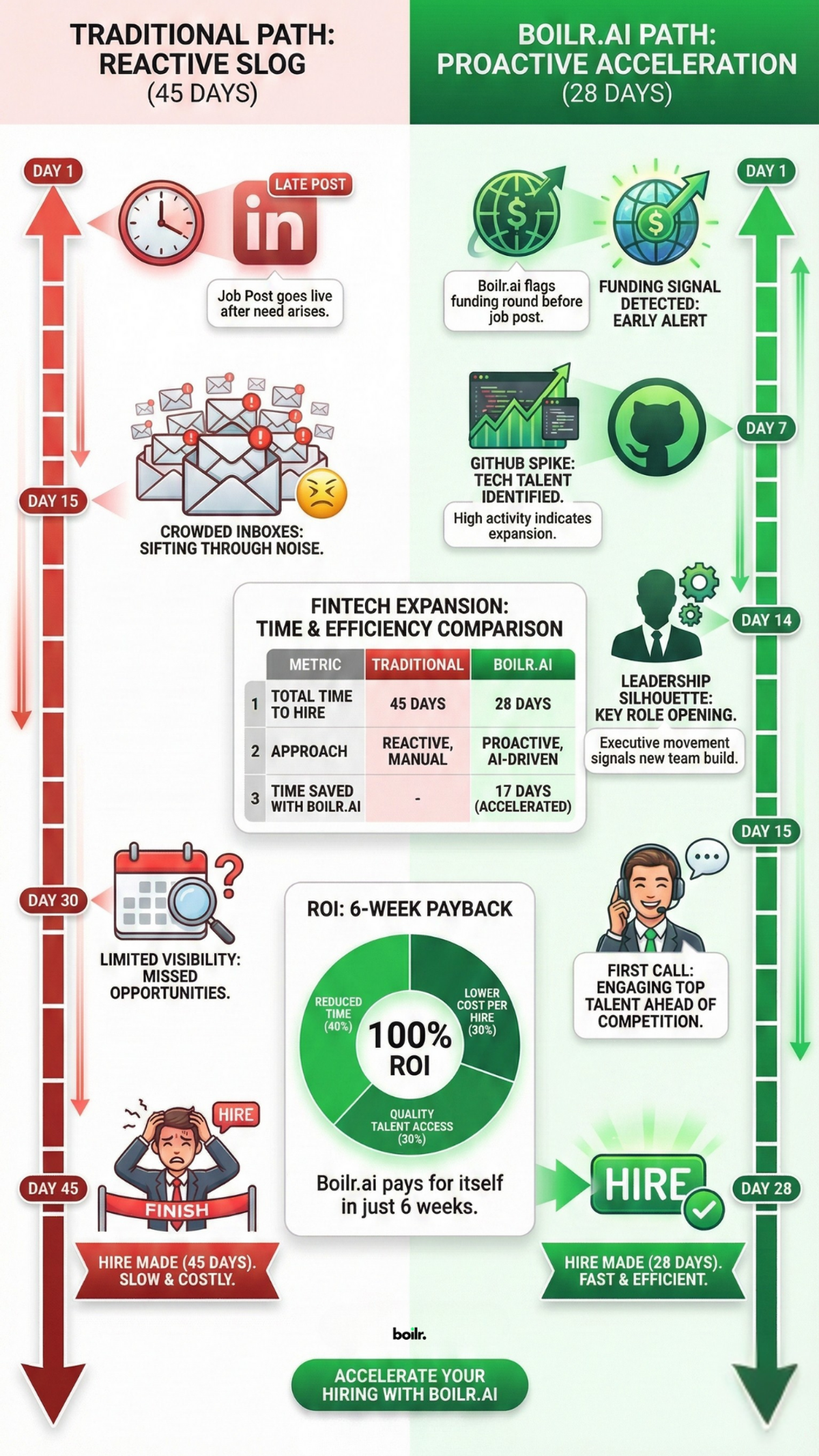
Composite Case Study 1: Expansion Signal Timeline
Note: Following case studies are composite scenarios based on patterns from recruitment agencies using signal tools like Boilr.ai.
A mid-sized UK agency targeted FinTech expansions. Signal: New Manchester office via press release (40 roles: ops/IT, no PSL).
Narrative Workflow: Outreach hit the hiring manager Day 0: "Expansion intel shows 15 IT needs - our network has 8 matches ready."
Result: Exclusive framework agreement, 22 placements in 28 days (vs. 45-day benchmark).
Time saved: 17 days, £450K fees.
Composite Case Study 2: Funding Round Metrics
Series A funding ($6M) spiked GitHub activity, signaling 15-20 hires (8 eng, 5 GTM).
Pitches referenced React/AWS stack for relevance. Revenue: £320K.
Step-by-Step Workflow to Reduce Time to Hire
- Define Metrics: Track requisition-to-start (agency: signal-to-placement).
- ICP Setup: Industry/size/location filters.
- Signal Dashboard: Daily alerts from AI tools.
- Outreach Cadence: 1-hour response SLA.
- Review Weekly: Admin savings, contact rates (target 50%+).
- Scale Winners: Double down on high-velocity signals.
2026 Benchmarks & ROI Proof
- Average time to hire: 38 days (tech: 50+).
- AI adopters: 30-50% faster fills.
- First-mover edge: Higher market share in competitive niches.
Agencies report 6-week tool paybacks via lead volume gains.
Common Pitfalls & Fixes
- Pitfall: Over-relying on job boards (70% roles hidden). Fix: Diversify to signals.
- Pitfall: No ICP (signal overload). Fix: Set once, refine quarterly.
- Pitfall: Siloed tools. Fix: Integrate signals-to-ATS.
Actionable Next Steps
Audit your last 10 placements: How many days from signal to close? Test one signal tool for a week - track first-contact uplift.
FAQs
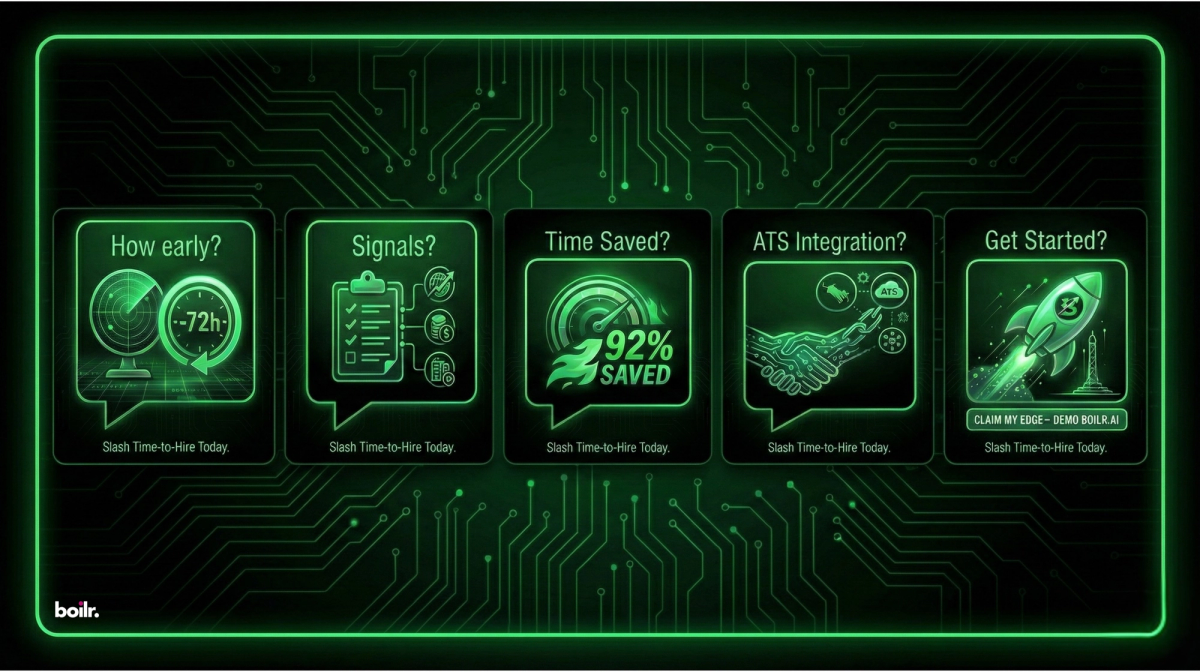
- How does Boilr.ai detect signals before job postings?
Boilr.ai scans 10,000 sources like funding news, GitHub, and org changes 48-72 hours early. - What types of hiring signals does Boilr.ai identify?
Expansion alerts, funding rounds, hiring velocity, and leadership changes with role estimates. - Is Boilr.ai suitable for non-tech recruitment?
Yes, ideal for tech/engineering but covers ops, sales, admin via multi-source intel. - How much time does Boilr.ai save recruiters?
92% weekly admin (13h to 1h), first-contact in hours vs. days. - What's the ROI timeline for Boilr.ai?
Payback in 6 weeks, with 200-300% more leads and 183% higher first-contact rates. - Can Boilr.ai integrate with my ATS like Bullhorn?
Yes, feeds leads directly into Bullhorn/Vincere for seamless workflow. - How does ICP filtering work in Boilr.ai?
Set once (industry/size/location), get noise-free, relevant leads only. - What markets does Boilr.ai cover best?
UK, Europe, US-strong in competitive tech hiring. - How accurate are Boilr.ai's role predictions?
Backed by velocity data, e.g., 12 hires/30 days or VP team builds. - How do I get started with Boilr.ai?
Visit here for demo-activated signals today.