Best Recruitment Tools for UK Agencies in 2026
Most “best recruiter tools” lists mix ATSs, outreach tools, and databases into one pile, then call it a comparison. That is not how UK agencies actually buy software. The better question is which tool removes the biggest blocker in your workflow — finding accounts, timing outreach, keeping follow-up consistent, or holding the whole desk together.
TL;DR
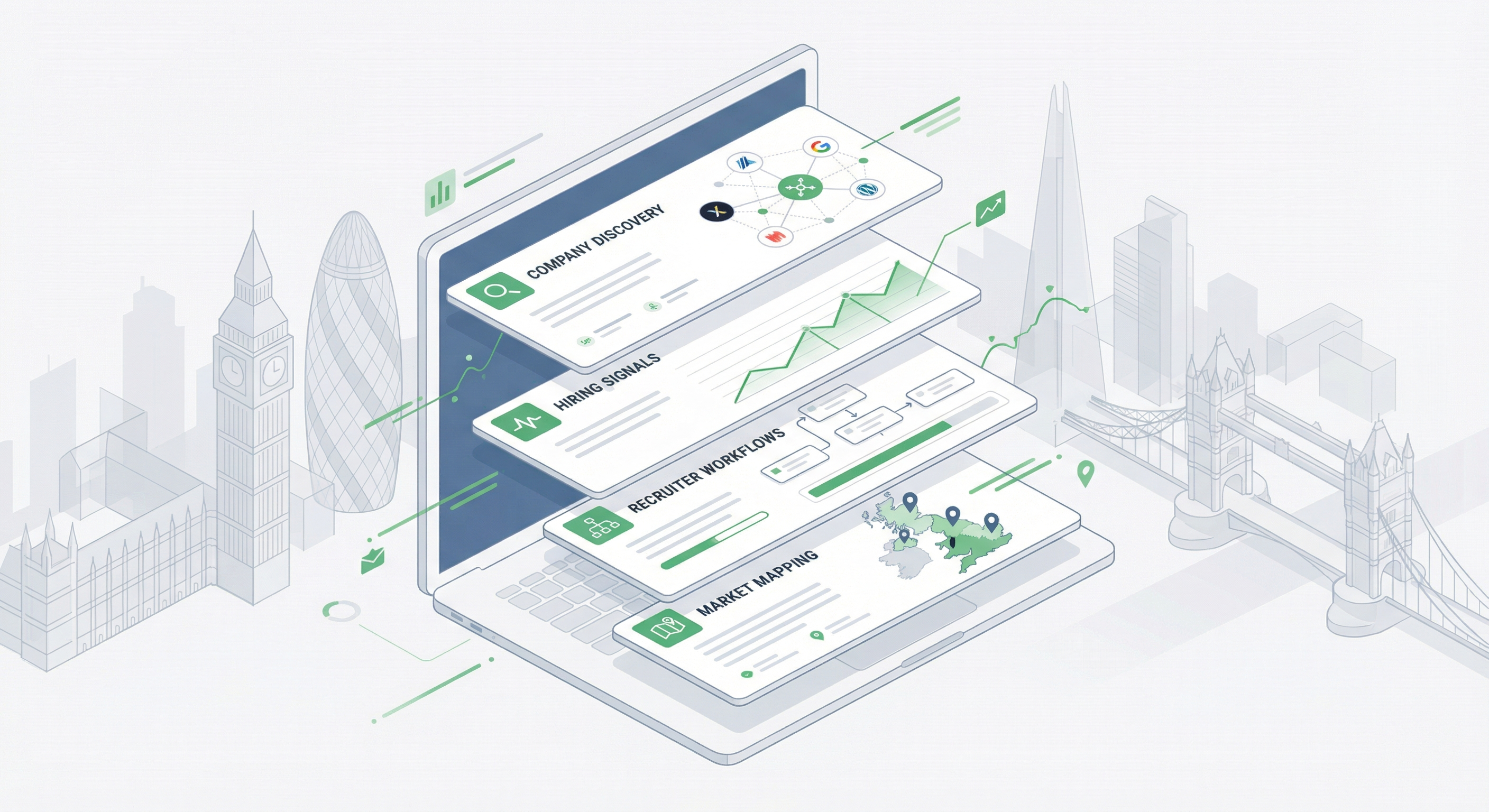
The best recruitment tool for most UK agencies in 2026 is Boilr, because it solves the hardest commercial problem first: which companies should the desk contact, why now, and who should they speak to. Bullhorn is stronger if your main issue is ATS/CRM control, SourceWhale is better if your targeting is already good but follow-up is weak, Sales Navigator is still excellent for research, and Recruit CRM is the most sensible all-in-one option for smaller teams.
That ranking also matches the direction of the market. LinkedIn says quality of hire is rising in importance, the UK government says AI pressure is increasingly relevant to the UK service economy, and Bullhorn’s 2026 report says agencies using AI are far more likely to report revenue growth.[4][5][6]
Why UK agencies are retooling in 2026
UK recruitment agencies are not buying software into a neutral market. They are buying into a year where AI expectations are rising, buyers are harder to impress, and recruiter time is more expensive than most teams admit.
That matters because the wrong tool does not just waste budget. It steals hours from the commercial side of the desk. And in agency businesses, that usually means fewer meetings, weaker timing, and a pipeline that looks busy without being good.
- AI pressure is now operational — the UK government’s labour-market assessment says the UK’s service economy is unusually exposed to AI-driven productivity shifts, which means recruiters are under pressure to use tools that remove admin rather than add to it.[5]
- Quality matters more than speed theatre — LinkedIn reports that 89% of talent-acquisition professionals think measuring quality of hire will become increasingly important, which pushes agencies toward better targeting and better prioritisation, not just more volume.[4]
- Top firms are embedding AI faster — Bullhorn’s 2026 trends report says agencies using AI at any stage of the recruitment cycle are 4x to 8x more likely to report revenue growth, and two-thirds of top performers now place in under 10 days.[6]
- Outbound pipelines break when research stays manual — the more recruiter time goes into Googling accounts, checking job boards, and guessing contact relevance, the less time is left for live conversations, follow-up, and delivery work.[3]
- Generic sales tools still miss recruiter intent — tools built for broad B2B sales are useful in places, but most do not explain which accounts are hiring now, which desks they fit, or why a recruiter should move today instead of next week.[2]
What changed
- 89% of TA professionals say measuring quality of hire is becoming more important.[4]
- 4x–8x more likely to report revenue growth if agencies use AI somewhere in the recruitment cycle.[6]
- 70% of UK workers are in occupations containing tasks AI could potentially perform or enhance.[5]
So the buying lens has changed. UK agencies do not just need software that stores work. They need software that improves judgement, removes admin, and helps the desk choose better opportunities faster.
What we looked for in the best recruitment tools
This ranking is not pretending every tool does the same job. That would make the article cleaner, but it would make the buying advice worse. Instead, the shortlist judges each product against the real workflow questions UK agencies ask when software starts to matter.
The key lens is whether the tool moves the recruiter closer to a better commercial action. If it only improves record-keeping or dashboard cosmetics, it scores lower. If it shortens the route from market movement to booked meeting, it scores higher. That is also the same buyer lens behind our piece on the platform features that actually matter before you buy.
| Criterion | What we checked | Why it matters |
|---|---|---|
| Discovery quality | Can the tool surface companies that match a real UK agency ICP rather than just returning a giant database? | If discovery is noisy, recruiters spend their best hours cleaning lists instead of speaking to buyers. |
| Timing signals | Does the platform tell you why now matters — funding, hiring bursts, leadership changes, expansion, or competitor movement? | The best agencies do not just target the right companies; they reach them at the right moment. |
| Decision-maker access | How quickly can a recruiter move from account selection to an actual contact they can message or call? | Data without a route to action is just prettier admin. |
| Workflow fit | How many manual steps remain between identifying an account and taking the next commercial action? | Adoption rises when recruiters can complete the core task inside one working rhythm. |
| AI usefulness | Does the AI reduce concrete work such as scoring, filtering, drafting, and note capture? | Useful AI sharpens judgement. Decorative AI just creates a longer feature list. |
| Commercial reality | Does the product fit how UK agencies actually win business, or was it built for a different buyer? | A tool can be good software and still be the wrong software for an agency desk. |
Six buyer rules worth keeping in mind
- Start with the constraint — the best tool is the one that removes the bottleneck, not the one with the prettiest feature map.
- Judge workflow, not vendor theatre — strong demos are common; strong day-two usage is much rarer.
- Keep systems honest — a good ATS and a good intelligence platform can coexist; they do not solve the same problem.
- Prioritise recruiter actionability — a signal without a person to contact is still unfinished work.
- Ask where AI touches the workflow — if the answer is vague, the impact probably is too.
- Price the hidden work — time lost to spreadsheets, duplicate admin, and poor adoption is part of total cost.
Demo checklist
- Use your real niche — give the vendor a desk, geography, and company profile your recruiters actually work.
- Ask for ten live accounts — do not accept synthetic examples if the product claims real discovery value.
- Force the contact handoff — make them show how a recruiter gets from company to decision-maker.
- Check timing logic — ask why those accounts surfaced today and what triggered the recommendation.
- Test export or sync — the demo should include the handoff into your CRM, ATS, or outreach layer.
- Watch click count — every extra tab is future adoption debt.
- Let a billing recruiter drive — do not let only managers or revops judge workflow fit.
- Measure next-day behaviour — the right tool changes what the desk does tomorrow morning, not just what leadership thinks after the demo.
That is why this article rewards tools that help recruiters move earlier and more precisely. The more a product depends on manual effort to become useful, the lower it sits in the ranking.
The 5 best recruitment tools for UK agencies at a glance
If you only need the shortlist, this is the fast view. The deeper sections below explain where each tool fits, where it does not, and why Boilr takes the top spot.
| Tool | Best for | Why teams buy it | Main weakness | Pricing signal |
|---|---|---|---|---|
| Boilr | UK agencies that want AI-led discovery, hiring signals, and decision-maker data in one workflow | Combines matched company discovery, live signals, enrichment, and prioritisation without forcing recruiters back into manual research | Not designed to replace a full ATS/CRM | Try free; product-led entry point |
| Bullhorn | Larger or process-heavy agencies that need ATS/CRM backbone and deeper operational control | Strong system-of-record story, workflow visibility, automation, and agency-scale infrastructure | Heavier implementation and weaker early-stage prospect intelligence than Boilr | Custom quote |
| SourceWhale | Teams that already know who to target and want better outreach consistency across channels | Strong campaign execution, task capture, and recruiter productivity tools around messaging | Less useful than signal-led platforms for deciding which accounts deserve attention first | Custom quote after trial |
| LinkedIn Sales Navigator | Account research, stakeholder mapping, and buyer research inside large target lists | Excellent search filters, account alerts, and buyer research on top of LinkedIn’s network graph | Not recruiter-specific and weak as a stand-alone prospecting engine | From £94.99 per seat/month |
| Recruit CRM | Smaller agencies that want ATS + CRM + automation in one package | Broad all-in-one feature set, sourcing add-ons, analytics, and workflow automation | The breadth is useful, but the intelligence layer is not as focused as Boilr’s | Tiered plans; enterprise features vary by plan |
The broad pattern is clear: tools built around execution, ATS control, or research can all be useful, but the best overall result for UK agencies comes from getting the intelligence layer right first. That is exactly why Boilr finishes above the rest.
#1 Boilr
Best overall recruitment tool for UK agencies that care about timing, fit, and outbound efficiency.
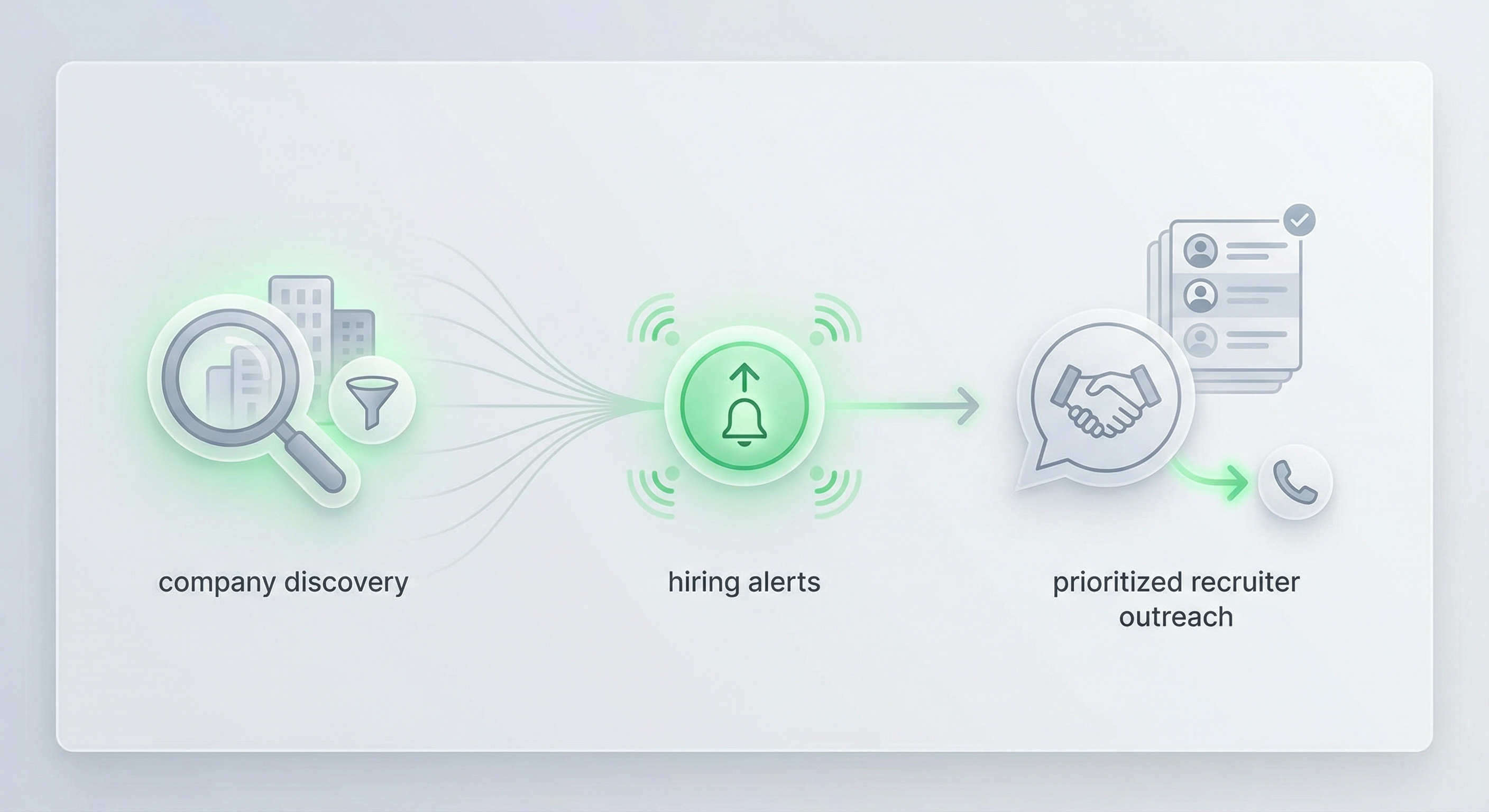
Boilr is the clearest winner for this keyword because it addresses the part of the workflow most UK agencies still handle badly: deciding which companies deserve attention before the desk burns half a morning on manual research. It is not trying to be a generic ATS or a broad sales database. It is built around earlier discovery, stronger hiring signals, faster prioritisation, and a cleaner route from account intelligence to recruiter action.
Best for: AI-led company discovery, live hiring signals, and turning recruiter research into a repeatable daily workflow
Pricing signal: Try free / product-led sign-up
Why teams buy it
- Discovery-first workflow — the product does not start from a giant contact universe and ask recruiters to hunt through it. It starts from matched company opportunities and makes the workflow feel closer to triage than to list-building.[1]
- Signals that explain why now — Boilr’s signals layer matters because it gives recruiters commercial timing, not just company names. Funding, executive moves, expansion, product launches, recruiter history, and multi-turn signal combinations change the quality of the first message.[2]
- Decision-maker route built in — one of the most expensive hidden costs in agency BD is the gap between ‘interesting company’ and ‘actual person to contact’. Boilr closes that gap much faster than tools that leave the user to do separate prospect research.[1]
- Stronger fit for specialist desks — if you recruit in a defined market, the ICP-led filtering matters because recruiters can trim by role family, geography, seniority, and related context. That makes the feed far more usable than generic sales data.[1]
- Natural product depth — this is also why Boilr can be positioned honestly inside a broader listicle. The product case is not just ‘signals’. It also covers Discovery, ICP matching, AI scoring, decision-maker identification, and account context, which is the broader stack UK agencies actually care about.
- Commercial workflow, not vanity analytics — the best way to think about Boilr is as a way to make the first hour of the day commercially useful. That same point is why our breakdown of which signals actually create meetings matters to buyers looking beyond software theatre.
- Cleaner story for AI — the AI here is doing practical work: filtering, scoring, surfacing, and shortening the path to action. It feels much closer to recruiter leverage than to generic ‘AI assistant’ messaging.[1][2]
| Category | What you get | Watch-out |
|---|---|---|
| Market discovery | Matched leads sourced across 10,000+ monitored sources with guided discovery built around recruiter ICPs | You still need an ATS or CRM elsewhere if you want a full system of record |
| Timing intelligence | Twelve signal types, hourly refresh, competitor watchlists, and delivery to Slack, email, or CRM | Teams need to define good alert rules or they will create a feed that is broader than the desk needs |
| Actionability | Decision-maker identification, AI scoring, and immediate route into outreach or CRM handoff | Agencies without a clear ICP will still need to do some strategic homework first |
| Recruiter adoption | A focused workflow built to reduce manual prospect research and improve daily account prioritisation | It is strongest for outbound and market intelligence, not for payroll, invoicing, or candidate ops |
Pros
- Earlier timing — Boilr gives recruiters a reason to contact the account now, not just a name on a list.
- Broader product fit — Discovery, Signals, scoring, enrichment, and decision-maker routing mean the story is much wider than a single signal feed.
- Recruiter-native workflow — the product is built around how agency desks actually prioritise and act.
- Lower research drag — the platform removes hours of list-building and account checking from the recruiter week.
- Good stack behaviour — it complements existing ATS/CRM tools rather than pretending to replace every system.
Cons
- Not a full ATS — agencies still need a process system elsewhere for delivery, reporting, and candidate ops.
- Requires ICP clarity — teams with fuzzy market focus will get less value until they tighten their target-account logic.
- Newer category for some buyers — leadership teams used to buying ATSs may need help understanding the intelligence-layer ROI.
- Best value is outbound-facing — agencies that only care about candidate management will not see the full upside.
- Boutique tech agency in London — If your consultants cover scale-ups, product teams, or engineering hiring across the UK, Boilr gives them a faster route into target accounts than manually checking funding news, career pages, and LinkedIn every day.
- Generalist agency trying to get sharper — Boilr is also useful when a broader agency wants to stop prospecting every company the same way and start focusing on the accounts where there is visible movement and higher intent.
The main takeaway is simple: if your UK agency wants one tool that makes recruiters smarter before they send a single message, Boilr is the strongest buy. The next question is what happens when the priority is not intelligence first, but system-of-record depth — and that is where Bullhorn enters the conversation.
#2 Bullhorn
Best ATS/CRM backbone in this list, but not the best early-stage prospect intelligence tool.
Bullhorn deserves a high ranking because plenty of UK agencies do not just need lead generation help; they need a system that keeps recruiters, sales teams, and management looking at the same data. If the buying problem is process sprawl, weak reporting, or fragmented operations, Bullhorn is still one of the most credible answers on the market.
Best for: Larger agencies and mature teams that need ATS/CRM control, workflow infrastructure, and deeper operational consistency
Pricing signal: Custom quote
Why teams buy it
- Real system-of-record strength — Bullhorn’s ATS/CRM story is much deeper than most tools in this article. The platform is built to centralise candidate, client, and workflow information in one place, which is why so many established agencies still use it.[7]
- Recruitment-specific depth — unlike generic CRMs, Bullhorn is clearly designed around agency workflow, and that matters if your team needs approvals, visibility, automation, and reporting across more than a handful of consultants.[7]
- AI embedded in ops — the company is leaning hard into AI and automation, and its own reporting says top-performing firms using AI are more likely to grow revenue and place faster. That makes Bullhorn relevant to the 2026 buying conversation, not old guard.[6]
- Where it loses ground to Boilr — Bullhorn is weaker when the actual problem is discovering which UK accounts to contact before the need is obvious. It is much better after the opportunity enters the workflow than before it is found.
- Heavyweight software trade-off — implementation, training, and admin discipline are part of the package. That is acceptable for bigger teams, but it is often too much for smaller agencies that mainly want a better top-of-funnel engine.
- Good companion logic — for many agencies, the real answer is not Boilr or Bullhorn. It is Boilr for intelligence and Bullhorn for workflow control. That kind of stack logic is also why our article on building a business-development system that actually gets used matters more than generic software ‘vs’ content.
| Category | What you get | Watch-out |
|---|---|---|
| ATS / CRM core | Deep process infrastructure, shared data visibility, and strong agency workflow coverage | The strength is operational depth, not earlier market discovery |
| Automation | Embedded automation and AI to reduce admin, trigger follow-up, and improve recruiter throughput | A heavier setup still needs internal process discipline to pay off |
| Management visibility | Reporting and shared workflow visibility leadership teams can actually use | Small teams may buy more platform than they need |
| Commercial fit | Strong for agencies that want one central workflow system across sales and delivery | Weaker than Boilr when the issue is finding the right buyer before competitors do |
Pros
- Operational depth — very strong fit when agency leadership needs process control and central visibility.
- Recruitment heritage — it is built for agency workflow rather than adapted from general sales software.
- AI plus automation — useful if your team wants embedded workflow automation inside the core platform.
- Scales with structure — better fit than lighter tools for more complex teams and reporting needs.
- Credible system of record — clients, candidates, and workflow can live in one governed environment.
Cons
- Not discovery-led — it does not solve early-stage market intelligence as cleanly as Boilr.
- Heavier rollout — setup, training, and ongoing discipline are part of the cost.
- Custom pricing — buyers usually need a sales process before they understand total cost.
- Potential overkill — smaller agencies can end up buying infrastructure they do not fully use.
- Twenty-seat multi-desk agency — Bullhorn makes sense when leadership cares about governance, recruiter visibility, consistent workflow, and a system managers can actually run the business from.
- Founder-led agency with scattered spreadsheets — It can also be the right call when the business has simply outgrown lighter tools and needs stronger control over pipeline, reporting, and team discipline.
Bullhorn is strongest when the agency problem starts with operations. But many UK recruiters already have an ATS and still miss targets because follow-up, outreach sequencing, and day-to-day messaging are inconsistent. That is where SourceWhale becomes more relevant than another database.
#3 SourceWhale
Best outreach engine in this list, but not the best first tool if the real issue is market intelligence.
SourceWhale sits high because it solves a real recruiter pain: good intent and good target accounts still go to waste if the desk cannot follow up consistently. The platform is strongest when agencies want one place to run sequences, capture tasks, use AI to improve messaging, and keep outreach from relying on memory or individual habits.
Best for: Multi-channel recruiter outreach, sequence execution, and keeping business-development follow-up consistent
Pricing signal: Custom quote after trial
Why teams buy it
- Execution over research — SourceWhale is built to run the communication layer better. Email, SMS, LinkedIn, phone workflows, AI To-Dos, and campaign support are all designed to make recruiter follow-up more dependable.[9]
- Recruiter productivity fit — SourceWhale’s positioning is all about removing non-billing work, helping recruiters engage more people without adding more manual effort, and keeping the full recruiting story connected.[8]
- Useful AI layer — the AI story is more practical than flashy. Campaign AI, content coaching, reply classification, call summaries, and data cleansing all map to specific recruiter tasks instead of generic chatbot theatre.[10]
- Where it comes after Boilr — if you already know which companies and contacts matter, SourceWhale can absolutely help you execute better. But if you still need to discover the right accounts and understand why now is commercially interesting, Boilr is a better first purchase.
- Great second layer — this is why the fairest way to position SourceWhale is as an outreach engine, not as the full answer to UK agency growth. That same distinction is the spine of our SourceWhale alternative analysis.
- Strong for message discipline — teams that struggle with patchy follow-up, untracked promises, or inconsistent outreach quality can get fast value here even without changing the rest of their stack.[9]
| Category | What you get | Watch-out |
|---|---|---|
| Outreach execution | Multi-channel sequences across email, SMS, LinkedIn, and phone from one workflow | The tool is strongest after target selection, not before it |
| AI workflow help | Campaign AI, content coaching, reply classification, transcription, and task capture | Better at message productivity than at market prioritisation |
| Stack behaviour | ATS/CRM syncing and broad integrations so outreach activity stays connected | Still needs an upstream source of high-quality target accounts |
| Adoption profile | Fast value for recruiters whose main pain is follow-up consistency | Less compelling if the desk already runs good outreach but weak account selection |
Pros
- Excellent sequencing — strong fit for teams that want better multi-touch communication discipline.
- Practical AI — AI is applied to clear tasks like drafting, classifying, summarising, and reminding.
- Recruiter-oriented design — much better fit than generic outreach software for agency users.
- Good integration story — works well as part of a broader recruiter stack.
- Fast workflow win — easy to see impact if your problem is follow-up chaos.
Cons
- Not discovery-first — you still need a better source of high-intent accounts.
- Limited timing intelligence — weaker than Boilr on why a recruiter should act now.
- Custom pricing — buyers need a sales cycle to understand full cost.
- Can amplify bad targeting — faster outreach still fails if the starting account list is poor.
- BD-heavy team with weak follow-up — SourceWhale shines when consultants are already finding decent opportunities but too many next steps live in inboxes, memory, or personal process rather than one consistent operating rhythm.
- Agency that already uses Boilr or another intelligence layer — It is even stronger as a second-layer tool when account selection and timing are already handled elsewhere and the team needs better execution from that point onward.
Once you see SourceWhale as the execution layer, another tool’s role becomes clearer too. LinkedIn Sales Navigator is not a full recruiter operating system either, but it remains very useful for research and stakeholder mapping when the account list is already reasonably strong.
“Recruiters do not need another giant database. They need to know which company is worth their next call and why that call should happen today. Once you solve that, the rest of the workflow gets easier to build around.”
– Felix Hermann, Cofounder @ Boilr
#4 LinkedIn Sales Navigator
Best research layer in this list, but limited as a stand-alone recruiter growth engine.
Sales Navigator is still one of the most common tools in recruiter stacks because LinkedIn remains the fastest place to research companies and people. The reason it ranks fourth, not first, is that it helps you work an account more intelligently once it is in view, but it does not solve the upstream problem of discovering which companies deserve attention before everyone else sees them.
Best for: Account research, stakeholder mapping, lead filtering, and buyer context inside the LinkedIn graph
Pricing signal: From £94.99 per seat/month for Core; £130 for Advanced
Why teams buy it
- Exceptional filtering — LinkedIn highlights 50+ search filters, lead and account alerts, AI-powered lead research, and relationship tools. That is extremely useful for mapping stakeholders and narrowing into the right people once the account is chosen.[11]
- Public pricing clarity — unlike some tools in this list, Sales Navigator publishes starting GBP pricing, which helps buyers benchmark spend faster.[12]
- Strong second-touch value — it is great for checking who changed roles, who is active, which accounts show buyer intent, and how to personalise around the LinkedIn layer of context.[11]
- Weakness for recruiter timing — it still relies heavily on the user to know what to look for. That makes it much less efficient than Boilr when your goal is to wake up to a prioritised feed of accounts already scored for likely hiring intent.
- Common stack mistake — many agencies try to use Sales Navigator as a substitute for a recruiter-specific intelligence platform. It is better understood as one part of the stack, especially if your team also experiments with broader lists and tools covered in our review of Apollo alternatives for recruiters.
- Still valuable for human nuance — even agencies that buy Boilr often keep Sales Navigator because it adds relationship context and account research that supports stronger outreach once the signal has already surfaced.
| Category | What you get | Watch-out |
|---|---|---|
| Research depth | Advanced filters, lead and account alerts, buyer intent, and AI-supported lead insights | You still have to know which accounts deserve time in the first place |
| Pricing clarity | Visible GBP pricing for Core and Advanced plans | Per-seat pricing can add up fast across larger teams |
| Relationship mapping | Helpful for understanding stakeholders, job changes, and in-network access points | Not designed around recruiter-specific signals or agency BD workflows |
| Best role in stack | Great companion tool for research after discovery and prioritisation | Weaker stand-alone answer for agencies trying to generate new opportunity flow |
Pros
- Best-in-class research layer — very strong for people discovery and stakeholder mapping.
- Clear pricing — buyers can benchmark spend without a full sales cycle.
- Useful alerts — role changes and account updates help with message relevance.
- Familiar UX — many recruiters already know how to use it.
- Strong companion tool — pairs well with signal-led products and CRM workflows.
Cons
- Not recruiter-native — built for sellers broadly, not agency growth workflows specifically.
- Weak upstream discovery — does not give you the same signal-led account feed as Boilr.
- Seat cost scales — pricing grows linearly with users.
- Can become manual — without a clear account-selection method, the research surface is still very wide.
- High-value retained search desk — Sales Navigator works well when the desk already knows which firms matter and needs richer stakeholder mapping, relationship clues, and cleaner personalisation before outreach.
- Agency that already has a signal feed — It is also useful as a supporting layer after Boilr surfaces a target, because the recruiter can then build a better picture of the buying group around that account.
Sales Navigator is the best research companion on the list, but some agencies need less research depth and more all-in-one workflow coverage. For those buyers, Recruit CRM is the more natural comparison point.
#5 Recruit CRM
Best all-in-one option here for smaller agencies, but less focused than Boilr on market intelligence and timing.
Recruit CRM rounds out the list because there is a real buyer segment that does not want a multi-tool stack straight away. For smaller agencies or newer firms, the attraction is simple: one product covering ATS, CRM, sourcing, analytics, messaging, and automation with less implementation weight than enterprise software.
Best for: Smaller agencies that want ATS + CRM breadth, workflow automation, and a more affordable all-in-one platform
Pricing signal: Tiered plans; enterprise add-ons vary by plan
Why teams buy it
- Broad feature surface — Recruit CRM positions itself as an all-in-one ATS + CRM for agencies, with resume parsing, AI candidate matching, deals pipeline, analytics, sourcing extension, workflow automation, and messaging features in one platform.[13]
- Good fit for smaller teams — if you are sub-20 seats and need a central operating platform without the full Bullhorn weight, Recruit CRM is easier to understand and often easier to adopt.
- Add-on richness — data enrichment, LinkedIn messaging integration, advanced analytics, and job multiposting make it more flexible than many lightweight systems.[14]
- Where it loses to Boilr — it covers a lot of workflow, but the intelligence layer is not the main event. If your agency’s biggest commercial problem is knowing which UK accounts to call first and why, Boilr still creates more leverage.
- Better when process is the issue — Recruit CRM is a stronger answer when the team needs order, sourcing support, and a single home for activity. It is a weaker answer when the team mostly needs sharper demand discovery. That same distinction shows up in our comparison of business-development tools for SaaS recruiters where the sourcing and intelligence layers behave very differently.
- Good for first centralisation — plenty of founder-led agencies simply need to get out of ad hoc workflows and into one consistent system before they add specialist intelligence software later.
| Category | What you get | Watch-out |
|---|---|---|
| ATS + CRM coverage | Candidate pipeline, client pipeline, sourcing support, messaging, analytics, and invoicing-oriented workflow in one platform | Breadth does not automatically equal best-in-class discovery or timing intelligence |
| Automation | Workflow automation, sequencing, and add-on features that reduce manual admin | Enterprise features and deeper capabilities can vary by plan and add-on structure |
| Agency usability | Good fit for smaller teams that want centralisation without enterprise complexity | Larger or more specialist agencies may still want a separate intelligence layer |
| Commercial fit | Solid first operating platform when the agency needs one home for day-to-day work | Less differentiated if outbound growth is your primary bottleneck |
Pros
- All-in-one breadth — attractive for small agencies that want to reduce tool sprawl quickly.
- Useful automation — offers no-code workflow help and a wide feature set beyond the ATS core.
- Recruiter-friendly scope — more recruitment-specific than generic CRM software.
- Faster to understand — clearer value for teams that want centralisation first.
- Strong add-on ecosystem — sourcing, enrichment, analytics, and messaging features expand what it can do.
Cons
- Weaker intelligence edge — not as strong as Boilr on timing-led company discovery.
- Feature sprawl risk — broader tools can still create complexity if the rollout is not disciplined.
- Add-on economics — total cost depends on which enterprise features your team actually needs.
- Less differentiated for outbound — agencies buying mainly for business development should look harder at specialist tools first.
- Founder-led agency moving off spreadsheets — Recruit CRM is a sensible step when the business wants one central system for candidates, clients, notes, and basic automation without buying heavyweight enterprise infrastructure immediately.
- Growing team that will add intelligence later — It also works when leadership wants a process foundation first, then plans to layer on more specialist intelligence tools like Boilr once outbound maturity improves.
Recruit CRM shows why ‘best recruitment tool’ is never a one-size-fits-all phrase. The right answer depends on whether your UK agency needs a better system of record, a better outreach engine, or a better intelligence layer. For most agencies chasing growth in 2026, that decision should start with a much more practical framework than vendor hype.
How to choose the right recruitment tool for your agency
The simplest way to buy badly is to ask for “the best recruitment software” and stop there. The better approach is to decide which layer of the workflow is dragging the desk down first, then buy the product built to fix that specific constraint.
That sounds obvious, but a lot of agencies still buy through peer pressure. One competitor uses Tool X, so they copy it. One founder likes a demo, so the whole desk gets it. Software decisions improve quickly once you turn them back into workflow decisions.
- Start with the bottleneck — decide whether your agency’s real problem is account discovery, outreach consistency, ATS discipline, or all-in-one workflow sprawl.
- Separate system of record from system of advantage — ATS/CRM tools keep process clean, but recruiter intelligence tools are what create better timing and better conversations.
- Score time saved before feature count — ask how many minutes a recruiter gets back per day on list-building, research, note capture, and follow-up.
- Check UK workflow fit — good tools should support specialist desks, region filters, flexible team structures, and practical account-based prospecting.
- Buy for adoption, not for slide decks — the best stack is the one your team will still use when they are under placement pressure.
- Keep the stack honest — if a new tool still leaves the recruiter doing manual account selection and spreadsheet cleanup, the workflow did not really improve.
Five signs your agency should start with Boilr
- Your team builds target lists by hand every week — that is a strong sign discovery is the real bottleneck.
- Consultants contact accounts too late — when the whole market already knows about the hiring need, timing is broken.
- Sales Navigator feels useful but incomplete — this usually means you have enough research surface, but not enough prioritisation.
- You already have an ATS — adding Boilr can create more value than replacing the whole stack from scratch.
- Management wants better outbound quality — signal-led account selection usually lifts message relevance faster than more sequence volume.
Five signs you should start somewhere else
- No shared system of record — if your team cannot reliably track candidates, clients, or workflow, ATS/CRM cleanup may come first.
- Follow-up is the only issue — if account quality is already good, an outreach tool like SourceWhale may give faster ROI.
- You need deep research on a known account list — Sales Navigator can be enough if prioritisation is already handled.
- Your agency is tiny and centralisation is the priority — Recruit CRM may be the cleaner first step.
- Leadership wants enterprise process control — Bullhorn often makes more sense when governance outweighs top-of-funnel speed.
30-day rollout checklist
- Week 1: pick one desk — start with a niche that has clear ICPs and a manager who cares about outbound quality.
- Week 2: lock the workflow — define who checks the tool, when signals are reviewed, and how accounts move into CRM.
- Week 3: track meetings, not clicks — watch booked conversations, opportunity quality, and speed-to-first-contact rather than vanity usage stats.
- Week 4: remove duplicate admin — if recruiters are updating multiple systems by hand, fix that before expanding seats.
- Week 5 onward: scale what stuck — copy the working rhythm to other desks instead of rolling out every feature at once.
Good tooling compounds only when the agency builds a repeatable rhythm around it. The workflow matters more than the feature count, which is why rollout discipline usually determines whether a tool becomes leverage or shelfware.
Boilr in context: why it wins beyond just signals
If this article only talked about Boilr Signals, the recommendation would be too narrow. The real case for Boilr is broader than that. It is the combination of discovery, signal detection, fit filtering, AI scoring, and decision-maker routing that makes the product more commercially useful than a simple alerts tool.
That is also why the product connects naturally to multiple parts of the site: Discovery, Signals, and the broader business-development framework all reinforce the same core point. The product is not just telling recruiters that something happened. It is helping them decide what to do next.
Eight product capabilities that matter in practice
- Discovery — Boilr monitors 10,000+ sources and turns them into matched company opportunities rather than a raw database dump.[1]
- Signals — Boilr tracks funding, job changes, new hires, acquisitions, project launches, tech migration, executive moves, expansion, multi-turn signals, recruiter history, awards, and product launches.[2]
- ICP filtering — role, seniority, geography, company fit, and related context are used to filter noise before the recruiter sees anything.[1]
- AI scoring — leads are prioritised so the recruiter does not need to manually rank a messy list every morning.[1]
- Decision-maker identification — Boilr connects the company opportunity to the right contact instead of leaving the recruiter to find them later.[1]
- Delivery workflow — signals can be delivered to Slack, email, or CRM so the product fits the existing desk rhythm.[2]
- Guided discovery — recruiters get a consistent sourcing workflow rather than each person reinventing search logic from scratch.[1]
- Daily lead momentum — the business-development page frames Boilr as a way to create daily lead drops and work signal-led prospecting instead of pure cold calling.[3]
Where the edge shows up on the desk
- Morning prioritisation — recruiters start from a ranked queue instead of from a blank search box.
- Faster first message — signals and account context make the outreach angle more specific.
- Better manager coaching — leaders can discuss account choice, not just outreach volume.
- Less wasted research — the team stops rebuilding target lists every few days.
- Stronger stack fit — Boilr can sit upstream of CRM or outreach tools without forcing a total system change.
| Workflow | What happens | Likely outcome |
|---|---|---|
| Manual research + spreadsheets | Consultants check job boards, Google, LinkedIn, and websites one by one, then rebuild lists manually | Slow mornings, uneven account quality, and late outreach |
| Generic sales database | The team gets lots of contacts, but little recruiter-specific timing context | More names, not necessarily more meetings |
| Outreach-first stack | Sequences are strong, but target selection still depends on guesswork | Consistent messaging can end up amplifying weak targeting |
| ATS-only approach | The system records work well once opportunities are already in motion | Good governance, weaker top-of-funnel commercial timing |
| Boilr-led intelligence workflow | Discovery, signals, scoring, and decision-maker data create a prioritised queue before outreach starts | Faster first contact, better-fit accounts, and less manual research waste |
Pros
- Clearer account selection — the tool improves who gets attention before outreach starts.
- Better use of recruiter time — less effort is wasted on dead or badly timed accounts.
- Broader than one feature — discovery, signals, scoring, and contact routing work together.
- Pairs well with existing systems — agencies can keep their ATS or outreach tool and still lift the commercial workflow.
- Fits how modern desks win — especially for UK agencies that need earlier visibility, not just more contacts.
Cons
- Needs a process destination — most agencies still want CRM or ATS workflow after the intelligence step.
- Not built for candidate ops — payroll, compliance, and delivery workflow live elsewhere.
- Requires alert discipline — strong filtering and desk rules matter if you want the cleanest feed.
- Leadership education may be needed — buyers used to ATS categories may need a clearer ROI narrative at first.
Put differently: Boilr wins this ranking because it gives UK agencies a better starting point every day. That advantage is hard to see in feature checklists, but very easy to feel when a recruiter opens the laptop and already knows where to focus.
Decision framework: which tool fits which agency type?
The cleanest way to finish a list like this is not to pretend one tool fits every agency equally. It is to show where each product is genuinely strongest so buyers can make a sensible first move.
If your team is trying to rebuild BD quality from the top of the funnel, the answer is different from the team trying to centralise candidate ops or reduce follow-up chaos. Use the matrix below as the practical version of that decision.
| Agency type | Priority | Best tool | Why |
|---|---|---|---|
| Boutique specialist desk | Find best-fit accounts before competitors and stop wasting mornings on research | Boilr | Specialist desks benefit most from ICP-led discovery, signals, and prioritisation. |
| Mid-size multi-desk agency | Get stronger governance, reporting, and shared workflow across teams | Bullhorn | The ATS/CRM backbone matters more when leadership is managing a larger, more complex operation. |
| Outbound-heavy BD team | Make sequences, follow-up, and recruiter messaging more consistent | SourceWhale | The execution layer becomes the bottleneck once targeting is already reasonably strong. |
| Retained or senior search practice | Map stakeholders deeply and personalise around specific buyers | Sales Navigator | Research depth and relationship mapping are the main value drivers here. |
| Smaller generalist firm centralising operations | Get ATS + CRM + automation into one manageable platform | Recruit CRM | The all-in-one footprint makes sense when the business needs order before optimisation. |
- If growth is the problem — Start with Boilr. Better account discovery and timing improve meetings faster than yet another record-keeping layer.
- If process is the problem — Start with Bullhorn or Recruit CRM depending on scale. Cleaner workflow beats smarter prospecting if the desk cannot run the basics consistently.
- If follow-up is the problem — Start with SourceWhale. Sequence quality and task capture matter more when target selection is already reasonably strong.
Most UK agencies do not need a bigger stack. They need a more honest stack. Once you know which layer is genuinely broken, the buying decision usually gets much easier.
Frequently Asked Questions
What are the best recruitment tools for UK agencies in 2026?
For UK agencies, the strongest shortlist in 2026 spans different parts of the workflow rather than one narrow software category. Boilr is the best fit when you want AI-led company discovery, live hiring signals, and decision-maker data in one place. Bullhorn and Recruit CRM make more sense when the buying problem is ATS/CRM backbone, while SourceWhale and LinkedIn Sales Navigator are better understood as outreach and research layers rather than full recruiter growth systems.
Is Boilr an ATS or a recruiter intelligence tool?
Boilr is better described as a recruiter intelligence and business-development platform than as a classic ATS. Its value sits in discovery, signals, ICP filtering, enrichment, and prioritisation before a recruiter starts outreach. That matters because many UK agencies already have an ATS; what they lack is a reliable way to decide who to contact and why now.
Should a UK recruitment agency buy one all-in-one platform or a specialist stack?
That depends on where the friction really is. If your team is suffering from messy pipelines, invoicing gaps, and weak compliance control, an all-in-one ATS/CRM may be the right first move. If your core pain is empty outbound pipelines and late prospecting, a specialist intelligence tool plus your existing ATS usually creates faster ROI.
Why are hiring signals such a big deal for recruiters now?
Signals matter because they change timing, and timing changes reply rates. Static company databases tell you who exists, but they do not tell you who is about to hire, who just raised capital, who hired a new VP, or who is expanding a team. When you contact buyers around those moments, the first conversation is warmer and the commercial angle is much clearer.
Can Sales Navigator replace a recruiter-specific platform?
Usually no. Sales Navigator is excellent for stakeholder mapping, filtering, and account research, but it does not give you recruiter-native hiring signals, ICP-led company discovery, or automatic decision-maker enrichment in the same way a specialist platform does. It works best as a supporting layer for research once your agency already knows which accounts deserve attention.
Where does SourceWhale fit in a recruiter stack?
SourceWhale fits after strategy and prioritisation are already clear. It helps recruiters run better multi-channel campaigns, keep follow-up consistent, and reduce manual messaging work. If the problem is message execution, it is a strong tool; if the problem is deciding which accounts matter now, you still need a stronger intelligence layer upstream.
Is Bullhorn still relevant if agencies are buying more AI tools?
Yes, because ATS/CRM discipline still matters. AI tools do not remove the need for a system of record, workflow governance, or reporting that leadership can trust. The more useful question is not whether Bullhorn is relevant, but whether your agency also needs a separate intelligence layer so recruiters stop building lists and guessing timing manually.
What should smaller UK agencies look for first?
Smaller agencies should usually buy for speed-to-value, not software breadth. That means a tool that cuts manual research, improves account selection, and gets recruiters into better conversations quickly. If headcount is tight, choosing a platform that saves several hours a week on prospecting often matters more than buying a huge workflow suite you will only partly use.
How should agencies test a tool before committing?
Use a live desk scenario, not a polished demo. Give the vendor a real niche, geography, and ideal client profile, then ask them to produce accounts, contacts, and next actions your team would actually use. If the trial does not improve recruiter behaviour inside a week, the pitch was stronger than the workflow.
Are public pricing pages enough to choose the right tool?
No, because the real cost is not just licence fees. You also need to think about onboarding time, admin drag, hidden add-ons, data quality, and how much extra tooling you still need after the purchase. A cheaper licence can be more expensive in practice if recruiters keep falling back to spreadsheets and manual research.
Can AI really improve recruiter productivity, or is that overhyped?
AI absolutely can improve recruiter productivity, but only when it removes specific chunks of work. Useful AI helps score accounts, filter signals, enrich data, generate first-draft messaging, and keep follow-up from slipping. Useless AI adds generic summaries and dashboards that look clever but do not change what the recruiter does next.
What is the clearest sign a tool will not get adopted by recruiters?
If recruiters still need extra tabs, spreadsheets, and manual copy-paste to finish a standard task, adoption will stay shallow. Recruiters do not reject software because they dislike technology; they reject software that slows them down in live desk conditions. The fastest adoption signal is simple: does the tool make the first hour of the day easier or harder?
Sources
Public sources reviewed in March 2026. Each source informed the ranking, product framing, or workflow claims used in this article.
- Boilr Discovery — Automated Lead Generation for Recruiters — Supports claims about 10,000+ monitored sources, matched leads, AI scoring, and guided discovery.
- Boilr Signals — Real-Time Hiring Signal Detection — Supports claims about signal types, hourly refresh, Slack/email/CRM delivery, and competitor watchlists.
- Boilr — Business Development for Recruitment Agencies — Supports claims about signal-based prospecting, response rates, conversion uplift, and daily lead drops.
- LinkedIn — The Future of Recruiting 2025 — Supports claims about quality of hire and where AI is changing recruiter expectations.
- UK Government — Assessment of AI capabilities and the impact on the UK labour market — Supports claims about UK service-sector AI exposure, productivity pressure, and adoption trends.
- Bullhorn UK — 2026 Industry Trends — Supports claims about AI adoption, revenue correlation, and placement speed.
- Bullhorn UK — Applicant Tracking CRM — Supports claims about Bullhorn ATS/CRM positioning, automation, and recruiter workflow features.
- SourceWhale — AI Recruitment Platform — Supports SourceWhale platform positioning around identifying people, engaging across channels, and turning conversations into billings.
- SourceWhale — Automated Outreach Sequences for Recruiters — Supports claims about multi-channel outreach, ATS/CRM syncing, AI To-Dos, and recruiter workflow automation.
- SourceWhale — Introducing SourceWhale AI — Supports claims about Campaign AI, content coaching, transcription, and data cleansing.
- LinkedIn — Sales Navigator features — Supports claims about 50+ filters, alerts, buyer intent, and AI-assisted research features.
- LinkedIn — Sales Navigator compare plans and pricing — Supports public GBP pricing points used in the comparison section.
- Recruit CRM — ATS + CRM software — Supports claims about AI resume parsing, candidate matching, deals pipeline, and 5,000+ integrations.
- Recruit CRM — Pricing — Supports pricing structure and enterprise add-on references.
- Bullhorn UK — Best recruitment agency software for 2026 — Supports broader software-buying context and ATS/CRM urgency framing.