SourceWhale Alternative for Recruiters in 2026: Why Boilr Wins on Early Hiring Signals
Searching for a SourceWhale alternative? See why recruiters choose Boilr for earlier hiring signals, sharper lead scoring, and faster CRM-ready outreach.
TL;DR
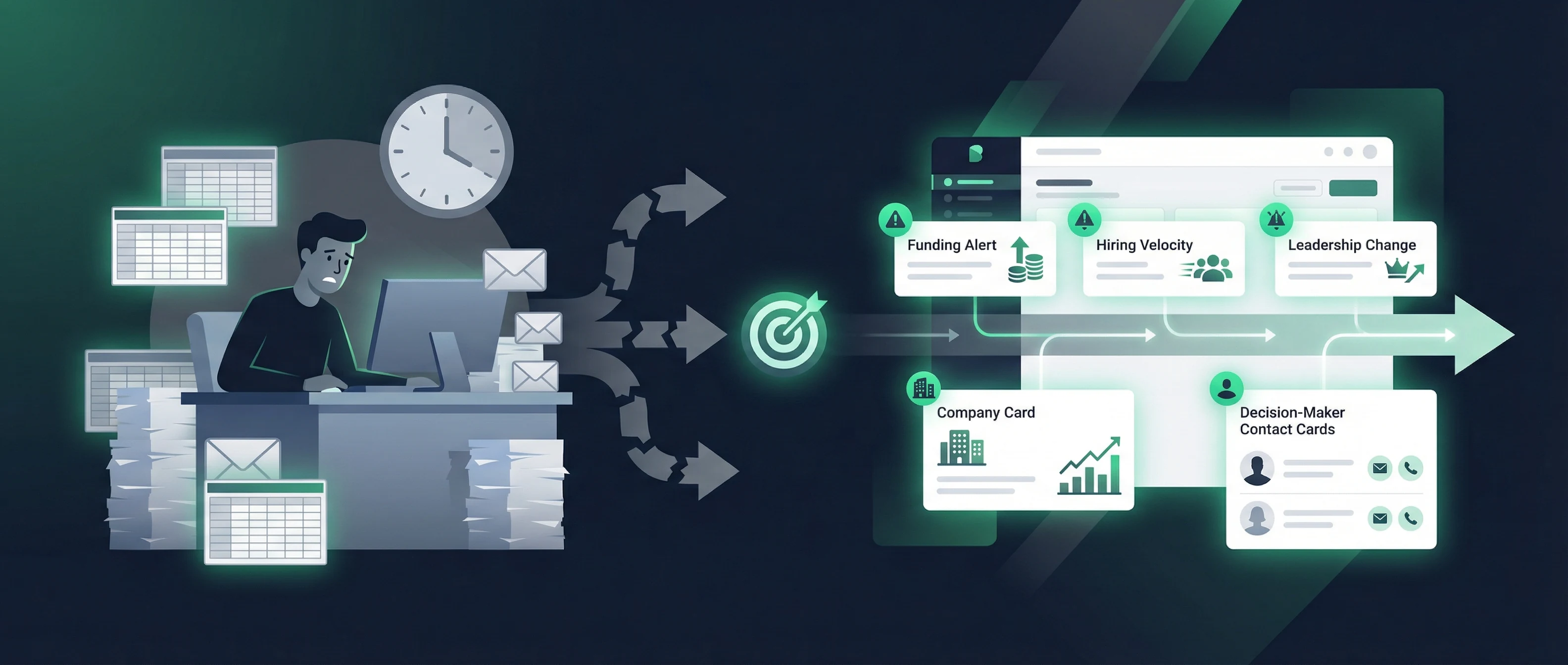
If you are searching for a SourceWhale alternative for recruiters, the first thing to decide is what you are actually trying to improve. If the biggest problem on your desk is follow-through after the recruiter already knows who to target, SourceWhale still makes sense. If the biggest problem is finding the right accounts earlier, spotting real hiring intent, and giving the team cleaner reasons to reach out, Boilr is the better fit.
That distinction matters because many software comparisons flatten two different types of recruiter tooling into one category. SourceWhale publicly positions itself around identifying the right people, engaging them across channels, and converting conversations into placements.[1] Boilr positions itself around scanning, enriching, and delivering qualified opportunities, then filtering them through recruiter ICPs, scoring them for intent, and handing them off to CRM or ATS.[2][3][4]
For agency business development, that upstream advantage is often the more valuable one. Recruiters rarely lose because they had too few ways to send a message. They lose because they spoke to the wrong company, at the wrong moment, with the wrong context. That is why this article lands on a simple verdict: Boilr is the best SourceWhale alternative for recruiters who want earlier hiring signals, better account prioritisation, and less manual prospecting.
The short version
- Choose SourceWhale if your main need is engagement workflow, recruiter coordination, and turning known conversations into placements.
- Choose Boilr if your main need is early demand detection, signal-led BD, contact enrichment, and CRM-ready lead prioritisation.
- Do not compare them as identical tools. Compare them as answers to two different bottlenecks in the recruiter workflow.
- What Boilr wins on — Signals, discovery, ICP filtering, intent scoring, decision-maker context, and earlier timing.
- What SourceWhale wins on — Joined-up workflow once the recruiter already knows who to engage and wants better follow-through.
- Best buyer for this page — Agency owners and BD leaders who want more qualified opportunities, not just a tidier activity layer.
If you want deeper context before committing to the comparison itself, Boilr already has useful background reading on which hiring signals actually create meetings, how recruiters build better lead lists, and how agencies build a BD system recruiters actually use. Those articles explain why a better list usually begins with better timing, not just better copy.
Why recruiters switch from SourceWhale in the first place
Recruiters rarely look for a new platform because the old one suddenly stopped working. They look when the bottleneck shifts from workflow hygiene to commercial timing.
The bottleneck changes as the desk matures
Earlier-stage pain
- Activity gaps - recruiters forget follow-ups, lose notes, and juggle too many tabs.
- Workflow friction - search, messaging, and handoff feel disconnected.
- Manager visibility - leaders struggle to see what the desk is doing day to day.
- Memory dependence - too much process still lives in inboxes and heads.
Later-stage pain
- Weak timing - the team is busy, but too many accounts still say "not right now".
- Manual research drag - mornings disappear into career pages, LinkedIn, and news tabs.
- Low-confidence prioritisation - recruiters cannot quickly tell which accounts matter now.
- Uneven commercial judgment - top billers still outperform because they read the market better than the system does.
SourceWhale fits the first set of problems well because it publicly positions itself around identifying the right people, engaging them across channels, and converting conversations into placements.[1] Boilr fits the second set because it starts earlier - scanning the market, filtering by recruiter ICP, enriching the account, and scoring the lead before outreach begins.[2][3][4]
Why this shift matters more in 2026
The market is rewarding desks that waste less motion and show more relevance from the first touch.
- LinkedIn research — 89% of talent acquisition professionals say quality of hire will become more important, while 61% believe AI can improve measurement.[6]
- Bullhorn research — 17 hours per recruiter per week could be saved with AI, including 4.5 hours spent on searching alone.[7]
What changes when timing becomes the real problem
- Account choice matters more - the desk stops asking only how to follow up and starts asking who deserves follow-up at all.
- Fresh movement matters more - leadership changes, funding, expansion, and hiring bursts become commercial clues, not just background noise.
- Queue quality matters more - recruiters need a sharper morning starting point, not just a tidier activity log.
- Repeatability matters more - managers want average performers working from stronger opportunities, not open-ended guesswork.
The three triggers that usually start the search
- Enough activity, weak timing - recruiters feel busy yet still hear "not right now" too often.
- Too much manual research - mornings are still spent rebuilding lists from career pages, LinkedIn, and funding updates.
- Need for a repeatable pipeline - managers want newer recruiters working from qualified opportunities, not vague target lists.
| Question a buyer is really asking | What it sounds like on the surface | What it usually means underneath |
|---|---|---|
| Why are replies inconsistent? | Maybe we need better sequences. | We may be reaching decent accounts at weak moments. |
| Why are recruiters still stuck in research? | Maybe they need tighter process. | They may need a signal-led discovery layer, not just stricter discipline. |
| Why do top billers outperform the rest by so much? | They are just better at BD. | They may be better at recognising live demand and acting earlier. |
That is the right frame for the rest of this article. The useful question is not "which tool has more features?" It is "which tool creates the stronger commercial advantage for the way this desk actually wins?"
What SourceWhale does well, and why some teams still love it
A fair SourceWhale alternative article should start with respect for the category it actually serves well. SourceWhale is strongest when the desk already knows roughly who to target and needs cleaner execution around that decision.[1]
Where SourceWhale earns its place
- People identification - it helps recruiters get to the right contact once the target account is already known.
- Cross-channel engagement - it supports the outreach and follow-through layer after the recruiter has a reason to engage.
- Real-time capture - activity, notes, and conversation context stay more connected inside one workflow.
- Operational visibility - managers get a clearer view of what the desk is doing without relying on memory.
- Workflow cohesion - recruiters spend less time stitching separate tools together during the day.
That is a real advantage for agencies dealing with scattered tabs, inconsistent follow-up, and too much process living inside personal inboxes. It is also why so many recruiter software vendors keep leaning into all-in-one workflow, integrated data, and AI inside the operating layer.[9][10][11][12]
Desks that usually feel the value fastest
- Known-market desks - teams that already understand their niche and mainly need cleaner execution.
- Multi-consultant desks - teams that need notes, activity, and handoff to stay visible across recruiters.
- Process-heavy environments - managers who care deeply about workflow discipline and consistency.
Why that still matters
- Less admin drag - recruiters waste less time reconstructing what happened across calls and messages.
- Better team memory - important context is easier to preserve and reuse.
- Cleaner execution - once a target is selected, the desk can run a more joined-up play.
Where SourceWhale looks strongest
- Activity capture - stronger operational continuity across the desk.
- Cross-channel workflow - useful once targeting is already known.
- Conversation visibility - makes recruiter activity easier to inspect and coach.
- Memory reduction - less dependence on individuals remembering every next step.
Where it is not obviously the best answer
- Early demand detection - it is not primarily positioned around finding high-fit accounts before competitors notice them.
- Signal-led scanning - it is less naturally framed as a market-monitoring engine.
- ICP-filtered queues - it is not the clearest answer for recruiter morning lead drops.
- Research replacement - it does not obviously remove the need to rebuild prospect lists from scratch.
That is why the honest buyer question is not "Is SourceWhale good?" It is "Do we need stronger execution after choosing an account, or a better system for deciding which account deserves attention in the first place?" For desks in the first camp, SourceWhale still makes a lot of sense.
Where SourceWhale can feel limited for signal-led recruitment BD
SourceWhale starts to feel limited when the desk is trying to solve for market timing rather than just workflow cleanliness. That is not a criticism of the product. It is a sign that the team now needs stronger upstream leverage than a joined-up engagement layer can provide on its own.
What the recruiter still has to work out manually
- Which accounts actually moved - who changed meaningfully in the last 24 hours rather than just looking plausible on paper.
- Which signals imply urgency - whether funding, hiring bursts, expansion, or leadership change likely translate into live demand.
- Which accounts fit the desk - whether the opportunity matches niche, geography, seniority, or service line.
- Which contact matters most - who inside the account likely owns the problem suggested by the signal.
Boilr is built around answering those earlier questions. Across its Homepage, Discovery, Signals, and Business Development pages, the product story is consistent: monitor the market, identify live hiring intent, filter by ICP, enrich the lead, score the account, and hand a higher-fit opportunity to the recruiter.[2][3][4][5]
| Morning question | Workflow-heavy starting point | Signal-led starting point |
|---|---|---|
| What changed overnight? | The recruiter often still has to go find that answer. | The system should already be surfacing movement worth attention. |
| Which accounts matter now? | The recruiter leans on instinct and manual market knowledge. | ICP filters, scores, and signal context narrow the field earlier. |
| Who should we contact first? | The desk often still has to map the likely owner from scratch. | Enrichment and contact context are attached to the opportunity sooner. |
| Why this account, today? | The explanation is often reconstructed after the fact. | The reason to act is built into the queue from the start. |
The hidden cost of starting too late in the workflow
- More wasted touches - recruiters spend time on accounts that are not under enough pressure to engage.
- Slower desk ramp-up - newer recruiters need a stronger first filter than "pick some accounts and see what happens".
- Weaker manager visibility - leaders can see activity volume yet still struggle to judge whether the team is chasing the right moments.
- Too much instinct dependence - the best billers still win mainly because they read the market better than the system does.
Practical takeaway: If your team says, "We need a better way to run conversations," SourceWhale may still be right. If your team says, "We need better conversations to exist in the first place," Boilr is the stronger SourceWhale alternative.
That is the real separation. SourceWhale helps once the play is already chosen. Boilr helps the desk choose a better play, earlier.
Why early hiring signals beat late-stage outreach workflows
Copy, cadence, and persistence matter only after the recruiter can answer one harder question: why this company now? Early hiring signals give the desk that answer before outreach begins.
What a useful early signal actually looks like
- Funding events - suggest budget, growth plans, or pressure to build capability quickly.
- Hiring bursts - suggest immediate capacity pressure rather than vague long-term interest.
- Leadership changes - suggest team redesign, new priorities, or fresh willingness to use external partners.
- Expansion signals - suggest local hiring, new functions, or a broader scaling move.
- Pattern clusters - multiple smaller changes together often matter more than any single signal alone.
Boilr’s Discovery and Signals pages make that operating model explicit - monitored sources, qualified lead drops, smart filtering, AI scoring, and alerts built around funding, job posts, leadership changes, expansion, and multi-turn patterns.[3][4]
Why signal-led BD matters more now
- Efficiency pressure is up - Bullhorn suggests firms expect AI to save meaningful time on searching and routine work, making manual prospect research harder to justify as the default workflow.[7]
- Quality pressure is up - LinkedIn shows a wider move toward precision, fit, and relevance rather than activity for activity’s sake.[6]
- Timing pressure is up - in crowded markets, the desk that sees movement first often gets the conversation before competitors pile in.
Why signals beat static lists
- Better reason to reach out - the recruiter can anchor the message in real business movement.
- Better contact choice - the likely owner becomes clearer when the signal itself provides context.
- Less research waste - account context is packaged earlier instead of recreated from scratch.
- Better follow-up quality - the second and third touch stay tied to a real event, not generic persistence.
- Better team leverage - managers can coach the queue, not just the copy.
Why signals lift conversion
- Urgency framing - the recruiter has a reason to contact the account now.
- Owner clarity - the likely stakeholder becomes easier to identify.
- Research compression - less context has to be rebuilt manually before outreach.
- Relevance carry-through - follow-up stays grounded in a real event rather than empty persistence.
Why static lists underperform
- Broadness - too many accounts look plausible without being urgent.
- Manual context load - recruiters still have to work out why the account matters.
- Volume bias - the system rewards activity more than timing.
- Instinct dependence - experienced recruiters still beat the process because the list is too generic.
| Approach | What the recruiter starts with | Main risk | Likely result |
|---|---|---|---|
| List-led workflow | A broad target account set and contact search | Weak timing and too much manual context building | High activity, uneven relevance |
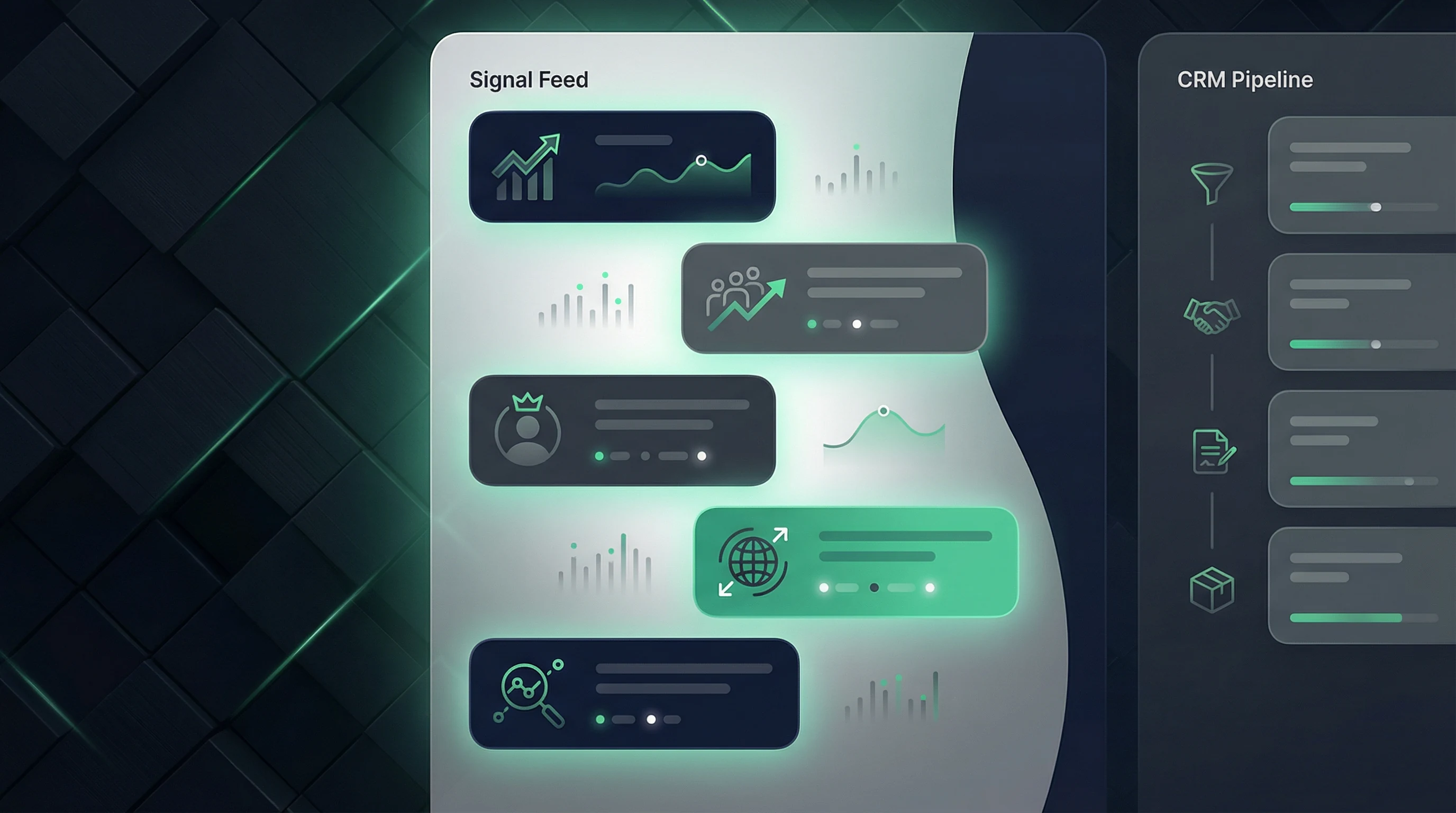
| Signal-led workflow | A live event, score, account fit, and likely contact owner | Requires a good signal engine and thoughtful filtering | Lower volume, sharper relevance, faster prioritisation |
If you want to pressure-test this further, compare how your team behaves after reading Boilr’s guides on why recruiter pitches fail and how to follow up without annoying prospects. Both assume the account is already worth talking to. Signal-led discovery improves that assumption before the first line is written.
Boilr vs SourceWhale: the feature comparison that actually matters
Most comparison tables fail because they compare labels instead of workflow logic. Recruiters do not buy "AI" or "automation" in the abstract - they buy better timing, clearer prioritisation, and more commercially useful output.
Compare these four things first
- Starting point - does the workflow begin with a known target account or with market movement worth acting on?
- Decision support - does the tool help explain why the account matters now?
- Contact context - does it identify the likely owner of the problem, not just more names?
- Handoff speed - can the opportunity move into CRM or ATS without more manual rebuilding?
On that test, SourceWhale is stronger when the recruiter already knows the account and wants a cleaner engagement workflow. Boilr is stronger when the desk needs the system to surface the opportunity, qualify it, and attach context before outreach begins.
| Criterion | SourceWhale | Boilr | Verdict |
|---|---|---|---|
| Where the workflow starts | Search, contact targeting, engagement, notes, and follow-through once the recruiter knows roughly who to approach. | Hiring signals, account movement, ICP-filtered discovery, contact enrichment, scoring, and CRM-ready handoff before outreach begins. | Boilr if timing and pipeline creation are the main problem. |
| Early demand detection | Not the main public positioning. The emphasis is stronger on joined-up workflow and engagement after targeting. | Core strength. Boilr highlights real-time signal detection across 10,000 plus sources and alerts matched to recruiter ICPs. | Boilr clearly wins. |
| Decision-maker context | Helps identify the right people and keep conversations connected. | Adds account context, likely hiring-manager mapping, enrichment, fit filtering, and intent scoring around the contact. | Boilr for richer upstream context. |
| Cross-channel engagement | Strong fit. This is one of the clearest parts of its public positioning. | Useful handoff into CRM or outreach tool, but not pitched as the main centre of gravity. | SourceWhale wins. |
| Adoption for BD teams | Good when the team already has target accounts and wants a cleaner operating workflow. | Good when the team wants higher-quality opportunities every morning and less manual research. | Depends on the bottleneck. |
| Signal-led recruiter BD | Possible, but not the clearest reason its homepage gives to choose it. | Explicitly built around signals, scoring, discovery, and recruiter business development. | Boilr wins. |
| CRM or ATS handoff | Works with existing tools and keeps information captured in the workflow. | One-click export to CRM or ATS is a core part of the product story. | Roughly comparable, with Boilr stronger on pre-handoff qualification. |
| Best fit buyer | Recruiters who want search-to-billing execution and engagement discipline. | Recruiters who want earlier opportunities, signal-based prioritisation, and cleaner client-prospecting workflows. | Boilr for signal-led agency BD. |
Choose SourceWhale if...
- Market visibility is already strong - your desk already knows who should be worked.
- Execution is the bottleneck - follow-up discipline and workflow cohesion matter most.
- Consistency after outreach matters - you want a tidier engine once the play has started.
- You are solving downstream friction - discovery itself is not the main problem.
Choose Boilr if...
- Manual prospect research is still heavy - your mornings disappear before outreach even starts.
- Timing is the main issue - you want earlier hiring intent, not just cleaner follow-up.
- Queue quality matters - you need ICP-filtered opportunities and contact enrichment.
- You want better first touches - recruiters should begin the day with a stronger queue.
Simple verdict: SourceWhale helps you run the play more cleanly. Boilr helps you identify a better play earlier. If early signals and sharper prioritisation are the real goal, Boilr is the stronger fit.
Nine real recruiter scenarios where the difference becomes obvious
Abstract comparisons are useful up to a point, but buyers usually decide based on whether they can see themselves inside the workflow. The scenarios below are the most practical way to understand when Boilr beats SourceWhale and when the reverse could still be true. None of them requires theoretical feature scoring. They simply ask what kind of desk you are running and where time, attention, and conversion are leaking right now.
- 1. The tech desk with too many possible targets — A specialist tech recruiter often has a huge market map and not enough confidence about who actually matters now. In that situation, SourceWhale can help once the desk has chosen the accounts and wants consistent engagement. Boilr creates more leverage earlier by narrowing the field through funding, hiring velocity, leadership changes, and matched ICP filters, so the desk starts from a shorter, sharper list.
- 2. The founder-led agency that still prospect-lists by hand — When the founder and one consultant are still manually checking career pages, funding news, and hiring announcements every morning, the biggest problem is not communication workflow. It is wasted research time. Boilr is better here because it automates the market scanning and gives the agency a daily feed of qualified opportunities rather than another set of activities to maintain by hand.
- 3. The contract desk that wins on speed — A contract desk usually needs timing more than perfect copy. If a company is expanding a cloud migration team, opening a new office, or replacing a senior engineering leader, the recruiter who knows first often wins the meeting. That is exactly the type of edge Boilr is designed to create, whereas SourceWhale is more helpful once the contact and conversation path are already defined.
- 4. The mature BD team with patchy CRM discipline — This is a case where SourceWhale can still be attractive. If the team already has enough demand and mainly struggles to keep outreach, notes, and follow-up connected, SourceWhale solves a real operational problem. Boilr would still add value upstream, but the first purchase priority might be workflow hygiene rather than signal intelligence.
- 5. The agency entering a new niche — When an agency opens a new desk, it rarely knows the market rhythm well enough on day one. A broad contact database is less helpful than visible patterns in who is expanding, who just raised, who changed leadership, and which roles are clustering by function or geography. Boilr helps build that market awareness much faster than starting from cold account lists and trying to infer demand afterwards.
- 6. The recruiter who keeps hearing 'not right now' — That answer usually reflects timing failure more than copy failure. The recruiter may be targeting reasonable accounts but speaking to them before urgency appears or long after another supplier is engaged. A signal-led tool changes the timing logic. By surfacing fresh intent markers and scoring them against the recruiter’s ICP, Boilr reduces the number of conversations that are commercially plausible but badly timed.
- 7. The team selling into hiring-manager-led functions — Some markets move fast when a new VP joins, a product line expands, or a funded team starts to scale. In those cases, finding the likely owner of the hiring problem matters more than generic coverage of the org chart. Boilr’s fit is stronger because it frames decision-maker lookup inside the signal, the account context, and the recruiter’s actual specialism.
- 8. The agency trying to reduce cold outreach volume — If the goal is to send fewer, better messages instead of more generic ones, Boilr is usually the better strategic move. The platform helps the recruiter narrow the prospect list before any sequence begins. That makes it easier to move toward the style of signal-led outreach described in Boilr’s own articles on hiring signals, better lead lists, and early-intent prospecting, all of which support a quality-over-volume approach.
- 9. The manager who wants a system new recruiters can actually use — A manager does not just buy tools for top billers. They buy tools for the middle of the team. Signal-led morning feeds, scores, and pre-qualified account context are often easier for newer recruiters to use than an open-ended market where they still need to decide what to search, which accounts matter, and how to prioritise them. That makes Boilr especially strong where ramp time and consistency matter.
The common thread across those nine cases is simple. SourceWhale gets stronger when the recruiter already knows where to point the activity. Boilr gets stronger when the desk still needs a system to decide where the activity belongs. That is why Boilr feels particularly compelling for founder-led agencies, growing niche desks, contract markets that reward speed, and teams trying to reduce broad cold outreach in favour of better-timed conversations.
It is also why managers often find signal-led systems easier to standardise. Top billers do not need much help inventing reasons to call good accounts. Mid-level recruiters do. If software can move more of the team closer to the instincts of the top performers by surfacing high-fit signals, likely owners, and account context, the whole desk becomes more commercially consistent. That matters more than another engagement prompt or better note capture if the desk is still starting from a weak list.
How Boilr fits the recruiter workflow in practice
This is the section where a lot of comparison articles become too salesy or too abstract. The better way to do it is to stay close to the real recruiter workflow: where the day starts, how an account gets prioritised, how much manual work still remains, and whether the handoff into the actual desk workflow is clean.
On that practical test, Boilr fits best when the team wants stronger inputs before outreach begins. It is not mainly trying to make the same prospecting motion look cleaner. It is trying to improve what lands on the desk in the first place.
Boilr starts with live market movement, not a blank search box
The biggest workflow difference is the starting point. Instead of asking the recruiter to build a prospect universe manually, Boilr starts from signals that often correlate with hiring demand. Discovery highlights 10,000 plus monitored sources and morning lead drops, while Signals adds events like funding, leadership changes, hiring bursts, expansion, and multi-turn patterns.[3][4]
That matters because a lot of recruiter effort gets burned before the first message is even drafted. If the desk has to rebuild market visibility from career pages, job boards, LinkedIn, and news every morning, the workflow is already leaking time. Boilr reduces that leak by turning market change into a starting queue instead of making the recruiter infer demand from scratch.
How the Boilr workflow starts
- A signal appears. Funding, hiring velocity, leadership change, expansion, or another relevant market event.
- The account gets filtered. Boilr checks whether that company matches the recruiter’s ICP rather than sending every possible event through untouched.
- The lead gets prepared. Context, likely contacts, and fit signals get packaged before the recruiter starts opening tabs.
- The team gets a usable queue. The recruiter begins the day with opportunities that already have commercial logic behind them.
Boilr turns a signal into a recruiter-ready lead
A signal only matters if it becomes something the recruiter can act on. That is why Boilr’s product story keeps repeating the same operational pieces: ICP filtering, enrichment, finding the right contact, smart scoring, alerts, and one-click export to CRM or ATS.[2][3][4]
This is where the product feels different from a generic signal feed. It is not just surfacing movement and leaving the recruiter to do the hard part afterwards. It is trying to carry the opportunity further down the line so the recruiter can move from “interesting company” to “ready-to-work lead” without rebuilding everything manually.
| Layer | What Boilr adds | Why it matters to the recruiter |
|---|---|---|
| Signal capture | Funding, leadership, hiring, expansion, and other movement across a broad source base. | The recruiter starts with a reason to look now, not just a cold account list. |
| Fit filtering | ICP logic across role, seniority, geography, and other criteria. | Noise gets cut before it becomes another tab or another wasted call. |
| Lead preparation | Enrichment, likely hiring-manager context, and priority scoring. | The recruiter has a clearer answer to who to contact and why that person matters. |
| Workflow handoff | Alerts plus export into CRM or ATS. | The opportunity moves into the real workflow quickly instead of dying in another dashboard. |
What Boilr gives a recruiter before the first message
- A live reason to look. Funding, hiring, leadership, expansion, or another clear trigger.
- A fit judgment. Whether the account matches the desk’s ICP and why.
- A priority signal. A score or ranking that helps the recruiter decide where to begin.
- Contact context. The likely owner inside the account rather than a vague company target.
- A cleaner handoff. Export into CRM or ATS without rebuilding the lead manually.
It makes the desk easier to run, not just prospecting faster
Boilr also fits the way modern managers want to run recruiter BD. The Business Development page pushes signal-based prospecting, richer account intelligence, and daily lead drops rather than raw activity volume.[5] That changes the coaching conversation in a useful way.
Instead of asking only whether recruiters sent enough messages, managers can ask whether the queue was sharp enough, whether filters are too broad, whether some signal types convert better on certain desks, and whether newer consultants are working the highest-fit opportunities first. That is a stronger operating model because it improves judgment upstream, not just compliance downstream.
- Why newer recruiters feel the value fast — Signal-led queues reduce the amount of market intuition a new consultant has to invent alone. The desk starts from something ranked, filtered, and explained rather than from endless possible targets.
- Why managers like it — The team becomes easier to coach because leaders can improve the input logic itself: filters, signal types, desk rules, and handoff quality.
- Why founder-led agencies care — Founders usually feel the cost of manual research first. A morning queue of qualified opportunities frees time that would otherwise disappear into prospect list rebuilding.
- Why specialist desks benefit — Desk-specific filters and alert logic matter more when each market has different buying signals. One desk may care about funding bursts; another may care about executive changes or new office launches.
A more believable commercial claim: Boilr is compelling not because it promises to replace recruiter judgment, but because it reduces low-value research and gives judgment better raw material to work with. That is a much stronger reason to buy than “send more and hope”.
The real buying decision is upstream versus downstream leverage
This is the simplest way to frame the decision. If your desk already knows who should be contacted and mainly needs a tighter system for engagement, follow-up, and execution, SourceWhale still deserves serious consideration. But if the desk is still spending too much time deciding which accounts matter and why now, Boilr is the stronger fit because it improves the input to the whole process.
That is also why Boilr makes the most sense as a recruitment intelligence layer for business development, not as a generic recruiter platform trying to do every job at once. It wins by changing the opportunity set, not by imitating SourceWhale’s best downstream features.
Choose Boilr when these statements feel true
- Your desk still rebuilds prospect lists manually.
- Your team needs stronger timing, not just better activity tracking.
- You want fewer low-confidence messages and more commercially grounded outreach.
- You need desk-specific queues that newer recruiters can actually use.
- You care more about earlier opportunities than cleaner workflow after the target is already known.
Bottom line on product fit: If your desk needs a tighter system for engaging people it already knows should be contacted, SourceWhale deserves serious consideration. If your desk needs a better answer to “who should we contact this week and why now?”, Boilr is the stronger buy.
A simple decision framework for choosing between Boilr and SourceWhale
Most buyers make this decision harder than it needs to be by weighting every feature equally. A better framework starts with the dominant bottleneck on the desk.
Use these four filters in order
- Locate the bottleneck - if the pain appears after target selection, SourceWhale stays relevant; if it appears before target selection, Boilr moves up fast.
- Check whether the desk wins by speed - in markets where the first recruiter to notice change has an edge, early signals matter more than workflow polish.
- Check whether average performers need help - if only top billers can reliably spot the right accounts, the desk needs stronger system guidance upstream.
- Check the handoff reality - if insights still need lots of manual rebuilding before CRM or ATS entry, the workflow is weaker than it looks in a demo.
| Your situation | Better fit | Why |
|---|---|---|
| You already know the target accounts and want stronger outreach execution. | SourceWhale | The workflow emphasis on engagement, capture, and follow-through is closer to the problem you are trying to solve. |
| You need to find better accounts earlier and reduce manual prospect research. | Boilr | Boilr starts with signals, discovery, filtering, scoring, and enrichment rather than activity after the fact. |
| Your recruiters complain they do not know who to contact this week. | Boilr | The biggest gap is pipeline creation and prioritisation, not communication tooling. |
| Your team already has enough opportunities but follow-up is inconsistent. | SourceWhale | The operational bottleneck is workflow discipline once conversations begin. |
| You want more signal-led BD and fewer broad cold lists. | Boilr | That is the use case Boilr is built around in its product pages and blog strategy. |
| You are evaluating a platform for a new desk or niche launch. | Boilr | Early market visibility and guided account discovery reduce the cost of starting from scratch. |
The four buying questions to ask in a demo
- What will a recruiter see at 08:30 on Monday? - ask the vendor to show the very first screen and what it tells the desk to do.
- How much manual research still remains? - if the recruiter still needs a dozen tabs, the system has not removed enough friction.
- What explains why an account was prioritised? - scores without reasoning do not train recruiter judgment.
- How fast can the lead move into our real workflow? - alerts and insights only matter if the handoff is easy.
That keeps the comparison honest. It forces both products to answer the same question: where exactly in the recruiter workflow do you create the most measurable leverage?
A practical 30-day switch plan if you want to move from SourceWhale-style workflow to signal-led BD
You do not need a dramatic migration story to test whether Boilr is the right SourceWhale alternative. The cleanest evaluation is a 30-day commercial test with one desk, one ICP, and clear before-versus-after judgement.
Week 1 - define the ICP and signal scope
- Pin down the niche - decide exactly which accounts matter.
- Define high-fit opportunity - make role clusters, geography, company stage, and exclusions explicit.
- Limit the first signal set - turn on only the signals that genuinely matter for that desk.
Week 2 - judge queue quality
- Work from the morning feed - let recruiters start from surfaced opportunities.
- Compare the first ten accounts - are they better than the first ten chosen manually?
- Tighten filters quickly - treat noisy output as a tuning problem, not an excuse to give up.
Week 3 - measure workflow speed
- Track tab reduction - how much manual research disappeared?
- Track lead readiness - how often was the context already strong enough to act on?
- Track handoff friction - how cleanly did leads move into CRM or ATS?
Week 4 - judge commercial output
- Review reply quality - are conversations more relevant?
- Review meeting quality - do surfaced accounts feel sharper than the old system?
- Review manager confidence - does the queue look commercially stronger, not just busier?
30-day checklist
- Pick one niche first - do not test the whole business at once.
- Write the ICP explicitly - industry, geography, role clusters, company stage, and exclusions.
- Turn on only the most relevant signals - avoid judging noise you never should have allowed through.
- Review the first week fast - tighten filters early rather than tolerating messy output.
- Track acted-on opportunities - measure how many leads were usable without extra research.
- Measure meeting quality, not just count - the goal is fewer better messages, not more motion.
- Ask whether the queue feels more credible - recruiters should trust the starting point more than the old manual process.
What success looks like after 30 days
- Faster starts - recruiters spend less time deciding where to begin.
- Sharper reasoning - managers can see why accounts were chosen.
- Fewer low-confidence messages - the desk sends less speculative outreach.
- Better prepared CRM entries - leads arrive with more useful context attached.
What failure usually looks like
- Over-broad ICP - the queue is noisy because the targeting logic is vague.
- No behaviour change - the team expects magic while prospecting exactly as before.
- No quality measurement - nobody checks whether surfaced opportunities are actually better.
- Wrong comparison standard - the new tool is judged against the wrong problem.
That is the right way to buy a SourceWhale alternative. Measure whether the system improves the quality of the opportunities reaching the desk. If it does, the switch is earning its keep.
FAQ
What is the best SourceWhale alternative for recruiters in 2026?
For recruiters who care most about spotting demand early, qualifying accounts faster, and prioritising the right outreach, Boilr is the strongest SourceWhale alternative in 2026. SourceWhale remains useful once a recruiter already knows who to engage and wants a tighter workflow around outreach, follow-up, and notes. Boilr wins upstream by helping recruiters identify active hiring intent sooner, map likely decision-makers, enrich the account, and push a cleaner opportunity into CRM before the market gets crowded.
Is Boilr a full replacement for SourceWhale?
It depends what your team uses SourceWhale for. If your workflow is centred on engagement, notes, and follow-through once a recruiter has already identified the target contact, SourceWhale still offers strengths there. If the bigger commercial problem is finding better accounts earlier and reducing manual prospect research, Boilr can replace the part of the workflow that drives timing, prioritisation, and lead discovery. Many teams should think in terms of replacing the weak stage of the process first, not forcing a one-label answer onto two products with different centres of gravity.
Why do recruiters look for SourceWhale alternatives?
Most teams do not switch because SourceWhale is bad. They switch because their bottleneck has moved. Once a team matures, they often realise the hardest part is not sending follow-ups or logging activity. It is knowing which companies matter now, which signals show real hiring pressure, and who inside the account is worth contacting first. At that point, a recruiter starts looking for a SourceWhale alternative that is stronger on demand discovery rather than engagement workflow alone.
What does SourceWhale do well?
SourceWhale positions itself around identifying the right people, engaging them across channels, and turning conversations into placements. That makes it attractive for recruiters who want a more joined-up search-to-billing workflow, especially where consistency of follow-up, communication, and recruiter memory matters. In other words, it does well when the team already knows the market and wants tighter execution. That is a legitimate strength, and any fair comparison should start there.
Where does Boilr outperform SourceWhale?
Boilr outperforms SourceWhale when the priority is earlier hiring-signal detection, recruiter ICP filtering, enriched account context, intent scoring, morning lead drops, and CRM-ready handoff. Instead of asking a recruiter to begin with a contact search, Boilr starts with market movement. That usually leads to better timing because the recruiter is reacting to a signal that suggests live or emerging demand rather than a static list of companies that merely look plausible on paper.
Is SourceWhale better for candidate engagement?
For teams whose main need is communication workflow, follow-up discipline, and keeping recruiter activity tied together after outreach begins, SourceWhale is often the more natural fit. Its public positioning leans heavily into real-time capture, engagement, and turning conversations into billings. Boilr is not trying to win by becoming a generic engagement layer. It wins by improving what happens before the outreach starts, which is often the higher-leverage commercial problem for agency BD teams.
Why do early hiring signals matter more than list size?
Because recruiter conversion depends on timing and context more than contact volume. A team with 5,000 names but weak timing still wastes energy on low-urgency accounts. A team with fewer accounts but stronger signals can reach companies during leadership changes, funding events, hiring bursts, or expansion phases when agency support is easier to justify. Early signals improve relevance, and relevance usually improves reply rate more than simply adding more names to the top of the funnel.
What should recruiters compare when evaluating a SourceWhale alternative?
They should compare starting point, signal depth, ICP filtering, enrichment quality, decision-maker mapping, CRM handoff, time-to-value, and how much manual research remains after the tool runs. Many comparisons stay too high level and ask whether two platforms have roughly similar feature labels. The better question is where the workflow begins and what kind of commercial advantage it creates. If one tool starts with active market movement and the other starts after account selection, the outcome is usually very different even if both mention AI and automation.
Is Boilr better for recruitment agency business development?
Boilr is better for recruitment agency business development when the team needs pipeline creation, earlier demand detection, and sharper account prioritisation. It is built around monitoring 10,000 plus sources, filtering signals against recruiter ICPs, identifying likely hiring managers, and delivering opportunities through alerts and CRM-ready handoff. That is especially valuable for desks that want to move away from cold, broad prospecting and towards signal-led outreach. If the team already has enough opportunities and merely wants a better engagement engine, the answer may be different.
What slug should a SourceWhale comparison article use?
For SEO and maintainability, a short slug such as /blog/sourcewhale-alternative is cleaner than a very long year-heavy slug. The headline can still contain the full keyword and freshness signal. Short slugs are easier to reuse, easier to link to, and less awkward if the page is refreshed next year. The ranking signal comes more from title, relevance, content depth, and internal linking than from stuffing every modifier into the URL.
Can Boilr help small recruitment teams, or is it mainly for larger agencies?
Small teams often feel the value fastest because they have less spare capacity for list building and manual market research. When one recruiter gets a morning feed of high-fit, scored opportunities instead of rebuilding a prospect list from scratch, the time savings are visible immediately. Larger teams benefit too, especially when they need desk-specific pipelines and consistent signal handling across consultants. The common thread is not agency size but whether manual discovery is still slowing the team down.
Should recruiters choose a SourceWhale alternative based on features alone?
No. Features only matter in the context of the problem you are trying to solve. Two products can both mention AI, automation, CRM sync, or enrichment and still create completely different day-to-day outcomes. The better buying question is this: after a recruiter opens the tool at 08:30, does it help them decide who to contact, why now, and what to do next with less friction than the current setup? If not, the feature list is probably hiding a weak workflow fit.
Sources
- SourceWhale - Homepage
- Boilr - Homepage
- Boilr - Discovery
- Boilr - Signals
- Boilr - Business Development
- LinkedIn - The Future of Recruiting 2025
- Bullhorn - GRID 2025 Industry Trends Report
- SourceBreaker - Homepage
- Loxo - Homepage
- Recruit CRM - Homepage
- Vincere - Homepage
- Bullhorn - AI-Powered Online Recruitment Software for Agencies