How Automated Recruitment Systems Save Recruiters Hours Daily
The landscape of talent acquisition and recruitment agency operations has undergone a profound transformation, driven by shifting economic realities, heightened competition for specialized talent, and the rapid maturation of artificial intelligence.

The landscape of talent acquisition and recruitment agency operations has undergone a profound transformation, driven by shifting economic realities, heightened competition for specialized talent, and the rapid maturation of artificial intelligence. In the current operational climate, recruitment agencies face a critical juncture: the traditional methodologies of reactive candidate sourcing and manual business development are no longer sufficient to sustain growth or maintain a competitive advantage. The integration of automated recruitment systems, particularly those leveraging signal intelligence and agentic workflows, has shifted from a theoretical competitive edge to a fundamental operational necessity.
The recruitment industry has historically relied on manual, highly repetitive processes to source candidates and acquire new employer clients. However, the modern labor market is characterized by record application volumes juxtaposed against severe talent shortages in niche sectors, rendering these legacy processes obsolete. To navigate this paradox, organizations are increasingly turning to sophisticated technological stacks that blend predictive analytics, large language models (LLMs), and autonomous agentic workflows. These systems are designed to eliminate the administrative friction that traditionally consumes the majority of a recruiter's workweek, thereby enabling a strategic pivot toward relationship building, complex negotiation, and high-value consulting.
This comprehensive research report examines the structural inefficiencies inherent in traditional recruitment models, analyzes the profound impact of automated systems on productivity, and explores the strategic integration of inbound marketing frameworks and outbound prospecting. By evaluating the technological capabilities of LLMs and predictive signal intelligence, alongside a detailed comparative analysis of leading market solutions including Boilr.ai, SourceWhale, Sourcebreaker, Paiger, Bullhorn, and Vincere this document provides a rigorous, data-driven blueprint for recruitment business development and operational excellence.
The Structural Deficit in Traditional Recruitment Workflows
To accurately understand the transformative value of automated recruitment systems, it is first necessary to quantify the operational inefficiencies that have historically plagued the industry. Research indicates that the traditional recruitment funnel is hindered by a severe misallocation of human capital, primarily consumed by repetitive administrative tasks that fail to drive direct revenue. This operational drag not only inflates the cost-per-hire but fundamentally limits the scalable capacity of recruitment agencies.
Analysis of a standard 40-hour workweek for a recruitment professional reveals a staggering disproportion between administrative duties and strategic, revenue-generating activities. Industry benchmarks indicate that recruiters currently dedicate approximately 92.5% of their time or 37 hours per week to administrative management and manual sourcing tasks, leaving a mere three hours for strategic client and candidate engagement.
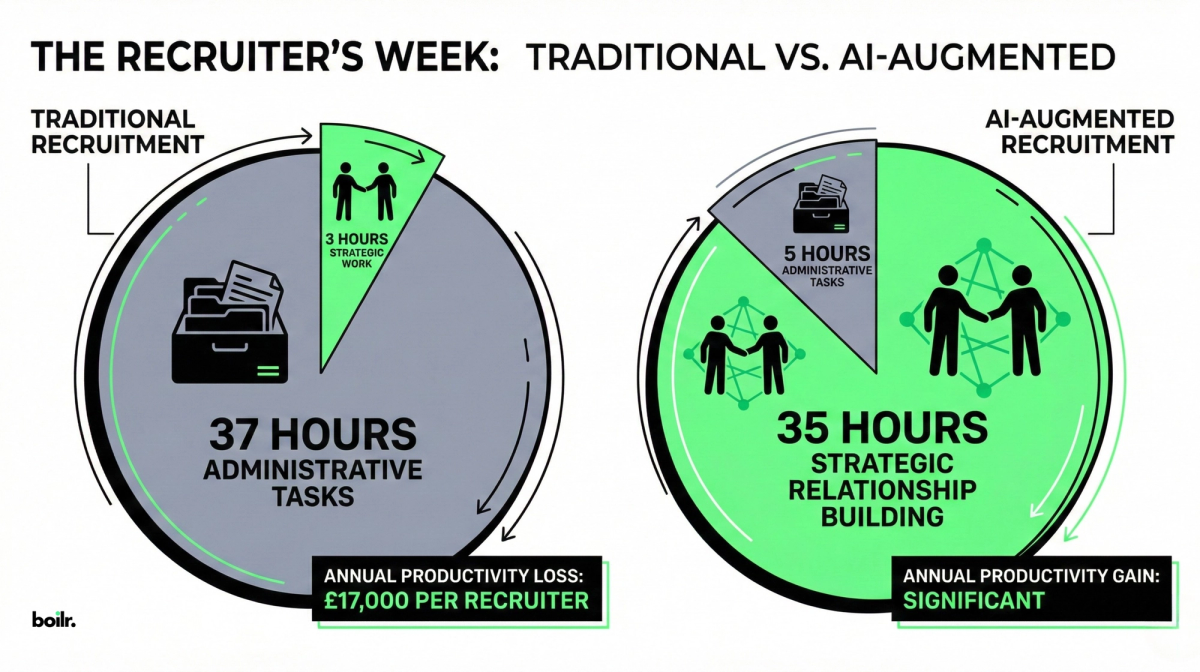
The following table illustrates the breakdown of this traditional time allocation and its operational impact:
This prevailing time distribution highlights a structural failure within the industry rather than a mere productivity issue among individual recruiters. When an agency receives 1,000 applications for a specific role, the manual screening process typically yields a 2% pass rate, resulting in 20 candidates being invited for further review. Ultimately, this funnels down to only about six actual interviews due to a standard 30% interview completion rate. Because manual screening requires human recruiters to evaluate documents at a rapid pace, 98% of candidates are effectively ignored, and highly qualified talent is frequently filtered out due to minor terminology discrepancies or non-traditional formatting.
Furthermore, this overwhelming administrative burden contributes to an extended average time-to-fill, which currently hovers between 44 and 48 days depending on the sector. The lack of bandwidth for consistent candidate communication leads to an epidemic of candidate ghosting, with 61% of job seekers reporting being ignored after interviews simply because recruiters lack the time to follow up and provide feedback. Economically, this inefficiency is devastating; analysts calculate that these administrative bottlenecks translate to an estimated £17,000 annual cost per recruiter in lost productivity. Consequently, 45% of business leaders report spending more than half of their working hours on talent acquisition administrative tasks, diverting crucial attention away from core business operations, strategic growth, and revenue generation.
Defining the B2B Sales Meaning in Talent Acquisition
To address these inefficiencies and effectively scale operations, recruitment agencies must conceptualize client acquisition through the rigorous lens of business-to-business (B2B) sales. The B2B sales meaning, in its fundamental economic definition, refers to the systematic process of one business identifying, engaging, and selling products or services to another corporate entity or organization, rather than to an individual consumer (B2C).
In the specific context of the recruitment sector, B2B sales translates directly to "Business Development" (BD) the proactive, strategic process of acquiring new employer clients, securing exclusive job orders, and establishing long-term preferred supplier agreements (PSAs). Understanding the B2B sales meaning is critical because the mechanics of selling recruitment services perfectly mirror the complexities of enterprise B2B software or consulting sales. The fundamental characteristics of this ecosystem dictate the required technological infrastructure.
The following table delineates the core differences between B2B and B2C paradigms, specifically illustrating how B2B dynamics govern recruitment business development:
Because recruitment business development involves navigating multiple stakeholders and extended decision-making processes, agencies cannot rely on passive, ad-hoc outreach. Securing a new client requires demonstrating how the agency's talent pipeline will directly impact the prospect's bottom line, reduce their time-to-market, and solve critical skills gaps. This complex environment necessitates sophisticated prospecting strategies that leverage both inbound marketing authority and highly targeted outbound execution.
The Prospecting Paradigm: Outbound vs Inbound Strategies
The strategic debate regarding outbound vs inbound prospecting is central to modern B2B sales and recruitment business development. Both approaches serve the ultimate goal of filling the sales pipeline with highly qualified leads, but they operate on fundamentally different mechanics, require different resource allocations, and yield distinct types of market engagement.

The Mechanics of Inbound Lead Generation
Inbound marketing is a customer-centric, pull-based strategy where the buyer initiates the sales interaction. Instead of interrupting potential clients with unsolicited pitches, agencies attract them organically by creating valuable, educational content tailored to the audience's specific pain points and industry challenges. Inbound tactics encompass search engine optimization (SEO), the publication of whitepapers, comprehensive salary benchmarking reports, educational webinars, and content-rich framework blogs.
The primary advantage of inbound lead generation is that prospects who reach out are already problem-aware and have established a preliminary degree of trust with the agency's brand. Because the prospect initiated the contact, the conversion friction is significantly lower. However, relying solely on inbound methodologies presents substantial strategic risks. Lead volume and quality can fluctuate unpredictably based on search algorithm updates or market seasonality. Furthermore, agencies are forced into a passive posture, waiting for prospects to discover them, which is not a viable strategy for organizations with aggressive revenue targets or those promoting highly specialized, newly developed recruitment services.
The Architecture of Outbound Prospecting
Conversely, outbound prospecting is a proactive, push-based, sales-led approach. In this model, the recruitment consultant or Business Development Representative (BDR) identifies target accounts that fit a precise Ideal Customer Profile (ICP) and initiates contact with potential buyers who may not yet be familiar with the agency. This involves sophisticated data gathering, building targeted prospect lists, and executing outreach via cold calling, personalized email sequencing, and professional networking platforms such as LinkedIn.
Outbound sales are inherently more aggressive and require substantial persistence, strong communication skills, and data-driven targeting to cut through the noise of a crowded market. While it demands significant upfront effort and technological infrastructure, outbound prospecting empowers recruitment agencies to exert total control over their pipeline. It allows firms to directly target high-value, enterprise-level accounts and bypass the waiting period intrinsically associated with inbound marketing.
In 2026, the landscape of outbound prospecting has evolved significantly. The era of mass, untargeted "spray and pray" cold emailing is effectively dead, penalized by strict email deliverability algorithms and sophisticated spam filters. Modern outbound strategies require meticulous domain warm-up periods (gradual sending over 2-3 weeks), strict adherence to authentication protocols (SPF/DKIM/DMARC), and rigid volume control limits. Outbound success is now predicated on signal-based outreach, where contact is triggered by real-time market events rather than arbitrary scheduling.
The Convergence: Hybrid Prospecting Models
Industry data dictates that the most effective B2B sales organizations do not choose between inbound and outbound; they integrate them into a cohesive hybrid model. Recent reports indicate that 43% of successful revenue teams blend inbound and outbound efforts within the same function, leveraging inbound content to build brand authority and trust, while deploying highly targeted outbound campaigns to secure immediate market share and penetrate named enterprise accounts. In this hybrid ecosystem, outbound efforts are significantly more successful because the prospect has likely encountered the agency's inbound content prior to receiving the cold outreach, thereby creating a warmer reception.
Architecting the "Framework Blog" for SEO and EEAT Authority
To successfully execute the inbound portion of the hybrid B2B sales model, recruitment agencies must adopt a highly structured approach to content creation, commonly referred to within digital marketing as a "framework blog."
A content framework is a defined, repeatable, and scalable workflow for planning, producing, and distributing digital content. It explicitly outlines the target audience, the core messaging pillars, the specific formats to be utilized, the distribution channels, and how each piece of content aligns with broader organizational revenue goals. Without a rigid framework, blogging and content marketing devolve into reactive, disjointed efforts. Content becomes random, topics are inadvertently duplicated, and the messaging fails to resonate with the target demographic, ultimately failing to generate measurable ROI or rank effectively on search engine results pages (SERPs).
The architecture of an effective framework blog typically follows a sophisticated funnel methodology, categorizing content to guide the prospect through the buyer's journey.
The following table illustrates the structural components of a comprehensive content marketing framework:
A prominent methodology utilized within these structured frameworks to ensure content quality is the LEMA framework an acronym for Logic, Explicitness, Memorability, and Actionability. Content built upon the LEMA framework ensures that complex market data is broken down logically, thesis statements regarding talent trends are explicit and novel, the narrative is deeply memorable through storytelling, and the hiring manager is provided with clear, actionable steps to improve their internal processes.
Furthermore, adhering to a framework blog structure is critical for establishing EEAT (Experience, Expertise, Authoritativeness, and Trustworthiness). Search algorithms increasingly prioritize content that demonstrates genuine, firsthand industry expertise. By publishing original research such as aggregating proprietary placement data to reveal true market salaries an agency transforms its website into a primary source of new data. This original research acts as a highly potent link-building mechanism; as other industry publications cite the agency's data, the site's Domain Authority increases, ensuring that highly competitive, commercial-intent service pages rank prominently in organic search results.
The "LLM Prospective": Adapting to Generative Search and Semantic Matching
The concept of the "LLM prospective" represents a dual-faceted technological shift that recruitment agencies must navigate. It encompasses both the optimization required for external marketing visibility and the internal operational utility of Large Language Models within candidate sourcing and matching algorithms.
From an external marketing and SEO perspective, traditional search engine algorithms are rapidly being augmented, and in some contexts replaced, by AI-powered answer engines and conversational LLMs (such as ChatGPT, Anthropic's Claude, and Perplexity). To maintain visibility and brand authority in this emerging digital ecosystem, a framework blog must be optimized not merely for specific keywords, but for deep semantic understanding. LLMs synthesize information by drawing complex connections across vast datasets; therefore, content must send clear, highly structured signals that AI models can parse effectively without human intuition. This evolution requires content creators to utilize clear hierarchical HTML headings, provide direct, concise answers to complex industry queries, and ensure a high density of factual, verifiable data. Content that is rambling, poorly structured, or lacking in authoritative citations will simply be bypassed by AI summarization engines, rendering the agency invisible to prospects utilizing these tools for vendor research.
Conversely, from an internal operational perspective, the "LLM prospective" dictates how modern recruitment agencies utilize these models to revolutionize candidate sourcing and data analysis. Legacy Applicant Tracking Systems (ATS) rely heavily on rigid, Boolean-based keyword matching. This antiquated approach is fundamentally flawed because it frequently filters out highly qualified talent who utilize different terminology, acronyms, or phrasing to describe identical skills.
LLMs possess the unique computational ability to process massive volumes of unstructured data including diverse resume formats, portfolio links, complex GitHub repositories, and disparate open-web footprints and synthesize this information into standardized, structured candidate profiles. An LLM can understand professional context, infer transferable skills across different industries, and accurately assess the true semantic relevance of a candidate's experience against a complex job requisition. By adopting an LLM prospective internally, agencies can uncover "hidden" candidates within their existing databases, significantly expanding their available talent pools without incurring additional acquisition costs. Furthermore, this semantic matching significantly reduces unconscious bias, as the model evaluates candidates based on observable capabilities and inferred competencies rather than superficial pedigree or specific institutional keywords.
The Ascent of Agentic AI in Autonomous Recruitment Operations
The integration of advanced LLMs has catalyzed a profound paradigm shift in recruitment technology: the transition from passive, assistive artificial intelligence to fully autonomous "Agentic AI." While standard generative AI creates text or analyzes static data based on direct, human-initiated prompts, Agentic AI operates autonomously to achieve predefined strategic goals. These systems are capable of making context-aware decisions, reasoning through obstacles, and executing complex, multi-step workflows with minimal to no human intervention.
Industry forecasts, including comprehensive analyses by Gartner and McKinsey, confirm that 2025 and 2026 mark the defining era for Agentic AI, projecting that 70% of enterprise organizations will operationalize autonomous AI systems designed to manage entire business functions. In the talent acquisition space, this evolution manifests as hyper-autonomous enterprise systems that orchestrate the entire recruitment lifecycle, moving far beyond mere task automation.
The following table details the evolutionary stages of workplace automation, culminating in the capabilities of Agentic AI:
Agentic AI systems fundamentally reshape how recruitment agencies operate by autonomously executing sophisticated processes:
- Autonomous Intelligent Sourcing: Instead of a recruiter manually running searches, an Agentic AI analyzes the nuances of a job requisition, independently queries massive platforms (accessing databases of over 750 million profiles), identifies the most promising candidates based on complex skill matrices and cultural fit indicators, and surfaces them directly into the ATS. The system continuously refines its search parameters based on the profiles that are ultimately progressed through the funnel.
- Proactive and Contextual Engagement: One of the most severe bottlenecks is maintaining consistent candidate communication. Agentic AI handles this by automatically sending personalized updates, answering complex candidate questions in real-time via natural language processing, and navigating the logistical nightmare of multi-party interview scheduling. This creates a seamless candidate experience from initial discovery through to the final offer, drastically reducing drop-off rates and eliminating the "ghosting" phenomenon.
- Dynamic Pre-Screening and Interview Intelligence: Agentic AI can conduct initial virtual interviews where the agent dynamically adjusts its line of questioning based on the candidate's real-time responses. Rather than following a rigid script, the AI probes deeper into specific technical competencies or behavioral indicators. Furthermore, these systems can join live video interviews, transcribe conversations, detect potential bias in the interviewer's questions, analyze cultural fit, and generate detailed, objective scorecards instantly.
- Always-On Workforce Planning: Agentic AI continuously scans both internal performance data and external labor market signals to forecast demand spikes, identify emerging skills gaps, and autonomously suggest adjustments to resource allocation models. This transforms workforce planning from a static annual exercise into a dynamic, real-time operational advantage.
By deploying multi-agent collaboration models where different specialized AI agents handle distinct domains such as sourcing, compliance, and outreach simultaneously agencies achieve an unprecedented level of operational scale and efficiency.
Predictive Signal Intelligence: The Ultimate Outbound Prospecting Advantage
While Agentic AI massively streamlines the candidate sourcing and screening side of the equation, the most significant disruption in recruitment agency revenue generation lies in client acquisition. Business development remains the most challenging aspect of agency growth, as competition for high-value clients is fierce. The traditional method of outbound prospecting relies heavily on monitoring decentralized job boards, LinkedIn pages, and corporate career sites for new vacancy postings.
However, this conventional approach contains a fatal strategic flaw: it is entirely reactive. By the time a job requirement is officially posted on LinkedIn or a public board, it is already public knowledge. Consequently, the hiring manager has likely already been inundated with outreach from three to five competing recruitment agencies. In the recruitment industry, business development is fundamentally a game of timing, and the first mover almost always secures the mandate.
This hyper-competitive environment has given rise to the deployment of predictive "Signal Intelligence." Signal intelligence platforms utilize advanced AI and machine learning to continuously monitor the vast expanse of the open web for leading indicators of organizational growth and hiring intent. These systems alert recruiters to emerging opportunities days, or even weeks, before a job is officially formulated and advertised by internal HR departments.
The Mechanics of Boilr.ai: A Case Study in Predictive Intelligence
A prime example of a specialized, enterprise-grade signal intelligence platform is Boilr.ai, a system architected explicitly for the unique operational needs of recruitment agencies. Unlike traditional sourcing tools that search the web for candidates to fill existing roles, Boilr functions as a highly sensitive "hiring radar" that searches for clients with emerging, unpublished needs.
The platform's efficacy is driven by its continuous Multi-Source Monitoring capability, which analyzes structured and unstructured data from over 10,000 distinct global sources. These critical data streams include:
- Venture capital funding announcements, series rounds, and financial press releases.
- LinkedIn organizational chart updates, departmental restructurings, and massive employee movements.
- GitHub repository activity, software commits, and subtle modifications to corporate technical stacks.
- Company career page code changes and aggregated employee reviews on platforms like Glassdoor.
- Government tender awards, contract wins, and updates within Vendor Management Systems (VMS).
By aggregating and synthesizing this vast array of unstructured data in real-time, the platform identifies actionable hiring signals 48 to 72 hours before a role becomes public knowledge. The intelligence generated by Boilr is meticulously categorized into four primary predictive signal types, each carrying specific actionable implications for the recruiter :
To ensure that high-performing sales teams are not overwhelmed by irrelevant data or false positives, signal intelligence platforms utilize robust Ideal Customer Profile (ICP) filtering mechanisms. Agency directors define their exact parameters target industry verticals, optimal company size, funding stage, technology stack, and geographic location only once. The system then autonomously filters the global noise, delivering only high-probability leads that match the agency's strategic focus.
Crucially, the output provided to the recruiter is not merely raw data or a generic notification that a company is hiring. Instead, the platform delivers highly contextualized, actionable intelligence. The system provides the specific hiring manager's verified contact details, the underlying macroeconomic or structural reason for the hire (e.g., a recent Series A round), and the specific technical stack requirements derived from GitHub. Armed with this profound context, a recruiter can execute a perfectly timed, hyper-personalized cold call or sequence of emails. By referencing the specific trigger event, the recruiter secures an exclusive engagement before the client's internal HR team is fully mobilized or competing agencies even become aware of the organizational need.
Competitive Ecosystem: An Exhaustive Analysis of Recruitment Tech
To architect an optimal, high-performing technological stack, agency leaders must understand that no single software platform performs all functions perfectly. The promise of an "all-in-one" system often results in compromised functionality across various specialized domains. Instead, the modern recruitment technology market is highly segmented into distinct, interoperable categories: Systems of Record (ATS/CRM), Workflow and Outreach Automation, Candidate Sourcing/Matching, and Predictive Signal Intelligence.
The following sections provide an exhaustive comparative analysis of the leading platforms dominating the industry in 2026: Boilr.ai, SourceWhale, Sourcebreaker, Paiger, Bullhorn, and Vincere.
1. The Systems of Record: Bullhorn vs. Vincere
These platforms serve as the foundational infrastructure of the recruitment agency the central database where all candidate profiles, client communications, financial forecasting, and placement data securely reside. They are the operational hubs that connect all other peripheral tools.
Bullhorn: Bullhorn is universally recognized as the legacy market leader in the ATS/CRM space. It provides a massive, end-to-end solution primarily tailored for large, multinational enterprise agencies and high-volume staffing firms, managing the entire lifecycle from initial requisition to final payroll and placement. Its primary strategic strength lies in its unparalleled partner ecosystem; the Bullhorn Marketplace boasts over 100 deep integration partners, allowing highly customized, albeit complex, technological environments. However, user feedback and implementation analyses frequently point to a highly complex user interface and a steep learning curve for new recruiters. Furthermore, Bullhorn often relies on these third-party integrations for advanced reporting (e.g., utilizing Cube19 for analytics) or specialized candidate and client portals.
Vincere (Access Vincere Evo): Vincere explicitly positions itself as a modern, agile "Recruitment Operating System" built specifically for high-performing, mid-sized agencies that require speed and out-of-the-box functionality. It differentiates itself aggressively from Bullhorn through a suite of natively built, highly innovative features that do not require third-party add-ons. Key differentiators include the "AI Coach" a proprietary dashboard that crunches the last 12 months of agency performance data to autonomously prescribe daily activity targets for individual consultants and the LiveList™ client collaboration portal. The LiveList™ is a native feature that allows recruiters to bypass email attachments, sending interactive, branded digital dashboards containing sleek candidate profiles, embedded video interviews, and secure compliance documents directly to clients. The system provides real-time push notifications the exact second a client views the list, enabling immediate, high-conversion follow-up. Vincere acts as the ultimate workflow manager, organizing complex processes seamlessly without the integration friction often associated with legacy systems.
2. Candidate Sourcing and Scraping: Sourcebreaker & Paiger
These sophisticated tools sit technologically above the CRM, specifically designed to scour the market to find and engage talent, or to automate the complex process of recruitment marketing and candidate presentation.
Sourcebreaker: Sourcebreaker is primarily a powerful candidate sourcing and advanced Boolean search platform. It utilizes state-of-the-art web scraping technology and semantic parsing algorithms to extract data from over 50 disparate online job boards and corporate career pages with an accuracy rate exceeding 95%. Features like the "Lead Scanner" automatically monitor these third-party platforms for active, live job postings, allowing recruiters to instantly cross-reference and match their existing, internal candidate pool to newly published external requirements. It also features an integrated "Email Finder" that equips recruiters with verified contact details for hiring managers directly within the platform, eliminating the need to exhaust expensive LinkedIn InMail credits. While exceptionally effective at identifying active market movements and consolidating candidate data into actionable lists, Sourcebreaker remains fundamentally reactive it processes and matches roles that have already been published and are actively being worked by competitors.
Paiger: Paiger occupies a different niche, operating as a specialized talent matching, brand amplification, and recruitment marketing platform. Its core functionality revolves around a feature termed "Candidate Marketing," which allows recruiters to rapidly build highly formatted, anonymized "spec CVs" using advanced AI. This system automatically removes biases, corrects formatting, and generates highly personalized outreach copy to send these top-tier candidates to prospective clients. Furthermore, Paiger heavily aids in corporate and personal branding by automating strategic social media sharing across networks and drafting optimized, error-free job advertisements tailored to specific platforms. While the platform does provide basic vacancy alerts and broad market intelligence, its primary, high-ROI utility lies in marketing premium candidates effectively and amplifying the agency's digital brand presence to attract inbound interest.
3. Workflow and Outreach Automation: SourceWhale
SourceWhale: SourceWhale functions as a relentless execution engine. It is crucial to understand that it does not act as a primary database, nor does it independently scrape the web to discover net-new companies to target. Instead, it is a highly sophisticated outreach automation, engagement, and sequencing platform. SourceWhale empowers recruiters to build complex, multi-channel business development and candidate nurturing campaigns, flawlessly orchestrating sequential touchpoints across email, LinkedIn messages, phone calls, SMS, and WhatsApp. It integrates deeply with primary CRMs (like Vincere or Bullhorn) to ensure every interaction is logged without manual data entry. Furthermore, it utilizes AI to hyper-personalize messaging at scale for example, automatically referencing a prospect's recent podcast appearance, university alumni status, or specific geographic location in the opening line of an email. It meticulously manages follow-up cadences to ensure that leads never fall through the cracks due to human error. Essentially, SourceWhale flawlessly executes the campaign; however, it requires an external data source to instruct it exactly who to target and contact.
4. Predictive Signal Intelligence: Boilr.ai
Boilr.ai: As previously detailed, Boilr occupies a highly unique, emerging category: predictive lead generation and signal intelligence exclusively for proactive business development. It is entirely focused on identifying client hiring needs before they materialize on job boards or trigger a Sourcebreaker scrape. Boilr provides the highly targeted, early-stage data and the contextual "why," serving as the ultimate top-of-funnel feeder system that gives agencies their first-mover advantage.
Comprehensive Competitor Analysis Matrix
The following table synthesizes the core differences, functional focus, and technological synergies of the analyzed platforms:
This comparative matrix highlights a critical strategic reality: these tools are not mutually exclusive competitors; rather, they are highly complementary components of a holistic digital ecosystem. The most advanced, high-revenue recruitment technology stack in 2026 utilizes Boilr.ai to identify hidden market signals and secure the first-mover advantage, feeds those highly qualified contacts into SourceWhale to execute automated, relentlessly personalized outreach, uses Sourcebreaker to quickly identify the perfect candidate from the broader web to fill the newly acquired role, utilizes Paiger to market that candidate brilliantly, and relies on Vincere or Bullhorn to seamlessly manage the compliance, interview stages, and final financial billing.
Quantifying the ROI: Financial and Temporal Efficiency Gains
The strategic implementation of automated recruitment systems, encompassing both agentic candidate screening and predictive signal intelligence for business development, yields profound operational efficiencies that directly translate to massive financial returns. The data indicates that technology investments in this sector are no longer discretionary; they are the primary drivers of agency scalability and profitability.
By systematically eliminating the manual processes that traditionally consume 37 hours of the workweek, agencies report transformative shifts in productivity. Broad AI adoption enables standard recruiters to save an estimated 17 hours per week, with 4.5 hours saved on rudimentary searching alone. However, in the specific context of Boilr.ai's signal intelligence applied to business development, the impact is exceptionally stark. Weekly administrative time dedicated to lead generation and market mapping plummets from an arduous 13 hours to just 1 hour representing an unprecedented 92% reduction in non-billable time.
This massive reclamation of temporal bandwidth allows recruiters to fundamentally alter their daily workflow, reallocating their efforts toward high-value, strategic tasks: consulting intimately with clients, negotiating complex compensation packages, and building authentic, long-term relationships with passive talent.
The quantitative improvements derived from this technological shift directly correlate with accelerated revenue generation across multiple KPIs:
The financial implications of these metrics are profound. When agencies utilize automation to reduce their time-to-fill by a full seven days (e.g., dropping from 48 to 41 days) and decrease their reliance on expensive, external job board advertising, the cost-per-hire drops significantly. Given that the average cost to hire in the US is approximately $4,000, recovering thousands of dollars in recruiter productivity and accelerating placement velocity is a primary driver of agency profitability. Furthermore, software investments in platforms like Boilr demonstrate an exceptionally rapid payback period, frequently achieving full ROI in as little as 6 weeks.
Strategic Implementation Framework for 2026
To capitalize on these technological advancements and maximize the quantified ROI, recruitment leaders must adopt a highly systematic approach to implementing an automated, AI-driven business development framework. The strategy requires aligning cutting-edge technology with rigorous human operational discipline.
Phase 1: Defining the Ideal Customer Profile (ICP)
Automation operates as a multiplier; it amplifies whatever process it is applied to. Therefore, applying rapid automation to a poorly defined target market results only in highly efficient spam, damaging domain reputation and brand equity. Success in outbound prospecting begins with a rigorous, analytically defined Ideal Customer Profile (ICP). Agencies must move beyond basic firmographics (e.g., targeting "Tech companies in London") to highly specific, granular parameters: funding stage, specific technology stack requirements, growth trajectory, and precise geographic footprint. This refined ICP is then programmed directly into signal intelligence platforms like Boilr to categorically eliminate noise and ensure only high-probability, high-margin leads enter the sales pipeline.
Phase 2: Architecting the Tech Stack for Interoperability
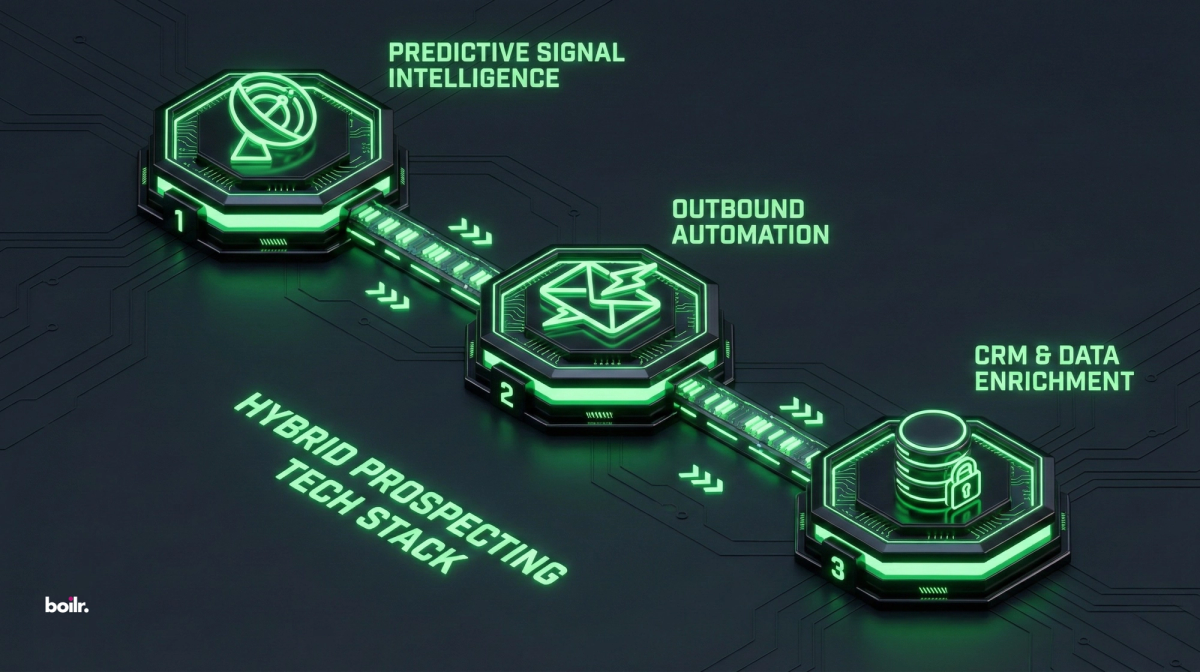
Agencies must avoid purchasing siloed software solutions. The modern tech stack must be architected to allow data to flow seamlessly across functional layers.
- The Intelligence Layer: Deploy signal intelligence (Boilr.ai) to continuously scan the global market for specific trigger events (e.g., funding rounds, office expansions).
- The Orchestration Layer: Automatically route these high-intent leads via API integrations into a dedicated outreach platform (SourceWhale).
- The Action Layer: Utilize embedded Agentic AI to draft hyper-personalized messaging that directly references the specific market signal (e.g., "I noticed the £6M Series A close and the appointment of your new VP of Engineering assuming you are now scaling the React team, we have three fully vetted developers ready for immediate deployment.").
Phase 3: Integrating Human Empathy with AI Efficiency
The overarching philosophy of technology implementation in recruitment should be to augment, not replace, human interaction. While AI can autonomously handle massive data scraping, complex resume parsing, semantic candidate matching, and initial multi-channel email outreach, the closing of a B2B sale remains a fundamentally human endeavor requiring empathy and nuance.
Despite the widespread adoption of AI tools, 93% of hiring managers explicitly emphasize the critical importance of human involvement in the final hiring and negotiation processes. Furthermore, statistical analysis of outreach campaigns demonstrates that incorporating a human phone call into a multi-channel automated sequence increases the likelihood of booking a client meeting by 56%. This conversion rate experiences a further 37% increase if the human call occurs within 24 hours of the prospect engaging with an automated email.
Therefore, the ultimate strategic objective is to utilize automation to clear the administrative bottleneck reducing the 37 hours of manual data entry and searching down to a mere fraction so that recruiters can spend 80% of their time on the phone or in video conferences. By dedicating their reclaimed time to building genuine rapport, negotiating complex compensation packages, and acting as trusted, strategic talent advisors to their clients, recruiters elevate their role from transactional administrators to indispensable business partners.
Conclusion
The recruitment industry in 2026 is defined by a stark operational dichotomy: the intense economic pressure to reduce costs and accelerate time-to-hire, juxtaposed against the increasingly complex demands of acquiring highly specialized talent and navigating sophisticated B2B sales cycles. The traditional methodologies, characterized by reactive job board monitoring, massive decentralized applicant pools, and labor-intensive manual administration, are mathematically and economically unsustainable in this environment.
The strategic implementation of automated recruitment systems resolves this structural deficit. By transitioning from passive candidate databases and static workflows to Agentic AI models that autonomously execute complex sourcing and engagement protocols, agencies can reclaim thousands of hours of lost productivity. Furthermore, by shifting business development strategies away from reactive inbound waiting or blind outbound spamming, and toward predictive signal intelligence, recruitment firms gain an insurmountable first-mover advantage in acquiring lucrative employer clients.
Platforms that detect actionable hiring signals 48 to 72 hours before public advertisement fundamentally alter the competitive dynamics of client acquisition. When combined with rigorous ICP targeting, multi-channel outreach automation, and strategic content marketing frameworks optimized for semantic LLM parsing, these technologies do not merely accelerate existing processes they redefine the absolute capacity of the modern recruiter. The future of talent acquisition and agency growth belongs unequivocally to the organizations that successfully fuse the hyper-efficiency and predictive power of artificial intelligence with the irreplaceable nuance, empathy, and negotiation skills of human relationship building.
FAQs
- What is the meaning of B2B sales in the context of a recruitment agency? In the recruitment industry, B2B (business-to-business) sales refers to the strategic process of an agency identifying, engaging, and selling its talent acquisition services to other corporate entities rather than individual consumers. Unlike B2C transactions, B2B recruitment sales involve navigating complex buying committees (such as HR directors and C-suite executives), managing longer sales cycles, and focusing heavily on demonstrating a clear Return on Investment (ROI) to secure high-value contracts.
- What is the difference between outbound vs inbound prospecting? Inbound prospecting is a pull strategy focused on attracting potential clients organically by creating valuable, educational content such as SEO-optimized framework blogs, industry reports, and webinars. Outbound prospecting, on the other hand, is a proactive push strategy where recruiters identify target accounts matching their Ideal Customer Profile (ICP) and initiate direct contact through cold calling, email sequencing, and networking. While inbound marketing builds long-term brand authority, outbound sales provide immediate, highly targeted access to decision-makers; consequently, combining both into a hybrid model is often the most effective strategy for sustainable pipeline growth.
- Exactly how much time do recruiters save by using automated systems? Traditional recruitment workflows are highly inefficient, with recruiters spending up to 37 hours of a standard 40-hour workweek on manual administrative duties, resume screening, and sourcing. By adopting advanced AI and automation systems, firms predict that recruiters can save up to 17 hours per week, including reclaiming 4.5 hours a week previously wasted on manual searching alone. For business development specifically, tools utilizing signal intelligence can reduce the administrative time spent hunting for leads from 13 hours down to just 1 hour per week.
- What is predictive signal intelligence, and how does it improve prospecting? Predictive signal intelligence uses AI to continuously monitor thousands of data points across the web such as new funding rounds, corporate expansions, leadership changes, and technical stack updates to identify when a company is about to scale its workforce. Platforms like Boilr.ai aggregate these signals to alert recruitment agencies 48 to 72 hours before a job requirement is officially advertised to the public. This provides recruiters with a critical first-mover advantage, allowing them to pitch their services to hiring managers before internal HR teams are overwhelmed or competing agencies are even aware of the need.
- What is a "framework blog" and why is it important for recruitment marketing? A framework blog is a highly structured, strategic approach to content creation that dictates how digital content is planned, organized, and presented to support specific business objectives. Instead of publishing random articles, a framework ensures that every piece of content targets specific SEO keywords, addresses distinct pain points in the buyer's journey, and maintains a consistent brand identity. This structured system helps recruitment agencies build topical authority, rank higher on search engines, and successfully drive inbound leads.