AI Agents for Recruitment Agencies: What They Actually Do in 2026
A practical, recruiter-first guide to AI agents in 2026 - BD agents, sourcing agents, ops agents, and how to adopt them without breaking the desk.

TL;DR
Recruitment agencies spent 2023 to 2025 testing AI features bolted onto existing tools. 2026 is the year agents move from novelty to production - running business development, sourcing, and operations in the background while consultants focus on calls and placements.
The short version
- AI agents pursue goals end-to-end - not just drafts or summaries, but full workflows like "find me 20 qualified hiring companies this week and surface the decision-makers".
- Three categories matter for agencies - BD agents (client discovery), sourcing agents (candidates), and ops agents (admin, CRM sync, comms).
- Over half of employers plan to use autonomous AI recruiters in 2026, reshaping how agencies need to pitch their value.
- The winning play is stacked - keep human judgement on qualification and delivery, let the agent handle everything upstream of the conversation.
- Start narrow - one workflow, one agent, one measurable outcome. Do not try to replatform the whole desk at once.
Why Agents, Why Now
Four forces converged between late 2024 and early 2026 to make agentic software viable for recruitment agencies. None of these were true even 18 months ago.
- Long-context reasoning models - Claude, GPT, and Gemini families now handle hundreds of thousands of tokens at once, so an agent can read a whole company website, a funding announcement, and a LinkedIn profile before deciding to act.
- Tool-use and function calling - agents can call APIs, browse the web, query CRMs, and send emails in structured loops, not just output text.
- Cheap inference - the cost per agent cycle has dropped by more than an order of magnitude since 2023, making always-on monitoring economic for even small desks.
- Market pressure on agencies - fee compression, internal TA teams going direct, and rising SaaS costs mean agencies need operational leverage to maintain margin. Agents are the cheapest way to buy that leverage.
- Recruiter demand - consultants increasingly refuse to do manual list-building when they know a tool could do it. Retention of senior billers now partly hinges on the quality of the agent stack.
Signal: Gartner projects that by 2028, 33% of enterprise software applications will include agentic AI - up from less than 1% in 2024 - and that AI agents will autonomously make at least 15% of day-to-day work decisions.
Source: Gartner press release, October 2024
The recruitment industry has always adopted enterprise tech late - but this cycle is different because the incremental cost is so low and the competitive cost of ignoring it so high. Agencies ignoring agents in 2026 are giving their competitors a 40-60% research productivity gap to exploit. That gap shows up in meetings booked, briefs won, and roles filled.
Agent vs Chatbot vs Copilot
The word "AI" covers three very different product categories. Most of the confusion in the recruitment market comes from vendors using "agent" when they actually ship a chatbot or a copilot. The difference matters for what you can trust it to do unsupervised.
| Dimension | Chatbot | Copilot | AI Agent |
|---|---|---|---|
| Trigger | User question | User action in a tool | Goal + schedule |
| Scope | Single answer | Single document or step | Multi-step workflow |
| Data access | Prompt context only | Host tool's data | Multiple external sources |
| Action | Text output | Suggestions | Reads, decides, writes, actions |
| Runs when you sleep | No | No | Yes |
| Recruitment example | "Write me a BD email" | CRM auto-complete for notes | Monitor ICP, surface leads, draft outreach |
When each one is right
- Chatbot - right for one-off research, phrasing help, explaining a contract clause. Low stakes, conversational.
- Copilot - right inside a tool you already use heavily (ATS, CRM, inbox) to accelerate individual tasks.
- Agent - right for goals that repeat, span systems, and need to run continuously. BD monitoring, sourcing, triage, and pipeline hygiene all fit.
The practical test is simple: can the tool complete the job without you in the seat? If yes, it is an agent. If no, it is a copilot or a chatbot regardless of the marketing page. This also explains why agencies moving from copilots to agents report a step-change in productivity - not because the model got smarter, but because the agent removes the bottleneck of needing a human to trigger every cycle.
What AI Agents Actually Do in a Recruitment Agency
Recruitment work breaks into three economic buckets - winning clients, sourcing candidates, and running operations. Each bucket now has a mature agent pattern. The pattern is what matters; vendor choice sits on top of it.
| Bucket | Goal the agent pursues | Inputs it reads | Outputs it produces |
|---|---|---|---|
| BD agent | Find new qualified clients continuously | Job boards, career sites, funding news, LinkedIn, company data | Ranked account list with signals, decision-maker contacts, draft outreach |
| Sourcing agent | Find and rank candidates for an open brief | CVs, LinkedIn, GitHub, profile aggregators | Shortlist with fit scores, outreach drafts, availability signals |
| Ops agent | Keep the desk clean and responsive | Email, calendar, CRM, ATS | Meeting summaries, CRM updates, follow-up reminders |
Most agencies start with the bucket that hurts most. In 2026, that bucket is overwhelmingly BD - because the AI-driven hit to candidate sourcing has been building for years, while BD automation is the newer, less-saturated opportunity. Agencies that already have hiring signal workflows - and understand how to identify hiring signals - get the fastest lift.
The BD Agent: Finding Clients Before Competitors
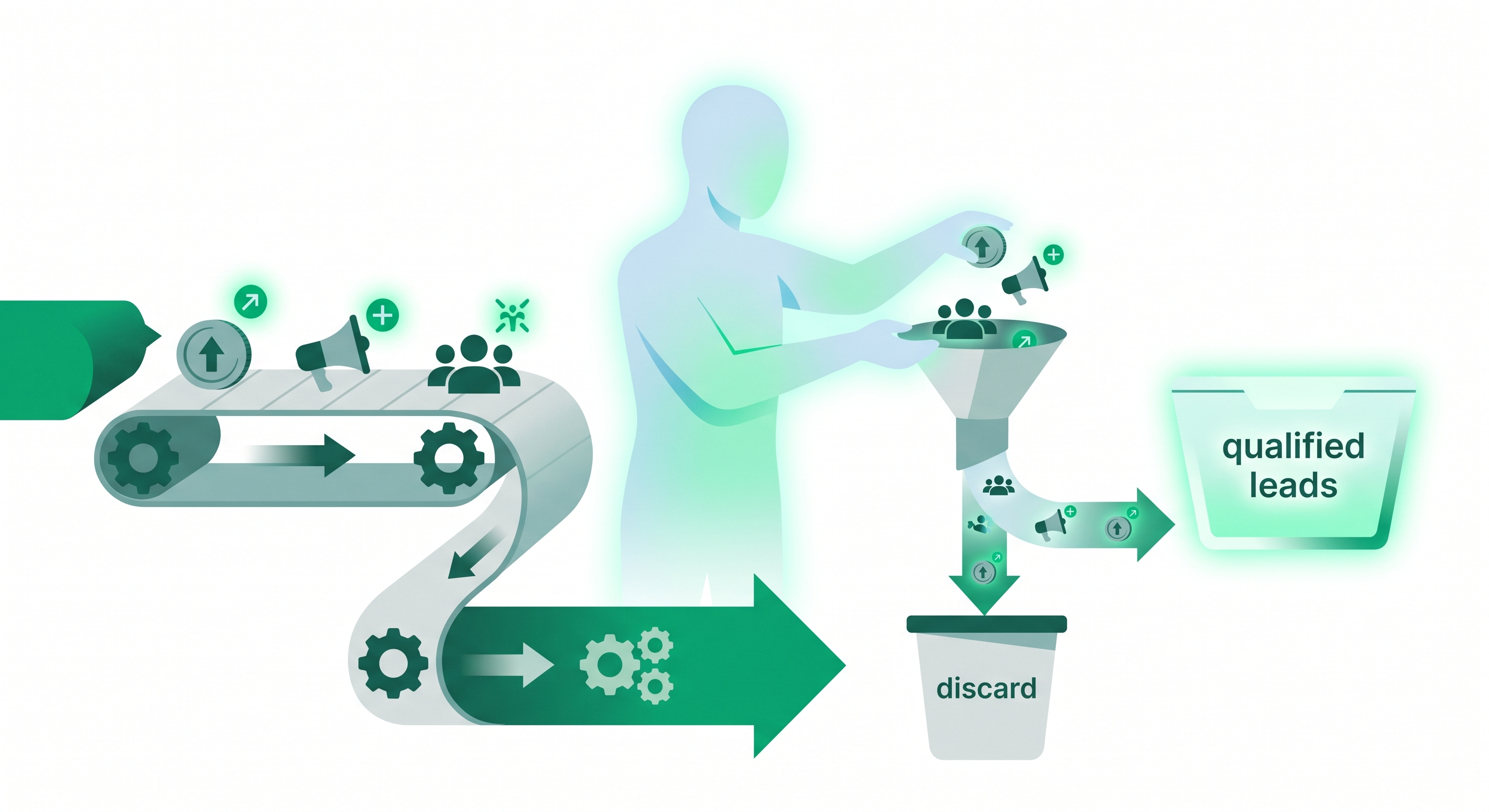
A BD agent is software that continuously watches the market for hiring intent, filters against your ideal client profile, enriches the winners, and hands them to a consultant as a warm starting point. It is the biggest structural unlock in agency BD since the email address.
The BD agent loop
- Perceive - ingest public data: job boards, funding announcements, executive moves, expansion news, career pages, competitor mentions.
- Filter - score every event against your ICP rules (industry, headcount, region, tech stack, fee model).
- Enrich - resolve each qualifying account into a company profile plus 1-3 decision-makers.
- Prioritise - rank by recency and signal strength (funding + new role at the hiring VP level beats a single old job post).
- Surface - push the top N items to Slack, email, or the CRM before the working day starts.
- Close the loop - observe which signals get contacted, replied to, or won, and improve the ICP model.
The old BD day vs the agent BD day
- Old - 08:00 open LinkedIn, scroll funding news, copy companies into a sheet, try to find the hiring VP, draft a LinkedIn message, repeat 30 times. Most of the morning gone, 25 unqualified conversations started.
- Agent-driven - 08:00 open Slack, see 12 pre-qualified accounts with signals and decision-makers attached. Decide who to call. Spend the morning in actual conversations instead of research.
Why timing beats volume in 2026
The gap between a role appearing publicly and the first agency landing a phone call has collapsed from weeks to hours. The first agency to reach a hiring manager with a relevant, timely message now wins a disproportionate share of briefs. Agents compress that gap to minutes. This is why agencies serious about growth now treat timing as the main BD lever, not volume.
BD agent as a category
Pros
- Removes manual research - consultants skip list-building entirely.
- Compresses response time - first-agency advantage on new briefs.
- Works 24/7 - does not miss signals overnight or on weekends.
- Scales with ICP, not seats - narrower ICP = sharper output, regardless of headcount.
- Improves over time - feedback loops sharpen the ICP model.
Cons
- Requires disciplined ICP - garbage ICP, garbage leads.
- Can flood a desk - needs alert thresholds to stay usable.
- Does not close - still needs humans to build trust and qualify.
- Data gaps outside public web - struggles on private or stealth companies.
"The best BD agent is the one that makes your Monday morning shorter, not your dashboard busier. If it adds to your to-do list, it is just another tool - not an agent."
- Felix Hermann, Cofounder @ Boilr
The Sourcing Agent: Finding and Ranking Candidates
Sourcing was the first part of recruitment to get AI. Long-context LLMs and profile aggregators now let an agent read a brief, build a boolean-free search across the open web, return a ranked shortlist, and draft outreach - all inside minutes.
What the sourcing agent does well
- Interpret a brief in plain English - replaces boolean gymnastics with natural-language instruction.
- Search across sources at once - LinkedIn, GitHub, Stack Overflow, portfolio sites, conference speaker lists, paper repositories.
- Score fit against the brief - with transparent reasoning attached to every score.
- Surface availability hints - tenure length, recent role change, engagement signals.
- Draft first-touch outreach - based on the candidate's work and the brief's specifics, not a generic template.
- Handle diverse pools - less prone than boolean to missing non-standard titles or career pivots.
Where the sourcing agent still fails
- Weak at soft qualification - cannot read body language in a call.
- Narrow markets - in super-niche segments, agents sometimes return low-relevance shortlists.
- No access to closed networks - private communities, alumni groups, referrals still need humans.
- Over-indexes on public signals - brilliant but quiet candidates can slip through.
Sourcing agent as a category
Pros
- Shortens time-to-shortlist - hours, not days.
- Reduces bias in first pass - structured scoring beats gut instinct.
- Scales to many briefs - no linear headcount dependency.
- Personalises outreach at scale - from candidate work, not templates.
Cons
- Cannot replace human qualification - the call still matters.
- Weak in super-niche markets - small signal base.
- Overlaps with existing tools - integration risk with ATS/CRM.
- Can inflate shortlists - needs human cut-off discipline.
The Ops Agent: Admin, CRM Hygiene, Communication
Recruitment desks lose 20-30% of a consultant's week to admin: call notes, CRM updates, meeting summaries, follow-up reminders, inbox triage, and status reporting. Ops agents are the quietest win in the stack because they do not add anything visible - they just remove hours.
Where an ops agent earns its keep
- Call transcription and summary - written notes inside the CRM within minutes of hanging up.
- Follow-up scheduling - time-bound next-actions flagged without human input.
- Inbox triage - inbound replies sorted by urgency, intent, and deal stage.
- CRM data hygiene - missing fields, duplicate records, stale stages cleaned automatically.
- Daily briefing - a personal digest that pulls pipeline, hot signals, and scheduled meetings into one morning view.
- Weekly reporting - activity breakdown that writes itself instead of taking Friday afternoon.
The 2026 AI Agent Tool Landscape
The market splits into three tiers. Knowing which tier a vendor sits in prevents mismatches - an enterprise TA platform is wasted on a 5-person boutique, and a lightweight agent cannot replace an enterprise ATS.
| Tier | Bucket | Example vendors | Best fit |
|---|---|---|---|
| BD / Discovery | Client-side agents | Boilr, Loxo Outbound, Paiger | Agencies prioritising client growth |
| Sourcing / Talent | Candidate-side agents | hireEZ, Beamery, Findem, SeekOut, Juicebox | High-volume or technical sourcing teams |
| Candidate experience | Conversational agents | Paradox (Olivia), Sense, Fountain | Volume / frontline hiring |
| Ops / Intake | Summary and CRM agents | Metaview, BrightHire, Ashby AI | Teams that live in calls and ATS |
| Platform AI | Built-in assistants | Bullhorn Copilot, Vincere AI, Recruiterflow AI | Agencies wanting single-vendor stack |
A common mistake is picking a "platform AI" assistant because it is bundled with the ATS and expecting it to perform like a specialist BD or sourcing agent. Bundled assistants are copilots - useful inside the tool, not autonomous across the desk. For comparison context on tool choices, see our recruiter-first breakdown of AI tools in 2026.
How to Adopt AI Agents Without Breaking the Desk
Most agent rollouts fail for the same reason: the agency tries to change too much at once. Pick one workflow, one agent, one outcome metric. Add a second only when the first is boring and invisible.
- Pick the most painful workflow - the one that costs the most consultant hours and contributes least to revenue.
- Write the ICP in plain English - industry, headcount, region, tech, fee model, excluded patterns. The agent can only be as sharp as this.
- Choose a single agent vendor - one that fits the specific bucket (BD, sourcing, ops). Do not layer three at once.
- Define a hard success metric - meetings booked per week, briefs won per month, time saved per consultant.
- Run a 30-day pilot - one or two desks, hard kill date, weekly review.
- Remove the manual workflow it replaces - do not run both in parallel forever; the agent only wins if the old process dies.
- Feed back into the model - reply data, closed-won data, lost-signal data all sharpen the next cycle.
- Document the rules the humans keep - qualification calls, negotiations, difficult client conversations. These stay with consultants.
- Train the team on how to use it - adoption dies fast if the team treats the agent as a side tool.
- Review monthly, not quarterly - agent tech moves fast, so your setup needs to move fast too.
30-day pilot checklist
- Pilot desk chosen - one, not five.
- ICP documented - not in someone's head.
- Baseline metrics captured - meetings, replies, hours per week.
- Kill date set - 30 days, no extensions without evidence.
- Weekly review meeting - 30 minutes, same attendees.
- Rollback plan - clear if-this-then-that kill criteria.
How Boilr Works as a BD Agent
Boilr is purpose-built as a BD agent for recruitment agencies. It runs two continuous loops - Discovery and Signals - across more than 10,000 public sources, delivering qualified clients to consultants instead of making them go looking for leads. Under the hood it combines public web monitoring, ICP filtering, firmographic enrichment, and decision-maker resolution.
Boilr in 10 features
- Always-on discovery - continuous monitoring of career pages, funding rounds, leadership moves, and expansions against your ICP.
- Real-time signal alerts - funding, job posts, exec moves, competitor activity delivered to Slack, email, or CRM.
- ICP-native filtering - role, seniority, geography, tech stack, headcount - all as first-class filters, not tags.
- Decision-maker enrichment - every account resolves to the right hiring manager or people leader, not a general switchboard.
- Intent scoring - accounts ranked by recency and signal strength, not static firmographics.
- CRM + ATS integrations - one-click export of enriched contacts and signals into Bullhorn, Loxo, and modern agency CRMs.
- Per-desk configuration - each consultant or desk can run its own ICP and signal rules.
- Competitor watchlists - track competitor client moves, fundings, or PR to catch vulnerable relationships.
- Morning signal feed - consultants open the day with a ranked, digestible list of warm BD openings.
- Rapid onboarding - live signal feed within 48 hours of initial ICP configuration.
Boilr vs generic BD tools
| Capability | Boilr | Apollo / Generic sales tools | ATS built-in AI |
|---|---|---|---|
| Recruitment-native ICP | Yes | No | Partial |
| Hiring-signal monitoring | Yes, 10k+ sources | No | Limited |
| Decision-maker enrichment | Hiring-manager grade | Generic contact data | No |
| Runs without human trigger | Yes | No | No |
| Works with existing CRM/ATS | Yes | Partial | Same vendor only |
| Pricing fit for small agencies | Yes | Yes | Often no |
Boilr - honest pros and cons
Pros
- Built for recruitment - not a sales tool repurposed.
- 24/7 signal engine - nothing slips overnight.
- Decision-maker grade - hiring VPs, not switchboards.
- Per-desk configurable - one platform, many ICPs.
- Fast onboarding - live feed in under 48 hours.
Cons
- Newer to market - smaller install base than Bullhorn or hireEZ.
- Not an ATS - pairs with, does not replace, your system of record.
- Focused on public web - private or stealth companies underrepresented.
- Needs a clear ICP - vague inputs produce vague outputs.
Agencies using Boilr typically pair the Discovery agent with their existing ATS (Bullhorn, Loxo, Vincere, JobAdder, Recruiterflow) and keep human qualification as the next step. This pattern - agent upstream, human downstream - is the pattern winning in 2026. For a fuller picture of hiring-intent workflows, see how to qualify hiring intent and how to find companies that are actually hiring.
Risks, Limits, and Where Agents Still Fail
AI agents are useful, not magic. Knowing where they break saves you from embarrassing mistakes and helps you spot vendor claims that are too clean to be true.
- Hallucinated contact data - cheap enrichers sometimes invent emails or titles. Insist on verified, traceable sources.
- Signal inflation - vendors count anything as a signal to pad numbers. Demand a taxonomy and hard thresholds.
- Over-reliance - consultants stop building relationships because the feed feels like enough. The feed is not enough.
- Data drift - ICP rules go stale as markets move. Review every 4-6 weeks.
- Regulatory risk - GDPR, state-level US data laws, and EU AI Act categorisations evolve quickly. Keep a sub-processor list on file.
- Homogenised outreach - if every agency sends agent-drafted messages, raw output stops standing out. Human editing is mandatory, not optional.
- Integration debt - four unconnected agents in four tabs is worse than one. Prefer tools with clean CRM/ATS integration.
- Vendor lock-in - proprietary scoring and enriched data that cannot be exported kills optionality.
Red flag: Any vendor that shows you a dashboard but cannot demonstrate the agent completing a full cycle (perceive → decide → act) on your own ICP is selling a data product with AI branding.
9 Real-World Scenarios
How this plays out on actual desks.
- UK tech-contract agency, 12 consultants - BD agent surfaces 8 new Series A companies with senior engineering hires each week. Meetings booked per consultant rises from 2 to 5 within 60 days.
- German Mittelstand engineering desk - sourcing agent finds passive senior engineers at competitor plants following a restructuring signal. Time-to-shortlist falls from 10 days to 3.
- Boutique fintech exec search - ops agent transcribes and summarises 30+ monthly client calls. Consultants recover one working day per week in admin time.
- US healthcare staffing firm - BD agent watches for new clinic openings and health system expansions. Consultants contact the TA lead within 48 hours of the PR release.
- Niche climate-tech agency - agent configured to monitor climate-tech funding rounds across 14 micro-verticals. New briefs per month doubles.
- Franchise-model generalist - signal feed configured per desk, rather than centrally. Individual consultants own their ICP, agency-level reporting rolls up cleanly.
- UK professional services desk - agent spots when mid-market accounting firms raise private equity - a reliable proxy for aggressive partner hiring.
- Continental European tech - agent tracks hiring velocity trends across DACH scale-ups, identifying accounts quietly accelerating before anyone announces a raise.
- Australian commercial agency - after piloting for 30 days, replaces two external list-building contractors. Net cost to the business falls while meetings rise.
FAQ
What exactly is an AI agent in the context of a recruitment agency?
An AI agent is software that can pursue a goal without constant human instruction. In a recruitment agency context, it means a system that reads data, makes decisions, and acts - for example, monitoring hiring signals across 10,000 sources, deciding which ones match your ideal client, enriching them with decision-maker contacts, and dropping them into your workflow by morning. The difference from a traditional tool is scope of action: an agent completes a multi-step task end-to-end rather than waiting for you to trigger each step.
How is an agent different from a chatbot or a copilot?
A chatbot answers questions when asked. A copilot drafts or suggests content inside a tool you are already using. An agent runs in the background, takes initiative, completes multi-step workflows, and only surfaces when something needs human judgement. Chatbots and copilots wait for you. Agents work while you sleep.
Will AI agents replace recruiters?
No, and the agencies that treat them as replacement technology will struggle. Agents remove the mechanical parts of the job - list building, signal monitoring, sequence drafting, research, status updates - so consultants spend more hours inside conversations where human judgement actually matters. The agencies growing fastest in 2026 are the ones using agents to stack capacity on top of their existing people, not the ones trying to replace them.
What kinds of work should I trust an agent to do today?
Trust agents with repetitive, rules-based, or research-heavy work: monitoring career pages, parsing job posts, enriching companies with firmographic data, identifying decision-makers, drafting first-pass outreach, and summarising inbound threads. Do not trust agents with negotiation, client strategy, qualification calls, or any judgement-heavy moment that affects revenue. The rule of thumb is simple: automate the inputs, keep humans on the outputs.
How much does an AI agent stack cost for a small recruitment agency?
A useful agent stack for a 3-10 person agency usually sits between GBP 400 and GBP 1,500 per month, depending on which parts of the workflow you automate. A signal-and-discovery agent like Boilr typically sits in that bracket and replaces several hours of daily research per consultant. Larger agencies buying an enterprise sourcing agent (hireEZ, Beamery, Eightfold) see enterprise pricing that scales with seats and data volume.
How long does it take to see results from an AI agent?
Most agencies see their first real signal or lead within 48 hours of onboarding because agents start working immediately against public data. Embedded results - meetings booked, briefs won, roles filled - typically show up in 30-60 days, matching the natural sales cycle of recruitment BD. If an agent vendor promises revenue in week one, they are talking about inbox volume, not booked meetings.
Do AI agents work for niche or specialist agencies?
Yes, and niche agencies often see the sharpest gains. The narrower your ICP, the easier it is for an agent to filter signals cleanly. A specialist agency focused on clean energy engineering in DACH markets can configure its agent to only surface hiring signals in that exact segment - something a generalist desk would never find time to do manually. Niche expertise paired with a disciplined agent is one of the highest-leverage combinations in the market right now.
What should I look for when evaluating an AI agent vendor?
Four things matter: what goal it pursues, what data it acts on, whether it closes the loop or only surfaces information, and whether it fits your desk workflow. Many vendors call themselves agents but really ship a dashboard of static data. Ask for a live demo of the agent working through a full cycle on your own ICP, not a slide deck.
Can AI agents help me win clients, not just candidates?
Yes, and this is the fastest-moving part of the market. Agents that focus on business development - like Boilr - monitor hiring events across your target market, identify where new roles are about to hit, surface decision-makers, and prepare outreach context. The result is that your consultants walk into Monday morning with warm, signal-backed reasons to call the right people - rather than staring at a static prospect list.
Will agents make recruiters less skilled over time?
Only if you let them. The best agencies use agents to kill low-value admin and reinvest that time into higher-skill work - qualification, storytelling, consultative selling, candidate coaching. The craft of recruitment moves up the value chain, it does not disappear. Agencies that treat agents as a crutch instead of leverage will get flatter - and lose to agencies that use the extra capacity to train and specialise.
How do AI agents handle data privacy and GDPR?
Any agent operating in Europe must be transparent about what data it ingests, where it stores it, and how long it retains it. Look for vendors that process public hiring data only, give you documented deletion paths, and are explicit about sub-processors. If a vendor cannot show you a data processing agreement and a list of sub-processors, treat that as a red flag, not as an edge case.
Are AI agents safe to use for outreach without sounding robotic?
They are, if you use them correctly. The failure mode is treating the agent output as the final message. The correct mode is treating agent-drafted outreach as a first pass that a consultant edits into the final message. Recruiters who personalise on top of agent drafts consistently see higher reply rates than recruiters who either write from scratch or send raw AI output.
What is the difference between an 'agentic' platform and a tool with an AI feature?
Agentic platforms are built around autonomous decision loops - perceive, decide, act, learn. Tools with an AI feature typically bolt a language model on top of existing software to draft content or summarise data. Both are useful. Only one keeps working while you are in a client meeting or asleep.
How does Boilr specifically act as an AI agent for a recruitment agency?
Boilr runs two agent loops continuously. Discovery monitors over 10,000 sources for companies matching your ICP and surfaces new, qualified accounts every morning. Signals watches for hiring events - funding rounds, job postings, leadership changes, expansions, competitor moves - and pushes alerts to Slack, email, or your CRM within minutes. Both loops reach into decision-maker enrichment, so your consultants wake up to a short, ranked list of warm BD starting points rather than a cold prospect list.
Sources
- Gartner, Top Strategic Predictions for 2025 and Beyond, 2024.
- McKinsey & Company, Why agents are the next frontier of generative AI, 2024.
- Deloitte, Tech Trends 2026 - Agentic AI.
- World Economic Forum, Future of Jobs Report 2025.
- Bullhorn, GRID Industry Trends Report, 2025.
- Staffing Industry Analysts, Global Staffing Industry Market Estimates.
- LinkedIn Economic Graph, Labour market data.
- Anthropic, Claude for Work.
- Recruiter's Lineup, Top Agentic AI Recruiting Tools 2026.
- European Commission, EU AI Act overview.