Why Recruiters Fail Without an ICP: Sales Signals vs. Noise | Boilr.AI
Stop losing deals. Learn how combining an Ideal Customer Profile (ICP) with signal intelligence gives you a 72-hour advantage over generalist recruiters.

Strategic Divergence in Recruitment: The Critical Role of Ideal Customer Profiles and Signal Intelligence in Client Acquisition
The global recruitment and staffing industry operates within a paradoxical market environment in 2026. While demand for specialized talent remains robust in key sectors such as technology, healthcare, and renewable energy, recruitment agencies face an existential crisis of differentiation. The barriers to entry for starting an agency have historically been low, leading to market saturation with over 26,000 staffing firms in the United States alone yet the barriers to scaling profitable client relationships have risen exponentially. This report provides an exhaustive analysis of the structural failures inherent in modern recruitment business development (BD), specifically the inability to define and operationalize an Ideal Customer Profile (ICP).
Drawing upon extensive industry data, competitive intelligence, and comparative analysis of current recruitment technologies including Boilr.AI, SourceWhale, Sourcebreaker, and Paiger this document argues that the traditional "spray and pray" methodology is mathematically obsolete. It posits that the primary determinant of agency success is no longer the size of the candidate database, but the precision of the client targeting strategy. This report introduces the concept of "Signal Intelligence" as the necessary evolution of the ICP, transitioning the industry from reactive harvesting of public job data to predictive engagement with the "Hidden Job Market." By dissecting the nuances of "icp meaning sales" and "icp marketing," we establish a new theoretical framework for sustainable agency growth in a hyper-competitive landscape.
The Crisis of Precision in the Recruitment Industry
The Activity-Productivity Paradox
The prevailing orthodoxy in recruitment business development has long been predicated on volume. The "numbers game" philosophy suggests that a sufficient quantity of cold calls, emails, and LinkedIn messages will inevitably yield client job orders. However, empirical evidence from the 2025-2026 market landscape suggests that this correlation has broken down. Recruitment leaders report that while activity levels (KPIs) remain high or have increased, conversion rates have plummeted. This phenomenon, known as the Activity-Productivity Paradox, is symptomatic of a broader failure in strategic targeting.
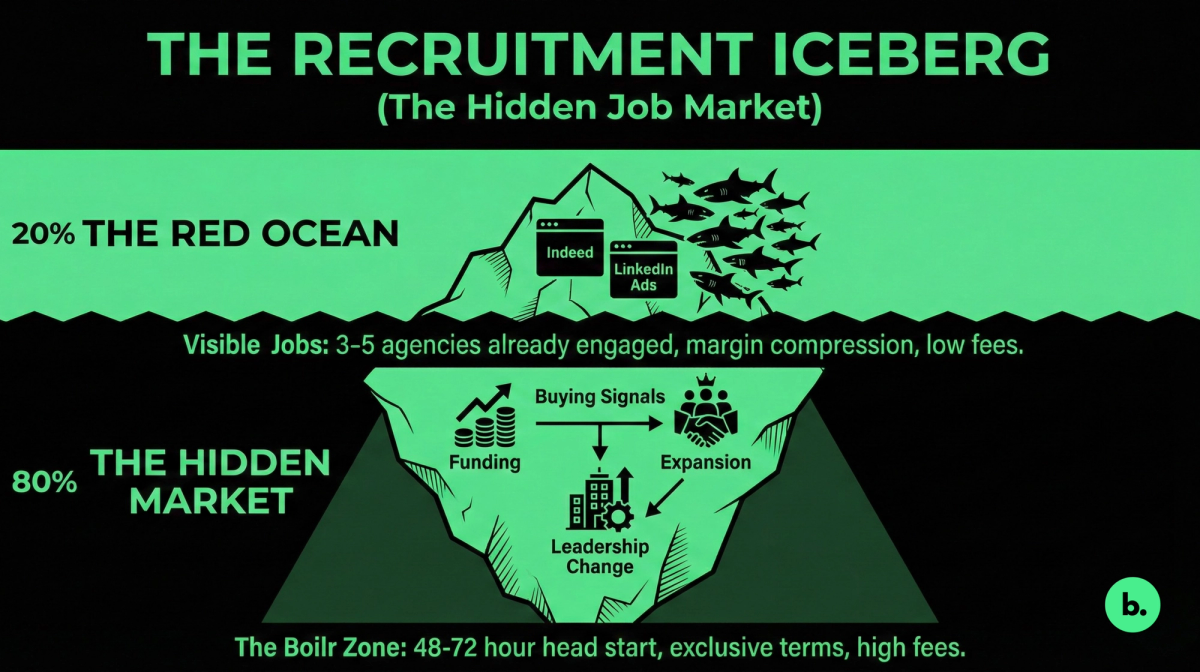
Recent industry reports indicate that up to 76% of recruitment agencies operate without a formalized business development plan. In the absence of strategy, tactical desperation takes over. Recruiters revert to the path of least resistance: targeting companies that have publicly advertised vacancies on job boards like Indeed, LinkedIn, or aggregators. While this approach guarantees that the target has a "need," it fails to account for the competitive density of that need. By the time a role is visible on the public web, it is a "lagging indicator" of hiring intent. Internal data from Boilr.AI reveals that by the time a position hits LinkedIn, three to five agencies have already contacted the hiring manager.
The recruiter in this scenario is not a consultant; they are a commodity supplier competing in a "Red Ocean" where speed and price are the only differentiators. This lack of strategic positioning is not merely an operational nuisance; it is a leading cause of business failure. Statistics show that nine out of ten startups fail, and in the staffing sector, poor cash flow often resulting from long sales cycles and low conversion rates is a primary driver of insolvency. The inability to secure retainers or exclusive terms exacerbates this cash flow volatility, leaving agencies vulnerable to market shifts.
The "Spray and Pray" Efficiency Trap
The absence of a defined target market forces agencies into a "spray and pray" operational model. This approach is characterized by indiscriminate outreach to any organization that appears to be hiring, regardless of whether that organization fits the agency's operational capabilities or profitability requirements. The cost of this inefficiency is staggering.
The Operational Cost of Poor Targeting
As illustrated in Table 1, the transition from a generalized approach to one driven by intelligence yields measurable efficiency gains. The "spray and pray" model is not just ineffective; it is actively destructive to the agency's brand. Sending irrelevant resumes or sales pitches to hiring managers who are not in a buying window creates "market fatigue," leading to domain blacklisting and reputational damage.
Furthermore, poor lead qualification drains internal morale. Sales representatives and 360-degree recruiters spend hours pursuing leads that were never viable. This "opportunity cost" is the silent killer of agency growth. When a recruiter chases a "bad fit" client, they are structurally prevented from finding a "good fit" client. The psychological toll of constant rejection from unqualified prospects leads to burnout and high turnover within recruitment teams, further destabilizing the agency.
The Commoditization of the Generalist
The staffing industry is witnessing the rapid commoditization of the generalist agency. In a market saturated with over 26,000 firms, the claim of being a "full-service agency" is no longer a value proposition; it is a liability. Generalist firms struggle to build the deep networks and industry authority required to command higher fees. They are often forced to compete on margin, accepting lower fill fees and unfavorable payment terms to win business against specialized competitors.
Conversely, niche agencies that specialize in specific verticals (e.g., "AI Engineering for Series B Startups") can command significantly higher valuation multiples upon exit. Investors and acquirers view niche revenue as more defensible and predictable. The specialist knows the jargon, understands the technical requirements, and has ready access to a passive candidate pool that the generalist cannot reach. However, specialization is impossible without a clear definition of who the agency serves. This brings us to the central strategic imperative: The Ideal Customer Profile.
Theoretical Framework of the Ideal Customer Profile (ICP)
Defining "ICP Meaning in Sales”
To solve the crisis of precision, agencies must adopt a rigorous definition of their target market. In the context of B2B sales, "icp meaning sales" refers to a categorical description of a company that derives the maximum value from a service offering and, crucially, provides the maximum value back to the service provider. It is not merely a list of companies the agency wants to work with; it is a list of companies that should work with the agency based on objective data.
An ICP is a composite of firmographic, technographic, and behavioral attributes that indicate a high probability of conversion, retention, and lifetime value (LTV). It acts as a boundary condition for business development: if a prospect does not fit the ICP, they are disqualified immediately, regardless of their potential revenue. This discipline is what separates high-growth agencies from stagnant ones.
The Core Components of a Recruitment ICP:
- Firmographics: The structural attributes of the target company.
- Industry: (e.g., FinTech, Biotech, SaaS).
- Size: (e.g., 50-200 employees).
- Location: (e.g., Manchester, Berlin, Austin).
- Revenue/Funding: (e.g., >$5M ARR, Series A funded).
- Technographics: The tools and technologies the company uses.
- Tech Stack: (e.g., React, Python, AWS, Salesforce).
- HR Tech: (e.g., Do they use an ATS like Greenhouse or Lever? This indicates hiring maturity).
- Situational Dynamics (The "Why Now?"): The specific business context that drives hiring.
- Growth Velocity: (e.g., Increasing headcount by >10% MoM).
- Trigger Events: (e.g., New office opening, recent funding, M&A activity).
The "icp meaning sales" is fundamentally about resource allocation. It answers the question: "Where should we invest our limited time and capital to achieve the highest return?" Without this definition, resources are dissipated across the entire market, resulting in negligible impact anywhere.
The Distinction Between ICP and Buyer Persona
A critical point of confusion for many recruitment leaders is the difference between the Ideal Customer Profile and the Buyer Persona. While often used interchangeably, they are distinct concepts that serve different functions in the sales stack.
- The ICP describes the Account (The Company).
- The Buyer Persona describes the Decision Maker (The Human).
Agencies that fail to distinguish between these two often craft compelling messages (Persona work) but deliver them to organizations that have no structural capacity or intent to buy (ICP failure). For example, a recruiter might perfectly understand the psychology of a CTO (Persona) their desire for speed, quality code, and minimal bureaucracy. However, if they pitch this narrative to a CTO at a stagnant manufacturing firm with a hiring freeze (wrong ICP), the effort is wasted.
Strategic Distinction Between ICP and Buyer Persona
Understanding this distinction allows agencies to build a two-step verification process for BD:
- Does the company fit our ICP? (If No -> Discard).
- Do we know the Buyer Persona within that ICP? (If Yes -> Engage).
ICP Marketing: Inbound Alignment
The concept of "icp marketing" extends the profile beyond sales targeting into the realm of brand positioning. In recruitment, marketing efforts (content, social media, events) often fail because they are designed to appeal to everyone. An agency that claims to be a "Global Talent Partner for All Industries" lacks the resonance of a firm that positions itself as "The Premier DevOps Scaling Partner for Series B SaaS Companies."
Effective "icp marketing" utilizes the specific pain points identified in the ICP definition to create content that acts as a filter. It ensures that inbound leads are pre-qualified by virtue of their alignment with the agency's core competencies. For example, if the ICP is "Series A FinTech," the marketing content should discuss "The challenges of scaling compliance teams post-Series A." This content will only attract the relevant audience, repelling those who do not fit the profile.
When "icp marketing" and "icp sales" are aligned, the agency achieves "GTM (Go-To-Market) Fit." Marketing generates leads that Sales actually wants to close, and Sales provides feedback to Marketing about which ICP segments are converting best, creating a virtuous cycle of refinement.
The Evolution to Signal Intelligence (SIGINT)
While defining a static ICP (Industry + Size) is a necessary first step, it is insufficient in a dynamic economy. A company may fit the firmographic profile perfectly but currently have no hiring need. The next evolution of the ICP involves Signal Intelligence the monitoring of real-time business events that indicate a moment of need.
The Origins and Application of Signal Intelligence
Signal Intelligence (SIGINT) originates from the military and intelligence domains, where it refers to the interception and analysis of signals (communications, electronic, telemetry) to gain a strategic advantage. In the corporate context, and specifically in recruitment, Signal Intelligence refers to the systematic monitoring of public and semi-public data streams to detect indicators of future hiring activity before it becomes common knowledge.
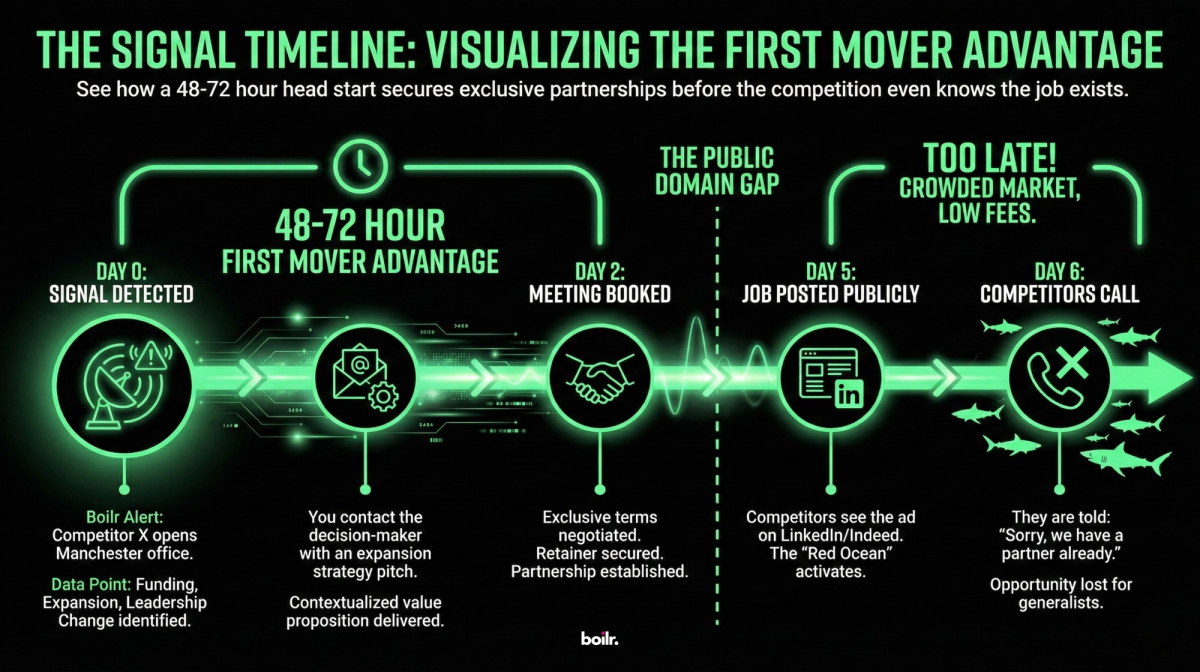
Boilr.AI represents the application of SIGINT to recruitment. By monitoring over 10,000 sources including press releases, GitHub activity, funding announcements, and organizational chart changes Boilr.AI detects hiring signals 48-72 hours before positions are publicly advertised. This transforms the ICP from a static document into a dynamic radar. The "Ideal Customer" is not just a company of a certain size; it is a company of a certain size that has just emitted a buying signal.
The Taxonomy of Hiring Signals
To effectively close clients, recruiters must understand the different types of signals that validate an ICP match. These signals serve as triggers for outreach, providing the "reason" for the call that goes beyond "I saw your job ad."
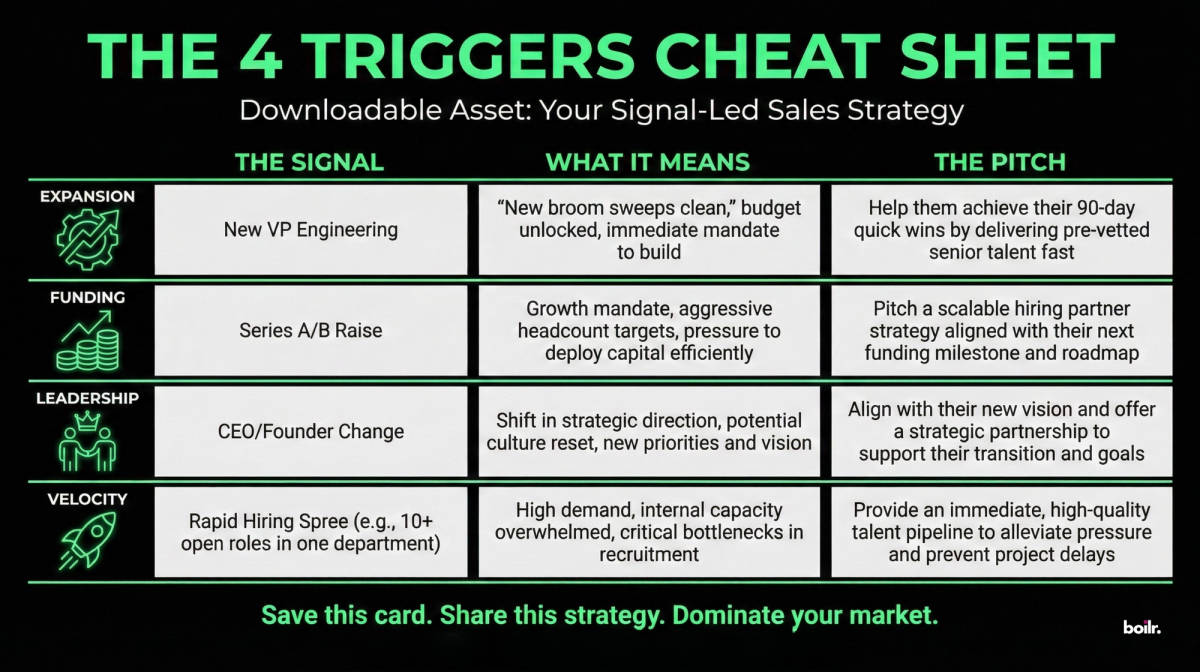
Expansion Signals
When a company announces a new office or enters a new geographical market, it inevitably requires a new tranche of talent, often in operations, sales, and infrastructure. These "Expansion Alerts" are high-fidelity indicators of volume hiring.
- Boilr.AI Capability: Detects specific expansion plans (e.g., "FinTech company opening Manchester office").
- Strategic Value: Allows the agency to pitch a project-based solution (RPO or MSP) for 40+ roles before a Preferred Supplier List (PSL) is put in place. The agency becomes an infrastructure partner, not just a CV supplier.
Financial and Funding Signals
Capital injection is the most reliable precursor to headcount growth. A Series A or B funding round typically allocates 40-60% of the capital toward hiring, particularly in engineering and go-to-market (GTM) functions.
- Boilr.AI Capability: Monitors venture capital activity and maps the likely hiring trajectory (e.g., "£6M Series A usually implies 15-20 hires: 8 Engineering, 3 Product, 5 GTM").
- Strategic Value: Outreach can be framed around the specific challenges of scaling post-funding (e.g., "We help Series A companies deploy capital efficiently by reducing time-to-hire").
Leadership Transition Signals
The appointment of a new C-level executive or VP (e.g., a new VP of Engineering) is a classic trigger event. New leaders are often mandated to "shake up" the team, accelerate delivery, or build new capabilities. They bring fresh budgets and a willingness to audit existing agency relationships.
- Boilr.AI Capability: Detects leadership changes (e.g., "New VP Engineering, Week 3").
- Strategic Value: Outreach timed to the arrival of a new decision-maker has a significantly higher success rate than cold outreach to a settled incumbent. The new leader is under pressure to deliver quick wins and is likely to be receptive to new partners who can help them achieve their 90-day goals.
Velocity and Technographic Signals
- Hiring Velocity: A sudden spike in headcount (e.g., +12% in 30 days) indicates a scaling phase that likely exceeds the capacity of the internal talent acquisition team.
- Technographic Shifts: Changes in a company's tech stack (e.g., migrating from on-premise to AWS, or adopting React) signal a need for specialized skills that the current internal team may lack.
From "Intent Data" to "Hiring Signals"
It is crucial to differentiate between "Intent Data" (commonly used in SaaS marketing) and "Hiring Signals" (used in recruitment).
- Intent Data (e.g., Bombora, ZoomInfo) tracks content consumption (e.g., someone reading articles about "ATS software"). It indicates marketing interest.
- Hiring Signals (e.g., Boilr.AI) track operational commitment (e.g., opening an office, raising funds). It indicates hiring intent.
For recruiters, Intent Data is often too "soft" reading an article doesn't mean a company has the budget to pay a recruitment fee. Hiring Signals are "hard" a £6M investment or a new office lease is a concrete commitment that necessitates spending.
The Technology Landscape: A Comparative Analysis
To understand why recruiters struggle, one must analyze the tools they use. The market offers various solutions, each serving a different stage of the recruitment funnel. A strategic error many agencies make is using a "Workflow" tool to solve a "Intelligence" problem. The following analysis compares Boilr.AI against key competitors (SourceWhale, Sourcebreaker, Paiger) to illustrate the difference between finding the opportunity (Signal Intelligence) and executing the process (Workflow Automation).
Comparative Feature Matrix
Comparative Analysis of Recruitment Technologies
Deep Dive: Sourcebreaker – The "Red Ocean" Navigator
Sourcebreaker is a powerful tool for candidate sourcing and identifying live job leads. Its "Search Builder" and "SourceBots" technology automates the creation of complex Boolean strings, allowing recruiters to find candidates and job leads across multiple platforms (CRM, LinkedIn, Job Boards) simultaneously.
- The Limitation: From a business development perspective, Sourcebreaker operates primarily in the "Red Ocean." It identifies roles that are already public, meaning the agency is competing with the open market. While it improves efficiency in finding these leads (aggregating them into one view), it does not solve the problem of being "too late." It effectively helps recruiters run faster in the same race as everyone else. It reacts to the market rather than predicting it.
Deep Dive: SourceWhale – The Execution Engine
SourceWhale excels at the mechanics of outreach. It is an "outreach automation and execution platform" that integrates with email, LinkedIn, and the CRM. It creates "Workflows" that automate follow-ups, ensuring that no lead is dropped. It also includes data enrichment features to find contact details (emails/phone numbers).
- The Limitation: SourceWhale answers the question, "How do I contact these 50 people efficiently?" However, it does not answer, "Who are the 50 people I should contact today?" Without a clear ICP and Signal Intelligence feeding into SourceWhale, the tool merely allows recruiters to spam the wrong people faster. It is a force multiplier for activity, but not for targeting. Boilr.AI acts as the ammunition (the "Who" and "Why"), while SourceWhale acts as the weapon (the "How").
Deep Dive: Paiger – The Brand Builder
Paiger focuses on the top-of-funnel marketing aspect building personal brands for recruiters and automating content sharing. It helps recruiters share job adverts and industry news to their social networks to attract inbound interest.
- The Limitation: Paiger is an inbound, long-term play. It builds authority over time ("icp marketing"), but it does not provide the immediate, actionable intelligence required for outbound business development in the same way Boilr.AI's signal detection does. It relies on the recruiter having a network to market to.
The Boilr.AI Advantage: Creating a "Blue Ocean"
Boilr.AI's strategic positioning is unique because it moves the recruiter upstream in the buying cycle. By identifying "Expansion Alerts" or "Funding Rounds" before job descriptions are written, it allows the recruiter to consult on the hiring strategy rather than just servicing a requisition.
- The Mechanism: You define your ICP once (industry, size, stage, location). Boilr remembers this profile and filters 10,000+ sources to deliver only opportunities that match.
- The Result: The recruiter receives "Ready-to-Go Leads" with context (e.g., "Company X plans 40 hires due to expansion"). This "First Mover Advantage" is the antidote to commoditization. The platform filters these signals through the agency's specific ICP, ensuring that the 2-3x increase in lead volume consists only of relevant opportunities.
The Hidden Job Market and The Economics of Exclusivity
A critical statistical reality reinforces the need for ICP-driven Signal Intelligence: the existence of the "Hidden Job Market." Research consistently shows that between 70% and 80% of job openings are never publicly advertised. These roles are filled through referrals, networking, and internal moves before they ever reach a job board.
The Invisibility of Traditional Methods
Recruiters without an ICP who rely on job board scrapers (like Sourcebreaker) or manual LinkedIn searches are effectively invisible to 70% of the market. They are competing for the visible 20-30% of roles, which are the most competitive and price-sensitive. This visible segment is where margins are compressed and "CV races" occur.
Boilr.AI grants access to this hidden market. A "Leadership Change" signal or a "Funding" signal reveals a future vacancy that has not yet been formalized. By acting on this signal, the recruiter can initiate a conversation about a role that doesn't officially exist yet. This allows them to shape the job description, influence the salary banding, and secure exclusivity the "Holy Grail" of recruitment sales.
The Mathematics of Exclusivity and Fill Rates
The strategic value of accessing the hidden market via ICP signals is quantifiable.
- Fill Rates: Agencies working on an exclusive basis fill roles approximately 66% of the time, compared to a significantly lower fill rate (often <20%) for non-exclusive, contingent roles where they compete with other agencies.
- Revenue Stability: "Acceptable" billing standards for permanent recruiters are rising, often exceeding $250,000 annually. Achieving these figures in a non-exclusive, multi-agency environment requires a massive volume of activity to compensate for low fill rates.
- Valuation: Agencies with a high percentage of exclusive or retained business (driven by early ICP engagement) command higher valuation multiples. The market values predictability; relying on the "Hidden Job Market" creates a proprietary pipeline that competitors cannot access.
Operationalizing the Signal-Led ICP Strategy
For an agency to transition from struggling to thriving, it must operationalize the concepts of "icp meaning sales" and "icp marketing" using a structured framework.
Step 1: Scientific Definition of the ICP
The agency must move beyond "We recruit for Tech." The ICP definition must be granular and data-backed.
- Vertical: SaaS, FinTech, GreenTech.
- Stage: Seed, Series A, Pre-IPO.
- Geography: Specific hubs (e.g., London, Berlin, Austin).
- Tech Stack: Specific languages or platforms (e.g., Python/Django, Salesforce).
- Signal Triggers: What event causes them to buy? (e.g., "Only target companies 3 months post-Series A").
Step 2: Calibrating the Radar (Boilr.AI Integration)
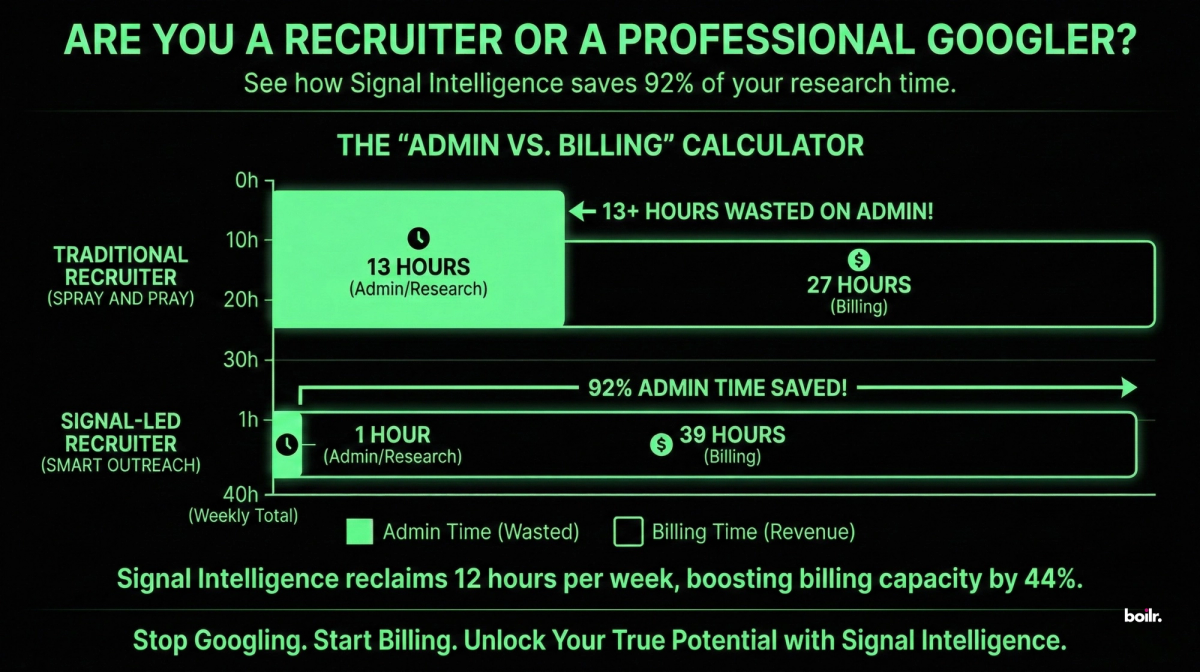
Once the ICP is defined, it is input into the Boilr.AI platform. The system then "remembers" this profile. This automates the filtering process. Instead of a recruiter spending 13 hours a week on "admin" (scanning news sites, LinkedIn feeds, and job boards), the platform delivers a curated list of leads that match the ICP and have exhibited a buying signal. This creates a "Zero-Waste" BD environment.
Step 3: Contextual Outreach Strategy
The outreach strategy shifts from generic to contextual, leveraging the signal to build trust.
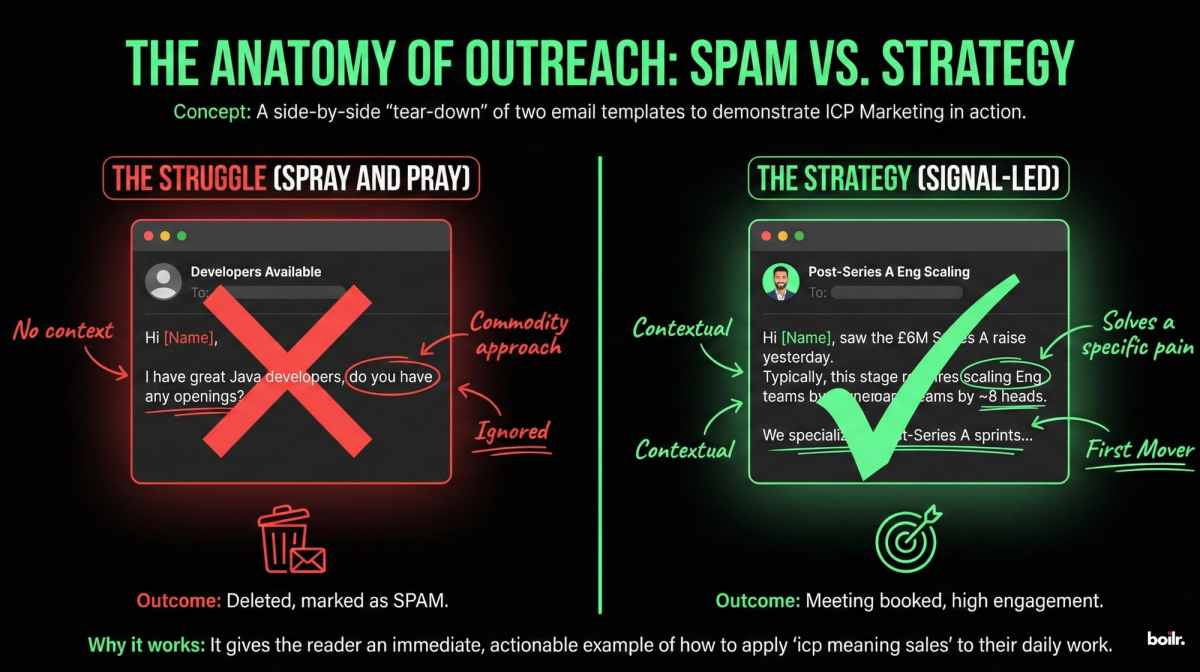
- Old Way (No ICP/Signal): "Hi, I see you are hiring Java developers. We have great candidates." (Likely ignored).
- New Way (Boilr ICP): "Hi [Name], I noticed the recent £6M Series A raise and the plan to expand the engineering team in Manchester. Given the tight market for React Native developers in that region, I wanted to share how we helped scale their team post-funding..."
This approach leverages the "fit" (ICP) and the "timing" (Signal) to create relevance. It answers the implicit question: "Why are you calling me now?".
Step 4: The Strategic Feedback Loop
The ICP is not static. It must be refined based on data. If "Series A FinTechs" are converting at 20% but "Series B HealthTechs" are converting at 5%, the agency must adjust the ICP settings in Boilr to prioritize the higher yield segment. This iterative process drives continuous improvement in the "Revenue Efficiency" of the agency.
Future Outlook (2025-2030) - The Era of the "Super-Agency"
The recruitment landscape is evolving toward hyper-specialization and automation. By 2025, the industry challenge has shifted from a "candidate shortage" to a "client shortage". In this environment, the "Generalist" agency is becoming an endangered species, squeezed between low-cost automated platforms and high-value specialist firms.
The Rise of the AI-Enabled "Super-Agency"
We are entering the era of the "Super-Agency," where small teams of highly specialized recruiters leverage AI tools to outproduce significantly larger firms. Tools like Boilr.AI act as a force multiplier, allowing a single consultant to monitor a market that would previously have required a team of researchers. These agencies will operate with leaner headcounts but higher revenue per head, driven by the efficiency of Signal Intelligence.
From "Headhunter" to "Growth Consultant"
Recruiters who master ICP-based signal intelligence will transition from transactional headhunters to strategic growth consultants. By approaching a client with data about their own growth trajectory (e.g., "Your competitors in this space are hiring X, implying a shift in strategy..."), the recruiter adds value beyond the CV. This elevates the conversation to the C-Suite, where budgets are approved and exclusive partnerships are formed.
The Binary Choice for 2026
The struggle of recruiters to close clients is rarely a result of a lack of effort; it is a result of a lack of focus. The absence of a clear Ideal Customer Profile forces agencies into a game of probability that the math does not favor. They waste 90% of their time on prospects who cannot or will not buy, engaging in a race to the bottom on price and speed.
The integration of a scientifically defined ICP with predictive Signal Intelligence offers the only viable path out of this commoditization trap. Platforms like Boilr.AI provide the technological infrastructure to execute this strategy, moving business development from a manual, reactive grind to an automated, predictive science.
For the modern recruitment agency, the choice is binary: Adopt a Signal-Led ICP strategy to secure the "First Mover Advantage" in the "Hidden Job Market," or remain in the "Red Ocean," fighting for the 20% of jobs that everyone else has already seen. In a business where timing is everything, seeing what is coming before everyone else does is not just an advantage; it is the definition of survival.