Why modern recruiters must think like sales + tech professionals
The modern recruiter stands at a critical juncture. The traditional path reliant on reactive sourcing, manual administration, and serendipity is a dead end, crowded with low-value competitors and threatened by automation.

The Convergence of Sales and Technology in Modern Recruitment: A Strategic Analysis for the 2026 Landscape
The Macro-Evolution of the Recruitment Industry (2020–2026)
The Collapse of Reactive Recruitment Models
The recruitment industry is currently navigating its most significant transformation since the digitalization of job boards in the late 1990s. For decades, the dominant operational model for recruitment agencies was fundamentally reactive—a paradigm often derisively referred to as "post and pray." In this traditional workflow, a recruitment agency would wait for a client to identify a hiring need, secure internal budget approval, and draft a job description. Only after these internal milestones were met would the role be broadcast to the market via public job boards or sent to a preferred supplier list (PSL). This linear, sequential process created a commoditized environment where agencies competed primarily on the speed of resume submission after the fact, often flooding clients with candidates in a chaotic scramble to claim ownership.
However, the market landscape of 2025 and early 2026 is defined by a level of hyper-competition that renders this reactive model obsolete. The window of opportunity for placing high-value talent has shifted dramatically upstream. By the time a role appears on LinkedIn or a major job aggregator, typically three to five agencies have already contacted the hiring manager. The democratization of contact data, driven by a proliferation of enrichment tools and open-source intelligence (OSINT), means that access to a hiring manager's email or phone number—once a recruiter’s proprietary gold—is now a commodity available to any player with a subscription to tools like ZoomInfo or Apollo. Consequently, the distinct value proposition of a recruiter has shifted from "finding people" to "identifying timing and intent."
This shift is exacerbated by the economic climate of the mid-2020s. Following the volatility of the post-pandemic years, organizations have moved from a mindset of "growth at all costs" to one of "efficient capability." Hiring decisions are scrutinized more heavily, and the cost of a mis-hire or a prolonged vacancy is calculated with greater precision than ever before. In this environment, the "reactive recruiter" who waits for a job order is viewed as a transactional vendor, easily replaced by internal talent acquisition teams or automated matching algorithms. The "strategic partner," conversely, is the one who identifies the business problem—the need for talent—before the client has even formally articulated it.
The Rise of the "Sales + Tech" Hybrid Professional
To survive and thrive in this new ecosystem, the modern recruiter can no longer exist solely as a "people person" or a "relationship builder" in the vague, traditional sense. The complexity of the digital economy demands a dual competency that hybridizes two previously distinct professional archetypes: the aggressive, strategic Sales Professional and the analytical, systems-oriented Technology Specialist.
The Sales Professional component of this hybrid identity is capable of consultative selling, navigating complex stakeholder maps, understanding revenue impact, and executing sophisticated business development (BD) campaigns. They do not merely take orders; they challenge assumptions, diagnose underlying business pain points, and quantify the economic impact of talent gaps. They utilize methodologies such as SPIN Selling or the Challenger Sale to reframe the client's perspective, moving the conversation from "price per placement" to "value of business continuity".
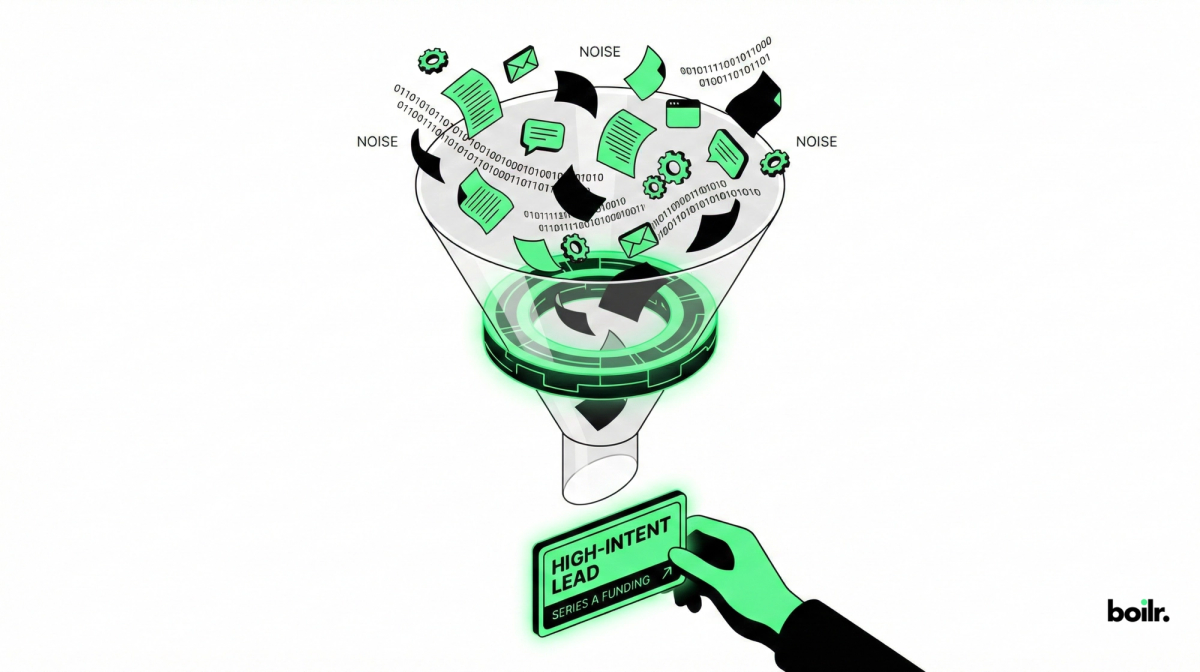
Simultaneously, the Tech Professional component is proficient in leveraging artificial intelligence, analyzing signal data, managing automated workflows, and interpreting predictive analytics to forecast hiring needs. This recruiter understands that their competitive edge lies in their "tech stack"—the integrated ecosystem of tools that allows them to see what others cannot. They are comfortable with concepts like API integrations, data enrichment, boolean logic, and signal-to-noise ratios. They view data not as a static record to be stored in an Applicant Tracking System (ATS), but as a dynamic stream of intelligence that dictates their daily actions.
This convergence is not merely about using software; it is about thinking like a technologist—understanding data structures, integration flows, and algorithmic signals—while acting like a salesperson—persuading, closing, and managing relationships. The recruiters who fail to adopt this hybrid mindset risk becoming "administrative overhead," while those who master it elevate themselves to the status of strategic advisors, indispensable to their clients' growth trajectories.
Key Industry Drivers for 2026
Several macro-trends are forcing this evolution, creating a landscape where the "Sales + Tech" mindset is not just advantageous but mandatory:
First, the ubiquity of AI and Automation has automated the administrative "grunt work" that previously consumed up to 60% of a recruiter's day. Tools that handle resume screening, interview scheduling, and candidate matching are now standard. This automation paradoxically increases the pressure on recruiters to perform higher-level tasks. If a machine can match a resume to a job description, the human recruiter must provide value that the machine cannot: strategic foresight, relationship nuance, and the ability to construct a deal.
Second, the shift toward Skills-Based Hiring has moved the goalposts for candidate evaluation. Employers are increasingly ignoring degree requirements in favor of demonstrated capability and specific technical skills. This requires recruiters to possess a deeper technical understanding of the roles they fill. They must be able to decipher the implications of a company migrating from an on-premise server architecture to a cloud-native AWS environment, recognizing that this "tech signal" implies a specific set of hiring needs (e.g., DevOps engineers, Cloud Architects) that a generic "IT Recruiter" might miss.
Third, Data-Driven Decision Making has become the lingua franca of business. Clients expect their partners to come to the table with market intelligence—salary benchmarks, supply/demand heatmaps, and competitor analysis—not just resumes. Agencies are now expected to provide "predictive intelligence," alerting clients to their own vulnerabilities or opportunities based on external market data.
Finally, Economic Pressure has forced a focus on profitability and efficiency. The "spray and pray" method of business development is mathematically unsustainable in a market where client acquisition costs (CAC) are rising. Agencies must increase their "win rates" by focusing their business development efforts on clients with the highest propensity to buy. This requires a "Sales + Tech" approach to lead generation: using technology to identify high-probability targets (Sales) and engaging them with a compelling, data-backed value proposition (Tech).
The Sales Mindset: Structuring Recruitment as a Commercial Discipline
"Recruitment is Sales" – Deconstructing the Resistance
Despite the operational parallels, there has historically been a cultural resistance within the recruitment industry to label the profession as "sales." Many practitioners prefer terms like "Consultant," "Talent Partner," or "Headhunter," viewing "sales" as a pejorative term associated with aggressive tactics and transactional relationships. However, the market reality of 2026 renders this semantic distinction moot. At its core, recruitment is a complex B2B sales function: recruiters are selling job opportunities to candidates (the supply side) and professional services to clients (the demand side).
The resistance to this label often stems from a misunderstanding of modern sales. The "Sales + Tech" recruiter does not view sales as "pushing product." They view it through the lens of modern enterprise sales methodologies, where the salesperson is a "trusted advisor" who helps the client navigate complexity and risk. They understand that a placement is not an isolated event but the closure of a complex sale involving multiple decision-makers, long lead times, and significant financial stakes.
In this context, the "Sales Mindset" involves a rigorous adherence to process and methodology. Just as a software salesperson uses a CRM to track deal stages from "Prospecting" to "Closed-Won," the modern recruiter tracks their "relationships" with the same granularity. They do not rely on serendipity; they rely on a sales funnel. They understand metrics like "conversion rates" not as administrative burdens, but as diagnostic tools to improve their own performance. If their "Time to Submit" is high, they know their "Win Rate" will be low, and they adjust their behavior accordingly.
The Psychology of the First Mover
In sales psychology and strategic management, the First-Mover Advantage (FMA) is a critical concept. The first entity to define a problem and offer a solution often sets the criteria for the entire purchasing decision, anchoring the buyer's expectations and establishing a barrier to entry for subsequent competitors. In the specific context of recruitment business development, FMA translates to the ability to engage a hiring manager before a job description is finalized and distributed.
The advantages of this "First Mover" status are multifaceted and compounding:
Setting the Agenda: By contacting a hiring manager based on a growth signal—for example, a news alert that the company has just raised Series A funding—the recruiter enters the conversation during the "planning phase" rather than the "execution phase." They can influence the scope of the role, the budget, and the required skills, effectively writing the job description in collaboration with the client. This positions the recruiter not as a vendor responding to a request, but as a consultant shaping the strategy.

Exclusive Access: Pre-market engagement effectively eliminates competition. If a recruiter builds a relationship and presents a high-quality candidate profile before the role is made public, they often secure exclusivity. The client, relieved to have a solution to a problem they were just beginning to worry about, may bypass the arduous process of engaging a Preferred Supplier List (PSL) or posting the role to LinkedIn. This "pocket listing" dynamic is the holy grail of agency recruitment, yielding higher margins and faster fill times.
Trust & Authority: Approaching a client with specific intelligence ("I see you're expanding your Manchester office and will likely need Ops and IT support") establishes immediate authority. It distinguishes the recruiter from the dozens of generic "do you have any roles?" calls that hiring managers receive daily. It demonstrates that the recruiter understands the client's business context and is proactive rather than reactive.
Business Development (BD) as a Precision Science
Traditional business development in recruitment was a volume game: make 100 cold calls, get 10 conversations, get 1 job order. This model is increasingly ineffective due to decision-maker fatigue and gatekeeping technologies. The modern "Sales + Tech" mindset utilizes Account-Based Marketing (ABM) principles, transforming BD from a game of chance into a precision science.
This approach requires recruiters to identify high-value targets based on hard data, not intuition. They segment their market not just by geography or industry, but by "propensity to buy." A company that has just laid off 10% of its workforce has a low propensity to buy; a company that has just secured a government tender has a high propensity.
Traditional BD vs. Data-Driven Sales Mindset
The Metrics of Sales Efficiency
To truly think like a sales professional, recruiters must obsess over the metrics that drive revenue efficiency. It is no longer enough to track "activity" (calls made); one must track "impact."
Speed to Lead: In the general sales world, data indicates that responding to a lead within 5 minutes increases the probability of conversion by up to 21x compared to responding after 30 minutes. In recruitment, the "lead" is the hiring signal. If a funding round is announced at 9:00 AM, the recruiter who calls at 9:05 AM captures the "Speed to Lead" advantage. The recruiter who calls at 2:00 PM is already part of the noise. The "Tech" aspect of the hybrid professional is what enables this speed, automating the detection and notification of the signal to allow for immediate action.
Win Rates: There is a direct statistical correlation between "Time to Submit" and "Win Rate." Being the first to submit a high-quality candidate significantly increases the likelihood of placement. The "Sales" mindset prioritizes velocity not for its own sake, but because it is a lever for revenue. A recruiter who understands this metric will structure their day to prioritize "closest to the money" activities, ignoring low-value administrative tasks.
Pipeline Velocity: This metric tracks how quickly opportunities move from identification (signal) to close. The "Sales + Tech" recruiter uses their CRM to identify bottlenecks. If deals are stalling at the interview stage, they apply sales techniques (closing, objection handling) to unblock them. If deals are stalling at the sourcing stage, they apply tech techniques (better search strings, automation) to accelerate candidate generation.
The Tech Mindset: Signal Intelligence and Data Architecture
From Digitization to Intelligence
The first wave of recruitment technology was focused on digitization—moving paper resumes into digital databases (the birth of the ATS). The second wave was about connectivity—linking those databases to the internet (LinkedIn, job boards). The current wave, and the defining characteristic of the 2026 market, is Intelligence. The focus has shifted from "storing data" to "generating insights."
The modern recruiter must function as a data analyst, interpreting signals from a vast array of sources. They must understand that their Applicant Tracking System (ATS) is not just a digital filing cabinet, but a "System of Record" that must be fed by a "System of Intelligence." This distinction is crucial. A System of Record (like Bullhorn or Vincere) manages what you have. A System of Intelligence (like Boilr.AI) tells you what you need to get.
Defining Signal Intelligence in Recruitment
"Signal Intelligence" in recruitment refers to the aggregation, analysis, and interpretation of external data points that indicate a future hiring need. It differs significantly from generic "Intent Data," which is often used in B2B software sales to track who is searching for specific keywords (e.g., "best CRM software"). Signal Intelligence in recruitment looks for proxies of organizational growth, structural change, or strategic pivoting.
A recruiter with a Tech Mindset categorizes these signals into specific actionable types:
Capital Injection: Funding rounds (Series A, B, C) are the most direct correlation to headcount growth. A £6M Series A investment typically results in 15-20 planned hires, usually heavily weighted toward Engineering (product build) and Go-To-Market (sales/marketing) functions. The "Tech" recruiter knows that this signal has a "latency period"—the time between the money hitting the bank and the job ads going live. Their goal is to exploit this latency.
Organizational Expansion: Signals such as opening a new office, signing a lease for a larger headquarters, or announcing a new regional hub are strong indicators of volume hiring. These events typically trigger needs for operational support, IT infrastructure, and administrative staff—roles that are often high-volume and exclusive if caught early.
Leadership Transitions: The arrival of a new executive is a "high-fidelity" signal. When a new VP of Engineering or Sales Director joins a company, they almost always have a mandate to restructure or grow the team. Statistical analysis suggests that new leaders initiate significant hiring or replacement cycles within their first 90 days. The recruiter who contacts the new VP in week 3 with a "welcome and assist" pitch is leveraging signal intelligence to align with the executive's fresh agenda.
Tech Stack Changes: For technical recruiters, monitoring a company's technology footprint is essential. A shift in a company's GitHub repository activity (e.g., a sudden spike in React or Kubernetes code) or a mention of a migration to AWS in a press release signals a specific, imminent need for specialized talent. This allows the recruiter to approach the client not with a generic question, but with a specific candidate: "I see you're moving to a microservices architecture; I have a Lead Developer who specializes in exactly that transition".
The Data Ecosystem: Sources and Noise
A "Tech" professional understands that raw data is noisy. The internet generates millions of data points daily—press releases, tweets, code commits, glassdoor reviews, government tender notices. Monitoring 10,000+ sources manually is impossible and inefficient. The value of technology lies in filtering and contextualization.
Noise Reduction: Technology must differentiate between a company "growing" and a company "hiring." Not all growth leads to hires. A company might raise capital to pay off debt (no hiring signal) vs. raising capital to launch a new product (strong hiring signal). The Tech Mindset involves configuring systems to distinguish these nuances, ensuring that the recruiter's attention is focused only on high-probability events.
ICP-Based Filtering: The modern recruiter configures their intelligence platforms to only surface signals relevant to their Ideal Customer Profile (ICP). If a recruiter specializes in FinTech in London, a signal about a manufacturing plant opening in Ohio is noise. Platforms like Boilr.AI allow this granular filtering, ensuring that the recruiter receives "ready-to-go leads" rather than raw data dumps.
Predictive Analytics and Future Trends
By 2026, the industry has moved beyond simple signal detection to Predictive Hiring. Tools are now capable of analyzing historical hiring velocity to forecast future needs with high accuracy. For example, if a company's headcount has grown by 12% in the last 30 days, predictive models can estimate the "burn rate" of talent and predict that they will need 4 engineers per week for the next quarter to sustain that velocity.
This moves the recruiter into the realm of "Prescriptive Analytics"—telling the client what they will need before the client knows it. Furthermore, the integration of Agentic AI allows for the automation of the initial outreach based on these predictions. An AI agent can detect the signal, identify the hiring manager, and draft a personalized email referencing the growth data, presenting it to the recruiter for a final "human-in-the-loop" approval before sending.
Deep Dive: Boilr.AI and the Operationalization of Signals
The Core Value Proposition: Timing as a Moat
Boilr.AI represents the crystallization of the "Sales + Tech" philosophy into a software platform. Its primary function is to provide an information advantage. In a market where timing is the single most critical variable, Boilr's ability to detect hiring signals 48-72 hours before positions are publicly advertised allows recruiters to execute the "First Mover" strategy effectively.
Mechanism of Action: Boilr continuously monitors over 10,000 sources, including funding announcements, press releases, LinkedIn updates, org chart changes, GitHub activity, company career pages, Glassdoor reviews, and government tenders. It ingests this massive stream of unstructured data and uses natural language processing (NLP) and machine learning algorithms to identify "hiring intent."
Crucially, it translates this abstract intent into concrete "Leads." It doesn't just say "Company X is growing." It says: "Company X has announced a £6M Series A. Based on this, they plan 15-20 hires. The likely hiring manager for the Engineering roles is [Name], the new VP of Engineering." This level of granularity bridges the gap between "Tech" (data collection) and "Sales" (actionable prospecting).
Impact on Agency Workflow
The integration of a tool like Boilr.AI fundamentally alters the daily routine of a recruiter, shifting the balance from low-value admin to high-value selling.
Reduction of Admin: Traditional business development involves hours of manual research—scrolling LinkedIn, reading news sites, checking job boards. Agencies report that this "weekly admin" burden often exceeds 13 hours per recruiter. Boilr automates this research, reducing the time spent finding leads to approximately 1 hour per week—a 92% efficiency gain. This liberated time is then redirected toward "sales" activities: calling, relationship building, and interviewing.
Contextual Outreach: The quality of the outreach improves dramatically. Instead of a cold call asking "are you hiring?", the recruiter makes a "warm" call armed with intelligence. "Congratulations on the £6M Series A. I know from experience with similar firms that you'll likely need to scale the engineering team by 8-10 heads in the next quarter. I have a team ready to go." This demonstrates the "Consultative Sales" approach, positioning the recruiter as a peer rather than a supplicant.
Opportunity Volume: Agencies utilizing Boilr report a 2-3x increase in lead volume. More importantly, they report a 183% increase in "First-Contact Rate"—the percentage of times they are the first agency to speak to the client. This metric is directly correlated with exclusivity and higher margins.
Strategic Differentiation
Boilr's differentiation lies in its specific focus on client acquisition (Business Development) rather than candidate sourcing. This is a critical distinction in the tech stack.
- vs. LinkedIn Recruiter: LinkedIn is primarily a tool for finding candidates. It is a database of people. Boilr is a tool for finding the jobs those candidates will fill. It is a database of demand..
- vs. Traditional Lead Gen Lists: Generic lead gen lists (e.g., ZoomInfo) provide contact details but lack the "trigger event" context. They tell you who is there, but not why you should call them now. Boilr provides the specific reason for the call (the signal), which is the key to breaking through the noise.
Competitive Landscape and Tech Stack Integration
To truly "think like a tech professional," one must understand where different tools fit within the agency's operational stack. The modern recruitment tech stack is modular, comprising specialized tools that integrate to form a cohesive revenue engine.
System of Record: ATS/CRM (Bullhorn vs. Vincere)
These platforms act as the "Central Nervous System" of the agency. They manage the data after it has been acquired.
Bullhorn: The undisputed market leader for enterprise agencies. Its strength lies in its ecosystem and scalability. It is a robust "System of Record" that excels at compliance, middle-office functions, and managing complex workflows. However, it relies heavily on its marketplace partners for top-of-funnel innovation. It is the repository where Boilr leads ultimately reside.
Vincere: Positions itself as the "Recruitment Operating System" with a heavier focus on growth and analytics. It includes built-in modules for intelligence and marketing that Bullhorn often outsources to partners. Vincere's "Goal Console" and analytics dashboards appeal to the "Sales" mindset of tracking KPIs and pipeline velocity.
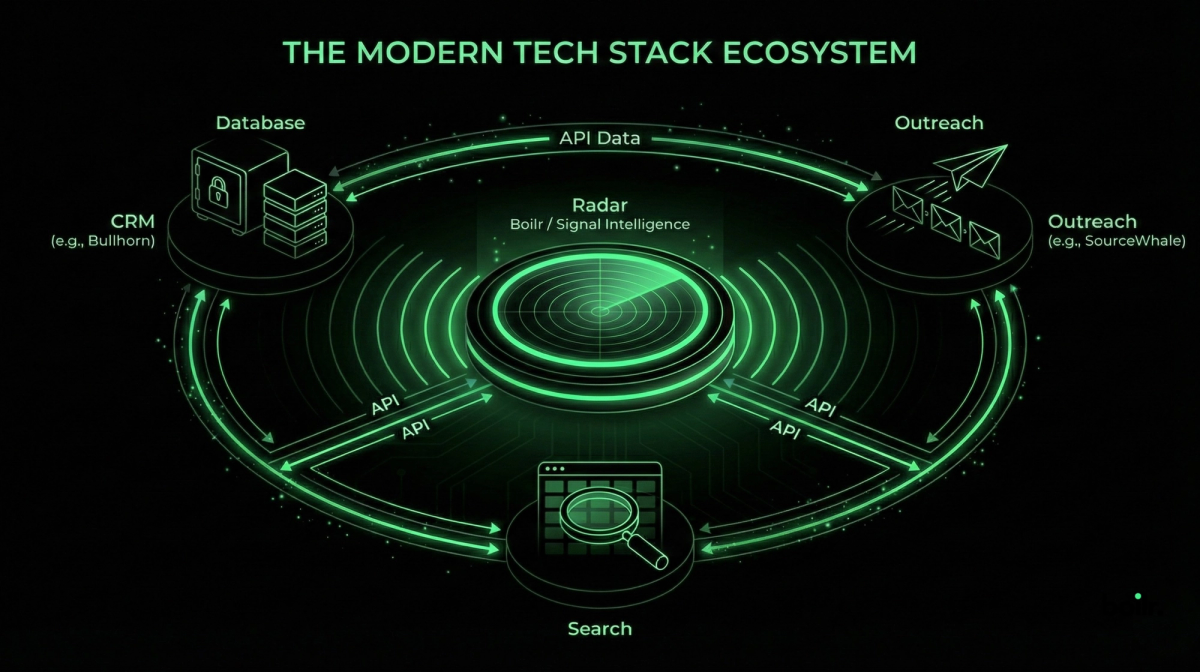
Integration Point: Boilr.AI sits above the ATS in the funnel. It identifies the lead (Signal) and then pushes that data into Bullhorn or Vincere to create a client record or job opportunity. It acts as the "Radar," while the ATS acts as the "Command Center".
Engagement and Outreach: SourceWhale
Once a lead is identified by Boilr, it must be engaged. This is the domain of "Sales Engagement Platforms."
SourceWhale: A powerhouse for outreach automation. It allows recruiters to build multi-channel sequences (email, LinkedIn InMail, phone tasks) that automate the follow-up process. It creates "persistence at scale." It is distinct from Boilr in that it executes the campaign, whereas Boilr identifies the target.
The Workflow: The ideal "Sales + Tech" workflow involves identifying a Hiring Manager via Boilr (Signal: "New VP of Sales"), pushing that contact to SourceWhale, and triggering a pre-built sequence that references the specific signal (e.g., "Saw the news about your new role..."). This ensures that the intelligence generated by Boilr is immediately operationalized.
Candidate Sourcing: Sourcebreaker & Paiger
Sourcebreaker: While Sourcebreaker has business development features (like tracking job leads), its primary legacy strength is in candidate search. It uses advanced algorithms to build complex Boolean strings and search multiple databases (LinkedIn, Job Boards, Internal Database) simultaneously to find candidates. In the "Sales + Tech" dichotomy, Sourcebreaker finds the product (candidates) to sell, while Boilr finds the buyer (clients).
Paiger: Focuses on Marketing and Personal Branding. It helps recruiters share content, jobs, and industry news to their social networks to attract inbound interest. It is a "one-to-many" marketing tool designed to build brand equity over time. In contrast, Boilr is a "one-to-one" sales intelligence tool designed for immediate direct action.
The Modern Recruitment Tech Stack
The Economics of the "Sales + Tech" Approach
The Cost of Vacancy (COV)
A recruiter thinking like a business consultant (Sales Mindset) understands the financial pain of their client. The "Cost of Vacancy" (COV) is the revenue lost per day a role remains unfilled. This metric is the most powerful tool in a recruiter's negotiation arsenal.
Revenue Roles: For a salesperson generating $500k/year, a vacancy effectively costs the company ~$2,000 per working day. A standard 90-day vacancy results in $180,000 in lost revenue opportunity. This does not include the intangible costs of territory erosion or competitor encroachment.
Technical Roles: Unfilled developer roles can have even higher costs due to interdependencies. One missing backend engineer can block a team of five frontend developers, delaying a product launch. Analysis suggests unfilled software developer positions can cost up to $1,292 per day in lost productivity and delayed revenue realization.
The Sales Pitch: By using Signal Intelligence (Boilr) to identify the need 72 hours early, the recruiter effectively reduces the "Time to Fill." If a recruiter can fill a role 2 weeks faster than the competition because they started earlier, they save the client ~$28,000 (14 days * $2,000). This is a CFO-level sales argument that justifies higher fees and retained models, far superior to the generic "I have a great candidate" pitch.
Speed to Lead and First-Mover Economics
The economic statistics regarding speed in sales are undeniable and directly applicable to recruitment business development.
Conversion Decay: The odds of qualifying a lead drop by 80% after just 5 minutes. In recruitment terms, if a hiring manager posts a job and receives 10 calls in the first hour, the 11th call is noise. The first call is a solution.
Win Probability: Data shows that 78% of B2B buyers purchase from the vendor who responds first. This is the "First Responder" effect. In a market where 5 agencies might spot a job post on LinkedIn simultaneously, the "first responder" advantage is neutralized because everyone sees it at the same time. The only way to regain the 78% win probability is to engage before the post exists—i.e., via signal intelligence.
ROI and Payback Period
Adopting this "Sales + Tech" stack requires financial investment. However, the efficiency gains drive a rapid Return on Investment (ROI).
Admin Savings: Saving 12 hours/week of admin time (per Boilr case studies) allows for approximately 600 additional sales calls or candidate interviews per year per recruiter. Assuming a standard conversion rate, this activity increase alone justifies the software cost.
Payback: Agencies utilizing Boilr report a payback period of approximately 6 weeks. This is driven by the increased volume of exclusive leads and the reduction in "wasted time" working on competitive roles where the agency has no advantage.
Future Trends: The 2026-2030 Horizon
Agentic AI and Autonomous Recruiting
By 2026, the industry is witnessing the rise of Agentic AI—autonomous agents capable of performing complex, multi-step tasks without human intervention. Unlike generative AI (which writes text), agentic AI performs actions. These agents will eventually handle the entire initial outreach, scheduling, and basic screening process.
The "Tech" mindset requires recruiters to become "pilots" of these agents. They will define the parameters—"Find me companies in Berlin raising Series B funding and contact the CTO with this value proposition"—and the agent will execute the "grunt work." The recruiter's role shifts entirely to the high-value "human" elements: negotiation, persuasion, and emotional intelligence.
The Shift to Skills-Based Intelligence
Recruitment is moving away from "Job Titles" to "Skills Clusters." A "Java Developer" title is less meaningful than a skills cluster of "Java + Spring Boot + Microservices + AWS." Signal intelligence will evolve to track these clusters. Tools will detect not just "hiring for a Developer" but "company adopting a tech stack that requires Rust and Kubernetes" based on open-source code commits. This requires recruiters to possess a high degree of technical literacy to interpret these signals correctly and match them to the right talent pools.
Data-Driven Talent Advisory
The ultimate evolution of the "Sales + Tech" professional is the Talent Advisor. Using data from tools like Boilr, recruiters will advise clients on strategic decisions: where to open offices based on talent supply (Supply/Demand analysis), how to budget based on competitor funding benchmarks, and when to hire based on industry velocity. This elevates the recruiter from a vendor (transactional) to a strategic partner (consultative), securing their position in the value chain against the threat of disintermediation.
Conclusion
The modern recruiter stands at a critical juncture. The traditional path—reliant on reactive sourcing, manual administration, and serendipity—is a dead end, crowded with low-value competitors and threatened by automation. The future belongs to the "Sales + Tech" hybrid: a professional who wields signal intelligence to see the future of the market and uses consultative sales skills to shape it.
Platforms like Boilr.AI are not merely "tools"; they are the foundational infrastructure for this new operating model. They provide the "Radar" that allows the "Sales Pilot" to navigate. By integrating signal intelligence with robust engagement (SourceWhale) and management (Bullhorn/Vincere) systems, agencies can construct a high-velocity, high-precision revenue engine.
For the recruiter of 2026, the mandate is clear: Stop looking for job posts. Start looking for signals. Stop taking orders. Start building business. The technology exists to make this transition; the only remaining variable is the mindset.
Appendix: Competitor and Tool Comparison Matrix
Detailed Feature Comparison
References: