The Speed Advantage: Why Exclusive Listings Help You Recruit Easy Meta
Is "fast" actually slow? We analyze why exclusive agreements reduce time-to-fill and help agencies recruit easy.

The global recruitment industry is currently navigating a period of profound transformation, characterized by shifting economic signals, the rapid integration of artificial intelligence, and an intensifying war for high-impact talent. In this volatile landscape, the traditional operational models that have defined agency recruitment for decades specifically the high-volume, non-exclusive contingency model are facing an existential crisis of efficiency. While the industry has historically conflated "speed" with the rapidity of résumé submission, a rigorous analysis of market data from 2024 and 2025 reveals a counter-intuitive reality: the fastest route to a successful hire is not a race between multiple agencies, but a disciplined, exclusive partnership.
This comprehensive research report, developed for Boilr.AI, dissects the mechanics of speed in recruitment. It posits that exclusive job listings provide a structural speed advantage that significantly outperforms the contingency model, reducing time-to-fill, increasing fill rates, and dramatically lowering the administrative burden on both agencies and hiring organizations. Central to this thesis is the concept of Signal Intelligence the ability to detect hiring intent before it manifests as a public job posting. By leveraging platforms like Boilr.AI, which identify expansion alerts, funding rounds, and leadership changes 48 to 72 hours ahead of the market, agencies can secure the First-Mover Advantage necessary to win exclusive terms.
Over the course of this analysis, we will explore the financial implications of the "Cost of Vacancy" (COV), the operational friction caused by "reactive recruitment," and the emerging "Recruit Easy" methodology that prioritizes data-driven foresight over volume-based chaos. Furthermore, we provide a detailed comparative analysis of the modern recruitment tech stack, distinguishing between candidate sourcing tools (like Sourcebreaker), workflow engines (like Bullhorn and Vincere), and true signal intelligence platforms. The findings suggest that for the modern recruitment agency, the transition to core recruitment partnerships underpinned by exclusivity is not merely a preference but a strategic imperative for survival and growth.
The Crisis of Contingency: Why "Fast" is Often Slow
To understand why exclusive listings provide a decisive speed advantage, one must first deconstruct the structural inefficiencies inherent in the contingency model that continues to dominate the staffing industry. The contingency model, where a client engages multiple agencies simultaneously on a "no win, no fee" basis, is often sold on the premise of speed and risk mitigation.
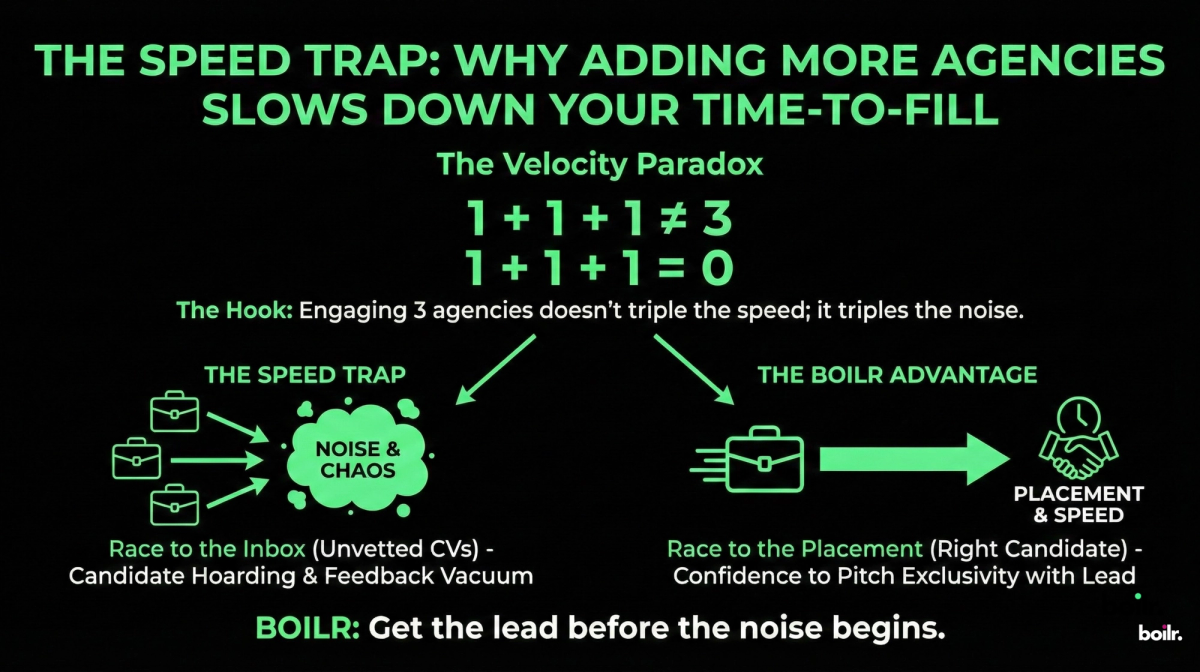
The logic suggests that by having three, four, or five agencies competing for the same role, the client will receive candidates faster. However, empirical data and behavioral economics suggest that this model creates a "velocity paradox" where frenetic activity masks systemic slowness.
The "Race to the Bottom" Dynamic
In a contingency environment, the agency's primary incentive is not quality, but speed of submission. Because the agency knows they are competing against several other firms and potentially internal HR teams the probability of making a placement on any given contingency role drops precipitously. Industry benchmarks indicate that contingency fill rates often hover between 20% and 35%, meaning that for every ten job orders a recruiter accepts, seven or eight will result in zero revenue.
This low probability of success forces recruiters to adopt a volume-based strategy, often described as "spray and pray." In this ecosystem, the operational behaviors are driven by fear of loss rather than pursuit of excellence:
- Minimal Screening: To ensure they are the first to submit a candidate, recruiters often bypass deep vetting processes. A CV that matches keywords is forwarded immediately, leading to a high rejection rate at the hiring manager's review stage.
- Candidate Hoarding and "Lock-in": Agencies rush to represent candidates, often submitting profiles without securing the candidate's full commitment or understanding their true motivations. This leads to high drop-out rates later in the funnel, often at the interview or offer stage, which resets the clock and extends the total time-to-fill.
- The Feedback Vacuum: Because hiring managers are inundated with duplicate or irrelevant CVs from multiple sources, they often disengage from the feedback loop. The administrative burden of managing five different agencies leads to communication paralysis, where recruiters are left chasing updates rather than managing the candidate experience.
Consequently, while the time-to-submit in a contingency model is superficially fast (often within 24–48 hours of the job release), the actual time-to-fill the metric that matters to the business bottom line is frequently elongated due to process churn, interview cancellations, and misaligned expectations.
The Client's Dilemma: Noise vs. Signal
From the client perspective, non-exclusive recruitment generates "noise." A hiring manager receiving 50 résumés from five different agencies faces a significant data processing challenge. The time spent de-duplicating candidates (resolving disputes over who "owns" a candidate) and filtering out "false positives" (candidates who look good on paper but are poor cultural or technical fits) adds days or even weeks to the process.
The contingency model also degrades the employer brand. When multiple agencies approach the same candidate pool for the same role, often with varying job titles or salary details, it signals desperation or disorganization on the part of the hiring company. Top-tier talent, receiving fragmented messaging, may perceive the company as unstable, leading to a reluctance to engage. This friction slows down the acquisition of high-quality candidates, who are often passive and require a high-touch, consistent narrative to be courted effectively.
In contrast, an exclusive engagement shifts the dynamic fundamentally. The agency is not competing against other agencies; they are competing against the market to find the best talent. This alignment allows the recruiter to act as a core recruitment partner and gatekeeper, only presenting candidates who are genuinely viable.
The 2025 Market Reality: The Cost of Slowness
The recruitment landscape in 2025 has exacerbated these issues. While job openings have stabilized in some sectors following the post-pandemic boom, talent shortages persist in critical high-value sectors like Technology, Engineering, and Healthcare. In this environment, the Cost of Vacancy has skyrocketed, making speed a financial imperative.
- Time-to-Hire Trends: The global average time-to-hire has increased to approximately 44 days, up significantly from the 30-day average seen in previous years. This elongation is partly due to more rigorous internal approval processes but is also a symptom of the inefficiencies in candidate sourcing.
- Candidate Drop-off: Lengthy processes are lethal in a candidate-short market. Statistics show that 70% of job seekers have declined offers simply because the process took too long. Top talent is typically off the market in as little as 10 to 20 days.
If a contingency process drags on for weeks due to the "noise" of multiple vendors, the best candidates are lost to competitors with more streamlined, decisive processes. In this context, the agency that can guarantee a streamlined, exclusive process is not just selling a service; they are selling velocity, certainty, and revenue protection.
The Physics of Speed: Deconstructing First-Mover Advantage
The concept of First-Mover Advantage (FMA) is well-documented in general business strategy, referring to the competitive edge gained by the initial significant occupant of a market segment. However, its application in the recruitment industry is specific, potent, and often misunderstood. In staffing, FMA does not merely mean submitting a candidate first; it means engaging the client before the competition is even aware that a need exists.
The "Pre-Market" Window
Most traditional recruitment tools and methodologies react to publicly available data. When a job is posted on LinkedIn, Indeed, or a company careers page, it effectively enters the "public domain." At this moment, the clock starts for every agency with a LinkedIn Recruiter license or a job board alert system. The barrier to entry for competition drops to zero.
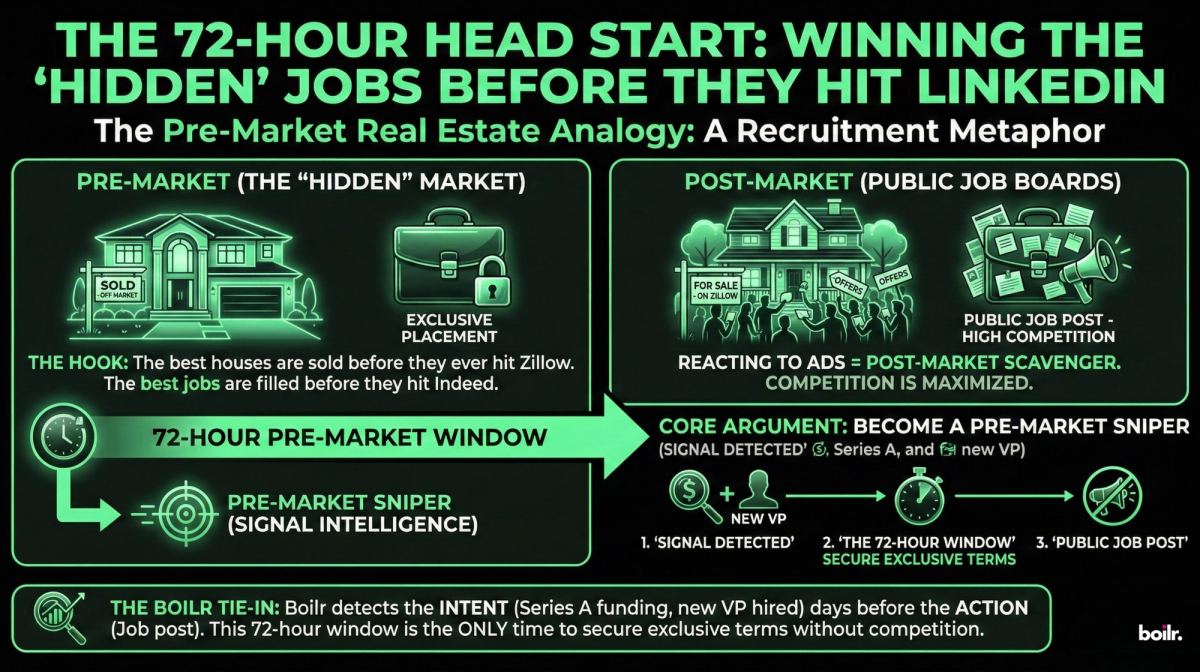
The probability of securing exclusive terms at this stage is low because the client has already signaled their intent to the open market. They have likely already received inbound applications and solicitations from multiple contingent recruiters. To secure exclusivity and the speed advantage that comes with it recruiters must operate in the "Pre-Market" Window.
True speed advantage comes from identifying the hiring signal 48–72 hours before the public posting.
- The 48-72 Hour Gap: This is the "Golden Window" for business development. During this period, a hiring manager is aware of a need perhaps due to a sudden resignation, a new project budget approval, or a confirmed funding round but has not yet formalized the job description or contacted HR to post the advertisement.
- The Pitch for Exclusivity: A recruiter contacting a manager during this window is not an annoyance; they are a solution to a problem the manager hasn't yet had time to address. By offering to handle the entire process immediately, the recruiter can secure exclusive terms simply by being the only solution present at the moment of need. This pre-emptive strike eliminates the competition before it can even form.
Operational Velocity in Exclusive Agreements
Once exclusivity is secured through early intervention, the mechanics of the search change to favor speed and precision. The operational workflow of an exclusive search is fundamentally more streamlined than a contingent one:
- Direct Access and Calibrated Communication: Exclusive recruiters typically negotiate direct access to the hiring manager, bypassing internal HR bottlenecks that often delay feedback in contingent processes. This allows for real-time calibration of the search. If the first three profiles are off-mark, the recruiter gets immediate feedback and adjusts, rather than sending ten more wrong profiles in the dark.
- Priority Scheduling: Candidates presented by an exclusive partner are prioritized for interviews. The client has a vested interest in the partnership's success and is less likely to cancel or reschedule interviews, a common occurrence with low-priority contingent submissions.
- Process Control and Accountability: In an exclusive arrangement, the recruiter controls the timeline. They can set firm expectations for feedback turnaround (e.g., "I will send a shortlist on Wednesday; we need interview slots confirmed by Friday"). This mutual accountability prevents the process from drifting and keeps momentum high.
- Candidate Experience: With exclusivity, the recruiter can fully brief the candidate on the company culture, the interview process, and the role's nuances without fear of another agency "stealing" the candidate. This results in better-prepared candidates who perform better in interviews, speeding up the decision-making process.
Data-Driven Speed Claims
Data supports the hypothesis that exclusivity accelerates outcomes and improves success rates.
- Fill Rates: Retained or exclusive searches boast fill rates of 85–95%, compared to the 20–35% typical of contingency recruitment. This discrepancy is massive. It implies that an agency working exclusively is 3 to 4 times more likely to generate revenue from a given unit of work than one working on contingency.
- Efficiency Gains: Clients utilizing exclusive partnerships report a significant reduction in administrative time sifting through fewer, higher-quality CVs. For agencies using signal intelligence tools like Boilr.AI to secure these exclusives, the weekly administrative burden can drop by 92% (from 13 hours to 1 hour). This time is repurposed into high-value activities: talking to candidates and closing deals.
The "physics" of this model are clear: by removing the friction of competition and the noise of duplication, exclusivity allows the recruitment process to flow at its maximum theoretical speed.
Signal Intelligence: The Engine of Exclusivity
To secure exclusive terms in a competitive market, recruiters must move upstream in the decision-making chain. They cannot afford to wait for a job description; they must anticipate the need. This requires Signal Intelligence the strategic use of data points to predict hiring intent before it is explicitly stated.
The Limitations of Traditional Tools
The current recruitment technology stack is crowded, but most tools fall into categories that are reactive rather than predictive. To understand the unique value of signal intelligence, we must distinguish it from existing solutions:
- Workflow and Process Management (ATS/CRM): Tools like Bullhorn and Vincere are the operating systems of the agency. They excel at managing candidates after they are found or managing job orders after they are won. They are systems of record, not systems of intelligence.
- Candidate Sourcing and Matching: Platforms like Sourcebreaker, LinkedIn Recruiter, and Paiger are designed to find candidates for a known job. They help fill the vacancy, but they do not help the agency win the vacancy in the first place especially not on exclusive terms.
- Contact Data Providers: Tools like ZoomInfo, Lusha, or Cognism provide contact details (emails, phone numbers) but lack specific hiring context. Knowing a CTO's email address is useless if you don't know why they might need your services right now.
Neither category effectively addresses the Business Development (BD) challenge at the signal level. They react to the market. Boilr.AI represents a new category: Predictive Hiring Intelligence. By monitoring over 10,000 sources (including funding announcements, GitHub activity, leadership changes, and government tenders), it identifies the pre-conditions for hiring.
The Boilr.AI Methodology: Decoding the Signals
Boilr.AI acts as a radar system for recruitment agencies. Instead of delivering a list of open jobs (which everyone has), it delivers actionable intelligence on companies that are about to hire. This intelligence is categorized into four main signal types, each providing a specific angle for pitching exclusivity.
The Four Core Hiring Signals
Context is King
The difference between a "cold call" and a "warm lead" is context. Boilr provides the "Why now?". When a recruiter calls a hiring manager and cites a specific trigger (e.g., "I noticed your new tech stack migration to AWS via GitHub activity"), they establish immediate authority. This context transforms the conversation from a sales pitch into a consultation.
- Relevance: The outreach is timely and relevant to the manager's immediate reality.
- Authority: It demonstrates that the recruiter understands the market and the company's specific situation.
- Trust: This authority is the foundation of trust required to ask for and receive exclusive terms. A client is more likely to grant exclusivity to a recruiter who understands their business drivers than to one who simply asks, "Do you have any jobs?"
By integrating these signals into their core recruitment strategy, agencies can shift from being vendors to being partners. This is the essence of the "Recruit Easy" methodology: making the sale easier because the timing and context are perfect.
The Financial Calculus of Speed: Revenue Implications
Speed and exclusivity are not just operational metrics; they are profound financial drivers. The impact of securing exclusive listings via early signal detection can be quantified through the Cost of Vacancy (COV) for the client and the Revenue per Billed Hour for the agency.
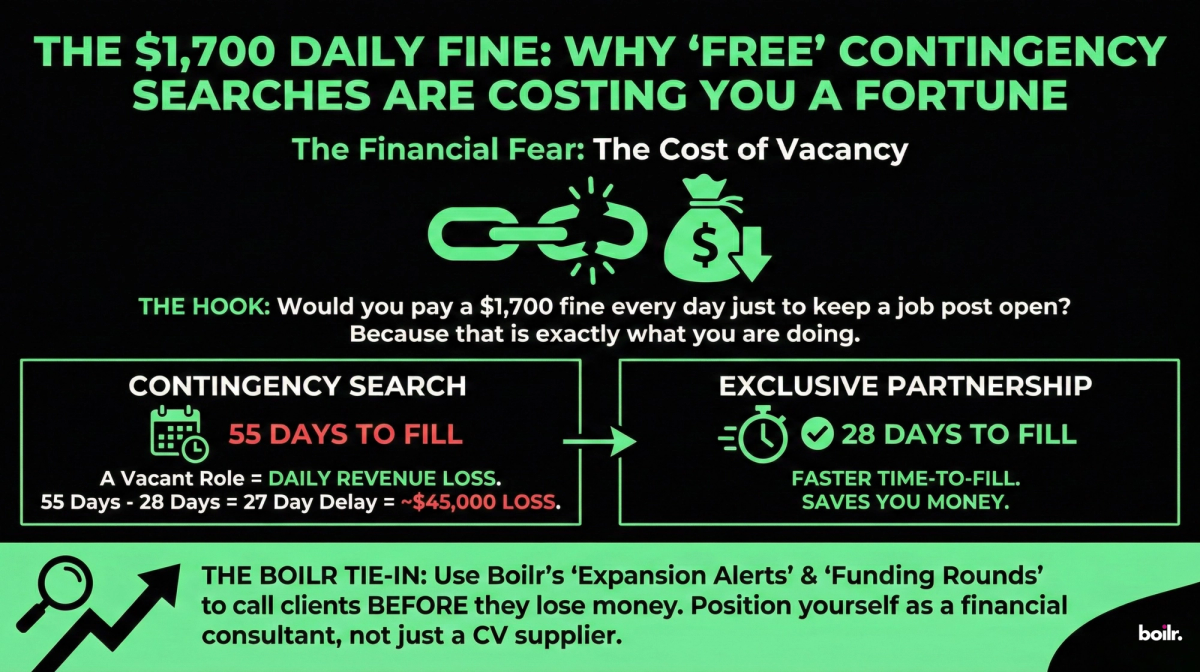
Understanding Cost of Vacancy (COV)
For the client, an open seat is expensive. The Cost of Vacancy is a metric that quantifies the revenue loss and productivity drain caused by an unfilled position.
- Revenue Loss: High-level professional vacancies (e.g., sales, leadership, specialized engineering) can cost companies between $4,000 and $10,000 per month in lost revenue and productivity. For revenue-generating roles like B2B sales representatives, the daily revenue loss can exceed $1,500.
- Indirect Costs: Beyond direct revenue, vacancies cause burnout among existing teams (who must pick up the slack), project delays, and potential loss of customers due to poor service levels.
When an agency pitches exclusivity, the argument should be framed financially:
"Mr. Client, every day this Sales Director role sits open, it costs your business approximately $1,700 in missed revenue opportunities. A contingency process, with its lack of focus and coordination, typically takes 60 days to fill. By working exclusively with me, I can dedicate 100% of my resources to this search, aiming to fill it in 30 days. That 30-day difference saves you over $50,000 in lost productivity. The fee for my service is an investment in stopping that loss."
This framing moves the negotiation away from "fee percentage" and towards "value delivered."
Agency Revenue Economics: The Efficiency Multiplier
For the recruitment agency, exclusivity transforms the Profit and Loss (P&L) statement by altering the "Fill Rate" mechanics.
- The Contingency P&L:
- Work on 10 roles.
- Fill 2 roles (20% Fill Rate).
- Result: 80% of the recruiter's labor is unbilled and wasted. The revenue from the 2 fills must subsidize the cost of the 8 failures.
- The Exclusive P&L:
- Work on 10 roles.
- Fill 9 roles (90% Fill Rate).
- Result: Only 10% of labor is unbilled. Revenue is maximized, and the recruiter's morale is higher.
Furthermore, exclusive retainers (even partial ones) smooth out cash flow. This predictability allows agencies to invest in better tools (like Boilr.AI) and training, creating a virtuous cycle of growth.
ROI of Signal Intelligence
The investment in a tool like Boilr pays for itself rapidly by facilitating this shift to exclusivity.
- Payback Period: Boilr claims a payback period of roughly 6 weeks.
- Lead Volume and Conversion: Agencies report 2-3x more leads and a 183% increase in first-contact rates.
- Scenario: If a subscription costs $500/month and leads to one extra placement of $15,000, the ROI is 30x. If it secures an exclusive partnership worth $100k/year in fees, the ROI is exponential.
Comparative Analysis: The Recruitment Tech Stack
To fully appreciate where exclusive-enabling tools fit, we must map the modern recruitment technology stack. The market is crowded with "AI-powered" tools, but they serve distinct functions. Understanding these distinctions is crucial for agency leaders making investment decisions.
Boilr.AI vs. The Field
The following comparison highlights the unique position of Boilr.AI as a "Pre-Market" intelligence tool versus "Post-Market" execution tools.
Deep Dive: Boilr vs. Sourcebreaker
Sourcebreaker is an excellent tool for finding candidates and matching them to live jobs found on job boards or within the agency's database. It uses semantic search to find people who fit a description. However, it relies on the job already existing. Boilr helps you find the client before the job exists. It focuses on the business development side.
- Distinction: Sourcebreaker reacts to a vacancy; Boilr predicts the vacancy.
Deep Dive: Boilr vs. SourceWhale
SourceWhale is a powerhouse for automating the execution of outreach sequences (emails, follow-ups, LinkedIn steps). It ensures that BD happens consistently. Boilr provides the target list for SourceWhale.
- Synergy: A recruiter uses Boilr to identify 50 companies hiring Engineering Managers due to recent Series B funding. They then push those contacts into SourceWhale to execute a personalized 3-step sequence referencing the funding. Boilr provides the who and why; SourceWhale handles the how.
Deep Dive: Boilr vs. Bullhorn/Vincere
Bullhorn and Vincere are the central nervous systems of the agency. They store data, manage compliance, and handle billing. However, an ATS is only as good as the data entered into it. Without fresh leads, an ATS becomes a "digital graveyard." Boilr feeds these systems. It injects new, actionable opportunities into the Bullhorn ecosystem, ensuring the CRM remains a dynamic engine of growth rather than a static repository.
The Integration Value: The "Recruit Easy" Stack
The most effective agencies in 2025 will not choose between these tools but will stack them to create an end-to-end Recruit Easy workflow:
- Detection (Boilr): Identify a Fintech company raising Series B capital 48 hours before the press release.
- Engagement (SourceWhale): Automate a hyper-personalized BD sequence to the CTO referencing the funding and offering an exclusive partnership.
- Acquisition (Sales): Secure the job order on exclusive terms using the "Cost of Vacancy" argument.
- Sourcing (Sourcebreaker): Search internal and external databases for the perfect candidate to fill the exclusive role.
- Management (Bullhorn): Manage the interview process, placement, and billing.
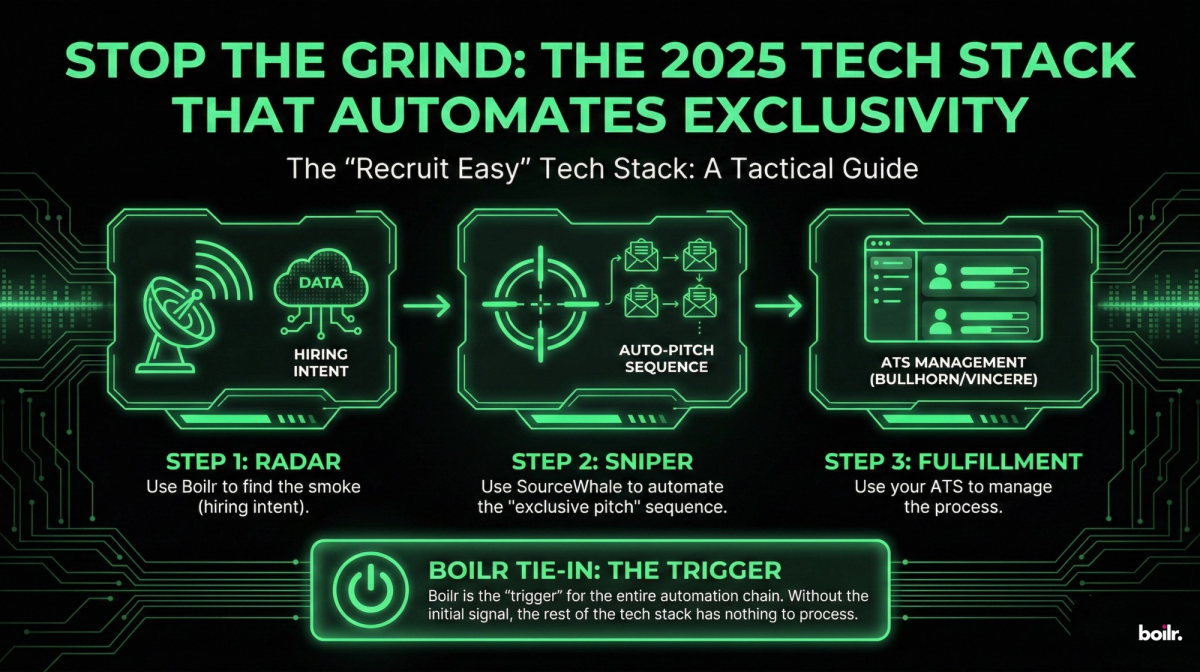
This integrated stack uses technology to remove friction at every step, allowing the recruiter to focus on the human element: persuasion and relationship building.
Optimizing Core Recruitment: A Framework for 2026
Core recruitment refers to the fundamental activities of identifying, attracting, and placing talent. To "recruit easy" in the modern era requires a shift in mindset from reactive order-taking to proactive consulting.
Moving from Reactive to Proactive
The traditional "post and pray" model waiting for inbound applications or reacting to client job orders found on boards is increasingly obsolete. Reactive recruitment leaves agencies fighting over scraps, dealing with commoditized roles where they have no leverage.
- Proactive BD: Agencies must act as strategic consultants. By using data (e.g., "I see you are expanding into the German market next quarter"), recruiters become advisors rather than just CV suppliers.
- Talent Pipelining: With exclusive terms, recruiters can build pipelines of passive candidates those not actively looking on job boards. These candidates are often higher quality, likely to stay longer, and are only accessible through a dedicated, proactive search.
The "Recruit Easy" Concept
Making recruitment "easy" is not about laziness; it is about removing noise and friction from the process. It is a methodology of efficiency.
- For the Client: "Recruit Easy" means dealing with one point of contact, receiving one consolidated update per week, and reviewing a shortlist of 3 excellent candidates rather than 30 mediocre ones. It means trusting the process.
- For the Recruiter: "Recruit Easy" means working on jobs you know you will fill. It means having the hiring manager's mobile number. It means receiving feedback in hours, not weeks. It means high billings with lower stress.
- For the Candidate: "Recruit Easy" means a transparent process where the recruiter actually knows the client, understands the culture, and can prepare them properly for the interview. This reduces anxiety and ghosting.
Building Trust through Data
Trust is the currency of exclusivity. In a market where trust in recruiters can be low, data is the bridge. You cannot ask for exclusivity without proving competence.
- The Data Pitch: "Mr. Client, industry data shows that using 4 agencies usually results in a 55-day time-to-hire. My exclusive fill time is 28 days because I control the process and eliminate duplication. Let's try exclusivity for 4 weeks to prove this speed advantage."
- Using Boilr Data: "I noticed your competitor just hired a new CTO and is likely to raid your engineering talent. Let's get ahead of this by securing your key hires now." This insight demonstrates value before a contract is even signed.
Deep Dive: Speed as a Strategic Weapon
Speed in recruitment is often misunderstood. It is not about sending a CV in 10 minutes. It is about Time-to-Acceptance the total time from the identification of a need to the candidate saying "Yes."
The Illusion of Contingency Speed
In a contingency model, Agency A sends a CV at 9:00 AM. Agency B sends the same CV at 9:05 AM. Agency A "wins" the submission timestamp.
- Reality: The client receives duplicates. They question the candidate's discretion ("Why is this person's CV everywhere?"). They pause the process to sort out ownership disputes between Agency A and Agency B. The interview is delayed while terms are clarified.
- Result: The submission was fast, but the hire is delayed. The illusion of speed created a bottleneck.
The Reality of Exclusive Speed
In an exclusive model, the recruiter might spend 48 hours mapping the market before sending a single profile. They interview 5 people. They submit 3 perfect candidates on Day 3.
- Reality: The client trusts the shortlist because they know the recruiter has done the filtering. Interviews are booked immediately for Day 5. An offer is made Day 10.
- Result: The submission was "slower" (3 days vs 10 minutes), but the hire was weeks faster because the friction, duplication, and administrative drag were removed.
Candidate Experience and Drop-off
Speed prevents drop-off. In a high-demand market, top talent is off the market in 10–20 days.
- If a process drags due to contingency chaos, top candidates accept other offers.
- Exclusive recruiters keep candidates warm, managing their expectations and "selling" the client throughout the process. This relationship management reduces the "ghosting" phenomenon and increases offer acceptance rates. By controlling the narrative, the exclusive recruiter ensures the candidate remains engaged until the offer is signed.
Emerging Trends & Future Outlook
As we move through 2025 and toward 2030, the reliance on signal intelligence and exclusivity will only deepen. Several macro-trends are accelerating this shift.
The "White Collar Recession" and Efficiency
With economic uncertainty (sometimes termed a "white collar recession" in specific sectors), companies are hiring fewer people but are more selective. They cannot afford mis-hires. This favors the Retained/Exclusive model where quality is guaranteed over the "throw mud at the wall" contingency approach. Clients want partners who can deliver precision, not just volume.
AI and Automation
AI is commoditizing the "easy" parts of recruitment. CV formatting, initial screening, and basic matching are increasingly automated. The value of a human recruiter is shifting entirely to Relationships, Strategic Insight, and Negotiation.
Tools like Boilr that provide insight will become standard infrastructure.
Agencies that refuse to adopt signal intelligence will be left fighting for low-margin, high-competition contingency roles, eventually being priced out by automation.
The Rise of "Recruitment as a Service"
We are seeing a blur between recruitment and consulting. Agencies are using market data (salary benchmarks, competitor hiring trends found via intelligence tools) to sell broader talent advisory services. Exclusivity is the natural contract form for this high-level relationship. Agencies are becoming strategic partners who advise on workforce planning, not just fillers of empty seats.
Conclusion
The evidence is overwhelming: in the modern recruitment landscape, exclusive job listings are the single most effective lever for increasing speed, quality, and revenue.
While the contingency model offers the illusion of speed through rapid activity, it is plagued by inefficiency, duplication, and low success rates. Exclusivity, underpinned by trust and process control, streamlines the path to placement, significantly reducing the true Time-to-Fill and saving clients thousands in Cost of Vacancy.
However, exclusivity is not given; it is earned. It requires recruiters to demonstrate value before the job order is even discussed. This is where Boilr.AI changes the game. By equipping agencies with Signal Intelligence the ability to detect expansion, funding, and leadership changes 48–72 hours before the market Boilr provides the decisive "First-Mover Advantage."
Agencies equipped with this foresight can approach clients not as desperate vendors asking for a job order, but as informed consultants offering a solution to an emerging problem. They can secure exclusive terms by being the first to the table with context and insight.
For the recruitment agency of 2025, the formula for success is clear: Signal Intelligence + First-Mover Action = Exclusivity. And Exclusivity is the ultimate speed advantage.
Key Takeaways for Recruitment Leaders:
- Stop Reacting: Don't wait for LinkedIn job alerts. By then, you are too late to secure exclusivity.
- Pitch Context: Use funding and expansion data to explain why you are calling. Context builds authority.
- Sell Speed via COV: Use Cost of Vacancy data to explain to clients why exclusivity will save them money.
- Align the Tech Stack: Use Boilr for the lead, SourceWhale for the outreach, and your ATS for the execution.
- Adopt the "Recruit Easy" Mindset: Let the software handle the signals so you can handle the relationships.
By adopting this data-driven, exclusive-first approach, agencies can escape the contingency rat race and build a scalable, high-margin business that delivers genuine value to clients and candidates alike.
The Efficiency Gap (Contingency vs. Exclusive)
Competitor Comparison (Signal Intelligence Focus)
Cost of Vacancy (COV) - The Price of Delay
Based on a company with $50M Revenue / 150 Employees
References:
- Cost of unfilled positions
- COV in Critical Positions
- Success Rate between Retained & Contingency Model
- Benefits on Recruiting on exclusive basis
- Strategic Advantage of exclusive partnerships in recruitment agencies
FAQs
- How does an exclusive search actually reduce Time-to-Fill compared to contingency?
While contingency recruitment often results in a faster time-to-submit (the "race to the inbox"), it frequently leads to a slower Time-to-Fill due to the noise of duplicate CVs, lack of candidate control, and delayed feedback. Exclusive partnerships allow recruiters to act as core recruitment gatekeepers, streamlining the interview process and ensuring candidates are fully vetted and committed. Data shows that exclusive processes can reduce the effective hiring timeline by removing the administrative friction caused by managing multiple vendors. - How can I use data to convince clients to agree to exclusive terms?
The most powerful argument for exclusivity is financial: the Cost of Vacancy (COV). By quantifying the revenue lost for every day a role remains open (often estimated between $1,000–$1,700/day for high-value roles), you can demonstrate that a streamlined, exclusive process saves them money. Furthermore, using Signal Intelligence from Boilr.AI allows you to approach the client with deep market context (e.g., "I know you just received Series B funding") before they post the job, proving your value as a strategic partner rather than just a CV supplier. - What is "Signal Intelligence" and why is it crucial for modern agencies?
Signal Intelligence is the practice of using data points such as funding rounds, office expansions, or leadership changes to predict hiring intent before a job description is publicly posted. In a market where speed is the primary differentiator, tools like Boilr.AI provide a First-Mover Advantage, giving agencies a 48–72 hour head start to pitch for exclusivity before the competition even knows the opportunity exists. - Why are fill rates so much lower for contingency recruitment?
Industry benchmarks suggest contingency fill rates often hover between 20% and 35%, meaning recruiters do unpaid work on 7 out of 10 roles. This is because contingency creates a "hedging" behavior where neither the client nor the recruiter is fully committed. In contrast, exclusive or retained searches typically see fill rates of 85% to 95% because the recruiter has the security to dedicate full resources to the search, ensuring a successful placement. - Does focusing on "Pre-Market" leads really replace the need for job boards?
Focusing on "Pre-Market" leads (opportunities detected via signals before they are advertised) does not replace job boards entirely, but it shifts the agency's model from reactive to proactive. Job boards are often a "red ocean" of high competition and low margins. By using signal intelligence to secure exclusive work in the "hidden job market," agencies can build a more profitable, predictable pipeline ("Recruit Easy") while using job boards merely as a supplementary sourcing channel rather than a business development crutch.