What does CRM really mean for recruiters and agencies?
The global recruitment landscape is currently navigating a profound and irreversible structural transformation.

The Paradigm Shift in Recruitment Intelligence: From Reactive CRM to Predictive Signal Architecture
The Structural Transformation of the Staffing Industry
The global recruitment landscape is currently navigating a profound and irreversible structural transformation. For the better part of the last decade, the industry operated under the paradigm of a "candidate-short" market. The primary value proposition of a recruitment agency was its ability to source, engage, and place hard-to-find talent in a competitive environment. This era gave rise to the dominance of the Applicant Tracking System (ATS) and candidate-centric technologies designed to nurture talent pools. However, as we advance through 2025 and approach 2026, the macroeconomic reality has inverted. We have entered a "client-short" market, characterized by economic caution, reduced hiring volumes in key sectors like technology, and a fierce consolidation of vendor lists.
According to the 2025 State of Staffing reports, the primary constraint on agency growth has shifted dramatically. In 2024, candidate shortages were cited as a top challenge by 17% of agencies; by 2025, this figure dropped to 12%. Conversely, "finding new clients" has surged to become the single most significant hurdle, cited by 23% of agencies as their primary operational bottleneck. This pivot from talent scarcity to opportunity scarcity exposes critical vulnerabilities in the traditional technology stack.
Legacy systems specifically the monolithic ATS/CRM platforms exemplified by market leaders like Bullhorn and Vincere were architected for a different era. They function as "Systems of Record," designed to manage workflows and store historical data. They are, by definition, reactive repositories. In a market where Speed to Lead is the decisive factor where responding within the first minute can increase conversion rates by 391% a system that waits for manual data entry is a liability.
This report provides an exhaustive analysis of the emergence of Signal Intelligence as the necessary evolution of the recruitment technology stack. It posits that the traditional understanding of "CRM" in recruitment is semantically and functionally flawed, leading agencies to invest in tools that manage relationships without providing the intelligence to initiate them. Through a detailed examination of the platform Boilr.ai, alongside competitors such as Sourcebreaker, SourceWhale, and legacy CRMs, this document outlines a strategic framework for adopting "Pre-CRM" intelligence. This approach leverages predictive signals funding rounds, leadership changes, and expansion alerts to identify hiring intent 48 to 72 hours before the broader market , thereby securing the First Mover Advantage (FMA) essential for survival in a constrained economy.
The Semantic and Functional Crisis of CRM in Recruitment
To address the strategic future of recruitment technology, one must first deconstruct the terminology that governs it. The industry is currently paralyzed by a semantic paradox surrounding the acronym "CRM," which has led to misaligned technology procurement strategies and operational inefficiencies.
The Duality of Definition: What Does CRM Stand For?
In the broader context of global enterprise, the query "what does crm stand for" yields a universally accepted definition: Customer Relationship Management. It is a strategic methodology and suite of software capabilities designed to manage a company's interactions with current and potential customers. The primary objective is to improve business relationships to drive sales growth, customer retention, and profitability. The "Customer" in this equation is the entity paying for the service.
However, within the recruitment and staffing sector, this definition has been bifurcated, creating a dangerous ambiguity:
- The "Candidate" Definition (Recruitment CRM): For the vast majority of recruitment technology vendors and practitioners, "CRM" has been co-opted to mean Candidate Relationship Management. In this specific domain, the "customer" is viewed as the candidate. These systems are engineered to build talent communities, automate candidate engagement, and manage passive talent pipelines. They answer questions such as “Who in our database is a Java Developer with five years of experience?” or “When was the last time we emailed this candidate?”
- The "Client" Definition (Sales CRM): Conversely, for agency owners and Business Development (BD) directors, "CRM" retains its traditional sales-centric meaning. It is the tool used to track companies, hiring managers, job orders, and revenue forecasts.
This distinction is not merely academic; it drives fundamental errors in software selection. When an agency leader searches for "what is a crm software" or "customer relationship management software crm", they are often seeking a solution to their revenue generation problems (finding clients). Yet, the recruitment software market predominantly delivers tools optimized for candidate nurturing.
The "System of Record" Trap
Standard customer relationship management software (CRM) is designed to be a System of Record. It acts as a centralized database where interactions are logged, notes are stored, and pipelines are visualized. In recruitment, this function is typically bundled with the Applicant Tracking System (ATS), creating "All-in-One" platforms.
- The ATS Function: This is the "Factory Floor" of the agency. It is process-driven, linear, and compliance-heavy. Its role is to move a candidate from "Application Received" to "Placed".
- The CRM Function: This is intended to be the "Sales Floor." It is non-linear and relationship-driven.
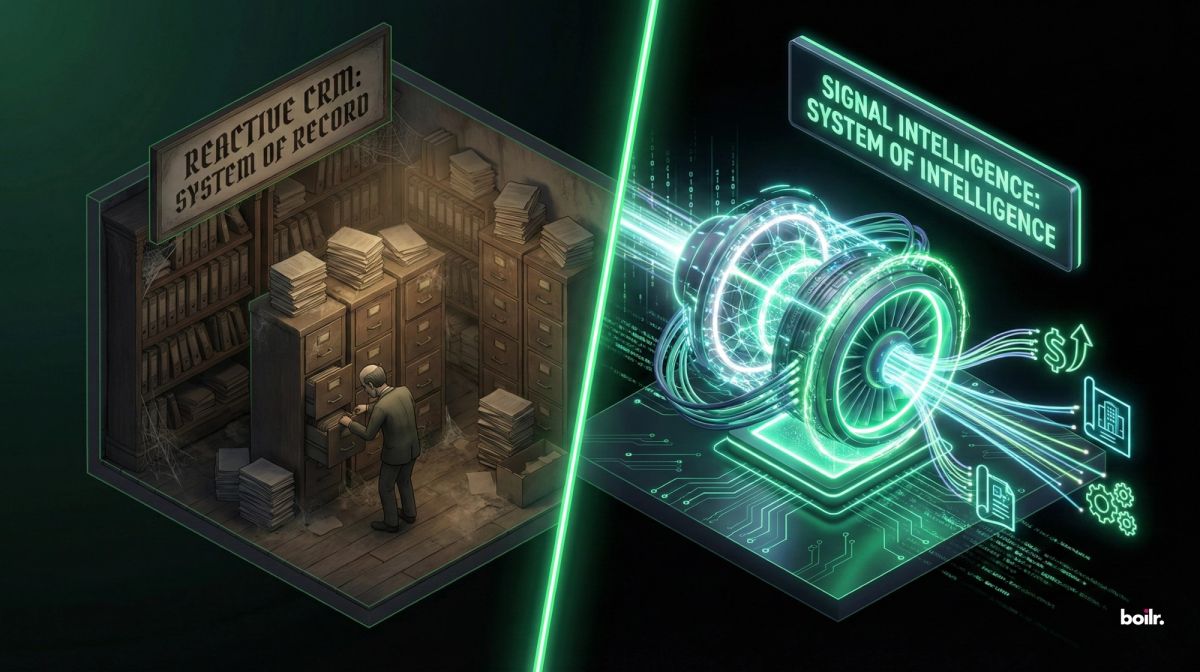
The critical failure of legacy recruitment CRMs is that they are passive. They rely entirely on manual data entry by recruiters to populate the database. This reliance creates the "Database Graveyard" phenomenon.
- Data Decay Dynamics: Research indicates that B2B contact data decays at an alarming rate. Approximately 70.3% of B2B data becomes inaccurate annually due to job changes, promotions, and company restructuring. Even conservative estimates place decay at 22.5% to 30% per year.
- Operational Impact: A CRM record created in 2022 for a "VP of Engineering" at a specific firm is, by 2025, statistically likely to be incorrect. The individual has moved, the company has pivoted, or the contact details have changed.
Therefore, answering "what is a crm software" for a modern agency requires a critical caveat: A traditional CRM is a container for historical data. It manages relationships that already exist. It does not identify new relationships. In a client-short market, a tool that manages history is insufficient; agencies require a tool that predicts the future.
The SEO Implication for Strategic Content
For Boilr.ai to effectively position itself through content, it must directly address these keywords by pivoting the narrative from "Management" to "Intelligence."
- Standard Keyword Intent: Users searching for "what is a crm software" are looking for definitions and features (database, email logging).
- Strategic Pivot: The content must validate this intent but immediately introduce the "Intelligence Gap."
Narrative: "While CRM stands for Customer Relationship Management, for recruiters in 2025, it must stand for Client Revenue Maximization through signal intelligence. A standard CRM stores data; a modern Signal Platform generates it."
The Crisis of Business Development in 2025
The necessity for a new category of technology Signal Intelligence is driven by the specific macroeconomic conditions of the 2025 staffing market.
The Great Market Flip: Talent vs. Clients
The recruitment industry is cyclical, but the current cycle is defined by a distinct scarcity of demand. The "War for Talent" has largely abated in many sectors due to tech layoffs and economic stabilization, leading to a surplus of available candidates in some verticals.
- The New Bottleneck: The Staffing Industry Analysts (SIA) 2025 trends report highlights that "finding new clients" is now the top challenge for 23% of staffing firms, up significantly from previous years.
- The Consequence: The leverage has shifted to the buyer (the employer). Employers are consolidating their Preferred Supplier Lists (PSLs), reducing agency spend, and utilizing internal Talent Acquisition (TA) teams more aggressively.
This shift renders the "candidate-first" BD strategy obsolete. Marketing "We have great candidates" is ineffective when the client has no open roles. The new requirement is to find the invisible demand the companies that have a need but have not yet broadcast it.
The Economics of Latency: The Cost of Being Late
In a client-scarce market, timing is the only non-commoditized differentiator.
- The 78% Rule: 78% of B2B buyers purchase from the vendor that responds first.
- The Platinum Minute: Lead conversion rates drop by 391% if the response time moves from 1 minute to just 2 minutes.
- Recruitment Reality: By the time a job is posted on a public board (LinkedIn, Indeed), the "First Mover" window has closed. The internal TA team has likely already engaged, and 3-5 competitor agencies have already made contact.

Entering the process at the "Job Post" stage forces agencies to compete in a "Red Ocean" of price wars (lower fees) and contingent terms. To restore margins and win exclusivity, agencies must enter the process before the job post.
Signal Intelligence: The New Frontier of Recruitment Technology
To solve the BD crisis, the industry is moving toward Signal Intelligence. This represents a technological leap from "Data" to "Insight," and from "Reactive" to "Predictive."
Defining Signal Intelligence vs. Intent Data
It is critical to distinguish between Signal Intelligence (the domain of Boilr.ai) and Intent Data (the domain of platforms like Bombora or 6sense).
Intent Data (Consumption-Based)
Intent Data monitors the digital consumption habits of companies. It tracks when an IP address associated with "Company X" visits a review site for "Recruitment Agencies" or reads a blog post about "RPO Implementation."
- Pros: Indicates psychological interest.
- Cons: High "noise-to-signal" ratio. Browsing does not equal budget. A junior HR admin researching "salary benchmarks" does not imply a mandate to hire 50 developers.
Signal Intelligence (Event-Based)
Signal Intelligence tracks objective, verifiable business events that create an operational mandate for human capital.
- Pros: High certainty. These events (Funding, Office Moves, Executive Hires) act as "forcing functions" for recruitment.
- The Logic: You cannot raise £10M for "Product Expansion" without hiring Product Managers. You cannot open a new Manchester headquarters without hiring Office Managers and Ops staff. The hiring is a derivative necessity of the event.
The Four Pillars of Predictive Hiring Signals
Boilr.ai aggregates data from over 10,000 sources (including GitHub, Glassdoor, Government Tenders, and News feeds) to identify four specific types of high-probability hiring signals :

- Expansion Alerts:
- The Signal: A company leases new real estate, registers a new legal entity in a different region, or announces a geographic expansion.
- The Strategic Implication: This signals an immediate need for "infrastructure" talent (Ops, Admin, IT) followed by "growth" talent (Sales, Engineering). Crucially, new office openings often occur outside the jurisdiction of existing PSLs, offering a backdoor for new agencies to enter.
- Example: "New Manchester Office 40+ Roles (Ops, Admin, IT) - No PSL in place".
- Funding Rounds:
- The Signal: Venture Capital or Private Equity investment (Seed, Series A/B/C).
- The Strategic Implication: Capital injection is the purest signal of budget availability. A Series A round typically allocates 40-60% of the funds directly to headcount growth.
- Granularity: Understanding the investor helps predict the roles. A "Deep Tech" VC investment signals R&D hires; a "Growth Equity" investment signals Sales & Marketing hires.
- Example: "£6M Series A - 15-20 planned hires: 8 Engineering, 3 Product, 5 GTM".
- Hiring Velocity:
- The Signal: A sudden, statistical spike in job postings or headcount growth (e.g., +12% headcount in 30 days).
- The Strategic Implication: This indicates that the internal Talent Acquisition team is overwhelmed. They have hit their capacity ceiling. The agency pitch shifts from "We have candidates" to "We can act as your overflow valve."
- Example: "4 Engineers/week, 3 Sales, 18 days average".
- Leadership Changes:
- The Signal: The appointment of a new C-Suite executive or VP (e.g., New VP of Engineering).
- The Strategic Implication: New leaders have a mandate to change the status quo. They often "clean house" and bring in their own teams. A new VP is the highest-probability trigger for a retained search assignment or a multi-hire project.
- Example: "New VP Engineering (Week 3) -> Team build: 2 Eng Managers, 4 Senior Devs".
The "Pre-CRM" Architecture
Signal Intelligence does not replace the CRM; it acts as the Pre-CRM Layer. The workflow evolves as follows:
- Old Model: Research (Manual) -> Data Entry (CRM) -> Outreach.
- New Model: Signal Detection (Boilr) -> Automated Enrichment -> CRM Injection (Bullhorn) -> Automated Outreach (SourceWhale).
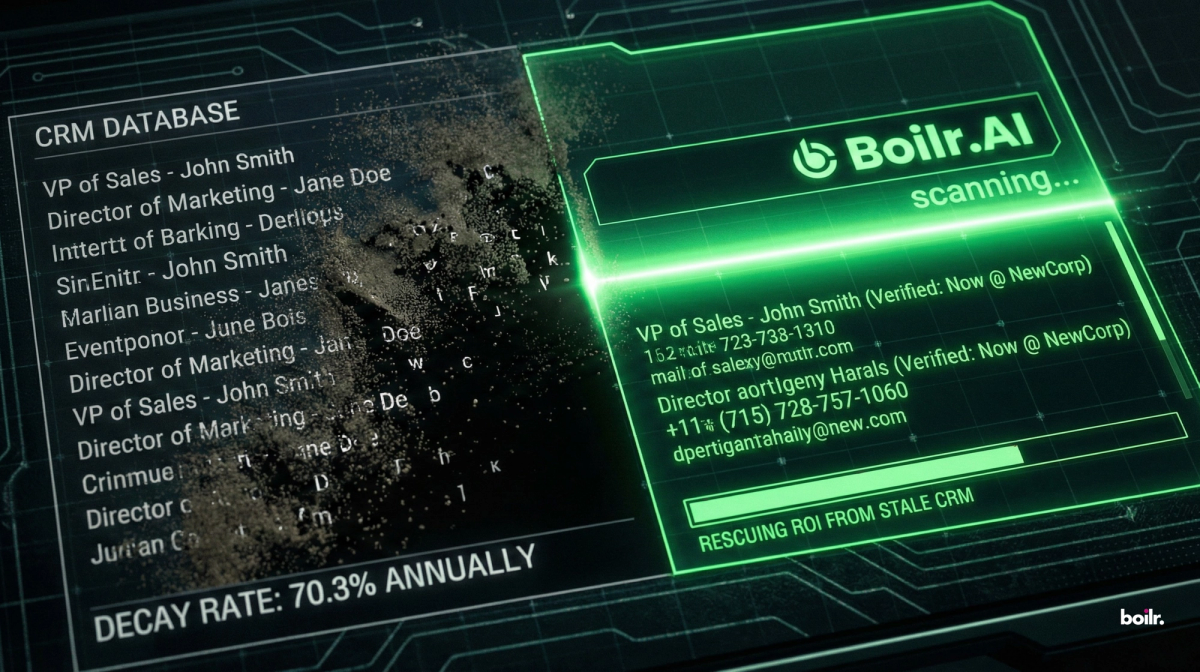
This architecture solves the "Data Decay" problem by ensuring that the CRM is continuously fed with fresh, active leads, rendering the state of the legacy data less critical.
Competitive Landscape and Strategic Positioning
To provide a comprehensive "EEAT-focused" analysis, we must evaluate Boilr.ai against the incumbent technology stack. The market can be segmented into Systems of Record, Execution Engines, and Intelligence Platforms.
Legacy ATS/CRM: Bullhorn & Vincere
Bullhorn and Vincere are the dominant Systems of Record.
- Function: They manage the recruitment lifecycle after a lead or candidate has been identified. They handle compliance, parsing, placement logic, and invoicing.
- Limitations (from Reviews): User feedback consistently highlights issues with performance and "bloat."
- Bullhorn: Reviews cite "nightmarishly slow" performance, high costs for implementation, and a steep learning curve. It is described as a "passive database" that requires significant manual effort to maintain.
- Vincere: While praised for being "all-in-one," reviews mention "kitchen sink syndrome" (too many features reducing usability) and a lack of native, sophisticated outreach cadences compared to dedicated tools.
- Boilr Differentiation: Boilr is complementary, not competitive. It feeds the leads into Bullhorn/Vincere. It solves the "Empty Warehouse" problem Bullhorn is the warehouse, Boilr is the supply chain.
Outreach Automation: SourceWhale
SourceWhale is the market leader in Execution.
- Function: It automates complex email and LinkedIn outreach sequences, ensuring high deliverability and consistent follow-up.
- Limitations: It is an execution engine, not a targeting engine. As noted in user discussions, "It's a gun, not the target." If a recruiter loads 500 irrelevant contacts into SourceWhale, the result is simply automated spam.
- Boilr Differentiation: Boilr provides the Target List. By integrating Boilr (Intelligence) with SourceWhale (Execution), agencies create a "Smart Bomb" effect highly relevant messages sent automatically to high-probability targets.
Search & Match: Sourcebreaker
Sourcebreaker is a direct competitor in the "Lead Generation" space but differs in focus.
- Function: Sourcebreaker is primarily a Search & Match tool designed to find candidates. Its "leads" module largely aggregates active job postings from company websites and job boards.
- Limitations: It is largely reactive. It identifies roles that are already public. While it has funding alerts, its core value proposition is candidate-centric.
- Boilr Differentiation: Boilr is purely Client-Centric and Predictive. It pushes the timeline back 48-72 hours before the job post appears. Sourcebreaker helps fill the job; Boilr helps find the job before the competition knows it exists.
Talent Matching: Paiger
Paiger focuses on Recruitment Marketing.
- Function: It automates social media sharing and helps recruiters build personal brands to attract candidates.
- Boilr Differentiation: Paiger is an Inbound tool (attracting talent via brand); Boilr is an Outbound tool (hunting clients via data).
The Economic Case: ROI and First Mover Advantage
The adoption of Signal Intelligence is not merely a technical upgrade; it is an economic imperative driven by the "First Mover Advantage" (FMA).
The Economics of FMA
In economic theory, FMA allows a company to establish brand recognition and customer loyalty before competitors enter the market. In staffing, this translates to:
- Exclusivity: By contacting a hiring manager based on a funding signal before they write the job spec, the recruiter can position themselves as a consultant, helping to define the role and securing exclusive terms.
- Fee Integrity: Competition drives fees down. Lack of competition preserves margins. First Movers do not need to discount.
Quantifiable ROI
Based on the Boilr.ai overview and industry benchmarks, the ROI of Signal Intelligence is measurable :
- Administrative Efficiency: Reduces weekly research/admin time from 13 hours to 1 hour (92% reduction). For a recruiter billing £200k, regaining 12 hours/week equates to ~£60k in additional billable capacity.
- Opportunity Volume: Delivers 2-3x more leads compared to manual sourcing.
- Conversion Efficacy: Increases First-Contact Rate from 23% to 65% (+183%). This massive jump is attributed to the relevance of the outreach. Calling with "I saw your Series A funding" is fundamentally different from calling with "Do you have any jobs?"
Strategic Implementation: The "Signal-Led" Playbook
For agencies to successfully integrate Signal Intelligence, they must adopt a new operational workflow. This "Pre-CRM Playbook" redefines the daily routine of the recruiter.
Step 1: The Signal Audit
Agencies must audit their current BD sources. If 80% of leads come from job boards, the agency is reactive. The goal is to shift the mix so that 50%+ of leads come from pre-market signals.
Step 2: The ICP Configuration
Boilr.ai and similar tools require a defined Ideal Customer Profile (ICP). Agencies must define their "Sweet Spot" not just by sector (FinTech) but by stage (Series A), tech stack (React/Node), and growth rate (+10%). Signal Intelligence allows for this level of granularity.
Step 3: The Integrated Workflow
The tech stack must be integrated to minimize friction:
- Boilr.ai detects the signal (e.g., "Company X Expansion").
- Enrichment API (ZoomInfo/Lusha) maps the contact details of the Hiring Manager.
- CRM (Bullhorn) receives the lead automatically.
- SourceWhale triggers a sequence: "Hi [Name], saw the news about the new Manchester office..."
Step 4: The Cultural Shift
The biggest barrier to adoption is recruiter behavior. Recruiters are conditioned to "farm" the CRM. Leadership must retrain teams to "hunt" using signals. This requires shifting KPIs from "Calls Made" to "Signals Actioned."
The Future of Recruitment Tech (2026-2030)
Looking beyond the immediate horizon, Signal Intelligence is the precursor to Agentic AI.
- Current State (2025): Predictive Intelligence. The software tells the recruiter who to call and why.
- Future State (2027+): Autonomous Agents. The software detects the signal, finds the contact, writes the personalized email, and books the meeting without human intervention.
Agencies that adopt Signal Intelligence today are building the data infrastructure and operational muscle memory required for the autonomous future. They are training their systems to understand what a good lead looks like.
Conclusion
The question "what does crm stand for" in recruitment is no longer a matter of semantics it is a matter of survival. The traditional definition Candidate Relationship Management has served the industry well during the talent shortage. However, the shift to a client-short market in 2025 demands a re-evaluation.
Agencies can no longer afford to treat their Client CRM as a passive address book. It must become a dynamic engine of opportunity. Signal Intelligence provides the missing link. By leveraging platforms like Boilr.ai to detect funding, expansion, and leadership changes 48-72 hours before the competition, agencies can secure the First Mover Advantage, protect their margins, and solve the critical challenge of client acquisition.
In the 2025 recruitment landscape, the agencies that win will not be those with the biggest database of candidates, but those with the fastest radar for clients. The era of the "Reactive Recruiter" is over; the era of the "Signal-Led Partner" has begun.
The Hierarchy of Recruitment Data
Comparative Analysis of Recruitment Intelligence Tools
Measurable Impact of Signal Intelligence
References
- Challenge Staffing firms faced in 2025
- Impact of Speed to Lead
- What is CRM in Recruiting?
- CRM - A clear picture
- Data Decay Rate Statistics
FAQs
- What does CRM stand for in a recruitment context, and why is there confusion?
In global enterprise, CRM stands for Customer Relationship Management, a strategy to drive revenue and client growth. However, the recruitment industry has bifurcated this definition. Many tech vendors use "CRM" to mean Candidate Relationship Management, focusing on talent pools and candidate nurturing. This duality creates a strategic gap: agencies often invest in software to manage "relationships" with talent while lacking the dedicated "intelligence" needed to identify and win new client contracts in a "client-short" market. - Why are legacy recruitment CRMs often described as "Data Graveyards"?
Standard CRMs are Systems of Record designed to store historical data. They rely on manual entry, which leads to rapid data decay; statistics show that up to 70.3% of B2B contact data becomes inaccurate within a year due to job changes and company restructuring. When a recruiter's database is "static," they spend an average of 13 hours per week on administrative research rather than active selling. A modern system must evolve from a "record" of the past into a System of Intelligence that provides real-time signals. - What are "Hiring Signals," and how do they differ from standard job alerts?
Standard job alerts (offered by tools like Sourcebreaker or LinkedIn) are reactive—they notify you after a job has been publicly posted. By that time, 3–5 agencies have already made contact. Hiring Signals (the core of Boilr.ai) are predictive indicators of intent. By monitoring events such as funding rounds, office expansions, and leadership changes, agencies can detect hiring needs 48–72 hours before a position is advertised. This allows recruiters to act as strategic partners rather than reactive vendors. - What is the "First Mover Advantage," and how does it impact agency margins?
In a competitive market, 78% of B2B buyers purchase from the first vendor to respond. In recruitment, being the "first mover" allows you to define the role requirements with the hiring manager before they are overwhelmed by competitors. This timing advantage leads to higher win rates (increasing first-contact conversion from 23% to 65%) and protects your margins by securing exclusive or retained terms rather than competing in "contingent" price wars. - Does Boilr.ai replace my existing CRM or ATS like Bullhorn or Vincere?
No. Boilr.ai functions as a "Pre-CRM" intelligence layer. While legacy systems like Bullhorn or Vincere excel at managing the recruitment workflow, compliance, and placements (the bottom of the funnel), they are "passive" databases. Boilr.ai acts as the radar system for the top of the funnel, identifying new opportunities and feeding fresh, enriched leads directly into your existing CRM for execution.