Sales tools every modern recruiter should understand
The recruitment industry is currently undergoing a profound structural and philosophical metamorphosis.
The recruitment industry is currently undergoing a profound structural and philosophical metamorphosis. Historically categorized as a purely human resources or administrative function, modern recruitment particularly within agency, executive search, and high-growth corporate environments has evolved into a highly sophisticated, technology-driven business-to-business (B2B) sales operation. The most successful talent acquisition professionals operating in the 2026 market do not view themselves merely as screeners of resumes; they operate indistinguishably from elite enterprise tech sales representatives. They leverage advanced sales tools, predictive data analytics, and automated workflows to secure market share, engage elusive passive talent, and dominate an increasingly competitive and complex economic landscape.
This convergence of talent acquisition and B2B sales methodologies is largely driven by severe macroeconomic pressures and shifting market dynamics. Following the hiring volatility and hyper-growth phases of the early 2020s, the global labor market has cooled significantly, entering a phase often characterized by economists as a white-collar recession. Consequently, recruitment teams have become notably leaner. The average internal recruiter headcount per team declined drastically from 31 in 2022 to just 24 in 2024, enforcing a strict mandate across the industry to do more with less, even as hiring volumes experience modest rebounds and the demand for highly specialized technical skills continues to outpace supply.
To compensate for reduced human capital and increased operational expectations, organizations are rapidly adopting artificial intelligence and advanced sales intelligence platforms. The data surrounding this technological shift is striking: enterprise AI adoption in the recruiting sector surged from a mere 26% in 2024 to 43% in 2025, with projections indicating that approximately 80% of enterprises will rely heavily on AI-driven hiring architectures by the end of 2026. Furthermore, a reported 87% of companies have already incorporated some form of AI into their recruitment processes, utilizing it for candidate sourcing, screening, and automated nurturing.
This exhaustive, educational analysis provides a nuanced, deep-dive exploration of the sales tools every modern recruiter must master to remain competitive and achieve elite performance levels. It examines the critical rise of predictive signal intelligence, the complex and often treacherous ecosystem of Customer Relationship Management (CRM) and Applicant Tracking Systems (ATS), the strategic implementation of outreach automation, and the essential educational pathways such as enrolling in a dedicated Salesforce class required to fully comprehend and orchestrate these complex technological ecosystems.
The Vanguard of Business Development: Predictive Signal Intelligence
The most profound technological advancement in recruitment business development is the transition from reactive sourcing to proactive, predictive signal intelligence. Traditional recruitment sales models rely heavily on lagging indicators. In a lagging model, a recruiter monitors public job boards, company career pages, or LinkedIn, and reacts only when a new vacancy is officially posted by an organization. By the time this public signal occurs, the opportunity is already heavily commoditized and saturated with competition. Industry data clearly indicates that by the time a role appears on LinkedIn, three to five competing recruitment agencies have already contacted the hiring manager, virtually eliminating any potential competitive advantage or premium positioning.
Signal intelligence platforms fundamentally invert this outdated model by capturing and analyzing leading indicators of organizational growth. These advanced systems continuously analyze disparate, unstructured data across thousands of digital channels to predict a company's hiring needs weeks or even months before a formal job requisition is drafted by the internal human resources department.
The Mechanism of Action: How Predictive Intelligence Algorithms Function
Platforms leading this specific category, such as the highly specialized Boilr.ai, do not function as traditional job aggregators. Instead, they monitor over 10,000 distinct data sources continuously, searching for the corporate events and financial triggers that act as the catalyst for headcount expansion. By applying machine learning and natural language processing (NLP) to these massive data streams, signal detection tools surface urgency, risk, and opportunity in real time, converting unstructured digital noise into highly structured, actionable sales insights.
The core predictive signals monitored by these advanced sales tools include:
- Funding Announcements and Venture Capital Movement: The detection of a major financial injection, such as a £6M Series A funding round, is an immediate, undeniable precursor to rapid headcount expansion. Signal intelligence translates this raw financial data into predictive hiring needs. Based on historical startup growth models, a system can predict that a Series A of this size will result in 15-20 planned hires, specifically localized across engineering, product development, and go-to-market (GTM) teams.
- Leadership and Organizational Restructuring: The appointment of a new executive, such as a Vice President of Engineering, typically precedes a massive departmental restructuring or expansion. A new leader will inevitably look to build their own team to execute their specific mandate, generating immediate opportunities for external recruiters to fulfill needs for engineering managers, senior developers, and DevOps specialists before internal HR is even briefed. Trigger-based outreach tied to leadership changes generates response rates of 14%, compared to a dismal 1.2% for standard cold calls.
- Geographic Expansion and Real Estate Alerts: Press releases, commercial real estate filings, or government tenders indicating a company is opening a new office location immediately signal localized hiring surges across administrative, operational, and IT functions. Contacting a hiring manager regarding a new location before a Preferred Supplier List (PSL) is established grants the recruiter exclusive access to the account.
- Technological Stack Adjustments: By continuously monitoring open-source repositories like GitHub, or tracking technology procurement and software implementation announcements, technical recruiters can anticipate an organization's need for highly specific, niche skill sets (such as advanced React, Node, or specific AI prompt engineering skills) before the internal team formalizes the technical requirements of the job description.
The Mathematical and Financial Advantage of the First Mover
In the highly competitive arena of recruitment business development, timing is the ultimate differentiator. Signal intelligence platforms provide a massive information asymmetry, giving recruiters a 48-to-72-hour head start over the rest of the market.
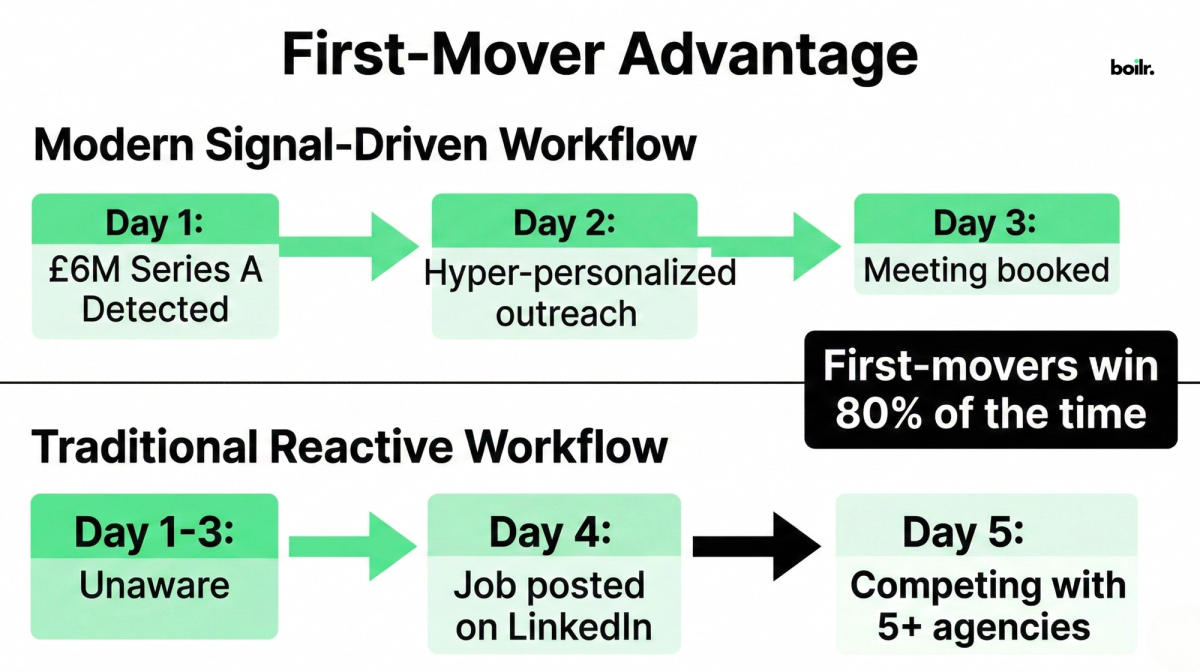
The return on investment (ROI) associated with this first-mover advantage is staggering and well-documented across B2B sales literature. Buyers in the B2B space which fundamentally includes hiring managers procuring external agency services begin their purchasing journey with at least one vendor in mind 92% of the time, and the vendor ranked first on day one ultimately wins the business approximately 80% of the time. Furthermore, the first seller to contact a decision-maker following a trigger event is mathematically five times more likely to secure the contract than subsequent competitors who reach out days later. Timing is explicitly correlated with conversion; vendors who contact newly funded firms within 48 hours of a funding announcement experience 400% higher conversion rates.
For recruitment agencies utilizing sophisticated platforms like Boilr.ai, the operational improvements are transformative. Agencies report a massive reduction in weekly administrative research time by 92%, dropping from an average of 13 hours per week of manual web scraping to just 1 hour of reviewing curated intelligence. More importantly, because the outreach is hyper-contextualized allowing a recruiter to reach out to congratulate a VP on a recent funding round rather than sending a generic, easily ignored capability statement the first-contact success rate skyrockets. Agencies see an improvement from a baseline first-contact rate of 23% to an impressive 65%, representing a 183% improvement in top-of-funnel engagement.
Strategic Competitor Analysis: Signal Intelligence vs. Traditional Market Tools
Understanding the precise distinction between signal intelligence and traditional candidate sourcing or workflow tools is a mandatory competency for anyone aiming to master modern sales tools.
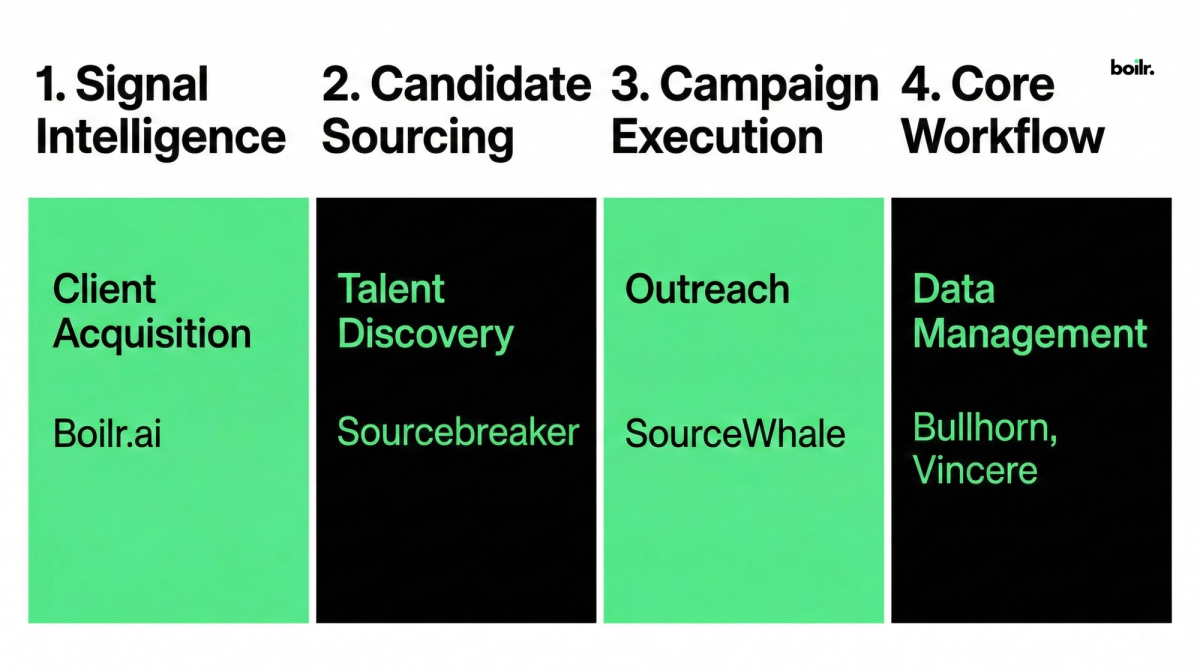
The market is highly fragmented, and utilizing the wrong tool for the wrong objective results in massive capital waste.
While the broader B2B sales intelligence market features massive, enterprise-grade tools like ZoomInfo Sales, Apollo.io, and 6sense, these tools are often overly broad for specialized recruitment. ZoomInfo provides massive B2B contact data and generalized intent signals, but often at a premium enterprise cost ranging from $15,000 to $40,000+ per year, heavily reliant on a credit-based system. Conversely, 6sense excels in predictive lead scoring for massive account-based marketing (ABM) campaigns. Recruitment-specific signal tools like Boilr strip away the generic B2B noise to focus exclusively on hiring velocity, organizational expansion, and specific talent acquisition indicators, providing a much higher ROI for specialized agency models.
The Infrastructure of Recruitment Sales: The Complex CRM and ATS Ecosystem
While predictive signal intelligence successfully dictates who a recruiter should contact and exactly when they should do it, the Customer Relationship Management (CRM) platform and Applicant Tracking System (ATS) dictate how those relationships are managed, nurtured, tracked, and ultimately monetized over months and years. In 2026, the historical distinction between a CRM (utilized for client-facing business development) and an ATS (utilized for candidate-facing applicant tracking) has essentially vanished. Modern recruitment sales tools must function as unified, seamless revenue orchestration platforms.
However, the current technology landscape is fraught with entrenched legacy systems that frequently hinder, rather than accelerate, the modern recruiter. Assessing the true operational cost, integration capabilities, and AI-readiness of these platforms is a mandatory competency for agency owners and individual consultants alike.
The Hidden Financial and Operational Costs of Legacy Infrastructure
When evaluating CRM platforms, the standard monthly per-seat licensing fee advertised on a vendor's website is merely the tip of the financial iceberg.
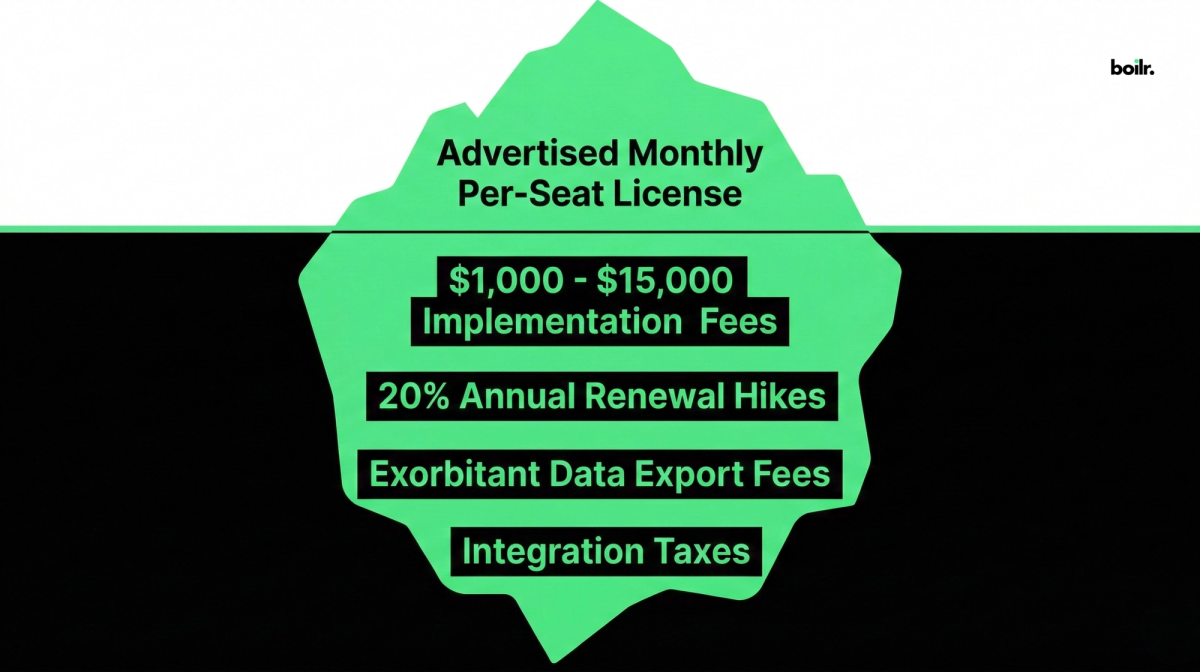
The true financial impact on a recruitment agency's Profit & Loss (P&L) statement is often hidden deep within implementation complexities, aggressive contract structures, and daily administrative friction.
- The Integration Tax and Extensibility: Legacy systems frequently rely on outdated, monolithic software architecture. Market incumbents, such as Bullhorn, often charge additional fees for nearly every module, add-on, or API integration that extends beyond the core ATS/CRM functionality. This business model forces agencies to pay a massive premium simply to connect their central CRM to modern email automation tools, VoIP dialers, or signal intelligence platforms.
- Data Hostage Fees and Contract Traps: Vendor lock-in remains a severe and highly unethical issue within the recruitment software space. Platforms such as Vincere have historical instances of charging agencies exorbitant fees sometimes exceeding 1,000 euros simply to export their own proprietary data upon the termination of a contract. Furthermore, legacy providers like Bullhorn are notorious for attempting aggressive 20% price increases upon contract renewal, which is consistently cited as the primary trigger pushing agencies to explore modern alternatives.
- Administrative Overhead and Friction: The most insidious, yet impactful, cost of poor CRM selection is lost human productivity. Every hour a highly paid recruiter spends fighting a clunky user interface, manually logging calls, or deduplicating candidate records is an hour directly subtracted from revenue-generating business development. At average agency billing rates, even 30 minutes of daily administrative friction per recruiter costs the business exponentially more annually than the most expensive enterprise CRM subscription available on the market.
Evaluating Enterprise vs. Agile CRM Platforms: A Competitive Analysis
The current recruitment software market is sharply divided. On one side are the entrenched legacy giants attempting to rapidly retrofit artificial intelligence into old codebases to remain relevant; on the other side are agile, AI-native platforms built specifically from the ground up to support modern automated workflows.
The industry consensus among technology analysts in 2026 clearly indicates a rapid, permanent migration away from systems that require heavy manual data entry. The CRMs that built AI into their foundational architecture from day one such as Atlas, Loxo, and Recruiterflow possess a massive, undeniable structural advantage over legacy platforms that are merely bolting AI features onto decade-old technology.
Ecosystem Mastery: The Strategic Imperative of the Salesforce Class
While highly specialized, niche recruitment CRMs like Loxo or Recruiterflow dominate the boutique agency market, the undisputed behemoth of global B2B sales infrastructure remains Salesforce. For large-scale recruitment agencies seeking to scale aggressively, diversify into complex professional services, or manage highly intricate enterprise-level client relationships, Salesforce acts as the central, indispensable nervous system of the organization.
However, Salesforce is emphatically not a plug-and-play solution; it is a highly complex, infinitely customizable platform ecosystem. The sheer depth and power of the platform mean that untrained recruiters will typically utilize less than 10% of its actual capability, rendering the massive financial investment largely useless. Consequently, undertaking formal, structured education by enrolling in a dedicated Salesforce class and achieving official certification has become one of the most highly sought-after, resume-defining competitive advantages for modern recruitment professionals.
The Career and Operational Value of Salesforce Certification for Recruiters
The global demand for deep technical proficiency in sales operations is surging at an unprecedented rate; macroeconomic projections indicate a critical need for 1.8 million new tech skills globally by 2030 as innovations like generative AI accelerate industry transformation. A formal Salesforce CRM certification unequivocally proves to employers, clients, and industry peers that a recruiter possesses the in-demand, technical expertise required to optimize business workflows and drive tangible revenue.
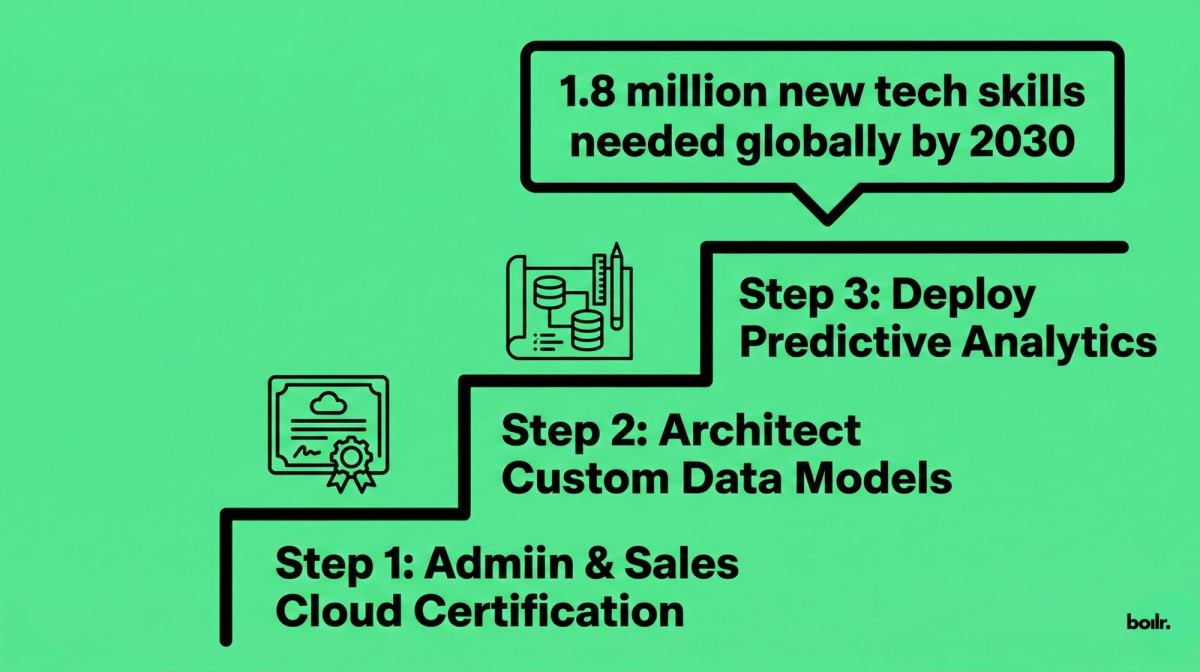
The tangible benefits of completing a rigorous Salesforce class and obtaining certification (such as the highly relevant Salesforce Certified Sales Representative, Sales Cloud Consultant, or foundational Salesforce Administrator credential) extend far beyond a simple resume update :
- Architecting the Sales Pipeline and Data Modeling: Certified recruiters transcend basic data entry. They possess the architectural knowledge to construct custom data models within Salesforce that perfectly mirror their agency's unique recruitment workflows. Through advanced classes, they learn to configure custom objects for distinct entities like candidates, job orders, interview stages, and client interactions, ensuring pristine data hygiene and total pipeline visibility.
- Unlocking Deep Automation: Through comprehensive educational classes, recruiters learn to move entirely beyond manual updates by mastering Salesforce's powerful declarative automation tools most notably Flow and Process Builder. This expertise enables the creation of highly complex, automated candidate nurturing campaigns, trigger-based interview scheduling, and automated compliance tracking, vastly reducing the administrative drag that plagues uncertified teams.
- Predictive Analytics and Executive Reporting: A proper, rigorous Salesforce education empowers recruitment leaders to construct complex, real-time dashboards that track vital "North Star" performance metrics. Instead of just tracking calls made, certified professionals build dashboards analyzing offer acceptance rates, pass-through rates by specific demographics, and granular time-to-fill metrics. This formally transitions the agency from a culture of reactive reporting to one of predictive, data-driven forecasting.
- Earning Potential and Career Trajectory: For the individual recruitment professional, Salesforce certification is highly lucrative. Because certified professionals possess verified, in-demand experience, they require significantly less training and onboarding, allowing organizations to realize value immediately. Consequently, companies are willing to pay a substantial premium for this talent. Certified professionals become visible for advanced, high-paying roles bridging traditional recruitment and revenue operations (RevOps), a field experiencing massive organizational growth.
Integrating the Broader Salesforce Ecosystem into the Recruitment Lifecycle
A high-quality, comprehensive Salesforce class will educate recruitment professionals not just on the core CRM, but on the entire interconnected ecosystem of products that drives modern B2B business development :
- Sales Cloud Mastery: Sales Cloud is the core transactional engine for managing relationships with hiring managers and corporate clients. It meticulously tracks the entire business development lifecycle, from initial cold outreach to signed Master Service Agreements (MSAs). Advanced training through a Salesforce class allows recruiters to utilize AI-driven sales forecasting, automate complex lead routing based on territory or specialty, and integrate cold calling directly into the workflow.
- Marketing Cloud (Account Engagement / Pardot): B2B recruitment is heavily reliant on long-term, sophisticated relationship nurturing. A deep educational understanding of Pardot allows recruitment agencies to execute enterprise-grade marketing strategies. Recruiters learn to intricately segment audiences, deploy multi-channel drip campaigns to hiring managers, and track highly specific behavioral engagement data. For example, the system can automatically score a lead higher and trigger a task for the recruiter if a VP of Human Resources frequently opens emails and reads the agency's proprietary salary guide content.
- Agentforce and the AI Integration Frontier: The absolute newest frontier in Salesforce education focuses heavily on artificial intelligence. Cutting-edge training on the Einstein 1 Platform and Agentforce teaches modern recruiters how to deploy autonomous AI agents. These agents can independently handle top-of-funnel inbound prospecting, dynamically draft highly personalized outreach emails, and generate concise summaries of hour-long candidate interview transcripts, thereby drastically scaling human output without increasing headcount.
Trailhead: The Lifelong Learning Engine for Sales Professionals
Because cloud software updates continuously, a single class is insufficient for lifelong mastery. For continuous, ongoing education, modern recruiters rely heavily on Salesforce Trailhead, the platform's massively popular, gamified, and free learning ecosystem. Dedicated learning modules and curated "Trailmixes" exist specifically tailored for Business Development Representatives (BDRs) and Sales Operations professionals.
Through Trailhead, recruiters can engage in highly practical, hands-on projects within isolated sandbox environments. They can practice building a complex data model for a custom recruiting app, learn nuanced conversational selling techniques, or master newly released AI tools without ever risking breaking their live, production organizational CRM. Trailhead enforces a mandatory culture of continuous improvement, ensuring that a recruiter's technological fluency evolves concurrently with platform updates and new releases announced at major ecosystem events like Dreamforce or TDX.
Outreach Automation and Multichannel Sequencing Execution
Possessing brilliant predictive signal intelligence (knowing exactly who to contact) and a robust, perfectly architected CRM (knowing exactly how to manage the data) is completely insufficient without a mechanism for highly efficient, scalable outreach. The third critical pillar of the modern recruiter's tech stack consists of sales engagement and outreach automation platforms.
The historical era of sending generic, mass-blast emails (colloquially known as "spray and pray") is officially dead and actively harms brand reputation. Modern B2B buyers and hiring managers are drowning in unprecedented digital noise; between constant Slack pings, LinkedIn connection requests, and overflowing email inboxes, valuable signals are easily lost or ignored. Modern outreach requires sophisticated multi-channel sequencing that feels intimately, almost frighteningly personalized, while operating flawlessly at machine scale.
The Automation Platform Hierarchy: Sourcing vs. Execution
To build a functional tech stack, recruiters must clearly differentiate between tools designed for market intelligence, tools designed for candidate discovery, and tools designed for actual campaign execution.
The SourceWhale and Sourcebreaker Dynamic
A prime example of optimizing the modern tech stack is deeply understanding the interplay and complementary nature of tools like SourceWhale and Sourcebreaker.
Sourcebreaker acts as the ultimate candidate discovery engine. It unleashes powerful AI and automation on traditional, highly manual sourcing processes, allowing recruiters to build vastly superior candidate pools at ten times the speed of a human operator. It intelligently aggregates data across multiple platforms simultaneously, ensuring recruiters find exceptional candidates that competitors relying solely on basic LinkedIn searches will completely miss.
Conversely, SourceWhale is a pure execution engine. It does not find the candidates or the clients; it contacts them relentlessly. SourceWhale integrates seamlessly with the agency's primary CRM and data intelligence tools to orchestrate highly complex, multi-touch outreach campaigns. For example, if a recruiter utilizes Boilr.ai to discover a hiring manager who just received Series B funding, they can push that contact's profile directly into SourceWhale. The platform will then automatically trigger a personalized email on day one, an automated LinkedIn connection request on day three, and a scheduled follow-up phone task in the CRM on day five, ensuring no lead falls through the cracks.
Overcoming the Deliverability Crisis and the AI Personalization Premium
A critical, frequently overlooked aspect of outreach automation is the technical challenge of email deliverability. As enterprise spam filters and email providers become increasingly aggressive in blocking automated outreach, even the most brilliantly written recruitment pitch is entirely useless if it lands directly in a prospect's junk folder. Agencies are increasingly turning to dedicated email warm-up and validation tools like MillionVerifier to ensure accurate outreach, verify email addresses before sending, and maintain high domain reputations.
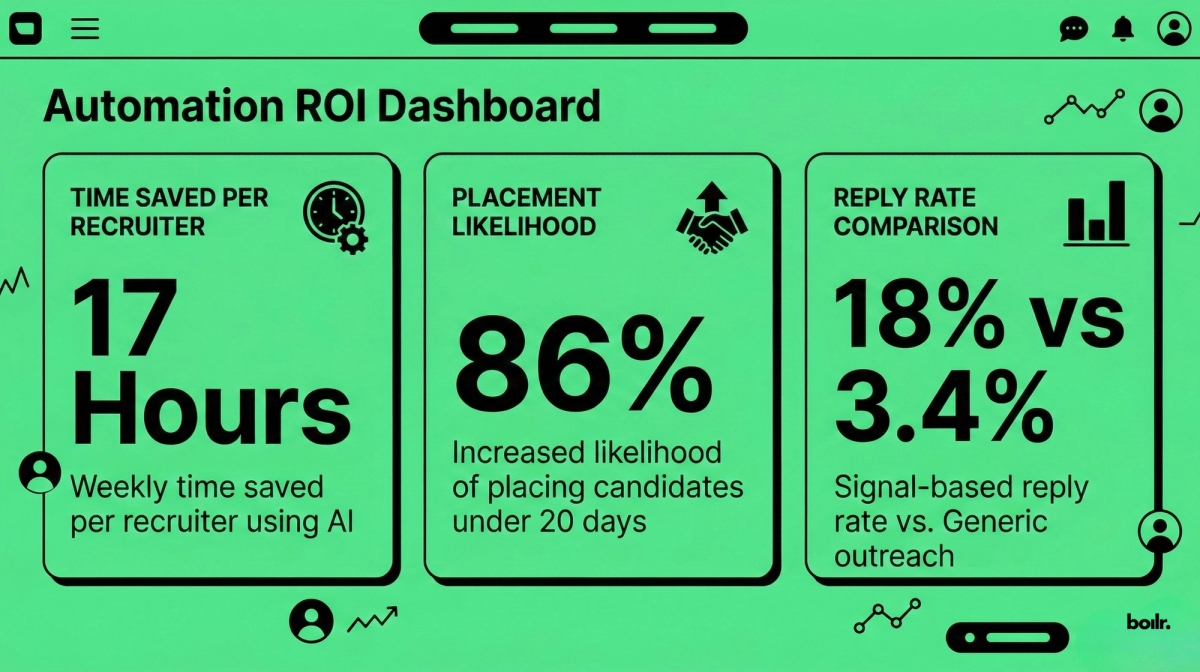
Furthermore, high-performing sales organizations are recognizing that pure, unrefined automation yields rapidly diminishing returns. Data shows that the industry average for cold outreach reply rates is a dismal 3.4%. However, highly personalized, signal-based campaigns using multiple custom fields boost reply rates to an average of 18%, representing a massive 5.2x improvement over generic outreach.
Advanced platforms like Outreach.io and Clay are utilizing AI to bridge this gap. Sellers using AI tools can cut manual research and personalization time by 90%. The objective of these advanced tools is not to completely remove the human from the process, but to seamlessly automate the administrative delivery mechanisms so the human recruiter can spend 100% of their time crafting highly targeted, deeply researched messaging based on the rich signal intelligence they gathered.
The Financial and Operational ROI of Recruitment Automation
The core justification for investing heavily in these advanced sales tools, complex CRMs, and comprehensive educational pathways (like a dedicated Salesforce class) lies in the irrefutable, deeply researched financial return on investment (ROI). The deployment of AI and automation in recruitment is no longer viewed as an experimental luxury or a trend; it is a fundamental baseline requirement for long-term economic survival and scalability.
Quantifying the Massive Efficiency Gains
The current state of manual, un-automated recruitment is defined by severe administrative bloat and massive inefficiency. Recent industry surveys reveal that business leaders report spending up to 45% of their valuable time on mundane talent acquisition administrative tasks, taking them entirely away from core revenue-generating operations. Furthermore, a staggering 73% of a typical hiring team's time is consumed by repetitive tasks that are easily and affordably automatable by modern software.
When advanced recruitment sales tools and signal intelligence are fully deployed, the operational transformation is immediate, profound, and easily measurable:
- Drastic Time-to-Fill Compression: The traditional B2B deal cycle notoriously stretches to an average of 83 days, but proper sales intelligence implementation reliably compresses this timeline to just 34 days. Similarly, in the recruitment sector, firms aggressively leveraging AI for candidate screening and matching are mathematically 86% more likely to successfully place a candidate in under 20 days.
- Recruiter Productivity Multipliers: The widespread adoption of AI tools is projected by industry analysts to save an average of 17 hours per recruiter, per week. Specifically, AI saves 4.5 hours per week on the tedious task of searching for candidates alone. By completely eliminating manual data entry and automating multi-step outreach, an AI-assisted recruiter can comfortably handle 40% more candidates weekly while simultaneously maintaining or actively improving the overall quality of hire.
- Surging Conversion and Win Rates: The deep integration of predictive analytics and lead scoring algorithms yields massive pipeline improvements. Companies utilizing AI-driven lead scoring witness their conversion rates jump by 25% to 45%, while simultaneously dropping their cost per acquisition (CPA) by an impressive 30%. Overall, sales teams utilizing AI features heavily report their win rates increasing by an astonishing 50%.
Modeling the True Financial Impact on Agency Economics
To truly understand the macro impact of this technology, one must look closely at the unit economics of a standard agency recruitment desk.
Consider a competent agency recruiter currently billing an average of 8 placements per month at a standard placement fee of $15,000. If this recruiter is trained to adopt signal intelligence (such as Boilr.ai) to generate a proven 200-300% increase in qualified lead volume, and utilizes an automated CRM workflow to save 17 hours a week of administrative labor, their operational capacity increases dramatically.
Even a highly conservative economic estimate suggests this automation capacity allows for 2 to 4 additional successful placements per month. This directly translates to an additional $30,000 to $60,000 in raw monthly revenue generated per recruiter. When this massive revenue upside is weighed against a highly sophisticated tech stack cost (even approximating a heavy $10,000 monthly overhead for an entire mid-sized agency's enterprise software suite), the financial ROI rests comfortably and consistently between 340% and 500% within the first 18 months of implementation.
Furthermore, the operational cost of not adopting this technology is quietly devastating to agency profitability. Replacing a failed sales hire, or losing a top-billing recruiter to a competitor because they are frustrated by archaic, manual tools, can cost an organization up to 150% of the departing employee's base salary in lost productivity and replacement costs. A frictionless, highly automated technological environment is now considered a primary driver of internal recruiter retention and satisfaction.
The Crucial Human Element: The Modern Sales Mindset
Despite the overwhelming power of predictive signal intelligence, AI-native CRM architectures, and hyper-personalized multi-channel sequencing, technology remains a multiplier of zero if the underlying human skillset utilizing it is deficient. As the industry adage dictates, a fool with a tool is still a fool. The ultimate, long-term success of a modern recruiter depends entirely on abandoning old paradigms and adopting a high-performance, consultative B2B sales mindset.
The traditional, passive "HR administrative" mindset is completely obsolete in 2026. Modern organizations demand recruiters who operate with the strategic rigor of elite Sales Development Representatives (SDRs).
The Conversational Selling Framework and the SV Academy Methodology
Leading educational programs, such as the prestigious SV Academy methodology deeply integrated into Salesforce's official SDR Coursera certification paths, emphasize a radical shift toward "Conversational Selling". This specific methodology is highly applicable to the daily realities of modern recruitment business development:
- Consultative Grounding and Strategic Questioning: Recruiters must permanently move away from highly transactional pitches (e.g., "I have a great candidate for your open role") and instead utilize strategic questioning to uncover deep organizational pain points. Why is the role open? What is the specific financial cost to the business for every week this critical engineering seat remains empty? By directly anchoring the conversation in the client's P&L (Profit and Loss statement), the recruiter elevates their status from a disposable vendor to an indispensable strategic consultant.
- Empathetic Listening and the "Golden Ratio": Elite sales success is dictated not by the ability to speak, but by a world-class ability to listen. Recruiters must strictly adhere to the "Golden Talk vs. Listening Ratio," ensuring they spend far more time actively absorbing the nuanced needs, frustrations, and goals of the hiring manager than blindly pitching their agency's generic capabilities.
- Advanced Objection Handling ("Triple-A Responses"): In a constrained economic environment, hiring managers will inevitably push back on agency fees, exclusivity terms, or the necessity of using external search. The modern sales mindset does not fear objections; it welcomes them as opportunities to deepen the relationship. Utilizing frameworks like the "Empathize and Challenge" model and "Triple-A Responses," recruiters learn to elegantly pivot prospect resistance into a reaffirmation of the agency's unique value proposition, specifically leveraging the hard data and market intelligence their advanced tech stack provides to prove ROI.
- Resilience, Accountability, and Data-Driven Optimization: The high velocity of modern, tech-enabled outreach means that rejection happens at scale. A growth-minded recruiter utilizes the granular data from their CRM to decouple their emotional state from rejection. If a 100-email automated cadence yields 5 direct rejections and 95 non-responses, the data-driven recruiter does not despair; they hold themselves accountable, analyze the open rates, tweak the A/B test subject line in a tool like SourceWhale, and launch the next highly optimized iteration.
As artificial intelligence continues to inevitably subsume the mechanical, low-value tasks of sourcing resumes, scheduling interviews, and conducting initial basic screenings, the premium placed on these deeply human "power skills" empathy, strategic negotiation, complex storytelling, and highly nuanced problem solving will only increase exponentially. The successful recruiter of 2026 is no longer an administrator matching keywords on a resume; they are a highly specialized revenue orchestrator.
Synthesis and Future Outlook
The global recruitment industry has definitively crossed a technological Rubicon. The days of relying on gut intuition, manual spreadsheets, and the highly reactive monitoring of public job boards are permanently over. To survive, thrive, and scale in 2026 and beyond, recruitment professionals must fundamentally re-architect their entire approach to the market, fully embracing their identity as elite B2B sales professionals operating within a complex, data-rich ecosystem.
The blueprint for enduring success requires a multi-layered, deeply integrated technological strategy. It begins at the very top of the sales funnel with predictive signal intelligence, utilizing advanced platforms like Boilr.ai to capture a lucrative first-mover advantage weeks before the broader competition is even aware an opportunity exists. It requires a ruthless, objective evaluation of CRM infrastructure, aggressively shedding legacy systems that impose administrative friction and integration taxes in favor of agile, AI-native platforms. Furthermore, it demands absolute mastery over campaign execution, leveraging tools like SourceWhale and Outreach.io to deliver hyper-personalized, multi-channel outreach flawlessly at scale.
Crucially, however, realizing the full potential of this technology requires an unwavering commitment to continuous, formal education. Enterprise platforms like Salesforce are far too powerful and complex to be utilized casually or learned implicitly. By actively investing in dedicated, rigorous educational pathways such as completing a comprehensive Salesforce class, earning industry-recognized certifications, and engaging with Trailhead continuous learning modules recruiters gain the deep architectural knowledge necessary to build predictive, data-driven revenue engines.
Ultimately, the deep integration of these advanced sales tools does not diminish the human element of recruitment; paradoxically, it elevates and isolates it as the ultimate differentiator. By aggressively automating the mundane, the administrative, and the repetitive, modern technology frees the recruiter to focus 100% of their cognitive energy on what matters most: building deep, consultative relationships, navigating complex human negotiations, and driving measurable, strategic growth for their clients. The recruiters who successfully master this intersection of advanced predictive technology and profound human empathy will undeniably define the next decade of global talent acquisition.
References