Revenue vs Profit: what recruiters should actually optimize
The global recruitment and staffing industry, currently valued at approximately $626 billion, represents a critical infrastructure layer within the modern economy, facilitating the deployment of tens of millions of contingent and permanent workers annually.
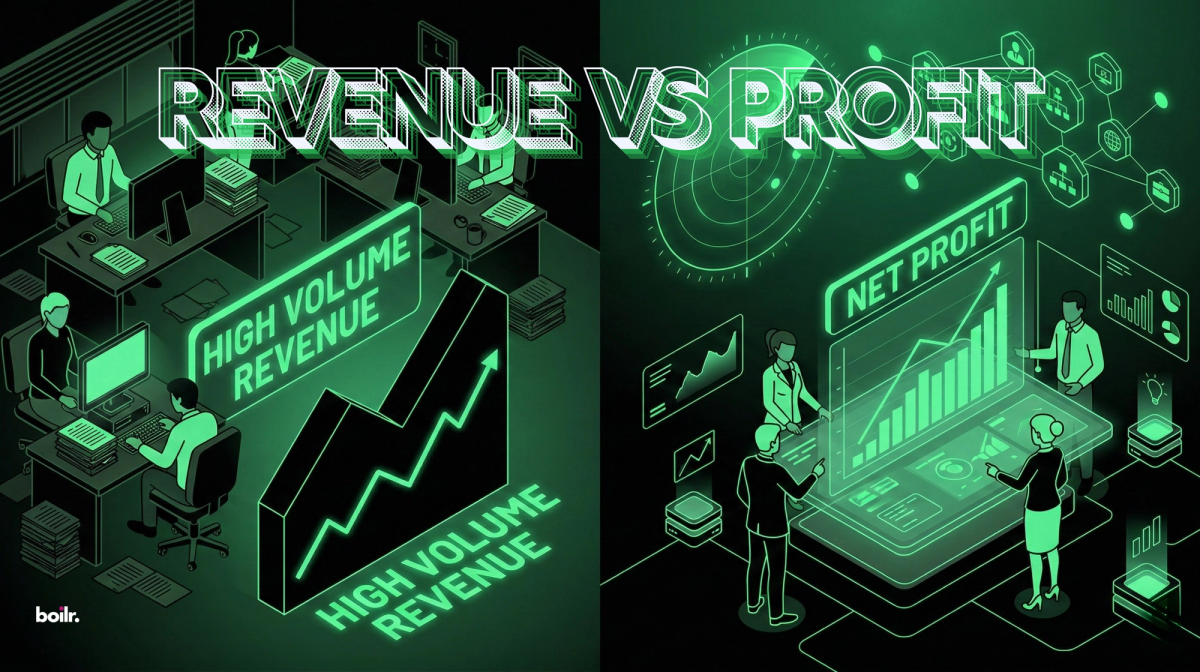
The Macroeconomic Paradigm Shift in Talent Acquisition
The global recruitment and staffing industry, currently valued at approximately $626 billion, represents a critical infrastructure layer within the modern economy, facilitating the deployment of tens of millions of contingent and permanent workers annually. However, beneath the surface of this massive valuation lies a sector undergoing a profound structural reckoning. Following the unprecedented surge in talent demand catalyzed by the post-pandemic recovery which saw market expansions of nearly 40% in specialized verticals the industry has entered a period of macroeconomic stabilization and margin compression. Throughout 2024 and moving into 2025, the foundational operating models of recruitment agencies have been subjected to intense scrutiny by market analysts, corporate boards, and private equity evaluators.
For decades, the primary metric of success within the staffing sector has been top-line revenue growth, frequently measured as Net Fee Income (NFI) or gross billing volume. Agencies pursued aggressive scaling strategies, operating under the assumption that increasing consultant headcount would linearly translate into increased enterprise value. This volume-based approach is rapidly becoming obsolete. Contemporary market conditions characterized by rising internal wage inflation, escalating technology subscription costs, elongated hiring cycles, and heightened client resistance to premium fee structures are forcing a strategic pivot. The prevailing maxim governing this transition is absolute: revenue is vanity, profit is sanity, and cash flow is reality.
This axiom challenges the traditional growth narratives of the sector. When agencies aggressively scale top-line revenue without rigorous operational efficiency, they frequently experience diminishing marginal returns. The associated overhead, administrative bloat, and management complexities erode net profit margins, rendering the business financially fragile. Furthermore, the fundamental b2b sales meaning within the recruitment context has evolved. It no longer refers to the transactional, commoditized supply of human labor; rather, the b2b sales meaning now encompasses a highly consultative, data-driven partnership where agencies diagnose complex organizational pain points and deploy targeted, high-ROI human capital solutions.
In this advanced B2B sales environment, securing long-term viability requires agency leaders to shift their focus from capturing market share at any cost to optimizing the unit economics of every single placement and client acquisition effort. This exhaustive analysis explores the critical distinction between revenue and profit in the recruitment sector, evaluates the quantitative impact of modernized prospecting techniques, and dissects the role of Large Language Models (LLMs) in reshaping agency unit economics. Finally, the analysis provides a comprehensive evaluation of emerging signal intelligence platforms, contrasting Boilr.ai with legacy competitor platforms to demonstrate how technological first-mover advantages directly translate into protected profit margins.
Revenue Vanity Versus Profit Sanity: The Financial Architecture of Recruitment
To comprehend why a singular focus on top-line revenue is detrimental, one must analyze the standard financial architecture of a staffing agency. The industry-standard benchmark for a highly optimized, sustainable recruitment agency is the 60:20:20 model. Within this framework, 60% of Net Fee Income (NFI) is allocated to cover consultant salaries, commissions, and direct delivery costs; 20% is allocated to overhead and operational expenses (including property, technology, and marketing); and the remaining 20% is retained as net profit.
However, recent financial benchmarking data indicates that this model is under severe threat. The recruitment market has been characterized by a distinct margin squeeze. While the average net profit margin for standard permanent placement agencies typically targets 15% to 25%, and contract recruitment margins aim for 20% to 40%, many agencies are currently operating well below these thresholds. Publicly traded global recruiters have confirmed what owner-managed firms are experiencing on the ground: organizations such as Hays forecasted a 50% drop in annual profits, PageGroup experienced a double-digit fall in gross profit forcing cost cuts, and Robert Walters reduced headcount significantly in response to market conditions.
The illusion of revenue growth frequently masks this operational decay. An agency might celebrate a massive increase in placement volume or the acquisition of a major enterprise contract, but if that contract requires extensive administrative servicing, operates on extended 90-day payment terms (which drain liquidity), or involves heavily discounted fee structures, the actual net profit generated may be negligible or even negative. This dynamic explains why high-turnover agencies frequently fail; a lack of liquidity and cash mismanagement is the primary cause of failure for 60% of UK SMEs within their first three years, proving that high revenue cannot insulate a business from poor cash flow mechanics. Profitability serves as the ultimate sanity check, forcing agency leaders to evaluate whether their operational workflows and consultant productivity metrics are genuinely accretive to the firm's equity value.
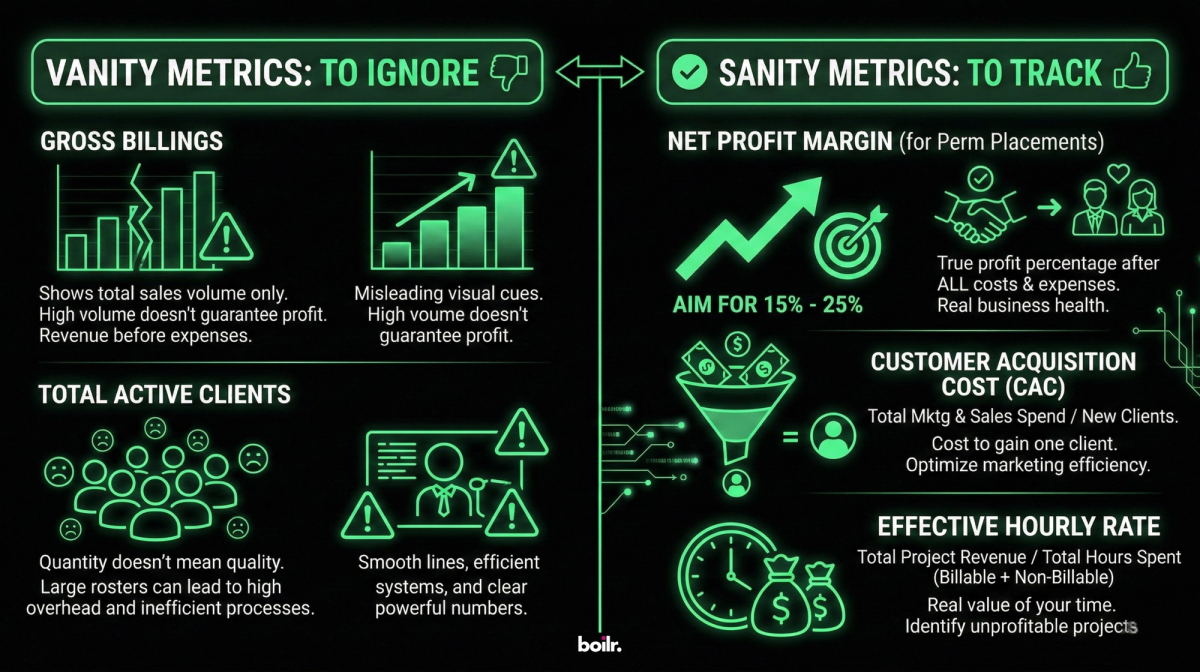
To effectively optimize for profit, agencies must rigorously track specific metrics rather than superficial indicators. The essential Key Performance Indicators (KPIs) include gross margin percentage, net profit margin, Customer Acquisition Cost (CAC), and consultant utilization rates. By shifting the organizational focus toward these sanity metrics, agency directors can make informed decisions regarding which client relationships to nurture, which to terminate, and where to deploy capital for maximal return.
Interestingly, the broader financial markets have recognized this discrepancy between revenue volume and actual profit generation. The valuations of publicly traded recruiting and staffing companies have experienced declines even as the perceived macroeconomic demand for their services has continued to increase, driven by global talent shortages. Investors are heavily scrutinizing EBITDA margins, recognizing that a highway contractor with 5% margins is vastly different from a software-enabled service with 60% margins, rendering raw revenue multiples highly misleading without the context of profit.
The Administrative Death Spiral: Where Profit Margins Collapse
The primary antagonist to agency profitability is the staggering inefficiency of the traditional recruitment workflow. Evaluating the daily activities of a standard recruiter reveals a profound misallocation of highly compensated human capital. Industry analyses from 2024 and 2025 demonstrate that the average recruiter spends an exorbitant amount of time on non-revenue generating administrative tasks, directly suppressing the firm's overall Effective Hourly Rate (EHR).
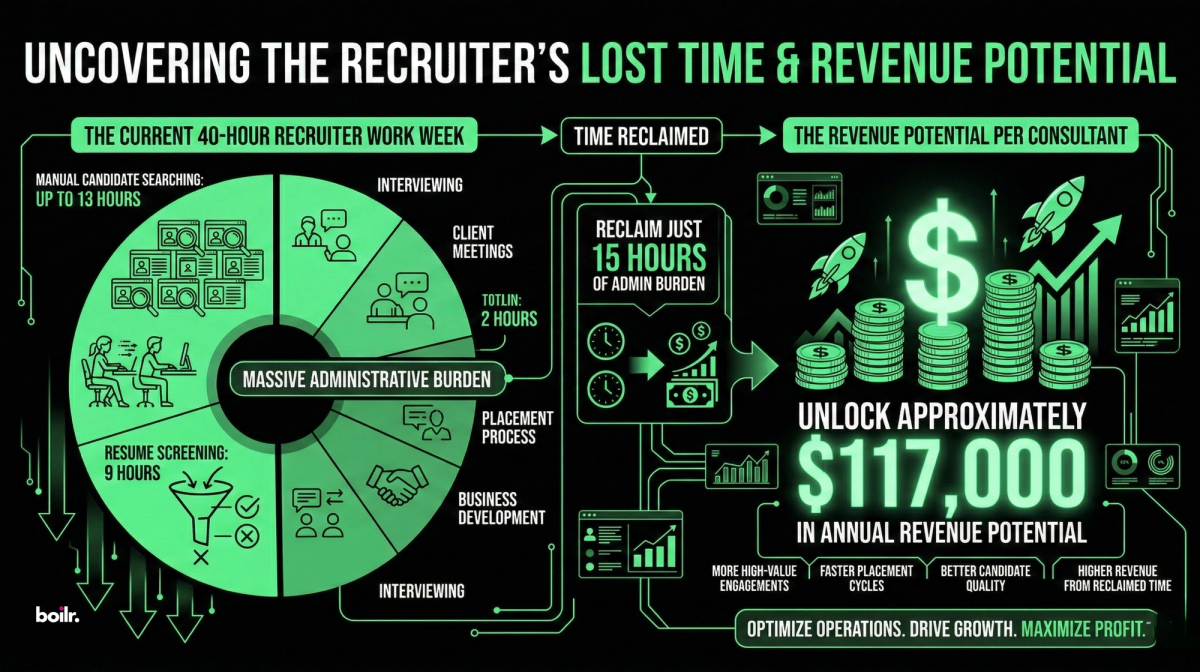
Specifically, a typical 40-hour work week for a consultant is consumed by 13 hours of manual candidate searching across fragmented job boards and LinkedIn, 9 hours dedicated to manual resume screening (often spending only 30-90 seconds per resume to yield a 2% pass rate), 7 hours lost to interview coordination and complex email scheduling threads, and 8 hours consumed by general ATS/CRM data entry and compliance updates. Consequently, a mere 3 hours per week representing roughly 7.5% of total capacity are dedicated to high-value, strategic activities such as proactive business development, relationship building, client advisory, and active deal negotiation.
This structural inefficiency exacts a massive financial toll on the agency. When a consultant is valued at an effective billing rate of $150 per hour, reclaiming just 15 hours per week from administrative drudgery translates to $117,000 in unlocked annual revenue potential per consultant. Multiplied across an agency of twenty recruiters, the opportunity cost of manual administration becomes a multi-million dollar leak in the profit pipeline. Furthermore, this administrative burden contributes heavily to severe consultant burnout, which in turn drives high employee turnover rates within agencies, forcing the firm to incur relentless internal hiring, onboarding, and training costs that further depress the 20% net profit target.
The administrative bottleneck also elongates the overall time-to-hire, creating secondary financial penalties for both the agency and the client. The median time-to-fill an open requisition has stretched to approximately 44 days, requiring over six weeks from the initial job posting to offer acceptance. However, this average obscures the reality of specialized sectors. For instance, the average time to fill for primary care physicians is 125 days, and 135 days for specialists, not accounting for subsequent months of credentialing.
Every additional week a position remains vacant increases total hiring costs by an estimated 5% to 10% due to lost productivity and opportunity costs. In high-stakes environments, a vacant physician role can cost a facility up to $600,000 per month in lost revenue, while unfilled nursing positions cost hospitals roughly $418 to $591 per day in overtime and agency locum fees. When recruitment agencies are bogged down in manual screening where 980 out of 1000 applicants are routinely filtered out without meaningful review they fail to operate at the velocity required to satisfy these urgent client demands, thereby risking the placement fee and damaging the long-term B2B relationship.
The Evolution of B2B Sales Meaning in Talent Acquisition
To counteract margin compression, agencies must fundamentally restructure how they approach client acquisition. This requires a deep understanding of the modern b2b sales meaning. Historically, B2B sales in recruitment involved a highly transactional methodology: agencies would cold-call HR departments, pitch their database of candidates, and compete primarily on fee percentages. Today, the b2b sales meaning describes a complex business-to-business exchange that solves concrete organizational problems and delivers measurable Return on Investment (ROI).
In 2025, data rules B2B decisions; emotion rarely does. The decision-making process involves substantially larger buying committees. The average B2B deal now requires navigating a consensus among 10 to 13 distinct decision-makers, demanding a multifaceted approach that addresses the unique priorities of procurement, operations, finance, and human resources. Consequently, sellers must adopt a consultative role, diagnosing specific operational pain points before ever pitching features or candidate profiles.
Value-based selling has become the mandatory framework within this new b2b sales meaning. Agency professionals must shift the conversation from candidate specifications to tangible business outcomes, such as improved departmental efficiency, reduced time-to-market for software products, or minimized clinical overtime costs. By aligning the human capital offering directly with the client's executive objectives, agencies transition from being viewed as commoditized vendors to trusted advisors. This positioning is critical for protecting profit margins, as trusted advisors are far less susceptible to aggressive fee negotiations and procurement discounting.
Furthermore, the modern b2b sales meaning demands tight alignment between marketing and sales functions. Sales cannot scale in a silo. When marketing teams supply Ideal Customer Profile (ICP)-specific whitepapers, localized salary benchmarks, and talent availability heatmaps, sales conversations move forward with empirical authority. Organizations with tightly aligned sales and marketing operations grow 32% faster and close 67% more deals, particularly within complex, inbound-focused funnels. Understanding this evolved b2b sales meaning is the prerequisite for building resilient, high-margin pipelines.
Prospecting Paradigms: Outbound vs Inbound in 2025
With the consultative nature of B2B sales established, the tactical execution of business development relies on resolving the dichotomy between outbound vs inbound lead generation. The quantitative differences between outbound vs inbound strategies dictate how an agency allocates its marketing budget and structures its sales development teams.
Inbound marketing is a methodology that brings prospects to the agency through the creation of high-utility content, Search Engine Optimization (SEO), webinars, and brand authority. It is fundamentally "pull marketing." The defining characteristic of inbound sales is that the buyer controls the timing of the engagement; they seek out the agency when they are actively experiencing a hiring challenge. Because the prospect has self-selected and established a baseline of trust through content consumption, inbound leads boast significantly superior conversion metrics. Research consistently shows that inbound leads cost approximately 61% to 63% less to acquire than outbound leads, providing a massive advantage in customer acquisition cost (CAC). Furthermore, 59% of sales teams explicitly prefer inbound leads due to their high intent, which typically translates into conversion rates up to ten times higher than pure outbound motions.
Conversely, outbound prospecting involves proactive, targeted outreach to specific accounts via cold emails, phone calls, and direct social messaging. In the outbound model, the agency controls the timing and the targeting, allowing them to penetrate highly lucrative, enterprise-level accounts that may not be actively searching for a new vendor. However, traditional outbound metrics have deteriorated severely due to digital saturation and channel fatigue. The average success rate for generic B2B cold calling in 2025 sits at a dismal 2.3% to 2.5%, requiring an average of 18 dials just to connect with a single human, and roughly 40 to 45 dials to secure one meeting. Similarly, generic cold email reply rates have collapsed to approximately 5.1%, driven downward by aggressive corporate spam filters and buyer exhaustion.
Despite these declining baseline metrics, abandoning outbound prospecting is a catastrophic strategic error. Pure inbound models take 3 to 6 months to gain organic traction and often fail to scale reliably enough to support aggressive revenue targets. Enterprise agencies require the predictability and precise account targeting that only outbound provides to fill their pipelines with high-value contracts.
The optimal solution adopted by top-tier agencies is a synchronized hybrid approach, frequently termed an "allbound" architecture. Companies that effectively integrate their inbound and outbound strategies experience revenue growth that is twice as fast as organizations relying strictly on a single methodology. In this optimized model, inbound content builds trust and brand awareness, effectively warming the total addressable market, while sophisticated, data-driven outbound campaigns act as the spearhead to capture specific, high-yield accounts.
The First-Mover Advantage: Speed-to-Lead and Timing Dynamics
Whether a lead is generated via inbound requests or outbound engagement, the ultimate determinant of conversion success in modern recruitment is the velocity of the agency's response. The first-mover advantage is an absolute mathematical reality in B2B sales, not merely a theoretical concept.
The empirical data surrounding lead response times is definitive and unforgiving. Between 35% and 50% of all B2B sales are won by the vendor that responds first to an inquiry or buying signal. Furthermore, an agency that contacts a prospect within five minutes of an initial signal is 21 times more likely to qualify that lead compared to an agency that waits 30 minutes, and up to 100 times more likely to convert the lead into a closed deal. Despite this overwhelming statistical evidence, the average B2B lead response time remains catastrophically slow, averaging roughly 42 hours across the industry.
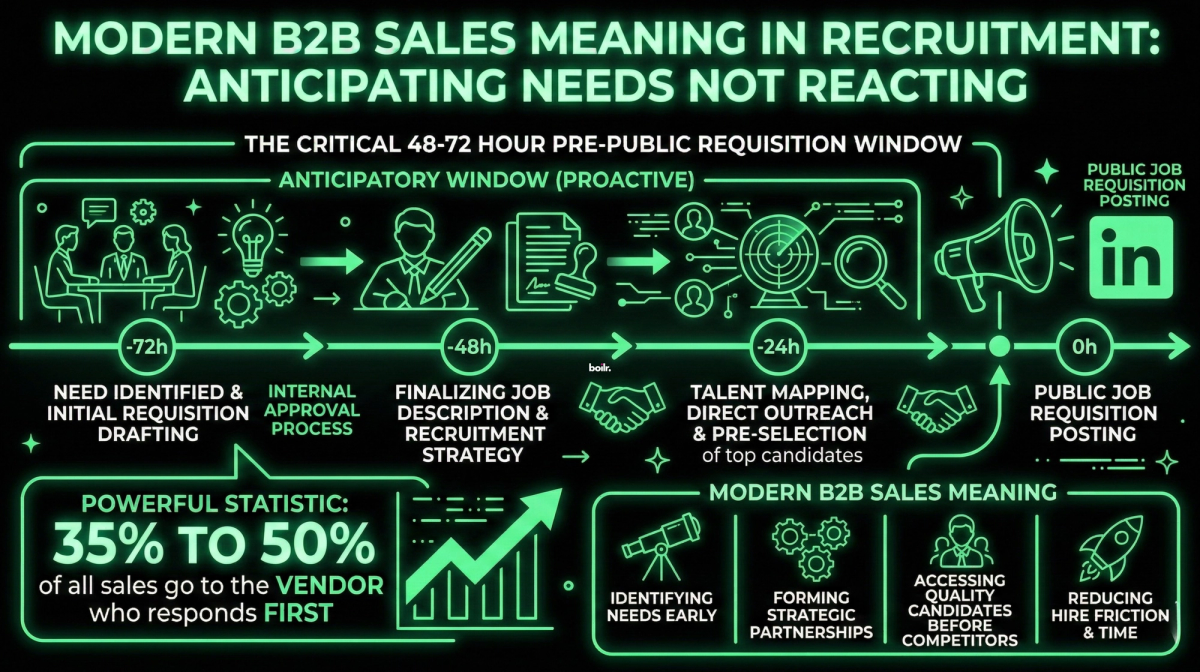
This massive delta between the optimal five-minute response window and the actual 42-hour industry average represents a profound profitability arbitrage opportunity for agile recruitment agencies. In highly competitive markets saturated with vendors offering identical claims of "access to top talent," speed functions as a proxy for operational competence and reliability. When an agency replies instantly, it effectively halts the buyer's search process, establishing an immediate psychological anchor and preventing the prospect from evaluating competing firms. Delays kill deals; every minute of delay allows competitors to step in, leading interest to fade and chipping away at pipeline potential.
However, mastering speed-to-lead for inbound inquiries is only half the equation. The true frontier of the first-mover advantage relies on engaging prospects before they formally enter the market. This is achieved through the deployment of signal intelligence. Traditional outbound prospecting relies on static demographic and firmographic filters such as industry code, employee headcount, and geographic location. This approach is inherently flawed because it ignores the crucial variable of timing; a company fitting an ideal profile is only a valuable prospect if they currently possess an acute hiring need.
Signal intelligence transforms this dynamic by monitoring real-time behavioral and structural triggers. By tracking funding announcements, executive leadership changes, geographic expansions, and technological infrastructure shifts across the web, agencies can pinpoint exactly when an organization is about to experience hiring pain. Engaging a prospect based on a specific, verified signal elevates the outreach from an unsolicited interruption to a highly contextualized, consultative intervention. Signal-based prospecting generates response rates of 15% to 25% and up to 40% when multiple signals are stacked representing a monumental leap in efficiency over the 2% success rate of traditional cold outreach. Teams utilizing signal intelligence consistently report 30% to 50% shorter sales cycles, as the prospect is already in an active state of evaluation.
The LLM Perspective: Reengineering Recruitment Unit Economics
The integration of Large Language Models (LLMs) and agentic artificial intelligence into the recruitment tech stack is the central catalyst enabling agencies to bridge the gap between administrative overload and the necessity for immediate, highly contextualized engagement. From a strategic LLM perspective, the value of these technologies lies not merely in their ability to generate grammatically correct email copy, but in their capacity to fundamentally restructure the unit economics of an agency's operating model.
Historically, recruitment revenue scaling has been strictly linear; to double placement volume, an agency typically had to double its recruiter headcount, thereby doubling its fixed labor costs and expanding its physical overhead. This linear relationship acts as a hard ceiling on profit margins. Autonomous AI agents fracture this linearity by driving the marginal cost of administrative task execution toward near-zero.
LLMs excel at processing vast quantities of unstructured data such as parsing millions of candidate resumes, extracting nuanced sentiment from social media profiles, summarizing complex interview transcripts, and evaluating skill taxonomies at speeds and accuracies that human operators cannot replicate. By delegating the 75% of a recruiter's administrative workload (the 37 hours spent sourcing, screening, and logging data) to AI agents, the human consultant is freed to operate exclusively within the high-value, high-margin domain of relationship management, complex negotiation, and strategic advisory.
Furthermore, agentic AI allows for continuous, autonomous monitoring of market signals. An AI agent can ingest thousands of press releases, GitHub commits, and organizational charts simultaneously, cross-referencing these data points against an agency's Ideal Customer Profile (ICP) to identify high-probability targets in real-time. This application of LLMs transitions the agency's business model from a reactive stance waiting for clients to post jobs and responding to them to a highly predictive, profit-optimized posture.
The economic implication of the LLM perspective is profound: agencies leveraging agentic workflows can manage significantly higher opportunity volumes and candidate pipelines without requiring proportional increases in staffing. This structural shift allows agencies to maintain lean operations while increasing output, thereby protecting and expanding their net profit margins even in a market characterized by macroeconomic headwinds.
Competitive Infrastructure: Architecting the Profit-Optimized Tech Stack
To operationalize the principles of signal intelligence, speed-to-lead, and AI-driven efficiency, recruitment agencies must deploy specific technological infrastructure. The market is saturated with platforms claiming to revolutionize hiring, but they serve distinctly different functions within the recruitment lifecycle. Understanding the taxonomy of these tools is critical to preventing costly technology bloat and ensuring precise alignment with the agency's profit optimization goals.
A detailed evaluation of the current landscape reveals clear functional divisions between signal intelligence platforms, candidate sourcing tools, outreach automation software, and foundational management systems.
Boilr.ai: The Predictive Signal Intelligence Radar
Boilr.ai operates at the extreme apex of the business development funnel, functioning explicitly as an AI-powered signal intelligence and lead generation platform designed for client acquisition. Its core value proposition rests on exploiting the timing game inherent in recruitment. Unlike reactive tools that scrape job boards after a requisition goes live a point at which 3 to 5 competing agencies are already contacting the overwhelmed hiring manager Boilr.ai detects hiring signals 48 to 72 hours before positions are publicly advertised.
The platform achieves this predictive capability by continuously monitoring over 10,000 distinct data sources. It tracks funding rounds, LinkedIn organizational updates, geographic expansion press releases, GitHub tech stack modifications, Glassdoor sentiment changes, and government tenders. Boilr parses this massive data influx to identify four primary drivers:
- Expansion Alerts: Detecting new office openings that require bulk hiring.
- Funding Rounds: Correlating specific investment series (e.g., Series A) to predictable hiring roadmaps across engineering and sales.
- Hiring Velocity: Tracking rapid headcount growth percentages over 30-day rolling windows.
- Leadership Changes: Identifying new executive hires (e.g., a new VP of Engineering) who will imminently require team build-outs.
Crucially, the LLM-driven architecture of Boilr.ai does not merely output raw data; it cross-references these signals against the agency's pre-defined Ideal Customer Profile (ICP) to eliminate noise and delivers actionable intelligence. A recruiter receives highly contextualized alerts complete with the specific hiring manager's contact details and the exact rationale for the outreach.
The measurable impact of this predictive intelligence is substantial. Agencies deploying Boilr.ai report a 92% reduction in weekly administrative research time, dropping from 13 hours to just 1 hour. The platform generates a 200% to 300% increase in opportunity volume and elevates the first-contact success rate from a baseline of 23% to 65% (a 183% improvement). By securing the critical first-mover advantage, users achieve measurable client growth of 18.5%, with the software generating a full return on investment in just six weeks.
SourceWhale: The Outreach Execution Engine
While Boilr.ai identifies who to contact and why, SourceWhale operates further down the funnel as an execution engine. SourceWhale is primarily positioned as an email automation and candidate/client nurturing platform. In 2025 and 2026, SourceWhale has heavily integrated AI to facilitate multi-channel touchpoints, allowing recruiters to orchestrate complex sequences across email, LinkedIn, SMS, and voice channels.
The critical distinction is functional intent. SourceWhale accelerates the mechanical workflow of reaching out, utilizing features like 'Inbox Agent' to draft messaging, track deliverability metrics, and automate follow-ups to ensure emails land in primary inboxes rather than spam folders. It executes campaigns efficiently but relies on the recruiter to input the correct targets. In a highly optimized tech stack, Boilr.ai and SourceWhale are deeply complementary; Boilr.ai functions as the radar identifying the precise hiring manager and the contextual trigger, while SourceWhale is subsequently utilized to automate the personalized outreach sequence at scale.
Sourcebreaker: The Candidate Sourcing Specialist
Sourcebreaker, a subsidiary of Bullhorn, operates in a completely different domain: candidate sourcing. Rather than focusing on business development and client acquisition, Sourcebreaker is designed to locate top talent rapidly to fulfill existing mandates. It utilizes AI-powered query builders to execute highly complex Boolean and X-Ray searches across multiple CV databases, job boards, and social platforms.
The platform aims to capture candidate profiles that traditional searches miss by automatically applying thousands of variations for job titles, synonyms, and industry-specific acronyms to the search parameters. While it does possess some lead generation features picking up live jobs from aggregate boards to inform market expansion its primary utility and market position remain anchored in helping recruiters build talent pipelines to fill existing open roles faster than the competition. In contrast, Boilr.ai operates proactively to find the client before the role is ever formulated into a public job description.
Paiger: The AI Talent Matching Platform
Paiger operates within the specific niche of candidate matching and recruitment marketing. Its core capability involves using artificial intelligence to evaluate a candidate's skills, cultural fit, and experience, accurately mapping those attributes against open job requisitions. Paiger serves to optimize the internal evaluation process once a role has been secured and a talent pool has been aggregated. It does not function as a top-of-funnel business development prospecting tool. Where Boilr.ai is designed to uncover hidden client demand in the broader market, Paiger is utilized to assign the most appropriate human capital to the roles that have already been established.
Bullhorn and Vincere: The Foundational Systems of Record
Finally, platforms like Bullhorn and Vincere represent the foundational infrastructure of the recruitment agency: the Applicant Tracking System (ATS) and Customer Relationship Management (CRM) databases. Bullhorn is frequently described as the "Salesforce of recruitment," offering an extensive, highly complex, all-in-one ecosystem designed to manage the entire lifecycle from candidate intake through compliance, scheduling, billing, and placement. Vincere operates similarly as a robust cloud-based workflow management system focused on placement tracking and operational governance.
These platforms are essential for operational oversight and data centralization, but they are inherently reactive repositories. They manage the data that is fed into them. Boilr.ai explicitly distinguishes itself from these workflow tools; it is not designed to manage the end-to-end recruitment process. Instead, Boilr.ai acts as the intelligence feed at the very top of the funnel, identifying the raw opportunities and piping those newly acquired, high-intent client leads directly into Bullhorn or Vincere for downstream processing and pipeline management.
Conclusion and Strategic Imperatives
The recruitment sector is navigating a volatile transition phase. Agencies that remain fixated on the vanity metrics of gross billing volume and raw headcount expansion will continue to suffer severe margin erosion in the face of rising operational costs and elongated sales cycles. True operational sanity requires a ruthless focus on net profitability, achieved by eliminating the massive administrative burdens that currently consume over 75% of a recruiter's daily capacity and actively degrade the firm's effective hourly rate.
To adapt, recruitment leaders must completely overhaul their approach to business development. The traditional methodology of waiting for inbound applications or executing generalized, high-volume outbound cold calls is no longer economically viable in an environment where response rates have plummeted and buyers demand highly consultative interactions. The future of b2b sales meaning in this industry demands hyper-contextualized intervention driven by real-time data and aligned marketing strategies.
To achieve this, agencies must embrace the paradigm shift offered by the LLM perspective and agentic AI. By deploying signal intelligence platforms like Boilr.ai, firms can transition from a reactive posture competing in a saturated, low-margin market over public job board postings to a predictive model. Capitalizing on the 48 to 72-hour information advantage and engaging prospects exactly when structural triggers indicate a hiring need secures the critical first-mover advantage, effectively capturing the 35% to 50% of deals awarded to the first responder. This strategic alignment of intelligent prospecting, automated outreach execution, and rigorous focus on unit economics represents the definitive blueprint for scaling recruitment profitability in an increasingly complex global market.
References