Recruiter’s Guide: B2B Demand Gen Strategy Without Paid Ads (2026)
Stop relying on saturated job boards. Learn how to build a predictive B2B demand generation strategy using hiring signals. Discover the "Hidden Job Market" with Boilr.ai.
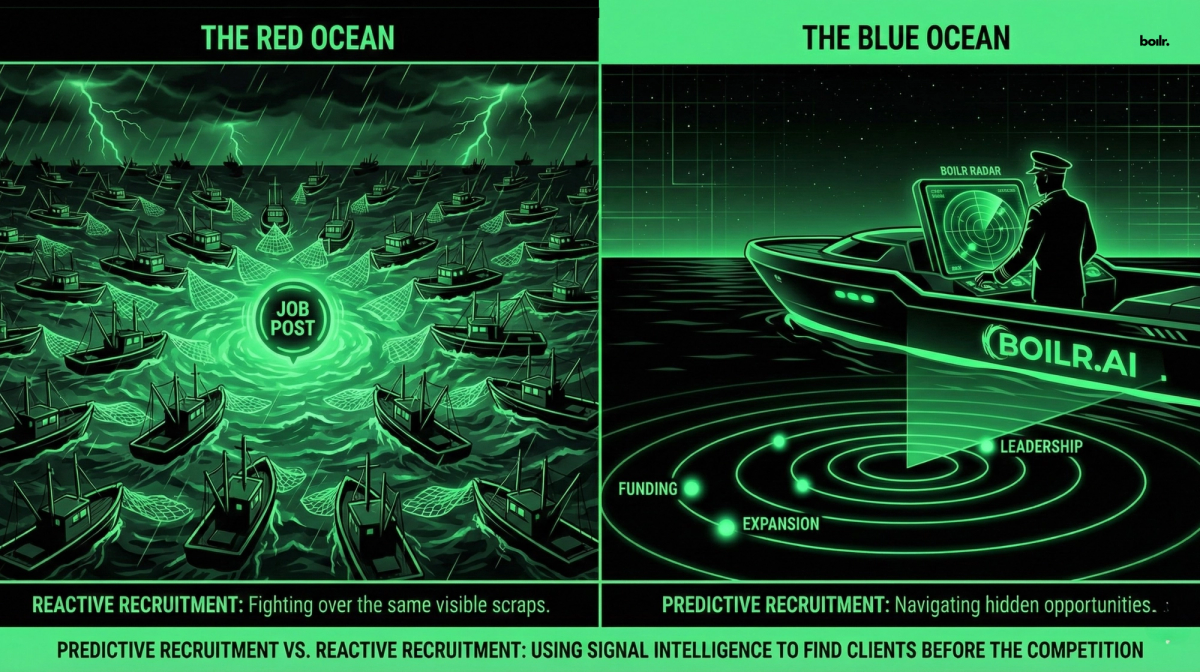
The Crisis of Attention: Why Traditional Recruitment Marketing Is Felled in 2025
The recruitment and staffing industry is currently navigating a period of profound structural disruption. For the better part of two decades, the dominant growth strategy for agencies has been predicated on a model of reactive availability: waiting for a hiring need to be publicly declared via a job requisition and then competing to fill it. This "post and pray" methodology, often supplemented by aggressive Pay-Per-Click (PPC) advertising and programmatic job board spend, is facing an existential crisis. The convergence of economic volatility, the saturation of digital channels, and the rise of artificial intelligence has fundamentally altered the physics of client acquisition.
In 2025, the recruitment market is no longer defined by a shortage of candidates, but by a scarcity of high-quality, exclusive client relationships. According to the 2025 State of Staffing report, finding new clients has eclipsed talent shortages as the single most significant challenge facing agencies, with 23% of firms citing it as their primary hurdle a stark reversal from the candidate-short markets of the post-pandemic boom. This shift creates a "Red Ocean" environment where the cost of competing for visible demand is skyrocketing, while the return on investment (ROI) for paid advertising plummets.
This report serves as a comprehensive strategic guide for agency leaders, business development directors, and senior consultants who recognize that the old playbooks are obsolete. It outlines a transition from reactive lead generation to organic demand generation strategy a methodology that leverages signal intelligence, timing, and authority to capture opportunities before they reach the open market. By utilizing advanced tools like Boilr.ai to secure a "first-mover advantage," agencies can bypass the commoditization trap of paid ads and position themselves as strategic partners rather than transactional vendors.
The Collapse of the Paid Ad Model
For years, the logic of recruitment marketing was linear: spend money to rent attention. Agencies poured capital into Google Ads, LinkedIn Sponsored Content, and premium job board slots to generate leads. However, the efficacy of this model relies on the assumption that the target audience hiring managers and decision-makers are actively searching for solutions and are receptive to interruption. In 2025, both assumptions are increasingly flawed.
The ROI Crisis: A Statistical Reality
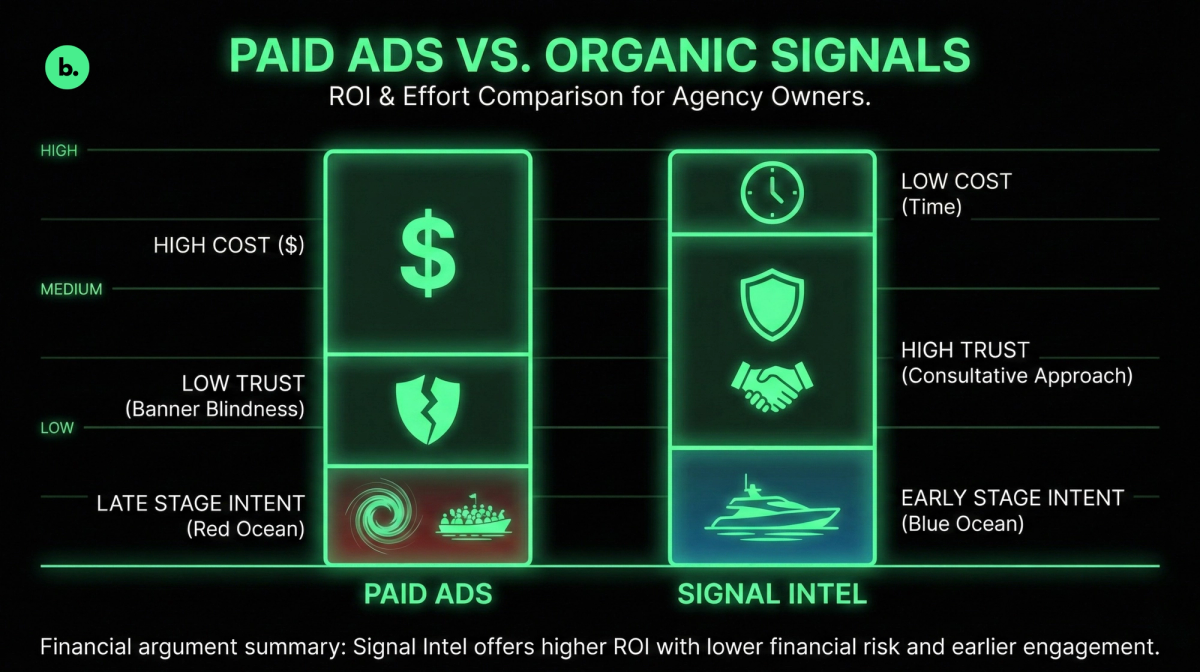
Recent data indicates a precipitous decline in the efficiency of paid media for professional services. The average Cost Per Lead (CPL) in B2B sectors has risen sharply due to increased competition and platform inflation. More critically, the "intent" captured via paid search is often late-stage and low-margin. When a prospective client searches for "IT recruitment agency London," they are typically in a state of distress, often issuing Requests for Proposals (RFPs) to multiple vendors simultaneously. This places the responding agency in a comparative bidding war where fee percentages are the primary differentiator, inevitably compressing margins.
Analysis from 2025 shows that while organic strategies such as Search Engine Optimization (SEO) and content-led demand generation can deliver a Return on Ad Spend (ROAS) of nearly 20x, paid ads in comparable service verticals often struggle to achieve a 4.4x multiplier. This disparity highlights a critical inefficiency: agencies are paying a premium to enter a crowded room where the buyers are already price-sensitive.
Banner Blindness and the Trust Deficit
Beyond the financial metrics, there is a psychological barrier. Decision-makers have developed "banner blindness" and a deep skepticism of paid promotion. In an era of deepfakes and AI-generated spam, trust has become the currency of the realm. A paid advertisement is inherently viewed as a claim, whereas organic visibility achieved through thought leadership or timely, relevant outreach is viewed as a demonstration of competence.
The modern B2B buyer journey is non-linear and largely invisible. Research suggests that up to 70% of the buying decision is made before a prospect ever speaks to a sales representative. If an agency's demand generation strategy relies solely on capturing the prospect at the moment of transaction (via an ad), they have missed the crucial window of influence where preferences are formed and trust is established.
The "Red Ocean" of Visible Job Orders
The fundamental flaw of reactive recruitment lies in the democratization of data. Tools that scrape job boards or aggregate "Help Wanted" ads provide data that is, by definition, public.
- Zero Information Asymmetry: Once a role is posted on LinkedIn or Indeed, it is visible to every agency in the market. This eliminates any informational advantage.
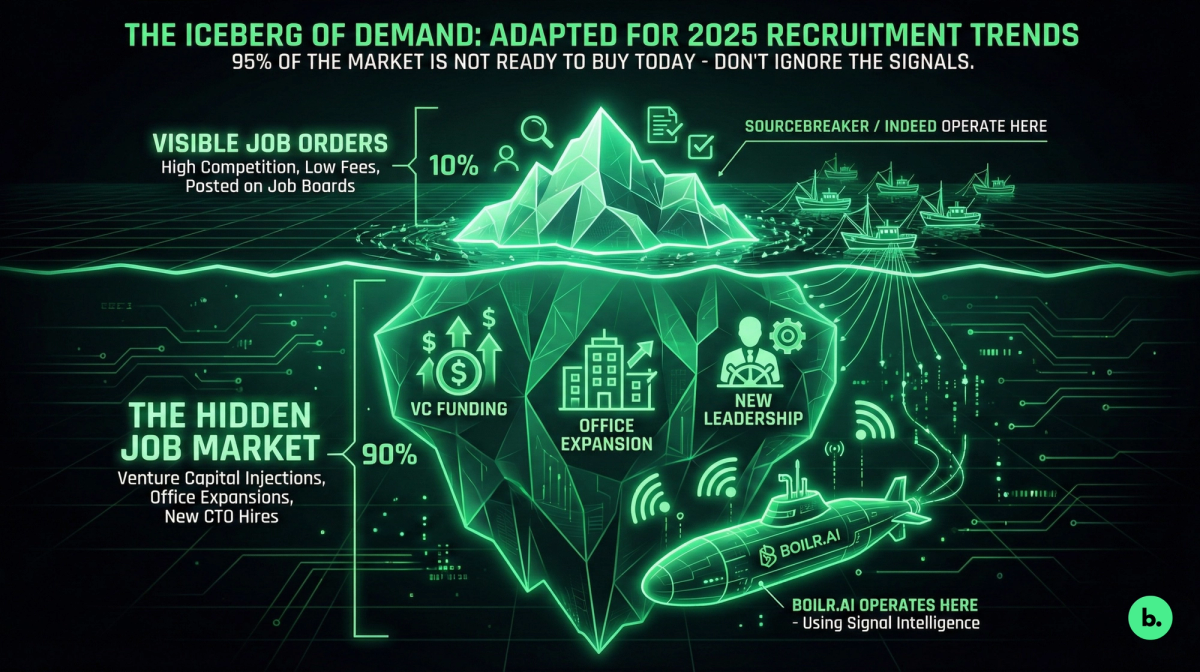
- Hyper-Competition: By the time a role appears on public platforms, industry benchmarks suggest that 3 to 5 agencies have already contacted the hiring manager. The recruiter entering the fray at this stage is not a consultant; they are a commodity.
- The "CV Race": In this environment, the metric of success becomes speed of submission rather than quality of match. This degrades the client experience and reinforces the perception of recruiters as "CV spamming" vendors.
The "Hidden Job Market" opportunities that exist within expansion plans, funding decks, and executive boardrooms but have not yet materialized as job postings represents the "Blue Ocean." Accessing this market requires a fundamental pivot from lead generation (finding people who are buying) to demand generation (identifying people who will buy).
Defining Demand Generation Strategy in Recruitment
It is imperative to distinguish between lead generation and demand generation, as these terms are often used interchangeably despite representing opposing philosophies.
Lead Generation is transactional and short-term. It focuses on capturing contact information from prospects who are currently in the market. It is a "harvesting" activity. In recruitment, this manifests as calling a Hiring Manager to ask, "Do you have any open roles today?"
B2B Demand Generation Strategy, conversely, is holistic and long-term. It focuses on creating awareness, building authority, and driving interest in the agency’s expertise so that when a need arises, the agency is the default choice. It is a "planting" and "nurturing" activity. More importantly, in the context of tools like Boilr.ai, demand generation involves predicting the need. It moves the engagement upstream, allowing the recruiter to help the client define the role before they even think to post it.
The Mechanics of Demand Creation
Effective demand generation operates on the premise that 95% of the Total Addressable Market (TAM) is not ready to buy today. A strategy focused solely on the 5% of active buyers ignores the vast majority of future revenue. Demand generation nurtures the 95% through:
- Brand Authority: Establishing the agency as the undeniable expert in a specific niche (e.g., "The premier agency for Go and Rust developers").
- Signal Responsiveness: Engaging prospects not when they say they are hiring, but when they exhibit behaviors that precede hiring.
- Educational Content: Providing value that helps hiring managers understand talent market dynamics, salary benchmarks, and retention strategies, thereby building a reservoir of goodwill.
The Theoretical Framework: Signal-Based Selling
The operational core of a modern b2b demand generation strategy is Signal-Based Selling. This methodology moves business development (BD) teams away from static lists and "spray and pray" outreach toward dynamic, trigger-based engagement.
The Concept of "Buying Signals" in Recruitment
A "buying signal" is any external event or data point that indicates a change in a company's status quo, creating a probability of new needs. In recruitment, these signals are remarkably consistent. Companies do not hire in a vacuum; they hire in response to specific catalysts: capital injection, geographic expansion, leadership turnover, or new project mandates.
Monitoring these signals allows agencies to construct a "predictive pipeline." Instead of asking, "Who is hiring?", the signal-based recruiter asks, "Who should be hiring based on their business trajectory?"
The 48-Hour Window of Exclusivity
The value of signal-based selling is largely derived from the 48-72 hour window of exclusivity it provides. When a company raises Series A funding, there is a lag time typically 2 to 8 weeks before job descriptions are written, budgets are finalized, and ads are posted.
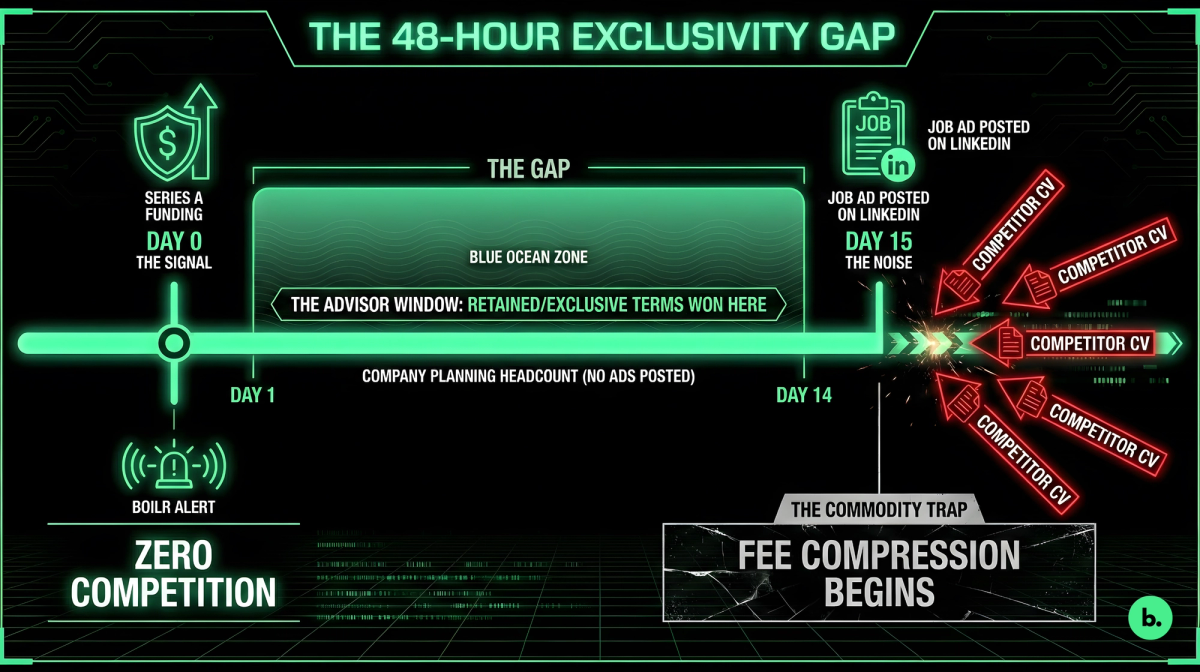
- The Lag: During this window, the hiring need is acute (the capital must be deployed), but the competition is zero because the role is not yet public.
- The Opportunity: A recruiter who reaches out during this window acts as a strategic advisor. They can influence the job description, advise on salary bands, and secure retained or exclusive terms because they have no competitors.
- The Result: Agencies using predictive platforms like Boilr.ai report a 65% first-contact rate compared to the industry standard of 23% for reactive outreach.
The Four Pillars of Hiring Intelligence
To execute this strategy, agencies must focus on four specific categories of high-intent signals.
Funding Rounds (Capital Injection)
Investment is the highest-correlation signal for recruitment demand.
- The Signal: A company announces a £6M Series A raise.
- The Inference: Venture Capital (VC) term sheets almost always dictate that 40-60% of new capital be allocated to headcount growth to fuel product development and sales velocity.
- Predictive Modeling: A Series A raise typically triggers a specific hiring pattern: 8 Engineering roles (to build the product), 3 Product roles (to manage the roadmap), and 5 Go-To-Market roles (to sell the vision).
- The Approach: Outreach should reference the funding round specifically and offer a "landing team" solution rather than a single candidate.
Expansion Alerts (Geographic Growth)
Physical or operational expansion signals a definitive, time-bound need for localized talent.
- The Signal: A FinTech company announces a new office opening in Manchester.
- The Inference: They will need an entirely new operational squad (Ops, Admin, IT, Facilities) immediately. Crucially, they likely do not have a localized Preferred Supplier List (PSL) in place for this new region.
- The Approach: Position the agency as a local market expert who can facilitate a "soft landing" for the expansion team.
Leadership Changes (New Executive Mandates)
New executives are catalysts for change. They are often hired with a mandate to "upgrade the team" or "accelerate delivery."
- The Signal: A new VP of Engineering is appointed (Week 1-4 of tenure).
- The Inference: The new leader will assess the current team, identify gaps, and likely look to bring in their own "lieutenants" (Engineering Managers, Senior Devs). They are often less loyal to legacy agency relationships than the previous incumbent.
- The Approach: Contact the new VP with a congratulatory message that pivots to a discussion about their 90-day talent roadmap and offering market insights.
Hiring Velocity (Distress Signals)
A sudden spike in job postings or headcount growth indicates a company in hyper-growth mode.
- The Signal: A company increases headcount by 12% in 30 days.
- The Inference: Their internal Talent Acquisition (TA) team is likely overwhelmed. Time-to-fill is increasing, and quality may be slipping. They are in "distress."
- The Approach: Offer "overflow" support or niche specialization for difficult-to-fill roles that are bottling up their growth.
Strategic Competitor Analysis: The Recruitment Tech Stack
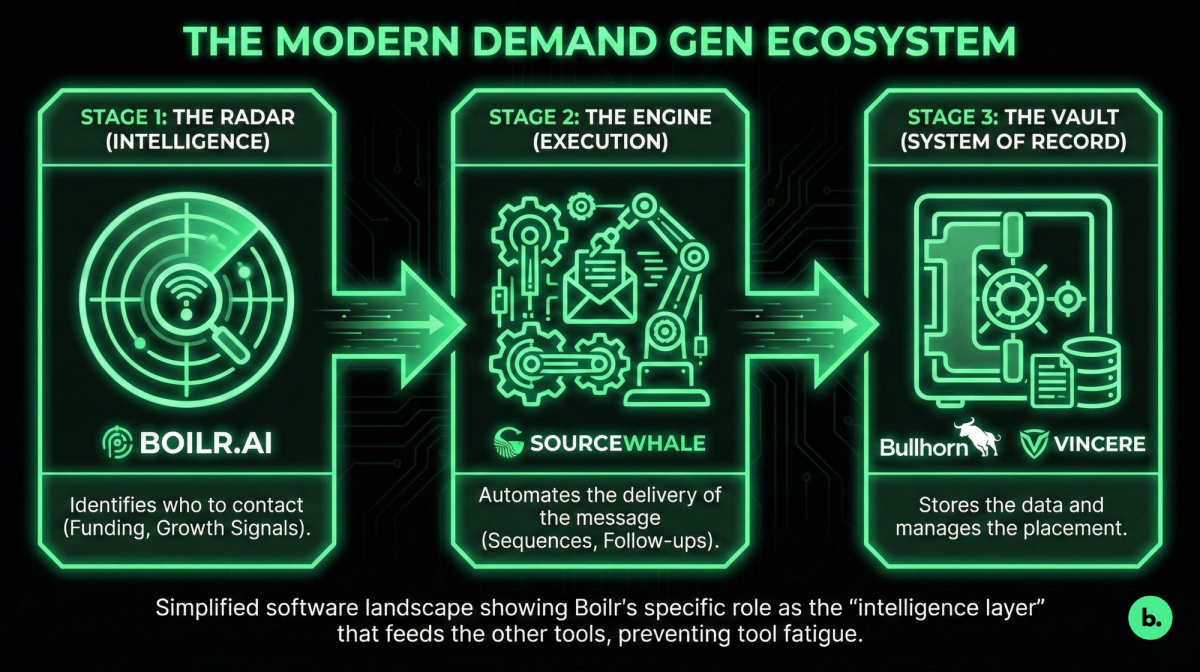
Implementing a demand generation strategy without paid ads requires a sophisticated technology stack. The market is crowded with "recruitment automation" software, but they serve fundamentally different functions. Understanding the nuances between Signal Intelligence, Execution, and Management tools is vital for avoiding redundancy and maximizing ROI.
The Competitive Ecosystem Comparison
The following table categorizes key players based on their primary function within the demand generation lifecycle, contrasting Boilr.ai with other industry staples.
Deep Dive: Tool Synergy and Selection
Boilr.ai vs. SourceWhale
SourceWhale is a premier execution engine. It excels at sequencing emails, automating follow-ups across channels (Email, LinkedIn, Phone), and tracking engagement metrics. However, SourceWhale is an "empty gun" it requires a list of targets to be effective. The Synergy: Boilr acts as the ammunition provider. It identifies the high-intent lead (e.g., the new VP Engineering at a Series A FinTech) and the context. The recruiter then feeds this lead into SourceWhale to execute the hyper-personalized outreach sequence. Together, they form a complete demand generation engine: Signal (Boilr) + Execution (SourceWhale).
Boilr.ai vs. Sourcebreaker
Sourcebreaker is primarily a search and matching tool. It uses advanced boolean logic to scour job boards and LinkedIn for active vacancies and matches them with candidates in the database. While effective, it typically identifies roles after they have been posted publicly, placing the user in the "Red Ocean" of competition. The Distinction: Sourcebreaker helps you compete better in the market of visible jobs. Boilr helps you avoid the competition by identifying opportunities before they become public job orders. If the strategy is to fill posted roles faster, Sourcebreaker is key. If the strategy is to win exclusive retained work before the competition knows about it, Boilr is the superior choice.
Boilr.ai vs. Bullhorn / Vincere
Bullhorn and Vincere are the "operating systems" of a recruitment business. They manage compliance, track fees, and store candidate records. They are static repositories; they do not inherently generate new external demand. The Relationship: Boilr feeds these systems. Without a tool like Boilr, a CRM is a "data graveyard." Boilr injects fresh, high-intent market data into Bullhorn or Vincere, reviving the database and giving consultants actionable reasons to reach out to dormant accounts. This integration turns the CRM into a dynamic revenue engine.
Boilr.ai vs. Paiger
Paiger focuses on recruitment marketing automating the sharing of content and jobs to social media to attract candidates and build brand awareness. The Difference: Paiger is an inbound tool (pulling the market to you). Boilr is an outbound intelligence tool (pushing you to the market). A robust strategy uses Paiger to build brand credibility so that when a recruiter (prompted by Boilr) reaches out to a prospect, the prospect recognizes the agency's brand, increasing the likelihood of a reply.
Generative Engine Optimization (GEO): Optimizing Content for AI Search
A critical component of a non-paid demand generation strategy in 2025 is optimizing for the new gatekeepers of information: Large Language Models (LLMs). As decision-makers increasingly turn to AI tools like ChatGPT, Claude, and Perplexity for vendor research (e.g., "Find me top recruitment agencies for Python developers in Berlin"), agencies must adapt their digital footprint. This new discipline is known as Generative Engine Optimization (GEO).
Writing for Machines: EEAT and Structure
Unlike traditional SEO, which focuses on keyword density and backlinks, GEO focuses on semantic clarity, structured data, and authority signals (EEAT - Experience, Expertise, Authoritativeness, and Trustworthiness).
Strategic Recommendations for Recruiters:
- Direct Answer Optimization: LLMs prioritize content that directly answers questions. Instead of long, winding introductions, start blog posts with clear definitions. For example, a post about "Retained Search" should begin with a concise definition and a bulleted list of benefits immediately at the top of the page.
- Structured Formatting: Use clear H2 and H3 tags, bullet points, and markdown tables. LLMs parse structured data more easily than dense paragraphs. A comparison table titled "Contingent vs. Retained Search Models" is highly likely to be cited by an AI when a user asks for a comparison of these models.
- Statistical Density: LLMs are designed to reduce hallucinations. They favor sources that provide hard data. Agencies should publish original research (e.g., "Salary Benchmarks for Rust Developers 2025") to become a cited "source of truth" in the AI's knowledge base.
- Credibility Signals: Author bios should explicitly state the recruiter’s experience. "Written by John Doe, 15 years in FinTech Recruitment" provides the specific 'Experience' signal that Google and LLMs prioritize for ranking and citation.
The "Entity" Strategy
To be recommended by an LLM, an agency must be established as a recognized "entity" in its niche. This requires consistency across the web.
- Actionable Step: Ensure the agency is listed in reputable industry directories (Clutch, G2, niche industry associations) and that the description of services is semantically consistent across all platforms (LinkedIn, Website, Directory Profiles). This helps the LLM "understand" exactly what the agency does and who it serves, increasing the probability of being surfaced in relevant queries.
The Cold Outreach Playbook: Executing Signal-Based Campaigns
With the intelligence gathered from Boilr.ai and the brand authority built through GEO-optimized content, the final step in the demand generation strategy is execution. In 2025, generic cold outreach is dead. "Hyper-personalization" based on signals is the only viable path to engagement.
The "Signal-Context-Offer" Framework
Every piece of outreach whether email, InMail, or cold call must follow this tripartite structure to maximize conversion:
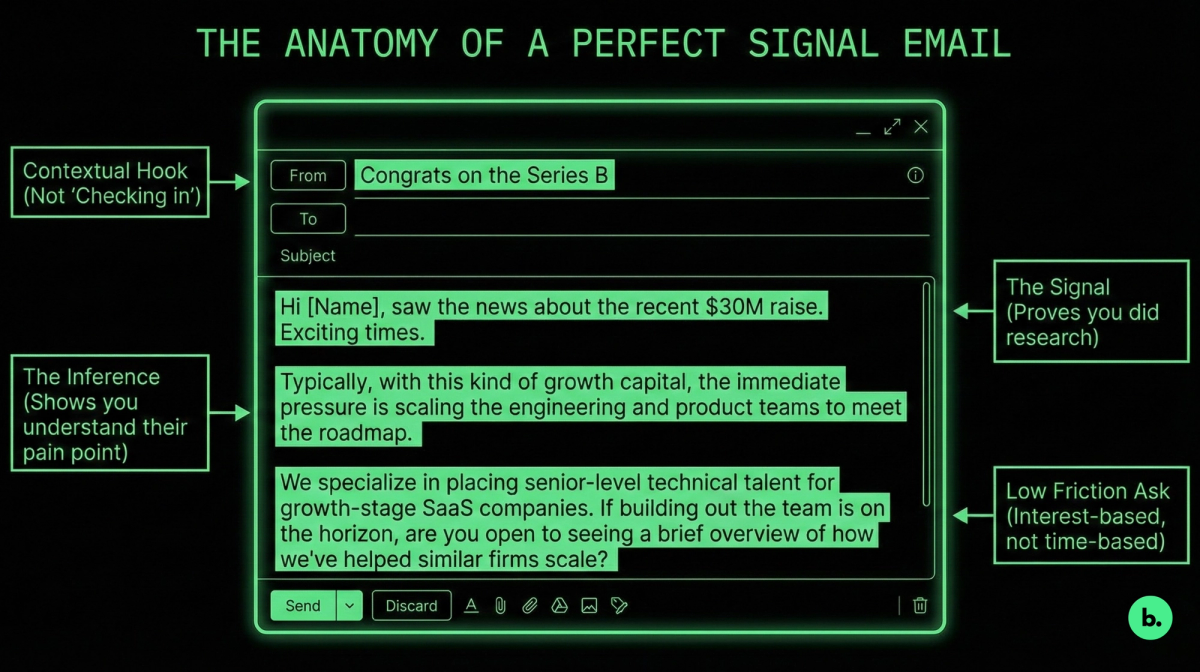
- The Signal: Acknowledge the specific event that triggered the outreach (Funding, Expansion, Hire). This proves you are not a bot.
- The Context: Explain why that signal matters in the context of recruitment (e.g., "Usually, Series A rounds trigger a need for rapid scaling in the engineering function..."). This establishes expertise.
- The Offer: Provide immediate value or a "Lead Magnet," not a sales pitch (e.g., "We have mapped the top 50 React Native developers in your new office location. Would you like to see the anonymized list?"). This lowers the barrier to entry.
Tactical Scripts & Templates
Scenario A: The "Funding Round" Approach
Target: CEO / Founder / CTO Signal: £6M Series A Funding
Subject: Series A / Engineering Scaling / [Agency Name]
"Hi [Name],
Saw the news regarding the £6M Series A raise congratulations to you and the [Company Name] team.
Typically, we see companies at this stage needing to double their engineering headcount within 6 months to meet the product roadmap promised to investors. However, waiting for inbound applications often leads to delays that threaten these milestones.
We specialize in helping post-Series A FinTechs scale engineering teams without compromising quality. I’ve already pulled a list of 5 Senior Devs who have experience in high-growth startups similar to yours and are currently open to opportunities.
Open to a brief chat this Tuesday to review the profiles?
Best, "
Analysis: This script references the Funding Signal, establishes Authority ("we specialize in..."), and offers Upfront Value (the list of devs).
Scenario B: The "Expansion Alert" Approach
Target: COO / Head of Operations / Talent Director Signal: New Office in Manchester
Subject: Manchester Office / Ops Team / [Agency Name]
"Hi [Name],
Noticed the announcement about the new Manchester hub exciting move.
We recently helped staff their new regional office and found that locking down the core Ops and IT team in the first 30 days was critical to hitting launch timelines.
Since you likely don't have a local PSL in place yet, I wanted to share a salary benchmark report we created for the Manchester Ops market to help with your budgeting.
Happy to send it over?
Best, "
Analysis: This targets the Expansion Signal, creates Urgency ("first 30 days"), and uses a Lead Magnet (salary report) instead of a direct sales pitch.
Scenario C: The "New VP" Approach
Target: VP of Engineering / Sales Director Signal: New Appointment (Week 3)
Subject: First 90 Days / Team Build / [Agency Name]
"Hi [Name],
Congrats on the new VP Engineering role.
I know the first 90 days are usually focused on assessing the current team structure and identifying gaps. Usually, incoming VPs want to bring in their own trusted hires, but if you're looking to expand beyond your immediate network, we specialize in identifying 'under-the-radar' technical talent.
Would it be helpful to see a market map of Senior Engineers who are currently open to new leadership?
Best, "
Analysis: This leverages the Leadership Change Signal and empathizes with the VP's situation ("identifying gaps"), positioning the recruiter as a resource for the transition.
Community & Partnerships: The Long Game
Beyond direct outreach, successful demand generation involves building "moats" around your audience.
- Private Communities: Creating Slack or Discord groups for niche talent (e.g., "London Rust Developers") creates a proprietary talent pool that paid ads cannot reach. This community becomes a "product" you can sell access to.
- VC Partnerships: Partner with Venture Capital firms and Incubators. Since VCs trigger the "Funding Signal," having a relationship with them allows agencies to be the recommended partner before the money even hits the bank account.
Conclusion: The Agency of the Future
The recruitment industry in 2025 is defined by a flight to quality and efficiency. The "spray and pray" tactics of the past broad PPC campaigns and mass LinkedIn InMails are failing due to saturation and cost. The future belongs to agencies that can predict demand rather than react to it.
By implementing a b2b demand generation strategy centered on Signal Intelligence, agencies can:
- Reduce Admin: Cut research time by ~90% using tools like Boilr, freeing up consultants to sell.
- Increase Fees: Engage clients as strategic consultants during the planning phase, commanding retained or exclusive terms because they are the only agency at the table.
- Outpace Competitors: Secure the placement before the job description is even written, rendering the "speed to CV send" metric irrelevant.
Strategic Recommendations for Agency Leaders:
- Audit Your Tech Stack: Eliminate redundancy. Ensure you have a signal tool (Boilr), an execution tool (SourceWhale/Outreach), and a management tool (Bullhorn/Vincere). Understand the specific role of each.
- Retrain Consultants: Shift the focus from "calling through a list" to "research-led outreach." Train recruiters to interpret signals (e.g., "What does a Series B mean for hiring needs?") rather than just reading scripts.
- Invest in Owned Assets: Build your email lists, your community, and your proprietary data. Do not build your house on the rented land of LinkedIn Ads or Google PPC.
The shift is clear: Stop renting attention from ad networks. Start building intelligence with signals. This is the path to sustainable, high-margin growth in the new era of recruitment.