LinkedIn and Recruitment: How to Find Hiring Companies 72 Hours Faster
Know how to upgrade your LinkedIn Recruiter workflow with signal intelligence and start contacting LinkedIn hiring managers before the competition.

The recruitment landscape of 2026 is defined by a fundamental paradox: while the digital footprint of hiring companies has never been larger, the ability of recruitment agencies to extract actionable commercial intelligence from this data has become increasingly difficult due to noise and saturation. The traditional agency model historically reliant on reactive monitoring of job boards and the "post and pray" methodology is facing an existential crisis. As market efficiency increases, the "alpha" available from public job postings has collapsed to near zero. By the time a vacancy is indexed on public aggregators or visible within the standard 'linkedin and recruitment' ecosystem, the opportunity has effectively commoditized.
This comprehensive research report, commissioned for Boilr.ai, provides an exhaustive analysis of the transition from reactive sourcing to predictive signal intelligence. It argues that the future of business development (BD) lies not in faster searching of existing job posts, but in the detection of hiring intent 48 to 72 hours before a requisition is formally created. Through a detailed examination of data provided in the Boilr.ai Overview , alongside broader industry benchmarks from 2025 and 2026, this document outlines a new operational framework for agencies.
We analyze the specific mechanics of identifying hiring companies faster, leveraging the nuanced capabilities of 'linkedin recruiter', and executing precision outreach strategies for 'contacting linkedin' decision-makers. Furthermore, this report provides a rigorous competitor comparison contrasting signal intelligence platforms with traditional search tools like SourceBreaker and outreach engines like SourceWhale to demonstrate how a layered technology stack creates an unassailable competitive moat.
The Broken Economics of Modern Recruitment
The recruitment industry has historically operated on a "lagging indicator" model. A company identifies a need, secures internal budget, drafts a job description, and posts it to a job board or LinkedIn. Only then does the recruitment agency mobilize. In 2026, this workflow is economically inefficient.
The Saturation of the Public Domain
Data indicates that the window of exclusivity for a publicly posted role has effectively vanished. Upon the publication of a job on LinkedIn, the hiring manager is subjected to an immediate deluge of contact. Analysis from Boilr.ai suggests that by the time a role appears on LinkedIn, 3–5 agencies have already contacted the hiring manager. This saturation creates a "Red Ocean" dynamic where agencies are forced to compete on fee percentages rather than service quality, as they possess no informational advantage to leverage for exclusivity or retained terms.
The core problem is not a lack of effort but a flaw in timing. Recruitment is a zero-sum game regarding placement fees; the "first mover" captures the lion's share of the value. The standard 'linkedin and recruitment' workflow puts the recruiter at "T-Zero" (time of posting), whereas the actual hiring decision occurred at "T-Minus-72 Hours" (time of internal approval or funding). The gap between these two points is where the profit margin resides.
The "Hidden Job Market" and "Ghost Jobs"
Further complicating the landscape is the phenomenon of the "hidden job market," estimated to account for 70–80% of actual hiring needs. Conversely, the public market is polluted with "ghost jobs"—positions posted for optics, pipeline building, or compliance reasons with no immediate intent to hire.
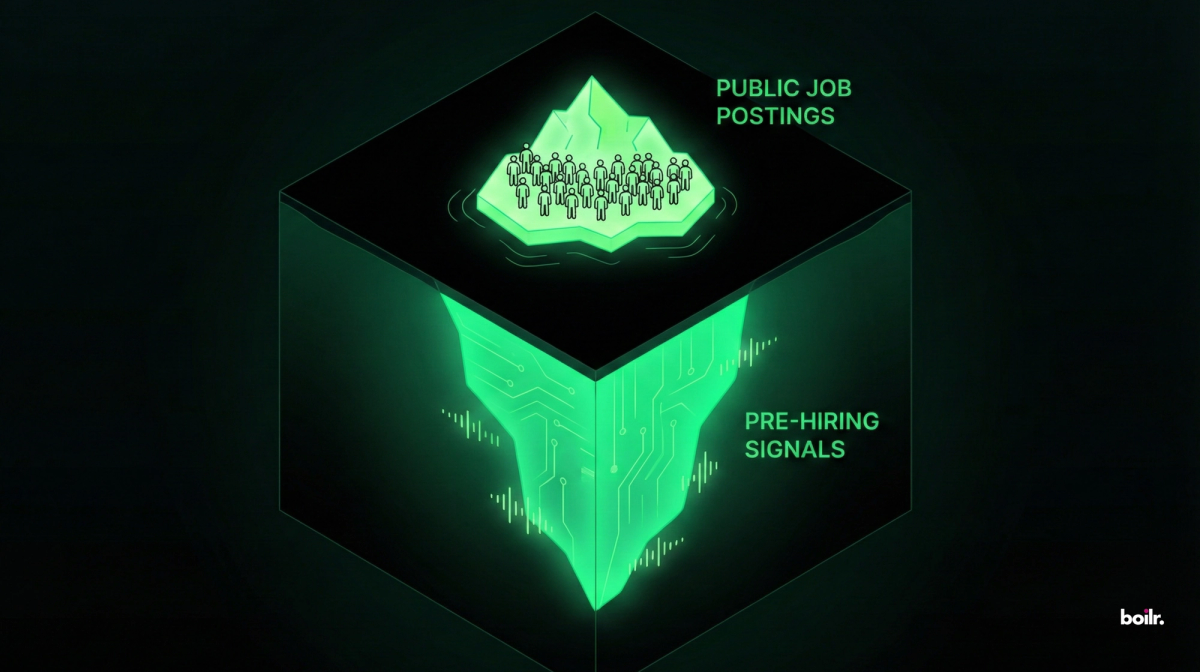
Agencies relying solely on 'linkedin recruiter' to scrape job posts are therefore filtering through a dataset that is both incomplete (missing the hidden market) and corrupted (filled with ghost jobs). To survive, agencies must move upstream in the information supply chain. They must identify the precursors to hiring—funding, expansion, leadership changes rather than the result of hiring (the job post).
The Administrative Burden of Manual Research
The shift to proactive business development imposes a heavy administrative tax. A recruiter attempting to manually replicate a signal intelligence workflow would need to monitor:
- Companies House or Crunchbase for funding.
- Google News for expansion plans.
- LinkedIn for C-suite movers.
- GitHub for tech stack changes.
Internal studies show that traditional BD workflows consume approximately 13 hours per week of a recruiter's time. This is time spent not selling, not interviewing, and not closing. The introduction of AI-driven signal intelligence reduces this to approximately 1 hour per week - a 92% efficiency gain that fundamentally alters the unit economics of a recruitment desk.
Deconstructing LinkedIn: The Engine of Modern Hiring
LinkedIn remains the indispensable operating system of the global talent market, with membership exceeding 1 billion professionals as of 2025. However, its ubiquity is also its primary liability for business development. When every recruiter has access to the same database, access itself is no longer a differentiator. Success depends on how one queries the database and interprets the results.
The 'LinkedIn and Recruitment' Ecosystem
The phrase 'linkedin and recruitment' encompasses a broad spectrum of activities, from employer branding to direct headhunting. For agency BD, however, it refers specifically to the identification of commercial opportunity. The platform's algorithm favors engagement and relevance, meaning that recruiters who interact with content related to their niche (e.g., commenting on a CEO's post about a new product launch) are more likely to see subsequent signals from that company.
However, the native "Jobs" tab on LinkedIn is a trap for business development. It is a lagging indicator. By the time a vacancy triggers a notification in the "Jobs" tab, the internal recruitment team has likely already screened the first batch of direct applicants or engaged their existing PSL. The "Jobs" tab should be viewed as a verification tool for market trends, not a primary source of leads for high-fee agencies.
Semantic Search vs. Keyword Search
A critical evolution in 2026 is the shift from keyword-based search to semantic intent search. Traditional recruiting on LinkedIn involved searching for "Hiring Manager" or "Talent Acquisition." Advanced users now leverage the semantic understanding of the platform.
- Keyword Approach: Searching for "We are hiring."
- Semantic Approach: Searching for posts discussing "scaling challenges," "roadmap acceleration," or "new territory launch."
While LinkedIn's native search has improved, it still largely relies on user-generated inputs. If a hiring manager does not explicitly state they are hiring, LinkedIn's standard search will not flag them. This is the gap that external signal intelligence tools fill.
The Advanced Guide to 'LinkedIn Recruiter' for Business Development
LinkedIn Recruiter is the premium enterprise tool designed primarily for candidate sourcing. However, astute agencies repurpose its powerful filters for client acquisition. The keyword 'linkedin recruiter' represents a significant operational cost for agencies, and maximizing its ROI for BD is critical.
Repurposing Candidate Filters for Client Lead Gen
The same filters used to find candidates can be inverted to find clients.
- "Spotlight" Filters: The "Open to Work" frame is for candidates, but the "Hiring" frame (the purple banner) is the single strongest visual indicator of a lead on the platform. Recruiters should run daily searches for 1st and 2nd-degree connections with the "Hiring" frame within their target geography.
- Past Applicant Filters: A company that posted a role 6 months ago (which you can see in Recruiter) likely has a new need or a backfill requirement now, given average attrition rates.
- Talent Flow Analytics: LinkedIn Recruiter provides "Talent Insights" which show inflow/outflow of talent. If a target company has a high outflow of engineering talent (high attrition), they are a prime target for backfill recruitment services. Conversely, if they are hiring aggressively from competitors, they are in growth mode.
Boolean Logic for Decision Makers
To bypass HR gatekeepers and find the functional decision-makers (who hold the budget), recruiters must master Boolean strings within 'linkedin recruiter'.
- The "Pain" String:
("VP Engineering" OR "CTO" OR "Head of Product") AND ("hiring" OR "growing" OR "scale") AND ("urgent" OR "immediately")This string isolates leaders who are publicly expressing urgency, a key leverage point for negotiating higher fees or faster terms. - The "Stealth" String:
title:("Founder" OR "Co-founder") AND keywords:("Stealth mode" OR "building something new") AND NOT title:("Investor")This helps identify startups before they have a formal company page or job postings, allowing the agency to become a founding talent partner.
Limitations of LinkedIn Recruiter
Despite its power, LinkedIn Recruiter has blind spots. It cannot see outside the LinkedIn ecosystem. It does not know that a company just received a government tender , nor does it track GitHub repository activity or real estate news. It is a "walled garden." This limitation necessitates the integration of third-party signal intelligence to provide the "why" behind the "who."
Signal Intelligence: The Paradigm Shift
The transition to Signal Intelligence is comparable to the shift from visual flight rules to radar in aviation. It allows agencies to see beyond the horizon. Boilr.ai exemplifies this technology, utilizing AI to aggregate and interpret data from over 10,000 sources to predict hiring intent.
The Four Pillars of Predictive Hiring
Boilr.ai categorizes signals into four main types, each offering a specific entry point for business development.
Expansion Alerts
- The Signal: A company announces a new office, a regional hub, or a remote-first expansion policy.
- The Implication: Physical or operational expansion is a "hard" commitment. It requires infrastructure (HR, Admin, Ops) followed by core delivery staff.
- Boilr Case Study: A FinTech company opening a Manchester office.
- Traditional View: No jobs posted yet.
- Signal View: 40+ upcoming roles (12 Ops, 8 Admin, 15 IT, 5 Facilities).
- Action: Contact the expansion lead 3 months before the office opens.
- Result: Exclusivity on the launch team.
Funding Rounds
- The Signal: Pre-seed, Seed, Series A/B/C announcements.
- The Implication: Investment capital creates an immediate fiduciary pressure to grow. A £6M Series A round typically translates to a headcount increase of 15–20 staff, heavily weighted toward Engineering (product development) and GTM (revenue generation).
- The Math of Funding: Agencies can calculate the "Headcount Budget" roughly as 40-50% of the raise (depending on burn rate). This allows for highly targeted fee negotiations.
Leadership Changes
- The Signal: A new C-Level or VP-Level executive is appointed.
- The Implication: "New brooms sweep clean." A new VP of Engineering often assesses the current team, identifies gaps, and hires their own trusted lieutenants within the first 90 days.
- The Opportunity: A new executive often does not have loyalty to the legacy PSLs or agencies used by their predecessor. This is the moment of highest vulnerability for incumbent agencies and highest opportunity for challengers.
Hiring Velocity and Tech Stack
- The Signal: A sudden increase in job postings (velocity) or a change in technology (e.g., new GitHub repos in Rust or Go).
- The Implication: Hiring velocity indicates a company is under pressure. Tech stack changes indicate a specific kind of scarcity.
- Boilr Insight: Knowing a company is switching to AWS or React/Node allows the recruiter to pitch a specific pool of candidates ("I have 5 React devs ready") rather than a generic service.
The Mechanics of 'Pre-Notification'
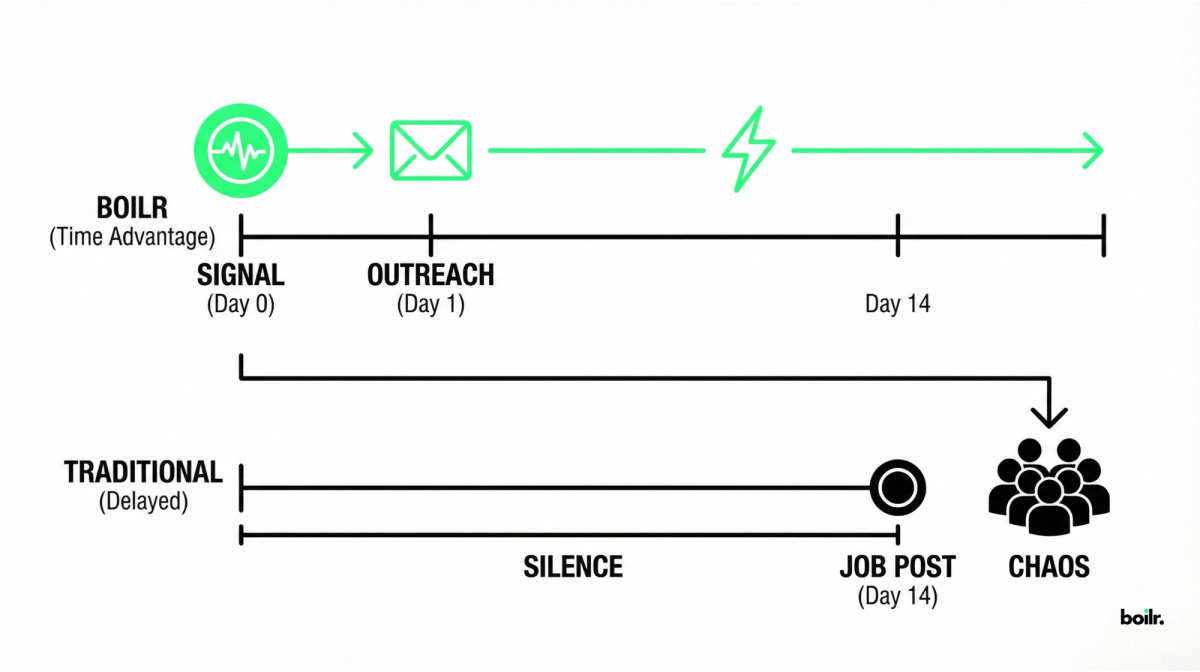
The core value proposition of platforms like Boilr.ai is the "Pre-Notification" window. The platform acts 48–72 hours before public posting.
- Day 1: Funding/Expansion decision leaked or announced in niche press/filings. (Boilr Detects)
- Day 2: Recruiter contacts Hiring Manager.
- Day 3: Hiring Manager briefs Internal HR.
- Day 4: Job Description drafted.
- Day 5: Job Posted to LinkedIn. (Competitors React)
By operating at Day 2, the agency using signal intelligence is helping to shape the requirement rather than just reacting to it.
Comparative Analysis of Recruitment Technology
To position Boilr.ai effectively, one must understand the ecosystem. The modern recruitment tech stack is segmented into Sourcing, Engagement, and Intelligence.

Boilr.ai vs. SourceBreaker
SourceBreaker is a search-and-match behemoth. Its primary function is to aggregate existing job leads and match them with candidates using proprietary algorithms.
- Core Difference: SourceBreaker answers "Who is hiring right now?" (Reactive). Boilr answers "Who will be hiring next week?" (Predictive).
- The Business Development Angle: SourceBreaker is excellent for finding vacancies that might have been missed on obscure job boards. However, once a job is on a board, the competition clock has started. Boilr provides leads that are not yet on boards.
- Integration: Ideally, an agency uses Boilr to find the client and SourceBreaker to find the candidate to fill the role. They are complementary.
Boilr.ai vs. SourceWhale
SourceWhale is an engagement and outreach platform. It focuses on the execution of communication—email sequencing, LinkedIn automation, and follow-ups.
- Core Difference: SourceWhale is the "Gun"; Boilr is the "Radar." SourceWhale does not tell you who to contact; it helps you contact them efficiently.
- Synergy: The most powerful workflow involves taking a high-intent list from Boilr (e.g., "CTOs of Series A companies") and pushing it into a SourceWhale hyper-personalized campaign.
Boilr.ai vs. Paiger
Paiger operates in the realm of recruitment marketing and personal branding. It automates content sharing to attract inbound interest.
- Core Difference: Paiger is "Inbound" (attracting clients via brand). Boilr is "Outbound" (hunting clients via intelligence).
- Use Case: Paiger builds the recruiter's reputation so that when they call a lead identified by Boilr, the client recognizes the name.
Boilr.ai vs. Bullhorn & Vincere
Bullhorn and Vincere are the Systems of Record (CRM/ATS).
- Core Difference: These platforms manage the process (interviews, placements, invoices). They do not inherently generate new business leads from the external market.
- Relationship: Boilr feeds the CRM. Without fresh leads from Boilr, the CRM becomes a static repository of old data.
Strategic Outreach: The Art of 'Contacting LinkedIn' Profiles
The identified signal is worthless without effective execution. The phrase 'contacting linkedin' profiles is often associated with spammy, low-quality automation. In 2026, the outreach must be "Context-First."
The "Context-First" Methodology
Generic outreach ("Do you have any jobs?") is ignored. Signal-based outreach uses the signal as the "hook."
- The Funding Hook: "Hi [Name], saw the £6M raise to expand the GTM team. Usually, scaling from 5 to 20 sales reps breaks the onboarding process. We have a 'pod' of 3 qualified SDRs ready to go who specialize in."
- The Expansion Hook: "Hi [Name], noticed the new Manchester hub. I specialize in staffing ops teams for satellite offices in the North. Here is a salary survey for Manchester admin roles to help your budgeting."
The Multi-Channel Cadence
To maximize the probability of a response when 'contacting linkedin' targets, agencies should employ a "Triple Touch" cadence within the first 48 hours of the signal.
- Touch 1 (Hour 0): LinkedIn Connection Request. Personalized note referencing the specific news (funding/expansion).
- Touch 2 (Hour 4): Email. A longer-form message (sent via SourceWhale) detailing the value proposition and providing "Give-to-Get" value (e.g., a market map or salary guide).
- Touch 3 (Hour 24): The "Bump". A comment on the company's funding announcement post or a video message sent via LinkedIn mobile.
Psychological Triggers in Outreach
- Authority: referencing specific technical details (e.g., "tech stack changes" identified by Boilr) signals competence.
- Scarcity: "We have 3 candidates finishing contracts next week who fit your new stack."
- Social Proof: "We just built the engineering team for following their Series A."
The Economic Case: ROI and Efficiency Models
The adoption of signal intelligence tools like Boilr.ai is not a luxury; it is a mathematical imperative for agency profitability.
Efficiency Gains
- Before Boilr: A recruiter spends 13 hours/week on admin (searching for leads, verifying data, finding emails).
- After Boilr: Admin time drops to 1 hour/week.
- Impact: 12 hours saved per week = 48 hours per month. This is more than one full work week per month returned to the recruiter for revenue-generating activity (calls, interviews, meetings).
The Value of First Contact
Data shows that the "First Contact Rate" (the percentage of leads where the agency is the first to reach out) improves from 23% to 65% with signal intelligence.
- First Mover Economics: The first agency to engage often secures a higher fee (e.g., 20% vs 15%) and exclusive terms (e.g., 2 weeks exclusivity).
- Placement Probability: The probability of filling a role drops exponentially with every additional agency engaged. Being first increases the "Fill Rate" from industry averages of ~20% to best-in-class rates of ~40-50%.
Payback Period
Boilr.ai cites a payback period of 6 weeks. For an average agency billing £10k–£15k per placement, a single additional placement generated via a funding lead covers the annual cost of the software multiple times over.
SEO Strategy: Dominating 'LinkedIn and Recruitment' Keywords
For agencies looking to attract clients via inbound marketing (SEO), aligning content with these keywords is crucial.
Optimizing for 'LinkedIn and Recruitment'
This keyword often attracts HR managers looking for best practices. Agencies should publish content titled:
- "Integrating LinkedIn and Recruitment Strategy for High-Growth Startups"
- "How to align your LinkedIn and Recruitment workflows for Series A Scale-ups" This positions the agency as a thought leader in the exact scenarios Boilr identifies (Growth/Scaling).
Optimizing for 'LinkedIn Recruiter'
Clients searching for this may be internal Talent Acquisition (TA) teams. Agencies can rank by offering:
- "When to outsource vs. using LinkedIn Recruiter internally."
- "The hidden costs of LinkedIn Recruiter for SMEs." This targets the "Build vs. Buy" decision maker.
Optimizing for 'Contacting LinkedIn'
This keyword signals intent around outreach mechanics. Content ideas:
- "Best practices for contacting LinkedIn candidates in a candidate-short market."
- "Why contacting LinkedIn hiring managers requires a signal-led approach."
Future-Proofing the Agency: 2026 and Beyond
As we move deeper into 2026, the recruitment industry will bifurcate.
- The " CV Admin" Agency: Relies on reactive job board sourcing. Will see margin compression and eventual obsolescence due to AI automation of matching.
- The "Strategic Partner" Agency: Uses signal intelligence to act as a growth consultant. They don't just "fill spots"; they "enable expansion."
The Era of Agentic AI
We are entering the age of "Agentic AI." Tools will soon evolve from identifying the signal (Boilr current state) to acting on it. An AI agent could detect a funding round, identify the hiring manager, draft the email, and schedule the call on the recruiter's calendar autonomously. Agencies that master signal intelligence data structures now will be the only ones ready for this autonomous future.
Conclusion
The "First-Mover Advantage" is the only sustainable advantage in recruitment. Tools like Boilr.ai provide the infrastructure to secure this advantage systematically rather than accidentally. By shifting from the "What" (Job Description) to the "Why" (Hiring Signal), agencies can escape the commoditized trap of modern recruitment and build a scalable, high-margin future.
Appendix: The Signal Intelligence Workflow Checklist
- Define ICP: Set clear parameters in Boilr (e.g., SaaS, Series A, London).
- Morning Briefing (08:30): Review "Overnight Signals" (Funding/News).
- Triage: Separate signals into Tier 1 (Call immediately), Tier 2 (Personalized Email), Tier 3 (Automated Nurture).
- Enrichment: Use 'linkedin recruiter' to map the specific stakeholders for Tier 1 leads.
- Outreach: Execute "Context-First" contact using the specific signal data.
- ** CRM Entry:** Log the lead in Bullhorn/Vincere for pipeline tracking.
End of Report Strategic Analysis for Boilr.ai February 2026
Detailed Boolean Strings for 2026 Recruitment
For recruiters who need to manually augment their signal intelligence, these Boolean strings are optimized for the 2026 LinkedIn search algorithm.
Finding Hiring Managers in Stealth Mode
Use Case: Identifying founders before they post jobs. title:("Founder" OR "Co-founder") AND keywords:("Stealth mode" OR "building something new") AND NOT title:("Investor" OR "Advisor")
Finding "Pain" (Immediate Need)
Use Case: Managers expressing frustration or urgency. title:("Manager" OR "Director" OR "Head") AND keywords:("we are hiring" OR "join my team" OR "growing the team") AND industry:"Software Development"
Finding Companies Removing Degree Barriers
Use Case: Identifying progressive clients for skills-based hiring. keywords:("no degree required" OR "skills based" OR "self taught") AND title:("Recruiter" OR "Talent" OR "People")
Finding Expansion Leaders
Use Case: Identifying operational leaders for new offices. title:("Head of Expansion" OR "General Manager" OR "Launch Manager") AND keywords:("New market" OR "Launching" OR "Opening")
By combining these manual "on-the-ground" tactics with the "eye-in-the-sky" capability of Boilr.ai, recruiters can achieve total market coverage.
The Psychology of the "First Mover"
It is crucial to understand why the first 48-72 hours matters. It is not just about logistics; it is about psychology.
- The "Whiteboard Phase": When a manager first gets budget approval (the moment Boilr detects), they are in the "Whiteboard Phase." They are optimistic, strategic, and open to consultation. They haven't written the job spec yet. A recruiter calling now is a Consultant helping them define the role.
- The "Inbox Phase": Once the job is posted (the moment traditional tools detect), the manager is in the "Inbox Phase." They are overwhelmed with CVs and sales calls. They are stressed and defensive. A recruiter calling now is a Vendor adding to the noise.
Signal intelligence allows agencies to interact with clients exclusively in the "Whiteboard Phase," where margins are protected and relationships are forged. This is the ultimate ROI of the technology.
Case Study: The "Series A" Sprint
Scenario: A London-based HealthTech startup raises £10M Series A (detected by Boilr).
- Traditional Agency: Waits 2 weeks for the "Head of Engineering" role to appear on LinkedIn. Applies via portal. Result: Ignored.
- Signal Agency:
- Day 0: Detects funding signal via Boilr.
- Day 0 (PM): Identifies the CTO on LinkedIn. Sees they previously worked at a Python shop.
- Day 1 (AM): Sends InMail: "Congrats on the Series A. Given your background at [Previous Co], I assume you'll be building a Python/Django backend. We have a 'bench' of 3 senior Django contractors who can start Monday to keep velocity up while you hire perms."
- Day 1 (PM): CTO replies. "Actually, yes. We need to move fast."
- Day 2: Interviews booked.
- Day 14: (When traditional agency sees the ad) Signal Agency has already placed 2 contractors and retained the perm search.
This is the tangible, bankable reality of Signal Intelligence in 2026.
FAQ: Common Objections to Signal Intelligence
Q: "Can't I just use Google Alerts?" A: Google Alerts relies on keywords. It gives you every mention of "hiring," including spam, press releases, and noise. It does not structure the data, nor does it provide contact details or context. You spend hours filtering. Boilr uses LLMs to filter the noise and deliver only actionable intelligence.
Q: "Is it GDPR compliant to contact them?" A: Yes, provided the outreach is relevant to their professional role (Legitimate Interest). Signal intelligence ensures relevance because you are contacting them about a specific business event (e.g., funding) that directly relates to their job function, unlike random cold calling.
Q: "Will AI replace recruiters?" A: AI replaces the admin of recruiting. It replaces the "finding." It does not replace the "closing." By removing the 13 hours of weekly admin, AI frees the recruiter to be more human, spending more time on negotiation, persuasion, and relationship building.
Implementation Roadmap for Agencies
For an agency leader reading this report, the path forward is clear.
- Audit current BD workflows: Measure how many hours are spent on manual research.
- Trial Signal Intelligence: Run a pilot with Boilr.ai alongside current methods. Measure "Time to First Contact."
- Retrain Staff: Shift training from "How to write Boolean" to "How to pitch from a signal."
- Update the Tech Stack: Ensure your CRM (Bullhorn/Vincere) and Engagement tool (SourceWhale) are ready to receive high-velocity data from your Intelligence layer.
The window to adopt this technology and gain the "First Mover Advantage" is closing. By 2027, signal intelligence will likely be the industry standard. In 2026, it is still a competitive superpower.