Modern Recruitment: Integrating CRM, ATS & Outreach
Learn how combining CRM, ATS, and outreach tools creates a powerful recruitment system. Discover the "Golden Stack" to unlock hidden jobs and proactive growth.
The Structural Decoupling of Sourcing and Intelligence
The global recruitment and staffing industry faces a pivotal inflection point in the 2025-2026 fiscal cycle. For decades, the fundamental value proposition of a recruitment agency was predicated on access specifically, access to a proprietary database of candidates that clients could not easily find themselves.
This era, characterized by the "black book" and the Rolodex, gave way to the digital age, where Applicant Tracking Systems (ATS) and job boards democratized access to talent profiles. Today, we are witnessing a second, more profound structural shift: the commoditization of candidate data and the simultaneous rise of demand intelligence as the primary driver of competitive advantage.
In this new paradigm, the agency's ability to find a candidate is assumed; the differentiator has shifted to the agency's ability to identify demand before it becomes public knowledge. This report provides an exhaustive analysis of the technological infrastructure required to execute this shift. We examine the convergence of three critical system layers: the System of Record (CRM/ATS), the System of Engagement (Outreach Automation), and the emerging System of Intelligence (Signal Data).
Central to this analysis is the emergence of Boilr.AI as a category-defining platform in "Signal Intelligence." Unlike legacy tools that aggregate retrospective data (such as job postings), Boilr.ai utilizes predictive analytics to detect "hiring signals" funding rounds, leadership changes, and expansion projects 48 to 72 hours before a vacancy is formally advertised. This "First Mover Advantage" is not merely a tactical edge but a strategic necessity in a market where 70% to 80% of roles exist within the "hidden job market".
This document serves as a blueprint for agency owners, operations directors, and recruitment technologists. It details the integration of Boilr.AI with market-leading execution platforms like SourceWhale and systems of record like Bullhorn and Vincere. It explores the economic implications of "Speed to Lead," the nuances of "Event Data" versus "Intent Data," and the future of the AI-augmented "Superagency.
The Macro-Economic Context: Why Reactive Recruitment is Failing
To understand the necessity of the modern tech stack, one must first analyze the failure modes of the traditional model. The historical standard operating procedure (SOP) for business development (BD) in recruitment has been inherently reactive. Agencies wait for a "trigger event" typically the publication of a job advertisement on a board or LinkedIn and then race to submit candidates. This "Post and Pray" or "Spot and Chase" methodology is suffering from diminishing returns due to three converging market forces: Market Saturation, Automation-Driven Noise, and The Hidden Market Reality.
The Saturation of Public Vacancies
The democratization of job data means that a publicly advertised role is, by definition, a "low-value" lead. By the time a vacancy appears on LinkedIn, it has likely been circulated internally, offered to employee referrals, and viewed by dozens of competitor agencies. Research indicates that by the time a role hits the public domain, 3-5 agencies have typically already contacted the hiring manager.
The economics of this competition are brutal. The probability of placing a candidate drops precipitously as the number of competing agencies increases. In a "first-to-submit" environment, speed is often prioritized over quality, leading to a "CV spam" culture that degrades the client experience and lowers fill rates. Agencies operating in this reactive mode are essentially fighting for the "crumbs" of the market the most difficult, price-sensitive, and competitive mandates.
The "Hidden Job Market" Reality
Perhaps the most compelling argument for adopting signal intelligence is the sheer volume of opportunity that exists outside the public domain. Data for 2025 suggests that the "hidden job market" accounts for between 70% and 85% of all hiring activity. These roles are filled through networking, internal mobility, referrals, or crucially proactive outreach by recruiters who anticipated the need.
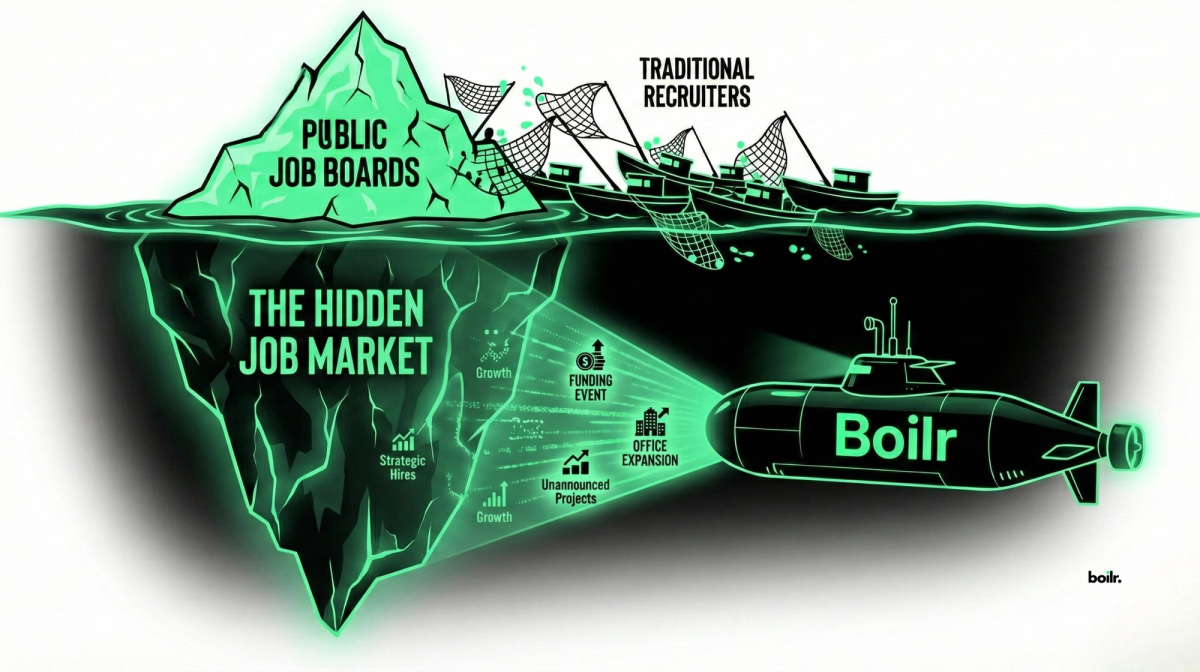
This 80% of the market represents "Blue Ocean" territory. Here, there are no PSLs (Preferred Supplier Lists) yet formed, no competing CVs in the inbox, and no rigid rate cards. Accessing this market requires a fundamental shift in detection capability. It requires moving from "lagging indicators" (job posts) to "leading indicators" (business events). This is the specific gap that platforms like Boilr.ai are engineered to fill.
The Economics of "First Mover Advantage"
The financial impact of timing cannot be overstated. "Speed to Lead" statistics from the broader B2B sales landscape which applies directly to recruitment BD paint a stark picture. Vendors that are the first to respond or reach out win between 35% and 50% of deals. More dramatically, contacting a lead within five minutes of an intent signal increases the likelihood of qualification by 21 times compared to waiting just 30 minutes.
In the context of recruitment, "Speed to Lead" is redefined as "Speed to Relationship." If a recruiter can initiate a conversation 48 hours before a job description is written, they have the opportunity to shape the role, advise on salary benchmarks, and position themselves as the exclusive partner. This "Pre-Market" engagement is the holy grail of high-margin recruitment, converting what would be a contingent race into a retained or exclusive partnership.
The Anatomy of the Modern Recruitment Stack
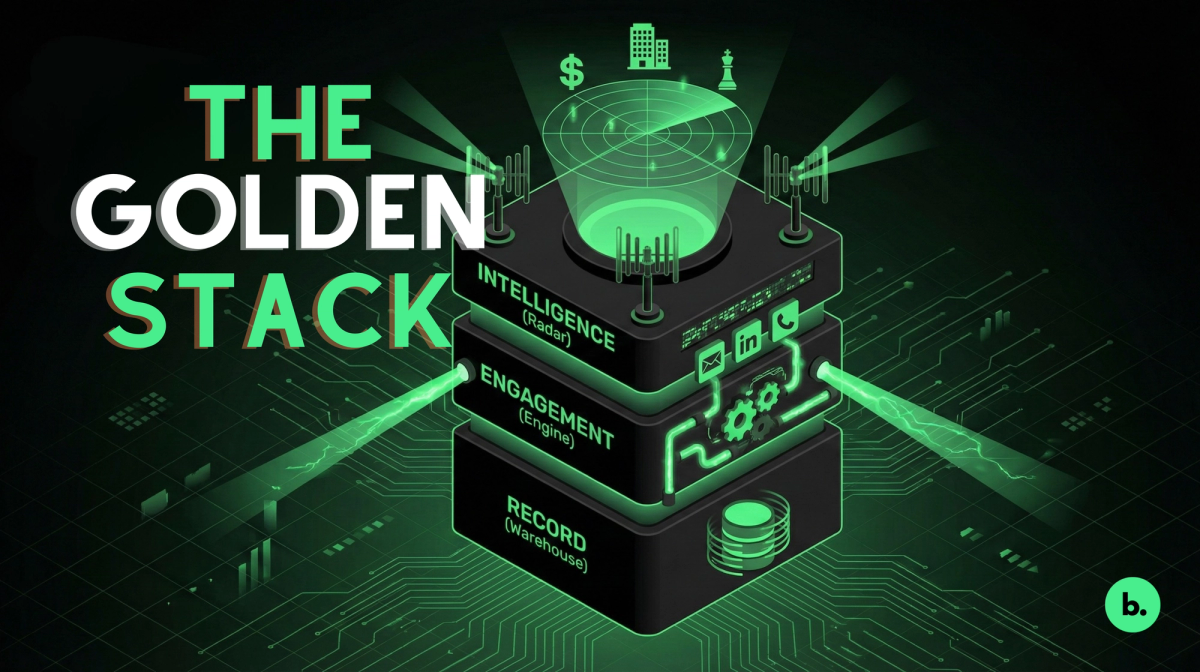
The technology infrastructure required to support this proactive model is fundamentally different from the legacy "database" model. The modern stack is composed of three distinct but integrated layers: Intelligence, Engagement, and Record. The seamless flow of data between these layers is what defines a "System," as opposed to a collection of disparate tools.
The System of Intelligence (The Radar)
This is the top of funnel layer, responsible for scanning the external environment for opportunities.
- Function: To identify where demand is emerging before it is explicit.
- Key Players: Boilr.AI (Hiring Signals), ZoomInfo (Contact/Intent Data), Sales Navigator (Network Data).
- Evolution: Historically, this layer was manual recruiters reading newspapers or scanning industry blogs. Today, it is algorithmic. Tools like Boilr.AI aggregate thousands of data points funding news, office leases, tender notices to triangulate "propensity to hire".

The System of Engagement (The Engine)
This layer operationalizes the intelligence. It is the execution arm that takes the raw signal and converts it into a conversation.
- Function: To automate and personalize outreach at scale across multiple channels (Email, LinkedIn, Phone, SMS).
- Key Players: SourceWhale, Outreach, Salesloft.
- Evolution: We have moved from manual "one-off" emails to "Sequencing." Platforms like SourceWhale allow for complex, multi-step workflows (e.g., "Send email on Day 1; if no reply, view LinkedIn profile on Day 2; call on Day 3"). Crucially, this layer handles the "Hyper-personalization" required to break through the noise, using variables derived from the Intelligence layer.

The System of Record (The Warehouse)
This is the foundational database where relationships, history, and compliance reside.
- Function: To store candidate/client data, manage the placement lifecycle, and ensure regulatory compliance.
- Key Players: Bullhorn, Vincere, JobAdder, Access Evo.
- Evolution: The modern CRM is no longer a static filing cabinet. It is a dynamic "Source of Truth" that is constantly enriched by the Intelligence and Engagement layers. Data hygiene the accuracy of the records is now maintained automatically by tools like SourceWhale syncing email signatures and Boilr updating company details.
Deep Dive: Boilr.AI and the Mechanics of Signal Intelligence
To understand the "Intelligence" layer, we must dissect its leading protagonist: Boilr.AI. As a platform purpose-built for recruitment agencies, Boilr represents a departure from generalist sales tools. It focuses exclusively on the signals that precede hiring, effectively acting as a "Radar" for the agency.
The Core Philosophy: Signal vs. Noise
The internet generates petabytes of data daily. For a recruiter, 99.9% of this is noise. A generic Google Alert for "FinTech" will return thousands of irrelevant articles. Boilr.ai’s core value proposition is the filtration and contextualization of this data through an "Ideal Customer Profile" (ICP) engine.
- Mechanism: The agency defines its ICP (e.g., "Seed to Series B startups, London & Berlin, SaaS & FinTech sectors").
- Filtering: Boilr monitors over 10,000 sources including government registries, patent filings, GitHub repositories, and press wires and only surfaces events that match the ICP and have a high correlation with hiring.
The Taxonomy of Hiring Signals
Boilr.ai categorizes intelligence into four primary signal types. Understanding these categories is essential for crafting the subsequent outreach strategy.
Expansion Signals: The High-Volume Play
Expansion is the most definitive indicator of multi-role recruitment.
- The Signal: "Company X announces new Regional HQ in Manchester."
- The Predictive Insight: An office opening is not a singular event; it is a structural change. It requires a "Pod" of hires: Office Manager, IT Support, HR Business Partner, and the core operational staff (Sales/Eng).
- The "Why Now": The company has likely signed a lease. They are burning cash on empty real estate. The urgency is intrinsic.
- Boilr’s Value: It detects this often via planning permission filings or local business press before the jobs are posted. A recruiter armed with this insight can pitch a "Managed Project" solution rather than chasing individual CVs.
Funding Signals: The Growth Catalyst
Capital injection is the fuel for headcount growth, but context is key.
- The Signal: "£6M Series A raise led by VC Firm Y."
- The Predictive Insight: Investors demand growth. A Series A typically triggers the "scaling phase." Boilr analyzes the typical spending patterns: ~40% of Series A funds go to Product/Engineering, ~40% to Go-to-Market (Sales/Marketing).
- The Nuance: Not all funding is for hiring. Some is for liquidity or debt repayment. Boilr attempts to distinguish "Growth Capital" from "Working Capital" by analyzing accompanying press releases and job board activity.
- Outreach Strategy: "Congrats on the raise. We know that Series A usually means you need to hire your first VP of Sales and 5 SDRs within 90 days. We have a pipeline of candidates who specialize in exactly this stage of growth.
Leadership Change Signals: The "New Broom" Effect
New executives bring new mandates and often clear out legacy providers.
- The Signal: "New Chief Technology Officer appointed (Week 1)."
- The Predictive Insight: A new CTO has a 90-day plan. This almost always involves assessing the current team, identifying gaps, and bringing in trusted lieutenants. Crucially, they do not have loyalty to the previous CTO’s recruitment agencies.
- The Opportunity: This is the single best moment to displace an incumbent competitor. The "New Broom" wants to make a mark quickly.
- Boilr’s Value: It tracks these moves via LinkedIn graph changes and press releases, alerting the recruiter immediately. A generic tool might see the title change; Boilr flags it as a "Buying Signal".
Hiring Velocity Signals: The "Silent Scream"
Sometimes, there is no press release. There is only panic.
- The Signal: "Headcount +12% in 30 days" or "4 Engineers hired per week."
- The Predictive Insight: The internal Talent Acquisition (TA) team is overwhelmed. When a company attempts to scale at this velocity, their "Time to Fill" metrics usually degrade, and hiring managers get frustrated.
- The Opportunity: This is an "Overflow" or "Sprint" pitch. "I see you are hiring aggressively. Your internal team is doing a great job, but if you need sprint capacity to hit your Q3 roadmap, we can pick up the overflow."
- Boilr’s Value: It calculates velocity by monitoring career page changes and LinkedIn headcount data over time, creating a "derivative" metric that indicates acceleration.
Event Data vs. Intent Data
It is critical to distinguish Boilr’s "Event Data" from the "Intent Data" provided by platforms like ZoomInfo, Bombora, or 6sense.
- Intent Data: Tracks behavioral proxies, such as IP addresses visiting specific web pages (e.g., "Someone from IBM visited your 'Pricing' page"). This is powerful for software sales but often generates false positives for recruitment. A visit to a pricing page doesn't necessarily mean a job opening exists.
- Event Data (Boilr): Tracks verifiable facts (Funding, Hiring, Moving). These events have a direct causal link to recruitment needs. For an agency, Event Data typically offers a higher "Signal-to-Noise" ratio and a more concrete reason for outreach.
The Integration Ecosystem: From Insight to Action
Intelligence is only potential energy. It becomes kinetic energy only when executed through outreach. This section details the technical and operational workflows that link Boilr.AI (Intelligence) with SourceWhale (Engagement) and Bullhorn (Record).
The "Golden Stack" Workflow
The most efficient agencies utilize a linear, automated data flow that minimizes manual entry and maximizes speed.
Step 1: Signal Detection & Enrichment
- Trigger: Boilr detects a "Series A Funding" event for a London FinTech.
- Enrichment: Boilr enriches this event with the contact details of the "Hiring Manager" (e.g., the CTO or VP of Engineering), not just the HR department. This distinction is vital; HR are gatekeepers, Hiring Managers are decision-makers.
- Context: Boilr appends the "Reason" (e.g., "Scaling Engineering Team for Mobile App Launch").
Step 2: CRM Ingestion (The System of Record)
- Mechanism: Via API integration or CSV export, the lead flows into Bullhorn or Vincere.
- Data Mapping: The "Company" record is updated with the funding amount. A "Lead" or "Opportunity" object is created, linked to the Hiring Manager.
- Automation: Bullhorn Automation (formerly Herefish) detects the new Lead. It can automatically tag the record as "Hot Prospect" and assign it to the relevant vertical consultant (e.g., the "FinTech Consultant") based on the industry tag.
Step 3: Outreach Orchestration (The System of Engagement)
- Mechanism: The new Lead in Bullhorn automatically triggers a "Flow" in SourceWhale. Alternatively, the recruiter pushes the lead from Boilr directly to SourceWhale via a Chrome Extension.
- Sequence Activation: The lead is enrolled in a specific "Series A Congratulatory Sequence."
- Hyper-Personalization: SourceWhale uses the variables passed from Boilr.
- Subject: "Question re: [Company Name] Series A"
- Body: "Hi [Name], saw the news about the £6M raise. Congratulations. Given you're scaling the team, I wanted to share..."
Note: This level of personalization, driven by data, increases response rates significantly often seeing 3x the engagement of generic cold outreach.
The Feedback Loop (Data Hygiene)
- Mechanism: As the email sequence runs, SourceWhale listens for responses.
- Sync: If the email bounces, SourceWhale updates the CRM to "Invalid." If the contact replies, SourceWhale logs the email body into the CRM's "Activity" tab and stops the sequence.
- Outcome: The CRM remains pristine. The "Data Decay" that typically rots databases at 70% per year is mitigated by the constant activity of the engagement layer.
The Role of "Paiger" in the Ecosystem
While SourceWhale handles direct outreach, Paiger plays a complementary role in "Recruitment Marketing."
- The Warm-Up: Before the recruiter sends the SourceWhale email, Paiger can be used to engage with the prospect on social media. Paiger automates the sharing of relevant content to the recruiter’s LinkedIn profile, ensuring that when the prospect clicks the recruiter's profile, they see an active, expert voice.
- Synergy: A recruiter using Boilr knows who to target. Paiger ensures the recruiter looks credible to that target. SourceWhale ensures the message reaches that target.
Comparative Analysis: The Competitive Landscape
To fully appreciate Boilr.AI's position, we must benchmark it against other tools in the recruiter's arsenal. The market is crowded, but tools generally fall into specific categories: Search Aggregators, Outreach Tools, and Generalist Data Providers.
Feature Comparison of Leading Recruitment Tools
Boilr.AI vs. Sourcebreaker
Sourcebreaker (now a Bullhorn company) is a powerful tool, but its core DNA is different from Boilr.
- Sourcebreaker: Its primary engine is a "Search & Match" bot. It scrapes job boards and career sites to find live vacancies. It then automatically searches the agency's database to find matching candidates.
- Philosophy: "Here is a job that exists now; here is a candidate who fits it."
- Limitation: It is structurally reactive. The job is already public.
- Boilr.AI: Its primary engine is an "Event Monitor." It looks for the precursors to vacancies.
- Philosophy: "Here is a company that will need to hire; call them now."
- Advantage: It creates exclusivity. By calling before the job is posted, the recruiter can negotiate terms without competing against 5 other agencies.
Boilr.AI vs. SourceWhale
These tools are not competitors; they are symbiotic partners.
- The Distinction: Boilr provides the bullet (the lead/reason). SourceWhale provides the gun (the delivery mechanism).
- The Workflow: Using SourceWhale without Boilr means the recruiter has a great gun but no ammo they have to manually research who to email. Using Boilr without SourceWhale means the recruiter has great ammo but has to throw it by hand typing emails manually is unscalable. The combination is essential for high volume BD.
Boilr.AI vs. ZoomInfo / Lusha
ZoomInfo is the giant of B2B data. It excels at providing phone numbers and org charts.
- The Gap: ZoomInfo is a generalist tool. Its "Intent Data" is often broad (e.g., "High consumption of Cloud Computing content").
- The Boilr Edge: Boilr’s signals are calibrated for recruitment. It translates "Series A" into "Headcount Growth." It parses "New Office" as "Expansion Hiring." This domain-specific translation layer saves recruiters from having to interpret raw business data themselves.
Strategic Implementation: Operationalizing the Intelligence Desk
Adopting these tools is not merely a software installation; it is a change management project. The "Intelligence-Led" desk operates differently from the traditional "360 Desk."
The Cultural Shift: From "Dialing" to "Advising"
In the reactive model, the KPI is "Calls Made." The goal is volume. In the intelligence model, the KPI shifts to "Meaningful Conversations."
- The Old Script: "Hi, I'm calling to see if you have any recruitment needs?" (Low value, high rejection).
- The New Script (Boilr-Enabled): "Hi, I noticed the announcement about your new Manchester hub. Typically, scaling a hub like that requires a specific sequence of hires Head of Ops first, then Engineering Leads. I have a case study of how we did this for [Competitor]. Can we discuss your roadmap?" (High value, consultative).
- Implication: Recruiters need higher commercial acumen. They must understand funding stages (Seed vs. Series A), tech stacks, and organizational structures to effectively use the signals Boilr provides.
Data Governance and "The Moat"
Agencies that successfully integrate this stack build a defensive moat: Proprietary Data.
- Mechanism: By constantly feeding Boilr signals into the CRM and enriching them via SourceWhale, the agency builds a "Living Database" of companies and decision-makers that is unique to them.
- Value: This proprietary dataset becomes an asset that belongs to the firm, not the individual recruiter. If a recruiter leaves, the intelligence remains in the CRM. This is a critical valuation driver for agency owners looking to exit.
KPI Realignment
To drive adoption, management must measure what matters.
- Signal-to-Meeting Ratio: Tracking how many Boilr alerts convert into first interviews.
- Pre-Market Fill Rate: Tracking the percentage of placements made where the job was never publicly advertised. This is the ultimate metric of signal intelligence success.
- Data Enrichment Score: Measuring the completeness of CRM records (e.g., % of records with valid email, phone, and recent growth data).
Future Outlook: The Rise of the Autonomous "Superagency"
As we look toward 2026 and beyond, the integration of CRM, ATS, and Signal Intelligence will evolve into full autonomy.
AI Agents and "Headless" Recruiting
We are moving toward a world of AI Agents. Currently, a human recruiter must look at Boilr, click a button to push to SourceWhale, and customize the text.
- The Future: An AI Agent will monitor Boilr 24/7. Upon detecting a high-confidence signal (e.g., "Perfect ICP Match + Funding Event"), the Agent will autonomously draft the email in SourceWhale, schedule the task in Bullhorn, and potentially even send the initial outreach, only alerting the human recruiter when a reply is received.
- Implication: This will drastically increase the "Recruiter-to-Revenue" ratio. One human recruiter, supported by agents, could manage a territory that previously required five people.
The Bifurcation of the Market
The market will split into two distinct tiers:
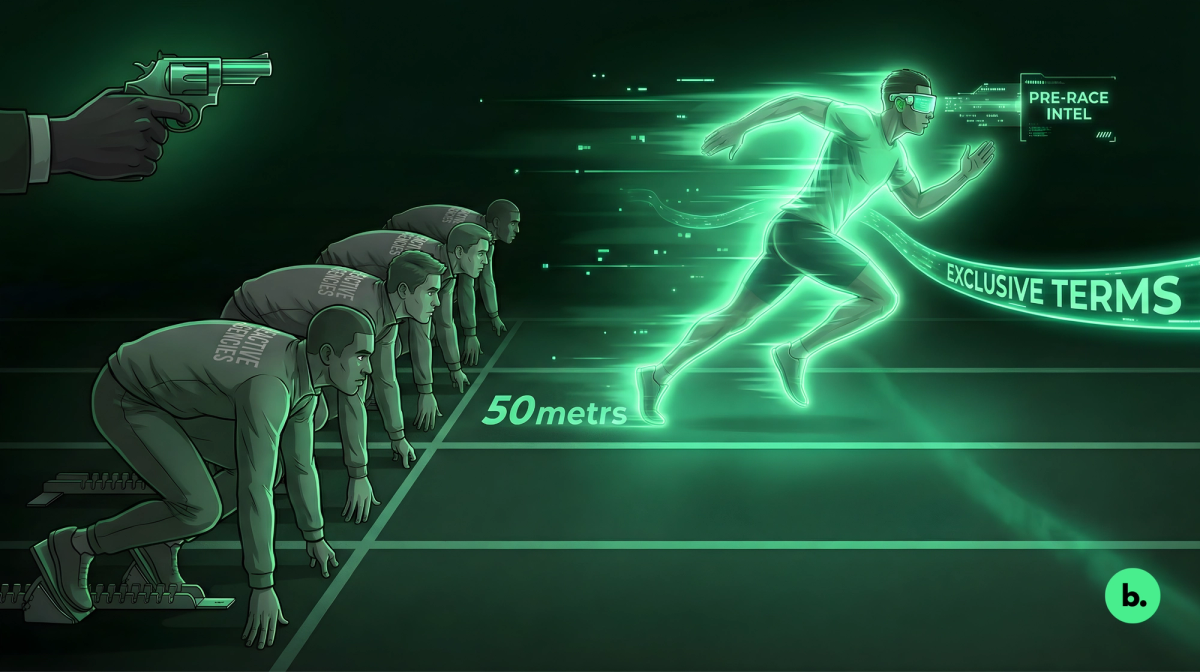
- The Transactional Layer: Agencies that fail to adopt intelligence will fight for the 20% of public jobs, competing on price and speed-to-submit. Margins will compress.
- The Advisory Layer: Agencies that master signal intelligence will dominate the 80% hidden market. They will operate as strategic partners, integrated early in the client's growth cycle. They will command higher fees because they are selling solutions to business problems, not just CVs.
The integration of Boilr.AI (Intelligence) with SourceWhale (Engagement) and Bullhorn (Record) represents the "Golden Stack" for the modern recruitment agency. This architecture solves the fundamental economic problem of the industry: the inefficiency of reactive business development.
By decoupling "sourcing" (finding people) from "intelligence" (finding demand), agencies can reclaim the initiative. They can move from being "CV vendors" to being "Growth Partners." The technology exists today to make this transition. The constraint is no longer software; it is the will to abandon the comfort of the "Post and Pray" model and embrace the discipline of the "Predict and Partner" approach.
In a world where candidate data is a commodity, timing is the only luxury. Signal intelligence provides that luxury.
Key Takeaways for Agency Leaders
- Shift the Metric: Stop measuring "Calls." Start measuring "Signals Actioned."
- Own the Data: Your CRM is only as good as the intelligence feeding it. Automate the feed.
- Train for Context: A signal is useless if the recruiter cannot contextualize it. Invest in commercial training.
- Attack the Hidden Market: If you are waiting for a job post, you have already lost. The battle is won in the 48 hours before the post goes live.
FAQs
- What is the fundamental difference between Boilr.AI and a traditional database like ZoomInfo?
While ZoomInfo is a generalist B2B data provider focusing on contact details and broad "intent" signals (like web traffic), Boilr.AI is a purpose-built Signal Intelligence platform for recruitment. It focuses on "Event Data" - verifiable triggers like funding rounds, office expansions, and leadership changes that have a direct causal link to immediate hiring needs, often filtering out the noise associated with general sales tools. - Does Boilr.AI replace my existing ATS/CRM (e.g., Bullhorn, Vincere)?
No. Your ATS/CRM is your System of Record; Boilr.AI is your System of Intelligence. Boilr sits at the very top of your funnel, acting as a radar to detect new opportunities. Once a lead is identified, it is pushed into your CRM to be managed, tracked, and converted. The two systems are complementary, not competitive. - I already use Sourcebreaker. Do I still need Boilr.AI?
Yes, because they solve different problems. Sourcebreaker is primarily a Search Aggregator designed to find candidates and match them to live job postings that are already public. Boilr.AI is a Business Development tool designed to find clients before they post jobs. Using both allows you to attack the market from both sides: filling live jobs (Sourcebreaker) and capturing exclusive pre-market roles (Boilr.AI). - How does Boilr.AI integrate with outreach tools like SourceWhale?
Boilr.AI and SourceWhale form a "Golden Stack." Boilr provides the "Why" (the reason to call), and SourceWhale handles the "How" (the execution). In a typical workflow, you identify a hiring signal in Boilr (e.g., a Series A funding round), push the contact to SourceWhale, and immediately enroll them in a hyper-personalized email sequence that references that specific funding news. - Can Boilr.AI really identify opportunities 48-72 hours before they are advertised?
Yes. This is the core concept of "First Mover Advantage." By monitoring upstream indicators such as planning permissions for new offices, investment press releases, or C-suite appointments Boilr identifies the trigger for recruitment before the operational task of writing and posting a job description is completed by the company's HR team. - What is the "Hidden Job Market" and why should I care?
The "Hidden Job Market" refers to the estimated 70-85% of roles that are filled via networking, headhunting, or referrals without ever being publicly advertised on job boards. Accessing this market allows agencies to avoid the "CV race," work on exclusive terms, and protect their margins, rather than competing with 5+ other agencies on a public job post. - Is Boilr.AI a candidate sourcing tool?
No. Boilr.AI is strictly for Client Acquisition (Business Development). It finds companies that need to hire. It does not search for candidates to fill those roles. For candidate sourcing, you would continue to use tools like LinkedIn Recruiter, Sourcebreaker, or your own CRM. - What specific "signals" does the platform track?
Boilr monitors over 10,000 data sources to detect four primary signal types:- Expansion: New office openings or regional growth.
- Funding: Venture capital or private equity injections.
- Leadership: New C-level or VP appointments (who often build new teams).
- Velocity: Abnormal spikes in hiring rates or headcount growth.
- How does using Signal Intelligence impact an agency's bottom line?
It shifts the agency from a reactive, low-margin model to a proactive, high-margin model. By engaging clients before they have engaged other suppliers, agencies can often secure retained or exclusive terms. Additionally, it significantly reduces the non-billable administrative time recruiters spend manually researching leads, increasing the "Recruiter-to-Revenue" ratio. - Is this technology only for large enterprise agencies?
Not at all. In fact, Signal Intelligence acts as a force multiplier for smaller boutique agencies. It allows a single consultant to monitor a vast market territory that would traditionally require a large research team. By automating the detection of leads, small teams can punch above their weight and compete directly with major firms for prime accounts.