How AI-Powered Outreach Helps Recruiters Book More Hiring Calls
Is AI cold calling enough? Learn how sales AI tools and Signal Intelligence help the modern AI recruiter identify leads 72 hours early and book more meetings.
The Era of Signal Intelligence: How AI-Powered Outreach and Predictive Data Are Redefining Recruitment Business Development
The Structural Transformation of the Recruitment Industry in 2025
The global recruitment and staffing industry stands at a precipice of fundamental structural change. As we navigate through 2025, the economic and operational realities facing agency owners and billing consultants have shifted dramatically from the paradigms that defined the previous decade. For years, the dominant narrative was the "War for Talent," a period characterized by candidate scarcity, wage inflation, and the desperate search for "purple squirrels" highly specialized professionals in a labor-tight market. However, data from late 2024 and throughout 2025 indicates a sharp, decisive inversion of this dynamic. The primary constraint on agency growth has flipped: the industry has moved from a candidate-constrained market to a client-constrained market.
This shift is not merely cyclical; it appears structural, driven by macroeconomic tightening, the maturation of internal talent acquisition teams, and the proliferation of technology that has commoditized candidate sourcing. According to the 2025 State of Staffing report, the number one challenge for staffing firms has shifted dramatically. In 2024, finding qualified candidates was the primary sleepless night for agency leaders. By 2025, finding new clients and securing job orders eclipsed talent sourcing, with 23% of agencies citing client acquisition as their top challenge, while candidate shortage concerns dropped to just 12%.
This "market flip" has caught many agencies off guard. The infrastructure, technology stacks, and training programs of most recruitment firms are optimized for candidate resourcing finding people rather than sophisticated B2B business development finding companies. The result is a landscape where agencies are fighting fiercely for a shrinking pool of visible job orders, leading to margin compression and increased cost of sale.
The Client Scarcity Crisis
The data paints a stark picture of the new reality. Job order volume is softening across major sectors, and new client acquisition cycles are lengthening. While unemployment remains relatively low in key technical sectors, the velocity of hiring has slowed, and companies are becoming more selective, often relying on internal teams or direct sourcing before engaging agencies.
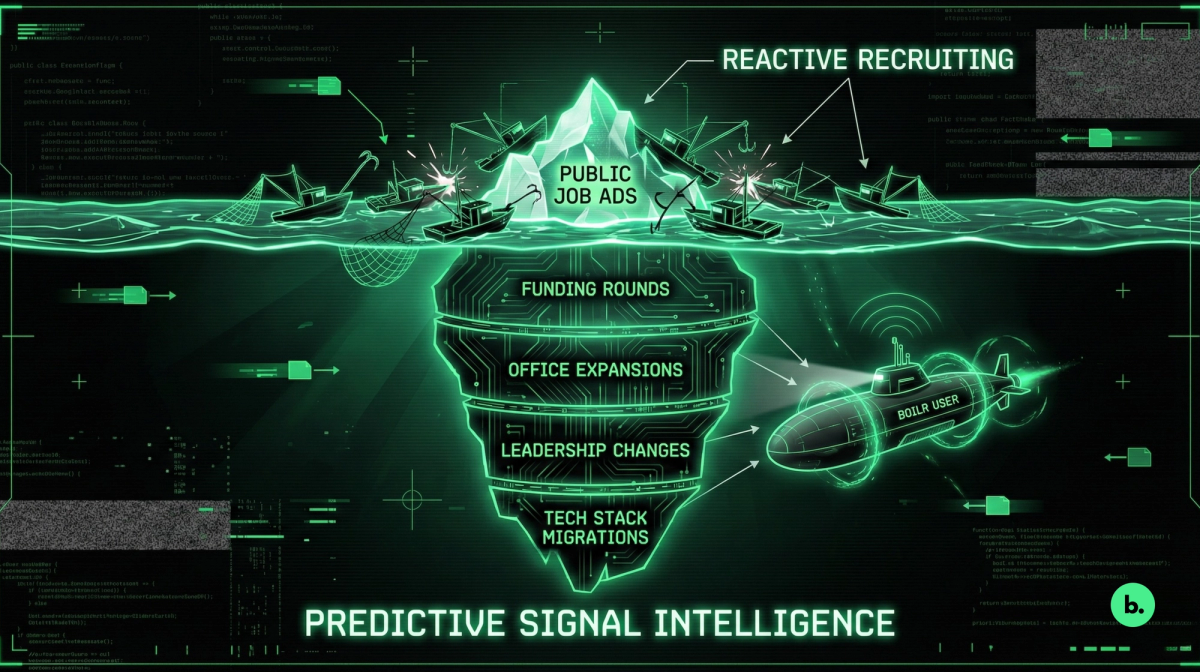
The implication for the agency model is profound. In a candidate-short market, an agency’s value proposition is "access to talent." If you had the candidate, you won the fee. In a client-short market, the value proposition must shift to "access to insight." Having the candidate is no longer enough if you cannot find a client willing to pay a fee for them. The scarcity has moved up the supply chain.
Furthermore, the difficulty of recruiting remains high, but for different reasons. Nearly 7 in 10 organizations (69%) still report difficulties recruiting for full-time regular positions. This suggests that while companies are hiring less volume, the complexity of the hires they are making remains high. They need partners who understand their specific context, not just CV suppliers.
The Saturation of "Red Ocean" Channels
The immediate consequence of client scarcity is the saturation of traditional business development channels. For the past decade, the standard agency playbook for business development has been reactive: monitor job boards (Indeed, LinkedIn, Glassdoor), wait for a company to post a vacancy, and then bombard the hiring manager with calls and emails.
This approach has created a "Red Ocean"—a market space crowded with competitors fighting over the same demand.
- The "Speed to Lead" Fallacy: On public job boards, "speed" has become a race to the bottom. By the time a role appears on LinkedIn, statistical analysis indicates that 3-5 agencies have already made contact with the hiring manager. The window of opportunity is effectively closed before it opens.
- The Commoditization of Outreach: Because every agency has access to the same job board data, the outreach becomes generic. Hiring managers report being inundated with hundreds of identical emails ("I saw your ad for a Java Developer...") within hours of posting. This leads to "recruiter fatigue," where legitimate service providers are ignored due to the noise created by low-value competitors.
- Diminishing Returns on Cold Calling: The efficacy of brute-force cold calling is declining. While the phone remains a vital tool, calling purely based on job board data yields low conversion rates because the prospect is already besieged. Sales statistics for 2025 indicate that 35% to 50% of sales go to the vendor that responds first. In the context of public job ads, being "first" is nearly impossible for an external agency, as internal candidates and referrals often have a head start.
The Administrative Burden
Compounding the competitive pressure is the operational inefficiency within agencies. The average recruiter spends a staggering amount of time on non-revenue-generating activities. Internal studies suggest that recruiters spend up to 13 hours per week on administrative tasks, primarily researching leads, scrolling LinkedIn for updates, and managing data.
This "Time Tax" is unsustainable in a low-margin environment. If a recruiter works a 40-hour week, losing 13 hours to admin means they are operating at 67% capacity. In a market where win rates are dropping, agencies cannot afford to have their most expensive assets their consultants doing the work of data entry clerks. The industry requires a mechanism to invert this ratio spending 1 hour on research and 13 hours on selling.
The Need for Asymmetric Information
To survive and thrive in this client-short, hyper-competitive market, agencies require asymmetric information. In economics, asymmetric information occurs when one party in a transaction possesses greater material knowledge than the other. In recruitment, this means knowing a company is hiring before the market knows.
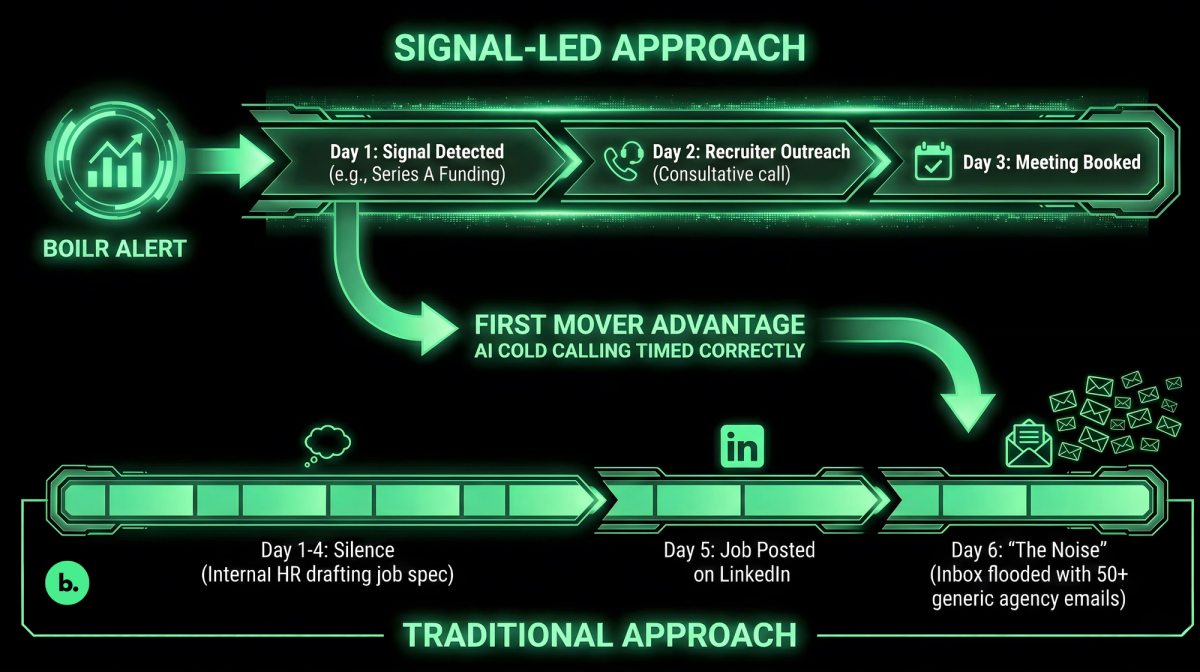
If an agency can identify a hiring need 48 to 72 hours before a role is publicly advertised, they effectively bypass the competition. They move from the "Red Ocean" of the job board to the "Blue Ocean" of pre-market exclusivity. This is the core economic principle driving the adoption of "Signal Intelligence." It transforms the sales conversation from a transactional pitch ("Do you want to see CVs for the job you posted?") to a consultative advisory session ("I see you are expanding into the DACH region; let's talk about your GTM hiring strategy").
Defining Signal Intelligence (SIGINT) in Recruitment
To understand the solution, we must first define the methodology. Borrowed from the military and intelligence domains, Signal Intelligence (SIGINT) in a commercial context refers to the systematic collection, analysis, and interpretation of digital signals to predict future behavior. In the context of recruitment, it involves monitoring the vast "digital exhaust" that companies produce to identify hiring intent before it manifests as a job requisition.
The Concept of "Pre-Hiring" Momentum
Hiring is rarely a spontaneous event. It is the final step in a long chain of strategic business decisions. The traditional recruitment model waits for the final step (the job ad). Signal Intelligence focuses on the preceding steps.
- Strategic Event: A company raises capital, wins a contract, or decides to open a new office.
- Budget Allocation: Finance and Leadership approve the headcount required to execute the strategy.
- Internal Planning: HR and Hiring Managers define the roles.
- Job Description Creation: The specifics of the role are drafted.
- Public Advertisement: The role is posted to the market.
Agencies relying on job boards enter at Step 5. Signal Intelligence allows agencies to enter at Step 1 or Step 2. This upstream movement is the only way to secure exclusivity and higher fees.
The Four Pillars of Hiring Signals
Boilr.ai, a platform pioneering this technology, categorizes hiring signals into four primary streams. By monitoring over 10,000 sources including press releases, government tenders, GitHub activity, and organizational charts the platform detects these precursors to hiring.
Expansion Signals (Geographic and Operational Growth)
When a company announces a new office, a new territory, or a new operational hub, hiring is a physical inevitability. Physical infrastructure investment always precedes human capital investment.
- The Signal: "FinTech Co. announces new Manchester Office."
- The Implication: A new office requires a "landing team." This typically includes a mix of operational staff (Office Managers, HR), technical staff (IT support, Network Engineers), and core business staff (Sales, Developers).
- The "Blue Ocean" Nuance: Crucially, new locations often do not have established Preferred Supplier Lists (PSLs) in place. A company with a strict PSL in London may have zero vendor relationships in Manchester or Berlin. This creates a window of opportunity for agile agencies to break into otherwise closed accounts.
- Predictive Timeline: These roles are often planned 3-6 months in advance of the office opening, giving the recruiter a long runway to build a relationship before the urgency hits.
Financial Signals (Funding Rounds and Capital Events)
Capital injection is the strongest statistical predictor of headcount growth in the technology and startup sectors. Investors do not provide capital for stability; they provide it for growth.
- The Signal: "£6M Series A Investment."
- The Implication: Historical data suggests that 40-60% of Series A capital is deployed into headcount costs over the subsequent 18 months. A £6M round typically triggers a hiring spree of 15-20 roles.
- Granular Analysis: The stage of funding dictates the type of hiring.
- Seed/Series A: Heavy focus on Engineering and Product development.
- Series B/C: Shift toward Go-to-Market (Sales, Marketing) and middle management to scale operations.
- Private Equity Buyout: Often signals consolidation or efficiency hires (CFO, COO) rather than mass headcount growth.
- Actionable Intelligence: Knowing a company has raised funds allows the recruiter to position themselves as a "Scaling Partner" rather than just a CV sender.
Leadership Changes (The Mandate Signal)
New leaders bring mandates for change. A new executive appointment is a high-probability trigger for downstream hiring.
- The Signal: "New VP of Engineering appointed (Week 3)."
- The Implication: A new VP evaluates the current team structure and almost always identifies gaps or "dead wood." They often have a "first 90 days" budget to build their own core team. Common patterns include a new VP of Engineering hiring 2 Engineering Managers and 4 Senior Developers within their first quarter.
- The Psychology: New leaders are under immense pressure to deliver quick wins. They are less likely to tolerate slow internal HR processes and are more open to using external agencies to get "their people" in the door quickly. They prioritize speed and quality over cost, making them ideal clients for agency recruiters.
Technical and Operational Signals (The Tech Stack)
These are subtle, often technical indicators found in the operational data of a company.
- Tech Stack Migration: A company's engineering team starring a specific new library on GitHub, or job postings for a specific cloud certification (e.g., migrating from on-premise to AWS), indicates a skills gap. If a team of Java developers suddenly starts interacting with GoLang repositories, they will likely need to hire external GoLang experts to lead the transition.
- Hiring Velocity: Tracking the rate of headcount growth offers insight into organizational stress. A company increasing headcount by 12% in 30 days is in hyper-growth mode. At this velocity, internal talent acquisition teams are statistically likely to be overwhelmed. They physically cannot screen resumes fast enough, making them receptive to agency support to handle the overflow.
The Role of Generative AI (LLMs) in Signal Processing
The sheer volume of data required to track these signals across millions of companies is beyond human capacity. This is where Artificial Intelligence, specifically Large Language Models (LLMs), becomes the critical enabler.
- Noise Reduction: A raw feed of "news" is useless. A recruiter cannot read 1,000 articles a day. AI filters this data through an "Ideal Customer Profile" (ICP). As noted in the Boilr documentation, the system "remembers your profile and only delivers relevant opportunities no noise, no time wasted".
- Contextualization: LLMs can synthesize disparate signals into a coherent narrative. Instead of just flagging a funding round, the system outputs a synthesized insight: "Company X plans 40 hires due to expansion; Tech stack is React/Node," providing the recruiter with the reason for the call.
- Predictive Validity: As LLMs evolve, they are beginning to predict not just hiring but attrition. By analyzing employee tenure and sentiment data, advanced systems may soon predict when a company is about to lose staff, creating backfill opportunities before the resignation letter is even signed.
The Boilr.AI Platform – A Technical Deep Dive
Boilr.AI positions itself not just as a data provider, but as a "Signal Intelligence Platform." Based on the provided documentation, its architecture is designed to solve the specific pain points of the agency recruiter.
The Core Proposition: Timing
Boilr’s core value proposition is timing. It claims to detect hiring signals 48-72 hours before positions are publicly advertised. This 2-3 day window is the "Golden Hour" of recruitment sales. It allows the agency to:
- Contact the hiring manager before the inbox is flooded.
- Shape the job description before it is finalized.
- Negotiate exclusive or retained terms because there is no competition yet.
Feature Set Analysis
The platform is built around four key functionalities:
- Multi-Source Monitoring (The "Ears") Boilr continuously monitors 10,000+ sources. This includes standard sources like LinkedIn Updates and Press Releases, but extends to "deep web" signals like Government Tenders, VMS Systems, and GitHub Activity. This breadth ensures that signals are triangulated a funding rumor is confirmed by a press release and validated by a leadership change.
- Predictive Hiring Intelligence (The "Brain") The platform categorizes raw data into the four signal types discussed above (Expansion, Funding, Leadership, Velocity). It then applies predictive logic. For example, it translates "£6M Series A" into "15-20 planned hires." This translation step is crucial; it converts financial data into recruitment data.
- ICP-Based Filtering (The "Filter") Recruiters define their Ideal Customer Profile (ICP) based on industry, size, stage, and location. This ensures a specialized agency (e.g., "German FinTech") doesn't receive alerts for "US Healthcare." This personalization reduces the "noise-to-signal" ratio, a common complaint with broader sales intelligence tools.
- Ready-to-Go Leads (The "Output") The system delivers "actionable intelligence," not just raw data. A lead includes:
- The Company: Context on growth.
- The Hiring Manager: Specific names of decision-makers.
- The Context: "Why now?" (e.g., "New VP appointed").
- Contact Details: Email and phone data. This packaging is designed to minimize the "time-to-dial."
Measurable Impact and ROI
The data provided suggests significant operational improvements for agencies adopting this technology :
- Weekly Admin Reduction: From 13 hours to 1 hour (-92%). This is the most immediate ROI, freeing up significant billable time.
- Opportunity Volume: 2-3x increase in qualified leads.
- First-Contact Rate: An increase from 23% to 65%. This is the most critical metric for sales efficacy. A 65% contact rate suggests that the relevance of the outreach (driven by the signal) overcomes the friction of cold contact.
- Payback Period: ROI is typically realized within 6 weeks, suggesting a fast time-to-value implementation.
Integrating AI Outreach – The Tech Stack Ecosystem
Identifying the signal is only half the battle; acting on it effectively is the other half. The integration of Signal Intelligence with AI-powered outreach tools creates a seamless workflow that maximizes the "first mover advantage."
The "Intelligence-Execution" Loop
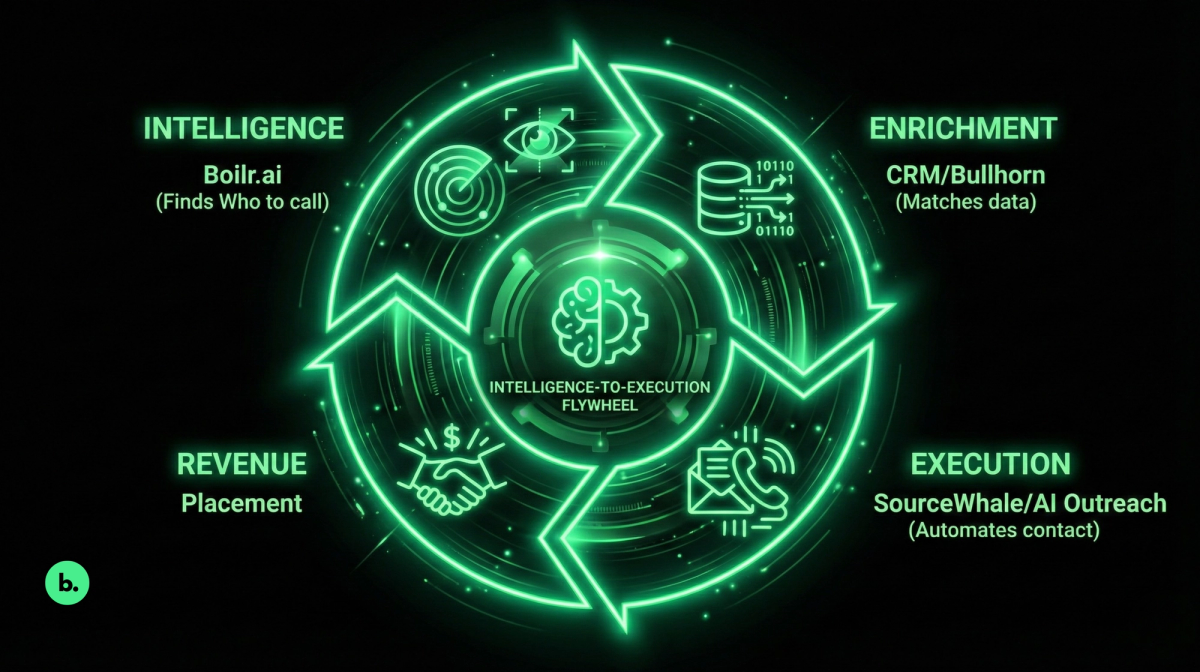
Confusion often exists regarding where "Signal Intelligence" sits in the recruitment tech stack. It is vital to distinguish between finding the opportunity (Intelligence) and executing the outreach (Automation).
The Modern Recruitment Technology Stack
The Workflow of the Future
The integration of these tools creates a powerful "flywheel" effect:
- Signal Detection: Boilr detects a Series B funding round for a SaaS company.
- Data Push: Boilr pushes this lead (Company + Hiring Manager) directly into the CRM (Bullhorn) and the Outreach tool (SourceWhale).
- Automated Engagement: SourceWhale triggers a "Funding Sequence." The email is dynamically populated with data from Boilr: "Hi [Name], saw the news about the Series B round. Typically, this stage requires scaling the..."
- The Call: The recruiter receives a notification that the email has been opened. They call the prospect. Because the email was relevant and timed perfectly, the "cold" call becomes a "warm" call.
- Candidate Matching: Once the lead is engaged, the recruiter uses Sourcebreaker to find candidates to fulfill the role.
This workflow eliminates manual data entry and ensures that no high-intent signal is missed due to recruiter inaction.
Competitor and Ecosystem Analysis
To establish Boilr.ai as an authoritative solution, we must clearly distinguish it from other tools in the recruiter's arsenal. Many recruiters confuse "Sourcing tools" with "Business Development tools."
Boilr vs. SourceWhale
- Function: SourceWhale is a market leader in execution. It excels at email automation, candidate nurturing, and multi-channel sequencing (email, LinkedIn, SMS). It acts as an "engagement engine".
- The Limitation: SourceWhale relies on the user to input the data. It is a gun without bullets. If the recruiter does not know who to email, SourceWhale cannot help.
- The Synergy: Boilr provides the ammunition (the lead and the context); SourceWhale fires the gun (the email sequence). They are highly complementary. "Boilr finds hiring managers; SourceWhale automates the outreach".
Boilr vs. Sourcebreaker
- Function: Sourcebreaker is a powerhouse for candidate sourcing. It uses advanced Boolean and X-Ray search technologies to find candidates across multiple databases. On the client side, it finds leads by tracking active job postings (scraping).
- The Distinction: Sourcebreaker is primarily a reactive tool for business development it finds leads that are already advertised. Boilr is a predictive tool finding leads before they are advertised.
- The Synergy: Use Boilr to find the client who is about to hire. Use Sourcebreaker to build the candidate shortlist so you can pitch the client with ready-to-interview talent immediately.
Boilr vs. Bullhorn / Vincere
- Function: These are Applicant Tracking Systems (ATS) and CRMs. They are the "Operating Systems" of the agency, managing the workflow from application to placement.
- The Distinction: These are systems of record, not systems of intelligence. They manage data you already have. They do not inherently go out into the open web to find new business opportunities.
- The Synergy: Boilr feeds these systems. Without fresh leads, a CRM becomes a graveyard of dead data. Boilr injects live, high-intent leads into Bullhorn/Vincere, keeping the pipeline fluid and preventing data decay.
Boilr vs. Paiger
- Function: Paiger focuses on recruitment marketing and personal branding. It helps recruiters share content on social media and identifies vacancies to match candidates to.
- The Distinction: Paiger is an "Inbound" tool it helps you attract interest by building a brand. Boilr is an "Outbound" tool it helps you conduct surgical strikes on high-value targets.
- Use Case: Paiger is for long-term brand equity; Boilr is for immediate revenue generation.
Summary of Competitive Positioning: Boilr occupies a unique "Blue Ocean" in the tech stack: Signal Intelligence. It is not trying to be a CRM, a sequencer, or a candidate search engine. It is purely focused on answering the question: "Who is hiring next week, and why?"
The Economics of First-Mover Advantage
Why is timing so critical? The economics of sales provide a clear answer. The "First-Mover Advantage" (FMA) in recruitment is quantifiable.
The "Winner Takes All" Dynamic
- Win Rates: Sales statistics consistently show that 35% to 50% of sales go to the vendor that responds first. In recruitment, where services are often viewed as commodities, being first establishes the "anchor bias" the first agency sets the standard against which all subsequent agencies are judged.
- Response Time: Leads are 9x more likely to convert when contacted within 5 minutes of intent detection. By identifying signals 72 hours before the market becomes aware, Boilr essentially gives recruiters an infinite "speed to lead" advantage relative to competitors waiting for job ads.
The Cost of "Red Ocean" Competition
When an agency competes for a publicly advertised role, they face:
- Fee Pressure: Clients can drive down fees because they have multiple agencies offering the same service.
- Lower Fill Rates: Competing with 5 other agencies divides the probability of success. Even a good agency might only fill 20% of the roles they work on in this environment.
- Exclusive Access: With Boilr, because the role isn't advertised yet, the recruiter can negotiate exclusivity. Working a role exclusively typically increases the fill rate to over 80%. This massive jump in efficiency (from 20% to 80%) dramatically improves the "Revenue per Head" of the consultant.
Admin Time Savings: The Hidden Profit Center
The reduction of admin time from 13 hours to 1 hour 1 is not just a convenience; it is a profit center.
- Calculation: 12 hours saved per week = 48 hours per month.
- Scale: In a 10-person agency, that is 480 hours of extra productivity per month.
- Equivalence: This is equivalent to hiring 3 full-time recruiters (at 160 hours/month) without incurring the salary, commission, or desk costs. The ROI of the tool is justified by the labor saving alone, even before considering the increased deal flow.
AI Cold Calling vs. Signal-Led Outreach
A controversial emerging trend in 2025 is "AI Cold Calling" using AI voice agents to make autonomous dials. It is crucial to distinguish Boilr's approach from this.
The AI Cold Calling Landscape
Tools like Aircall, Regie.ai, and Air.ai are pushing the boundaries of autonomous voice agents. These tools use synthetic voices to dial prospects, qualify them, and book meetings.
- Pros: Infinite scale. An AI can make 10,000 calls a day.
- Cons: High "hang-up" rates, potential damage to brand reputation if the AI hallucinates or sounds robotic, and a general consumer backlash against "robocalls."
- Efficacy: While some report success, "AI Cold Calling" is often viewed as a volume play spamming the market to find the 1% interested.
The Signal-Led Human Approach
Boilr advocates for Signal-Led Human Outreach.
- Methodology: The AI (Boilr) does the research, but the Human makes the call.
- Why? High-value recruitment (fees of £10k-£50k) is a trust-based sale. A Hiring Manager at a Series A FinTech company wants to speak to a consultant who understands their market, not a bot.
- The Advantage: The human recruiter uses the intelligence provided by AI to make a highly relevant, "warm" call. The AI empowers the human; it does not replace them.
- Conversion: This approach yields the 65% First-Contact Rate , whereas fully autonomous cold calling often languishes in the low single digits.
Strategic Operational Playbook
For agency owners and billing managers, adopting Signal Intelligence requires a shift in operational behavior. It is not enough to just buy the software; the "daily habits" of the recruiter must change.
The New Daily Routine
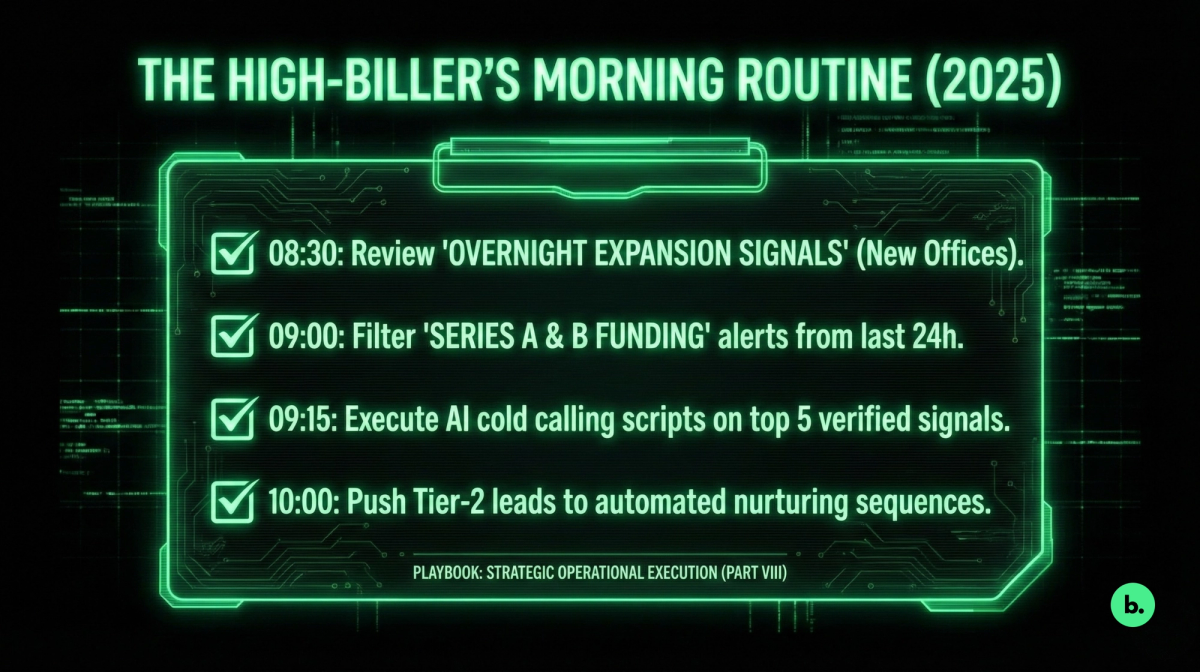
08:30 – 09:00: The Signal Briefing
- Old Way: Check emails, scroll LinkedIn feed, check job boards.
- New Way: Review the Boilr Dashboard. Filter for "Overnight Signals" (e.g., funding rounds announced in the US overnight, or new office openings).
- Action: Triage the top 5 "Tier 1" signals (high growth, high fee potential).
09:00 – 10:00: The "Pre-Market" Power Hour
- Focus: Execute calls on the top 5 signals identified.
- Scripting: Use the context. "Hi [Name], saw the news about the Series B. Congratulations. I specialize in building GTM teams for Series B SaaS..."
- Goal: Book "Discovery Calls" rather than just asking for job specs.
- 10:00 – 12:00: Automation Management
Action: Push "Tier 2" signals (lower priority) into SourceWhale for automated nurturing sequences. - Logic: Let the machines handle the lower-probability leads while the human focuses on the "Whales."
Redefining KPIs
Traditional KPIs (e.g., "100 Dials a Day") are obsolete in a signal-rich environment. Agencies should pivot to quality-based metrics:
- Signal-to-Meeting Ratio: How many identified signals resulted in a conversation?
- Pre-Ad Placement %: What percentage of jobs were filled before being advertised?
- Market Penetration: Success rate in breaking into new accounts (non-PSL) using Expansion Signals.
Change Management
Recruiters are creatures of habit. Moving them away from the "comfort blanket" of the job board requires leadership.
- Education: Train the team on why a funding round leads to hiring. Teach them the business logic.
- Incentivization: Offer bonuses for "First Mover" wins—placements made where no other agency was involved.
- Success Stories: Highlight internal wins. "Sarah booked this £20k fee because she called the CEO 2 days after the funding news, before anyone else."
The Future of Recruitment (2026-2030)
As we look beyond 2025, the trajectory of AI in recruitment points toward Agentic AI.
From "Prompt" to "Agent"
Currently, we are in the era of "Copilots"—AI assists the human (e.g., Boilr finds the lead, human calls). By 2026-2027, we will enter the era of Agents.
- Scenario: An AI agent monitors the market, identifies the signal, autonomously generates the email, negotiates the meeting time via email, and populates the recruiter's calendar. The recruiter only steps in for the actual meeting.
- Boilr's Evolution: Platforms like Boilr will likely evolve from "Intelligence Dashboards" to "Autonomous Business Development Representatives (BDRs)," fully integrating the finding and the initial engaging.
The End of the Job Board?
As Signal Intelligence becomes ubiquitous, the utility of the public job board may decline.
- Prediction: If agencies and internal teams can predict hiring needs perfectly, the need to broadcast a role to the "noisy public" diminishes.
- Implication: The "Hidden Job Market" will grow. Roles will be filled through direct, signal-led outreach and talent pipelining before they ever reach the public domain.
- Agency Survival: In this future, agencies without signal intelligence will be locked out of the majority of the market, fighting over the scraps of roles that were too difficult or low-value to be filled via direct methods.
The Information Advantage
The recruitment industry of 2025 is unforgiving to those who are slow. With client acquisition becoming the primary bottleneck, the ability to predict hiring needs before they are advertised is not just a "nice to have" it is the single decisive competitive advantage.
Boilr.ai represents the technological response to this shift. By leveraging AI to process 10,000+ sources and identify intent 72 hours before the competition, it provides the "Unfair Advantage" necessary to book more hiring calls. It transforms recruiters from reactive processors of job descriptions into proactive strategic partners.
For agency owners, the choice is binary: continue to fight in the "Red Ocean" of public job boards, competing on price and speed against a saturated market, or adopt signal intelligence to swim in the "Blue Ocean" of pre-market opportunities. The data, the economics, and the trajectory of the industry all point to one conclusion: the future belongs to the first movers.
References: