CRM vs ATS: The Best Tool to Help You Hire Faster
Struggling to choose between a CRM and ATS? Uncover which platform best supports your workflow, engages candidates, and helps you close open roles faster.

The Crisis of Timing in Modern Recruitment
The Erosion of the Traditional Agency Edge
The recruitment industry in 2026 operates within an ecosystem defined not by a scarcity of talent, but by a scarcity of timing. For decades, the primary value proposition of a recruitment agency was access: access to a proprietary database of candidates that the client could not find themselves.
This "Black Book" model, predicated on information hoarding, has been systematically dismantled by the democratization of data. LinkedIn Recruiter, decentrally accessible job boards, and the proliferation of AI-driven sourcing tools have leveled the playing field regarding candidate visibility. Today, internal talent acquisition (TA) teams have access to the same candidate pools as external agencies.
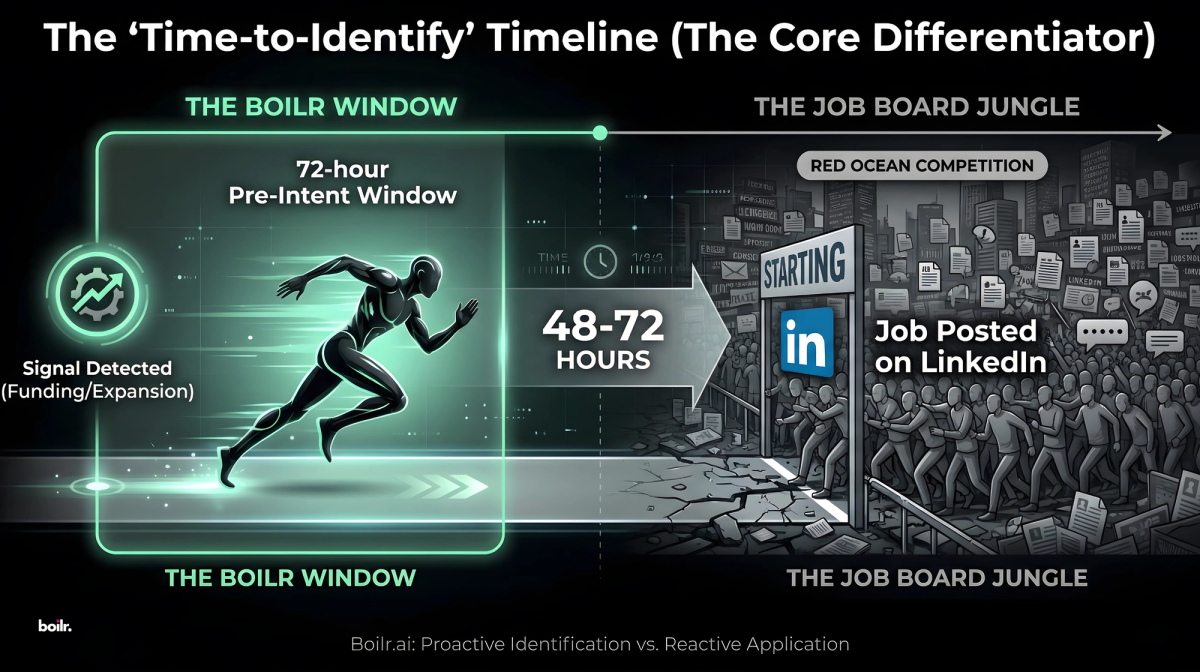
Consequently, the agency's value has shifted from who they know to when they know it. In a hyper-competitive market where the average time-to-fill has stabilized at approximately 42 to 54 days depending on the sector , the speed-to-submission remains the primary determinant of agency win rates and commercial viability.
The window of opportunity to secure an exclusive or retained mandate or even to submit a candidate into a contingency process with a high probability of success has compressed dramatically.
Research indicates that by the time a role appears on public aggregation platforms like LinkedIn or Indeed, the opportunity is effectively commoditized. Snippet reveals a stark reality: "By the time a role appears on LinkedIn, 3-5 agencies have already contacted the hiring manager.
You're too late." This lag creates a "Red Ocean" scenario where agencies are forced to compete on price (fees) rather than value, engaging in a race to the bottom that erodes margins and recruiter morale.
The economic implications of this delay are profound. The "First-Mover Advantage" in recruitment is not merely a theoretical business concept; it is a statistical predictor of revenue. Agencies that act within the "Pre-Intent" window specifically the 48-72 hours before a job description is publicly codified secure disproportionately higher fill rates.
This is because they are engaging with hiring managers during the formation of the requirement, allowing them to shape the job specification, advise on salary benchmarking, and often secure exclusivity before a formal Preferred Supplier List (PSL) tender process is initiated.
The "CRM vs. ATS" Fallacy
In response to this pressure for speed, the recruitment technology industry has largely offered a binary choice: the Applicant Tracking System (ATS) or the Candidate Relationship Management (CRM) platform. For years, agency leaders have been locked in a debate over which tool is the "single source of truth" or the key to efficiency. Vendors like Bullhorn, Vincere, and others have fueled this by acquiring disparate tools to create "all-in-one" ecosystems.
However, this debate fundamentally misunderstands the nature of the problem. Both ATS and CRM are, by design, repositories of internal data. They are systems that manage information the agency already possesses.
- The ATS manages the workflow of active applications (The "Now").
- The CRM manages the nurturing of known contacts (The "Future").
Neither system addresses the critical gap: Origination. Neither tool has the inherent capability to scan the external market and identify new revenue opportunities. They are engines without fuel. An agency can have the most sophisticated Bullhorn automation or the most personalized Vincere pipeline, but if the recruiter does not know which company to target until the job is posted on Indeed, the technology is merely helping them process a low-probability lead more efficiently.
This report posits that the "CRM vs. ATS" dichotomy is obsolete. To close roles faster in 2026, agencies must adopt a third pillar: Signal Intelligence. This new category of technology, exemplified by platforms like Boilr.ai, moves beyond "managing" data to "predicting" demand. It bridges the gap between market noise and actionable revenue opportunity, transforming the recruiter from a reactive administrator into a proactive consultant.
Scope of Analysis
This research report provides an exhaustive analysis of the recruitment technology stack required for high-velocity client acquisition. We will dissect the functional architectures of major platforms including Bullhorn, Vincere, Sourcebreaker, SourceWhale, and Paiger, contrasting them with the predictive capabilities of Boilr.ai. We will examine the mechanics of "Closing Speed," the limitations of job scraping, and the emerging dominance of "Signal-Based Selling." Finally, we will outline a strategic blueprint for the "Velocity Stack" an integrated ecosystem where Signal Intelligence feeds the CRM/ATS to maximize revenue per recruiter.
The Applicant Tracking System (ATS) - The System of Record
The Architectural Mandate: Compliance and Workflow
To understand why an ATS cannot solve the speed problem, we must first analyze its core architecture. The ATS represented by market leaders such as Bullhorn, JobAdder, and the ATS components of Vincere is designed primarily as a "System of Record". Its fundamental purpose is to impose order on the chaotic process of hiring.
From a data structure perspective, an ATS is requisition-centric. A candidate record exists in relation to a job record; a placement record exists in relation to a client record. This structure is essential for compliance, reporting, and financial forecasting. In an industry increasingly regulated by data privacy laws (GDPR, CCPA) and diversity mandates, the ATS ensures that every interaction is logged, every consent form is tracked, and every interview is documented.
However, this rigidity is precisely what makes the ATS a poor tool for business development (BD). Business development is inherently unstructured. It involves rumors, tentative conversations, and "soft" signals data points that do not fit neatly into the "Job Order" fields of a traditional database. As noted in snippet , "Many ATS platforms cram in features to try to be everything to everyone... This pursuit of flexibility over simplicity leads to clutter." The result is that recruiters often view the ATS as an administrative burden a place to "dump" data after the real work is done rather than a tool that helps them win business.
The "Reactive" Trap
The primary limitation of the ATS regarding closing speed is its reactive nature. An ATS only becomes useful after a job has been identified. It excels at measuring "Time-to-Hire" (process efficiency) but offers zero utility in improving "Time-to-Identify" (market velocity).
Consider the workflow of a recruiter relying solely on an ATS:
- Trigger: The recruiter spots a job ad on a board or receives an email from a client.
- Action: The recruiter creates a "Job" record in the ATS.
- Process: The recruiter searches the database for candidates, parses CVs, and logs submissions.
In this sequence, the "Trigger" is external and manual. The ATS is passive. It waits for the recruiter to input the demand. By the time the data enters the ATS, the "First-Mover Advantage" window (the first 48-72 hours) has likely closed. As snippet articulates, "An ATS focusses on processes and organisation... An ATS focusses on now." It is a tool for managing existing inventory, not for acquiring new inventory.
The Evolution of the "All-in-One" Platform
Major ATS providers have attempted to solve this by expanding their feature sets through acquisition. Bullhorn, for example, has acquired companies like Sourcebreaker (Search & Match) and Herefish (Automation) to create a more comprehensive "Operating System". Similarly, Vincere markets itself as a "Growth OS" that integrates CRM and ATS functionalities.
While these integrations reduce the friction of switching between tabs, they do not fundamentally alter the data flow. Even with Sourcebreaker inside Bullhorn, the data source remains primarily public job data (via scraping) or internal candidate data. The system is still reacting to what has already happened in the market. It optimizes the response to a job post, but it does not predict the job post.
Reviews of legacy platforms highlight this struggle. Users of Bullhorn frequently cite the "clunky" interface and the complexity of features as barriers to speed. While powerful for enterprise staffing firms managing thousands of contractors, these systems are often overkill for boutique agencies where agility and speed-to-market are the primary differentiators.
The Economic Cost of ATS Reliance for BD
Relying on an ATS for business development leads to what can be termed "Administrative Latency." If a recruiter spends 2 hours a day manually entering leads from LinkedIn into Bullhorn, that is 10 hours a week of non-revenue-generating activity. Furthermore, because the data is entered manually, it is often incomplete or immediately obsolete.
Snippet describes a scenario where a firm spent $100,000 on a CRM/ATS setup that failed because it became a "graveyard of missed opportunities." The system was full of data, but lacked the intelligence to trigger action. The recruiters were "drowning in data but starving for results." This is the inevitable outcome of using a System of Record as a System of Intelligence.
The Customer Relationship Management (CRM) - The System of Engagement
The Shift from Tracking to Nurturing
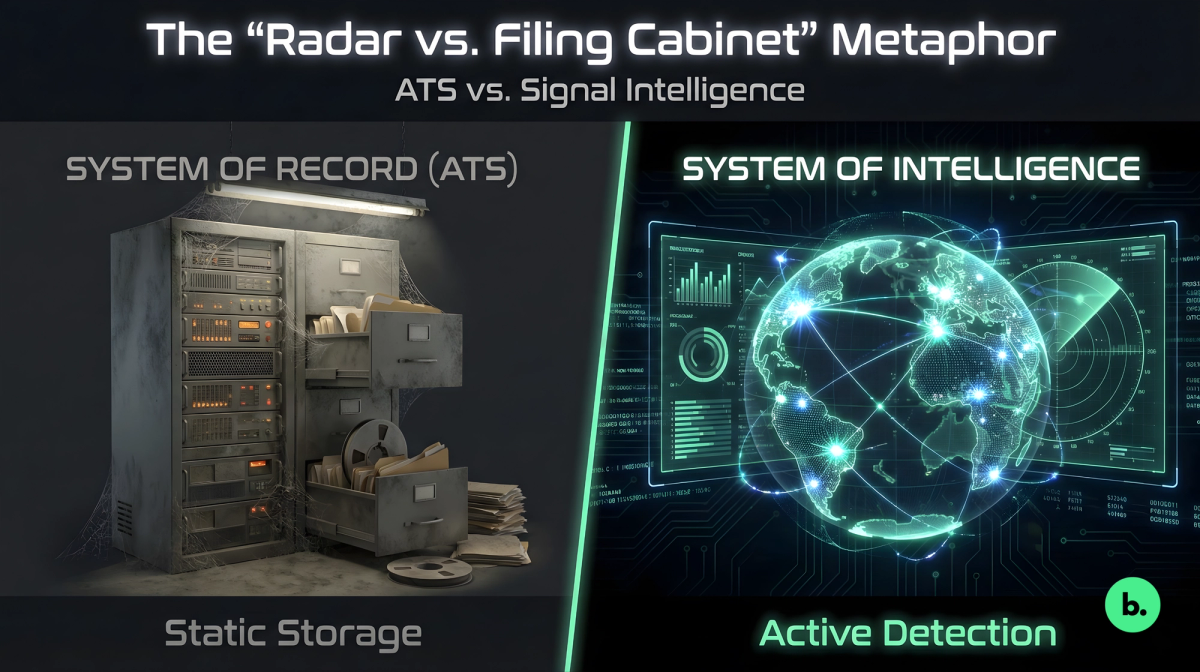
If the ATS is the "digital filing cabinet," the CRM is the "digital megaphone." The rise of Recruitment CRM (or Candidate Relationship Management) was driven by the realization that the best talent is often passive and requires long-term nurturing before they are ready to move.
Unlike the transaction-centric ATS, the CRM is person-centric. It is designed to manage relationships over time, independent of specific job openings. Tools like Loxo, HubSpot (adapted for recruitment), and the CRM modules of Vincere allow recruiters to build "Talent Pools" and execute "Nurture Campaigns"
The Promise of Pipeline
The core value proposition of the CRM is "Pipeline Security." By maintaining regular contact with candidates and clients, the agency ensures that when a need arises, they are "top of mind." Snippet notes, "Where an ATS focusses on processes and organisation, a CRM focusses on people and engagement... An ATS is about today; a CRM is about tomorrow."
In a business development context, a CRM is essential for managing the sales cycle. It tracks the stages of a prospect from "Cold" to "Meeting Booked" to "Client." It allows for the automation of follow-up emails, ensuring that no lead falls through the cracks. This effectively solves the problem of consistency in sales.
The "Trigger" Problem
However, like the ATS, the CRM suffers from a critical flaw: it relies on the user to define the target. A CRM can automate a 5-step email sequence to a CEO perfectly. But it cannot tell the recruiter which CEO to email today.
Most recruitment CRMs are populated with data that is static. A contact record containing "John Smith, VP Engineering, Acme Corp" tells you nothing about John's current state of mind or his company's buying intent.
- Is Acme Corp expanding?
- Did John just get budget approval?
- Is John about to resign?
Without this context, CRM-driven outreach becomes a game of volume "Spray and Pray." Recruiters, armed with automation tools, send thousands of generic emails hoping to hit the right person at the right time by sheer luck. This approach, while scalable, is increasingly ineffective. Snippet argues that CRMs often fail in recruitment because they treat hiring as a transactional sales process rather than a nuanced relationship game. "CRMs aren't built for this kind of two-way relationship... They don't handle collaborative evaluations, sensitive communication, or context-rich decision-making well."
Automation Fatigue and the "Dead Database"
The over-reliance on CRM automation has led to "Automation Fatigue" among buyers. Hiring managers are inundated with generic, templated outreach. As a result, open rates and response rates for non-personalized sequences are plummeting.
Furthermore, CRMs suffer from rapid data decay. In the recruitment industry, people change jobs frequently. A database that is not automatically enriched becomes a "Dead Database" within 12-18 months. While some tools like SourceWhale help with enrichment, the CRM itself is often a lagging indicator of the market. It reflects the market as it was when the data was entered, not as it is today.
The "All-in-One" vs. Best-of-Breed Debate
The market is divided between "All-in-One" platforms (Bullhorn, Vincere) and "Best-of-Breed" stacks (e.g., Bullhorn ATS + SourceWhale + Loxo).
- All-in-One: Offers a single source of truth and unified reporting. Reduces integration headaches. However, the BD features are often basic compared to dedicated tools.
- Best-of-Breed: Allows agencies to use the best possible tool for each stage (e.g., SourceWhale for outreach, Boilr for intelligence, Bullhorn for compliance). This stack is increasingly favored by high-growth agencies prioritizing speed.
The Third Pillar - Signal Intelligence and The Boilr.ai Advantage
Defining the "System of Intelligence"
To solve the speed problem specifically the challenge of identifying opportunities before they are commoditized agencies must move beyond the ATS/CRM binary. They require a "System of Intelligence."
Boilr.ai represents this new category. It is an AI-powered signal intelligence platform built specifically for recruitment. Its mandate is not to store data (ATS) or nurture data (CRM), but to generate data. It answers the question: "Who is hiring right now, and why?".
The Mechanics of "Pre-Intent"
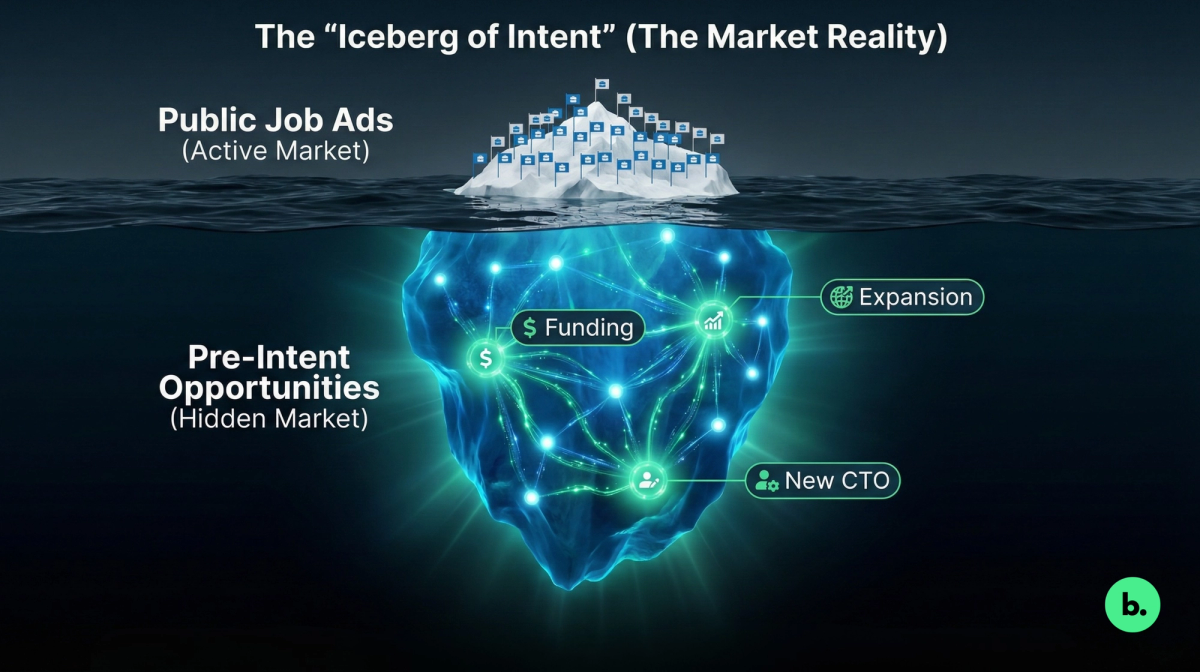
Traditional lead generation relies on "Intent Data" usually evidenced by a job posting or a keyword search on a review site. By definition, once intent is public (explicit), the opportunity is depreciating. Everyone sees the job post.
Boilr operates in the realm of "Pre-Intent" or "Implicit Intent." It monitors over 10,000 signal sources including funding announcements, press releases, LinkedIn updates, GitHub repositories, government tenders, and news feeds to detect the precursors to hiring.
This creates an Information Asymmetry in favor of the recruiter. By knowing that a company has just secured £6M in Series A funding, the recruiter can infer a hiring need (e.g., "They will need 15-20 engineers") before the internal HR team has even drafted the job descriptions.
The Four Signals of Revenue
According to the Boilr Overview , predictive hiring intelligence relies on four specific signal types that correlate strongly with high-value, exclusive job orders:
Expansion Alerts
- The Signal: A company announces a new office opening, a new regional hub, or a massive operational scale-up (e.g., "New Manchester Office").
- The Implication: This signals volume hiring across multiple verticals (Ops, Admin, IT, Sales). Crucially, new office openings often happen before local PSLs are established.
- The Play: The agency approaches the Head of Operations with a "Launch Partner" proposal, offering to handle the initial wave of hires.
Funding Rounds
- The Signal: Capital injection (Seed, Series A, B, C).
- The Implication: Immediate pressure to scale. Investors expect the capital to be deployed into headcount to drive growth.
- The Predictive Logic: The amount raised correlates with specific hiring patterns. A £6M Series A typically mandates 15-20 hires, heavily weighted towards Engineering (Product, Tech Lead, Devs) and Go-to-Market (Sales, Marketing).
- The Play: "Congrats on the Series A. I know this typically triggers a need for. We specialize in scaling Series A engineering teams."
Hiring Velocity
- The Signal: Statistical anomalies in headcount growth (e.g., "+12% headcount in 30 days" or "4 Engineers hired per week").
- The Implication: The internal talent team is likely overwhelmed. When velocity exceeds capacity, "spillover" occurs. Agencies pick up this spillover.
- The Play: Offer "Project RPO" or "Sprint" support to help clear the backlog.
Leadership Changes
- The Signal: New executive appointments (e.g., "New VP Engineering" or "New CRO").
- The Implication: The "First 90 Days" rule. A new VP usually has a mandate to restructure or build their own team. They are often less loyal to incumbent agencies and more open to new partners who can help them hit the ground running.
- The Play: Contact the new leader immediately to understand their vision and offer support in executing their new strategy.
The "Boilr Effect" on Speed and ROI
The integration of Signal Intelligence into the recruitment stack fundamentally changes the "Time-to-Contact" metric.
This data suggests that the "closing speed" is determined not by how fast the recruiter works, but by when they start working. By starting 3 days early, the recruiter avoids the bottleneck of the public application process entirely.
Why "Intent Data" isn't enough
While general B2B "Intent Data" (like 6sense or Bombora) tracks who is researching topics (e.g., "companies searching for recruitment agencies"), it is often too broad for recruitment. Recruitment requires specific triggers. Knowing a company is "interested in HR software" is less valuable than knowing "Company X just hired a CTO and has £5M in the bank." Boilr's specificity to the recruitment domain (tech stacks, headcount velocity) makes it a superior form of intelligence compared to generic sales intent platforms.
The Competitor Ecosystem - Forensic Comparison
To provide an authoritative guide, we must situate Boilr within the broader landscape of recruitment tools. Many "competitors" are actually complementary, while others represent older generations of technology (Scraping vs. Signaling).
Boilr.ai vs. Sourcebreaker (The Scraper vs. The Radar)
Sourcebreaker is a dominant player, particularly in the UK market. It is primarily a Search & Match and Job Scraping tool.
- Technology Difference: Sourcebreaker uses "SourceBots" to scrape job boards and company career pages. It then matches these jobs to candidates in the database.
- The Limitation: Scraping is inherently reactive. A scraper can only find a job after it has been posted. If Sourcebreaker finds it, it is because it is already public. Therefore, every user of Sourcebreaker (and Indeed, and LinkedIn) sees the same lead simultaneously.
- The Boilr Difference: Boilr tracks the signals that precede the job post. It operates upstream.
- Use Case: Sourcebreaker is excellent for filling active roles (Resourcing). Boilr is superior for finding new roles (Business Development).
Boilr.ai vs. SourceWhale (The Intelligence vs. The Engine)
SourceWhale is essentially a Sales Engagement Platform built for recruitment. It automates the delivery of outreach.
- The Synergy: SourceWhale and Boilr are not direct competitors; they are force multipliers.
- Boilr provides the "Who" and the "Why" (Targeting).
- SourceWhale provides the "How" (Execution).
- The Workflow: A recruiter receives a Boilr alert ("Company X Series A"). They push this lead into a SourceWhale "Series A Sequence." SourceWhale automates the emails/InMails.
- Contrast: Used alone, SourceWhale requires the recruiter to manually find the leads. Boilr automates the sourcing of the leads.
Boilr.ai vs. Paiger (The Sales vs. The Brand)
Paiger focuses on Recruitment Marketing and Personal Branding.
- Core Value: It helps recruiters share relevant industry news to their LinkedIn feeds to build authority and attract inbound interest.
- Contrast: Paiger plays the "Long Game" (Brand Building). Boilr plays the "Short Game" (Direct Sales).
- Overlap: Both use "news" as a data source. However, Paiger uses news as content (to post), whereas Boilr uses news as context (to prospect).
- Speed Impact: Paiger helps close roles faster indirectly by warming up the market over months. Boilr helps close roles faster directly by identifying immediate needs.
Boilr.ai vs. Bullhorn / Vincere (The Intelligence vs. The Record)
As established, Bullhorn and Vincere are the "Operating Systems."
- Relationship: Boilr feeds these systems. It pushes new client and contact data into the CRM/ATS, turning them from static repositories into dynamic engines.
- Conflict: Bullhorn has its own "Marketplace" partners (like Sourcebreaker), but lacks native, high-fidelity signal intelligence for non-public jobs.
The Economics of Velocity - What Actually Helps You Close Faster?
The user's query centers on "what actually helps you close roles faster." Based on the research, we can quantify this velocity.
The "Speed to Submission" Correlation
Industry statistics from Staffing Industry Analysts and Bullhorn Grid Reports show a direct correlation between "Time to Submit" and "Fill Rate".
- The "First 48 Hours" Rule: Agencies that submit a qualified candidate within 48 hours of a job opening have a fill rate 2-3x higher than those submitting after 5 days.
- Psychological Driver: Hiring managers suffer from "Decision Fatigue." The first 2-3 strong CVs set the "Anchor Bias." Subsequent candidates are compared against this anchor. If the anchor is strong, the manager often stops looking to save time.
- Boilr's Impact: By identifying the role 72 hours early, the Boilr user is often the only agency submitting during the "Anchor" phase.
Contingent vs. Retained Speed
- Contingent Recruitment: In a non-exclusive race, speed is the only differentiator. If you are not first, you are last. Boilr's head start is the only reliable way to beat the "Job Board Agency" crowd.
- Retained Recruitment: Speed here means "Speed to Trust." To win a retainer, you must demonstrate expert knowledge. When a recruiter calls a CEO and says, "I see you just raised £6M and appointed a new CTO; based on similar companies, you'll need to hire 5 Java Engineers in Q3," they demonstrate Consultative Authority. This shortens the sales cycle, allowing the agency to close the mandate faster.
The "Job Board Tax"
Relying on ATS/CRM alone forces recruiters to play in the "Red Ocean" of job boards.
- The Stat: A typical LinkedIn job post receives 250+ applications.
- The Cost: To close a role found on a job board, an agency must work 4x harder to differentiate themselves from the noise.
- The Signal Dividend: Roles found via Signal Intelligence often have zero competition. The "Time to Close" is faster because there are no other CVs to compare against, and no external agency distractions.
SEO, LLMs, and Future-Proofing
The "Answer Engine" Optimization (LLM Perspective)
The way clients find agencies is shifting from "Search Engines" (Google) to "Answer Engines" (ChatGPT, Perplexity). In 2026, a client might ask an AI: "Find me a recruitment agency in London that specializes in FinTech Series A scale-ups."
- Implication for Agencies: Agencies need to specialize. "Generalist" agencies are harder for LLMs to categorize.
- Boilr's Role: By using Signal Intelligence, agencies can build a track record in specific "Events" (e.g., "The Series A Expert"). This data, when published in case studies ("How we helped Company X scale after Series A"), feeds the LLMs, improving the agency's visibility in AI-generated answers.
The Velocity Stack - A Strategic Blueprint
The "Stack of Speed"
To close roles faster in 2026, the tech stack must be re-architected. It is not "CRM or ATS."
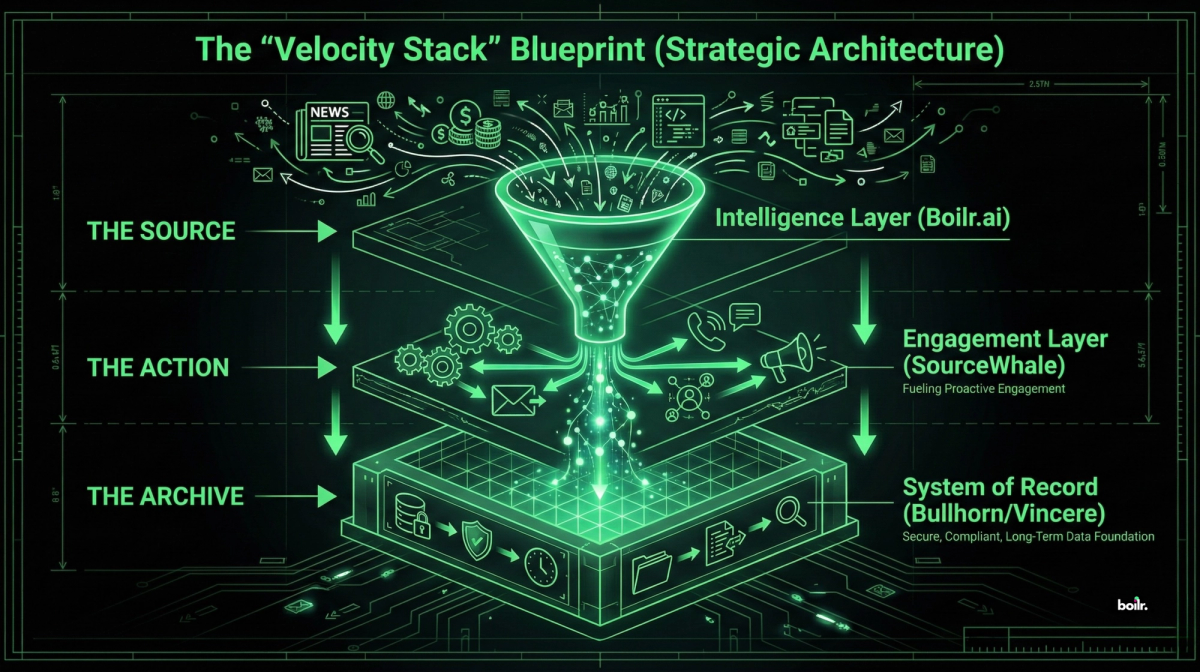
It is a layered ecosystem:
Layer 1: The Intelligence Layer (The Eyes) - Boilr.ai
- Function: Scans the market (Funding, News, Growth) to find opportunities before they exist as jobs.
- Output: "Pre-Intent" Leads (The "Why Now").
Layer 2: The Engagement Layer (The Voice) - SourceWhale / Loxo
- Function: Takes the lead from Boilr and executes a hyper-personalized, multi-channel sequence.
- Output: Booked Meetings (The "Conversation").
Layer 3: The Management Layer (The Brain) - Bullhorn / Vincere
- Function: Manages the compliance, candidate workflow, and invoicing once the business is won.
- Output: Placements & Revenue (The "Result").
Layer 4: The Brand Layer (The Face) - Paiger
- Function: Ensures that when the prospect checks the recruiter's profile, they see credible, relevant content.
- Output: Trust & Conversion.
The question "CRM vs. ATS" is a false binary that distracts from the real challenge: Origination. While an ATS optimizes administration and a CRM optimizes nurturing, neither solves the problem of finding the opportunity in a crowded market.
Signal Intelligence is the missing link. By adopting platforms like Boilr.ai, agencies shift from being reactive processors of public information to proactive architects of their own pipeline. In the 2026 recruitment landscape, speed is the ultimate competitive advantage, and that speed comes from knowing what is about to happen, before it happens.
Stop optimizing your filing cabinet. Upgrade your radar.