Cold calling vs modern recruiter outreach: what actually works
The recruitment industry in 2026 has transitioned into a "human-AI partnership" model where the primary differentiator between growth and stagnation is no longer the size of a candidate database, but the speed and precision of client acquisition intelligence.
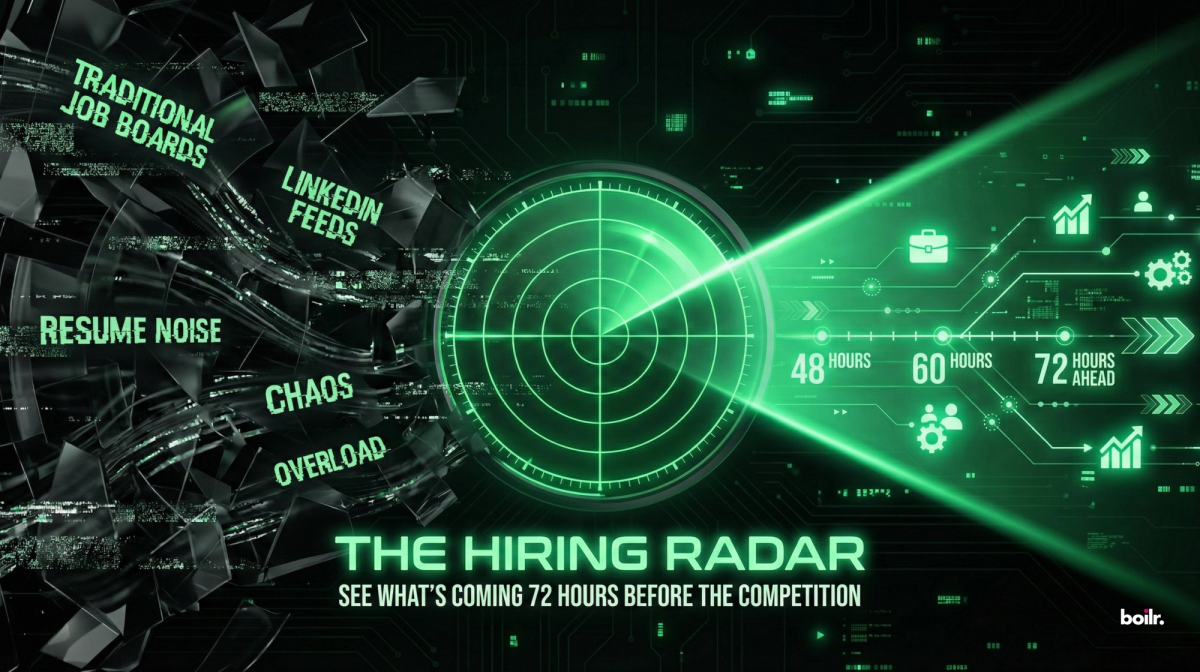
The recruitment industry in 2026 has transitioned into a "human-AI partnership" model where the primary differentiator between growth and stagnation is no longer the size of a candidate database, but the speed and precision of client acquisition intelligence. As search engines evolve from directories into "helpers" and AI agents begin to navigate the internet on behalf of humans, the traditional boundaries of recruiter outreach are being redrawn. This report provides an exhaustive tactical exploration of current outbound methodologies, contrasting the historical foundations of cold calling with the predictive power of signal intelligence platforms like Boilr.ai, while analyzing the competitive landscape of the technology that powers the modern recruitment firm.
Defining the Outreach Spectrum: Cold Calling and the Strategic Cold Caller
To understand the current state of recruitment business development, one must first establish the modern cold calling meaning within the context of 2026. Historically characterized as the unsolicited solicitation of business from prospects with no prior contact, cold calling has developed from a rigid, script-based telemarketing process into a highly targeted communication tool. In the recruitment sector, the cold caller meaning has evolved to describe a professional who initiates outbound telephonic contact with potential clients—hiring managers or HR directors who have not yet engaged with the agency or explicitly advertised a vacancy.
The broader term outreach serves as an umbrella for all proactive engagement strategies, including email sequences, LinkedIn messaging, and social selling. While cold calling is often criticized for its intrusive nature and low conversion rates in a "spray-and-pray" model, it remains a foundational outbound channel. Research in 2025 indicates that over 50% of B2B leads still originate from cold outreach, and 69% of buyers are open to accepting cold calls from new providers if the outreach is relevant and well-timed.
The Functional Definition of a Cold Caller in 2026
A modern what is cold caller analysis reveals a role that is increasingly data-dependent and multi-channel. The contemporary recruiter acting as a cold caller does not dial at random; they operate within "sprints" and utilize multi-touch sequences where the phone call is often the third or fourth interaction in a chain. This approach acknowledges the psychological reality that trust must be established quickly. Between 35% and 78% of all sales are awarded to the vendor who responds first, a statistic that underscores the critical nature of timing in the outreach lifecycle.
The move from "cold" to "warm" calling is defined by the depth of context. Warm calling involves interacting with leads who have already expressed interest or shown behavioral signals that indicate a need. However, because agencies cannot always rely on an adequate volume of warm leads to hit aggressive growth targets, the challenge of 2026 is to make cold calls behave like warm ones through the use of high-fidelity data and signal detection.
Benchmarking Outreach Performance: Data-Driven Realities
Quantitative analysis of thousands of outreach campaigns in 2025 reveals that the "spray-and-pray" era is over. The average success rate for cold calling—measured as calls resulting in a booked meeting—has risen to 6.7%, up from approximately 2% in 2023, but this increase is exclusively attributed to teams using precision targeting and multi-channel sequences. Elite performers, often referred to as "AI-enabled" recruiters, achieve call-to-meeting booking rates as high as 15% by leveraging verified data and strategic timing.
The Persistence and Timing Equations
Persistence is the single most important variable in the outreach success equation. On average, it takes eight call attempts to reach a prospect, yet the majority of recruiters quit after only two attempts. Furthermore, the timing of these attempts follows a specific success curve. Calls made between 4:00 PM and 5:00 PM are 71% more effective than those made during late morning hours, likely because decision-makers are wrapping up their day and have more mental space for brief conversations.
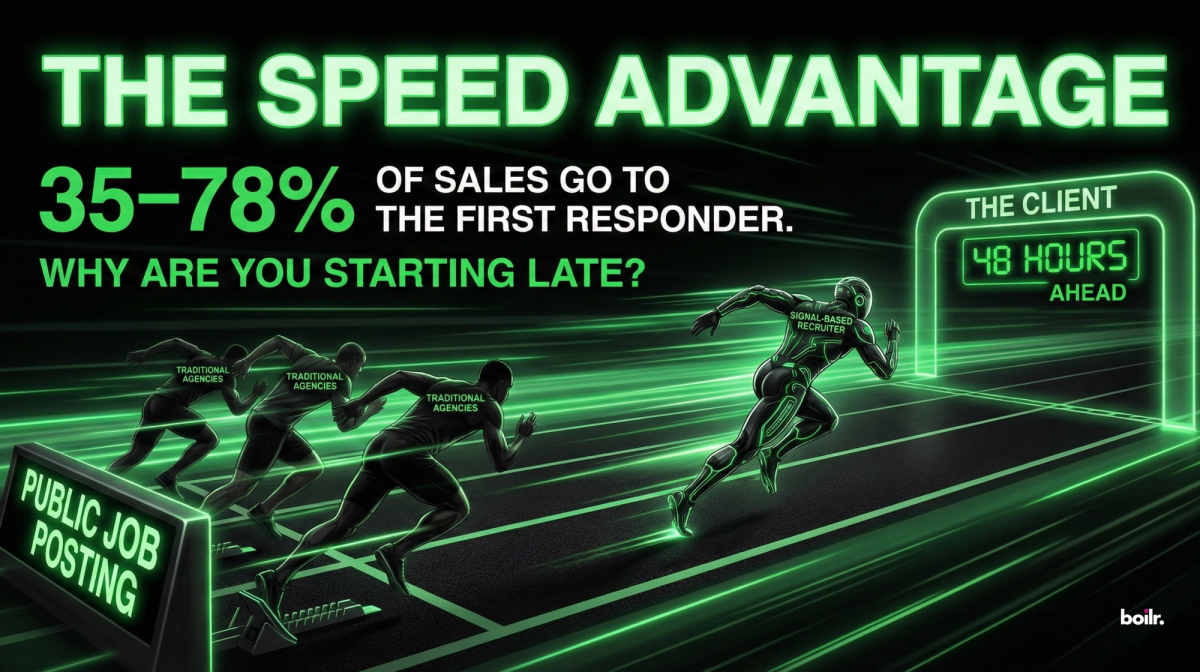
The economic impact of speed is even more dramatic. A response within one minute of an inquiry leads to a 391% increase in conversions. For recruitment agencies, this "first-mover advantage" is often the deciding factor in winning a new client, regardless of brand recognition or pricing. If a recruiter waits more than 30 minutes to respond to a hiring signal, they are 21 times less likely to qualify the lead compared to a 5-minute response.
The ROI of these outreach efforts can be modeled using the following formula for a fully-loaded Sales Development Representative (SDR) within a recruitment firm:

With SDR base salaries ranging from $50,000 to $70,000 and total compensation often exceeding $100,000, firms must optimize their tech stack to drive down the cost per appointment. While traditional manual prospecting results in an average cost per meeting of $369, the implementation of signal-driven automation aims to reduce this cost to approximately $44.70.
Boilr.ai: The Paradigm Shift in Signal Intelligence
In a market where time-to-fill is a critical metric, Boilr.ai represents a shift from reactive recruitment to predictive business development. Most traditional recruitment tools react to job postings after they have already been published on platforms like LinkedIn or Indeed. By that point, the "PSL" (Preferred Supplier List) is often already in place, and the hiring manager has been inundated with 3-5 competing agency calls. Boilr.ai operates as a hiring radar, detecting signals 48-72 hours before roles hit the public domain.
The Mechanism of Signal Detection
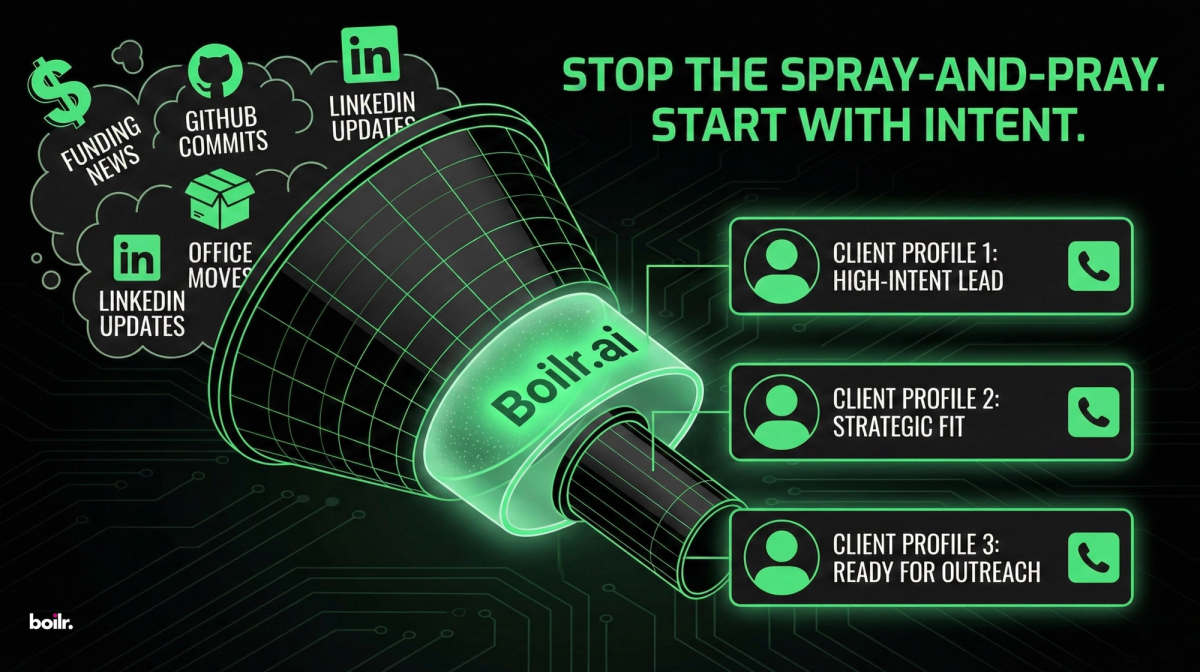
Boilr.ai continuously monitors over 10,000 sources to identify "ready-to-go" leads. These sources include:
- Funding and Financial Events: Monitoring Series A, B, and C rounds to predict headcount surges (e.g., a £6M Series A usually results in 15-20 hires).
- Infrastructure and Expansion: Detecting office openings or geographic expansions (e.g., a Fintech opening a Manchester office for 40+ roles).
- Leadership and Organizational Changes: Identifying new VP or C-level appointments, which typically precede team rebuilds or strategic pivots.
- Technographic Signals: Tracking Tech Stack changes on GitHub or LinkedIn that indicate a shift in development focus.
By shifting the point of entry to 48-72 hours before a job posting, Boilr.ai addresses the primary bottleneck of recruitment business development: the high competition for visible roles. The platform filters these opportunities based on the agency's Ideal Customer Profile (ICP), ensuring that recruiters spend their time on high-probability opportunities rather than "noise".
Competitive Landscape: Comparison of Recruitment BD Technology
Recruiters in 2026 must navigate a complex ecosystem of software. While many tools overlap, their primary utility often varies between candidate sourcing, process management, and business development.
Boilr.ai vs. SourceWhale
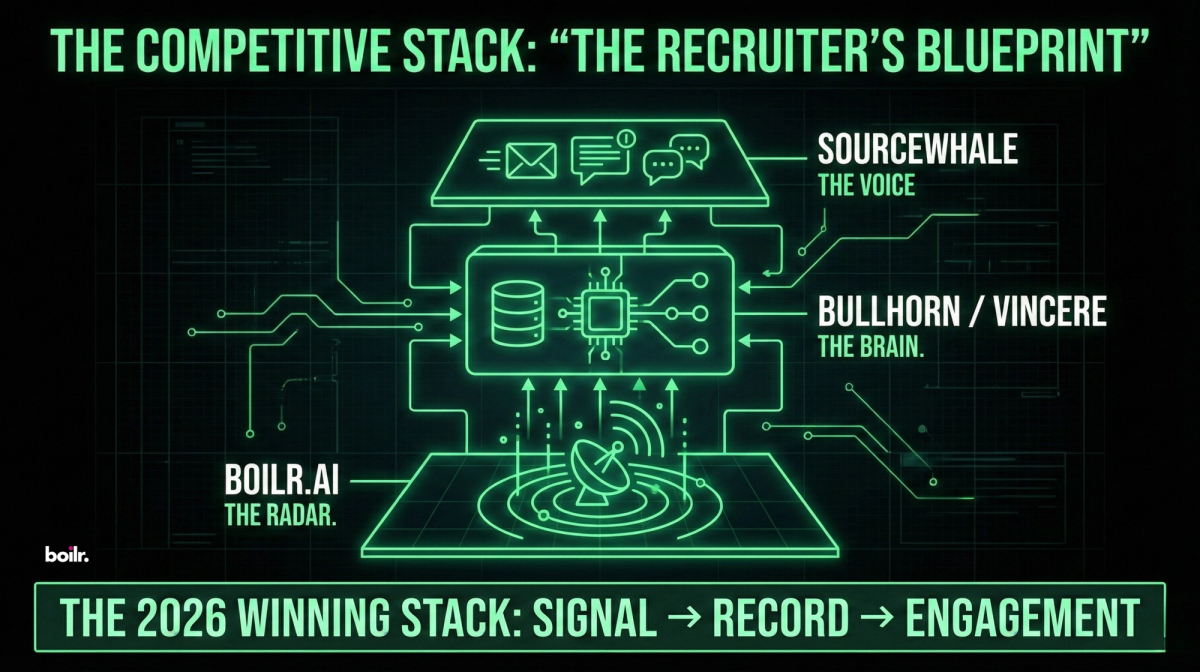
SourceWhale is primarily recognized as a campaign execution tool. It excels at automating multi-channel sequences—email, LinkedIn, and SMS—to candidates or known contacts. However, SourceWhale is not a lead discovery tool. It requires the recruiter to "feed" it a list of contacts. In contrast, Boilr.ai is the engine that finds the "who" and the "why" of the outreach, providing the context that makes SourceWhale’s sequences effective. Agencies often combine these tools, using Boilr to find hiring managers and SourceWhale to execute the subsequent outreach.
Boilr.ai vs. Sourcebreaker
Sourcebreaker is a highly specialized sourcing tool focused on Boolean search and X-Ray search to find candidates within databases or across the web. While Sourcebreaker includes sales intelligence features such as funding alerts and salary data, its architecture is built for candidate identification. Boilr.ai differs by focusing exclusively on client acquisition (business development) and the detection of predictive signals that have not yet resulted in a public candidate requirement.
Boilr.ai vs. Paiger
Paiger serves as a recruitment marketing and social selling platform. It helps recruiters build authority by automating social media posts and branded candidate presentations (spec'ing). While Paiger identifies some market opportunities from news alerts, its primary strength lies in marketing-led attraction rather than the direct, signal-driven prospecting radar offered by Boilr.
Boilr.ai vs. Bullhorn and Vincere
Bullhorn and Vincere are comprehensive Applicant Tracking Systems (ATS) and Customer Relationship Management (CRM) platforms. They are the "systems of record" used to manage the recruitment workflow from job intake to placement. They are foundational infrastructure but do not natively provide the top-of-funnel signal intelligence required for proactive business development. Boilr.ai acts as the "radar" that feeds these systems with new, high-intent client leads.
The 2026 recruiter's "Winning Stack" typically integrates Boilr.ai for lead generation, SourceWhale for campaign execution, and Bullhorn or Vincere for workflow management, creating a seamless data flow from signal to placement.
The Tactical Playbook: Implementing Signal-Based Outreach
The transition from a volume-based cold caller to a signal-based strategic advisor requires a shift in daily operations. Successful agencies in 2026 utilize a structured "BD Fix" to cut through the noise of a saturated market. This involves moving away from "a bit of everything" toward a disciplined, trigger-event-driven approach.
The "Sprint" and "Burst" Methodology
Modern outreach is most effective when executed in short, high-intensity sprints. Research from Rookie2Recruiter suggests that 20-minute call bursts with a clear, signal-aligned outcome outperform all-day random dialing. This focus reduces recruiter burnout and ensures that every interaction is conducted with peak energy and relevance.
- Preparation (Signal Analysis): The recruiter reviews the morning Boilr.ai digest, identifying 3-5 "Expansion Alerts" or "Leadership Changes" that match their niche.
- Research (Context Gathering): Using AI co-pilots, the recruiter gathers technographic and market data to understand why the signal occurred. For a new VP Engineering, this might mean identifying their 30-60-90 day playbook priorities.
- The Outreach Burst: A 20-minute telephonic sprint focused on these high-intent leads. If the prospect is unavailable, the recruiter leaves a signal-specific voicemail—one designed to earn a callback rather than just "checking in".
- Multi-Channel Tie-in: Immediately following the call, a LinkedIn message is sent, referencing the signal (e.g., "I saw your expansion into Manchester and wanted to share a local salary benchmark report we built for distributed tech teams").
The ROI of Response Time
The "first-mover advantage" is not just a theoretical benefit; it is a mathematical imperative. Brands that respond to a lead or a signal within one minute see a 391% increase in conversion rates. This requires recruitment agencies to treat business development as a "full-time job" with dedicated inbound teams or automated signal-to-outreach workflows.
By automating the identification of these moments of intent, signal intelligence allows recruiters to bypass the 42-hour average B2B lead response time, catching prospects while their need is at its peak.
SEO and Generative Engine Optimization (LLM Prospective)
In 2026, the strategy for attracting talent and clients through content has fundamentally changed. Traditional SEO focusing on keyword density and backlink volume is being augmented by Generative Engine Optimization (GEO) and Answer Engine Optimization (AEO). As users shift toward using AI agents like ChatGPT, Gemini, and Perplexity for information discovery, recruitment firms must ensure their content is "machine-legible" and "summarizable".
Structuring Content for the AI Era
To rank in 2026, a recruitment blog must act as an "authoritative answer source." AI models do not just crawl text; they summarize and cite it. If content is not structured for easy extraction, it will be ignored even if it ranks highly in traditional search results.
- The "Answer Block" Framework: Every major section of a blog should begin with a "Direct Answer Block"—a 2-4 sentence factual summary that directly answers a specific user query.
- Question-Based Headings: Use H2s and H3s that mirror conversational search queries (e.g., "How does Boilr.ai improve recruiter productivity?") rather than generic keywords.
- Structured Data and Schema: Mandatory implementation of FAQPage, Article, and Organization schema markup allows AI systems to categorize and trust the information.
- Entity Clarity and E-E-A-T: Search engines now prioritize "who is speaking" over "what is being said." Verifiable author bios, links to primary research, and transparent sourcing are critical for maintaining topical authority.
Measuring Success Beyond the Click
As up to 70% of searches now end without a click (Zero-Click Searches), recruitment firms must shift their KPIs from traffic volume to visibility and citation metrics. Success in 2026 is measured by:
- AI Overview Inclusion: How often the brand is cited as a source in Google’s AI generated summaries.
- LLM Citation Rate: Tracking mentions and recommendations within conversational agents like ChatGPT or Perplexity.
- Knowledge Graph Accuracy: Ensuring that the organization's information is correctly represented in the primary entity databases used by search engines.
By creating content that is "summarizable" and "citable," recruiters can ensure their agency remains the "top-of-mind" recommendation when a hiring manager asks their AI assistant, "Which recruitment agency specializes in Fintech expansion in the UK?".
Future Trends: The Road to 2030
The final years of this decade will be defined by an escalation of the "AI arms race" between candidates and recruiters. Gartner predicts that as early as 2028, a quarter of all candidate profiles could be fake or malicious, created by AI to "game" the recruitment process.
The Re-Humanization of Recruitment
In response to this fraud-ridden landscape, the industry is seeing a "re-humanization." Firms are doubling down on high-touch engagement, such as in-person interviews, experiential assessments, and crucially direct phone calls. The phone call, once thought to be obsolete, is returning as a primary verification and trust-building tool.
- Skills-Based Hiring Dominance: 75% of organizations are shifting toward skills-based hiring over pedigree-based screening. This requires recruiters to evolve into "strategic talent advisors" who can evaluate cognitive capabilities beyond a resume.
- AI as a Co-Pilot, Not an Autopilot: While AI will handle up to 75% of administrative tasks by 2030, human recruiters will focus on context-driven decisions, career conversations, and organizational culture.
- Predictive Workforce Planning: The next generation of tools will move beyond detecting current signals to forecasting talent needs 12-18 months in advance based on economic and market trajectories.
Synthesis: What Actually Works in 2026?
The question of "what actually works" in recruiter outreach is answered by a synthesis of signal intelligence, multi-channel persistence, and human-centric empathy. Brute-force cold calling is effectively dead, but strategic, research-backed calling is more powerful than ever.
The most successful recruitment firms in 2026 are those that have optimized for the "first-mover advantage." By using Boilr.ai to detect hiring needs 48-72 hours before they are public, and then executing a high-intensity, multi-channel outreach sequence, these agencies bypass the noise of the crowded job market. They leverage the efficiency of AI to handle the "grunt work" of research and administrative management, reinvesting the saved time up to 12 hours per week into building deeper, more consultative relationships with both clients and candidates.
In an era of relentless change, the organizations that will outperform the market are those that balance technological innovation with human needs, ensuring that as recruitment advances, it does not lose sight of the fact that people remain the heart of every organization. The strategic recruiter of 2026 is not a cold caller; they are a signal-driven talent advisor, armed with predictive intelligence and the human empathy to turn a 93-second conversation into a multi-year partnership.
References:
- Top AI Recruiting Trends 2026
- Recruiting Trends in 2026
- Boilr vs Competitors
- Top 4 Recruiting Software Comparison 2026
FAQs
- Is cold calling still an effective strategy for recruitment agencies in 2026?
Yes, but only when it is transformed from "spray-and-pray" into a signal-led tactical sprint. While traditional cold calling conversion rates hover around 2%, signal-driven outreach has seen success rates jump to 6.7% by prioritizing timing and relevance. Modern recruiters achieve the best results by layering calls into multi-channel sequences that include email and LinkedIn. - How does signal intelligence like Boilr.ai provide a competitive advantage over job boards?
Traditional tools and job boards are reactive, meaning you only see a role after it has been published and multiple competitors have already engaged. Signal intelligence acts as a "hiring radar," detecting intent signals such as funding or leadership changes 48-72 hours before positions hit the public domain. This allows you to secure "first-mover advantage" and speak with hiring managers before they are inundated with competing agency calls. - When is the most effective time to perform recruiter outreach for high connect rates?
Data suggests that calling between 4:00 PM and 5:00 PM is 71% more effective than late-morning outreach, as decision-makers are often wrapping up their day and have more mental capacity for brief conversations. Furthermore, speed is a critical variable; responding to an inquiry or signal within one minute can lead to a 391% increase in conversions. - Can Boilr.ai be integrated with traditional recruitment software like Bullhorn or Sourcebreaker?
Yes, Boilr.ai is designed to be a complementary "top-of-funnel" lead generation engine rather than a replacement for your existing tech stack. While Sourcebreaker is optimized for candidate sourcing and Bullhorn serves as a "system of record" for workflow management, Boilr.ai feeds these systems with high-intent client leads detected through market signals. - What specific "signals" should I look for to identify companies ready to hire?
Recruiters should monitor for "trigger events" such as new funding rounds, which typically precede headcount surges, or the appointment of a new VP-level executive, who often rebuilds their team within the first 90 days. Other key signals include geographic expansion into new regions or significant changes in a company's technology stack detected through public activity.