Predictable Lead Gen for Recruiters: The Ultimate Guide
Stop chasing ghost jobs. Learn to use signal intelligence to identify hiring intent 48-72 hours early and build a predictable lead generation engine today.
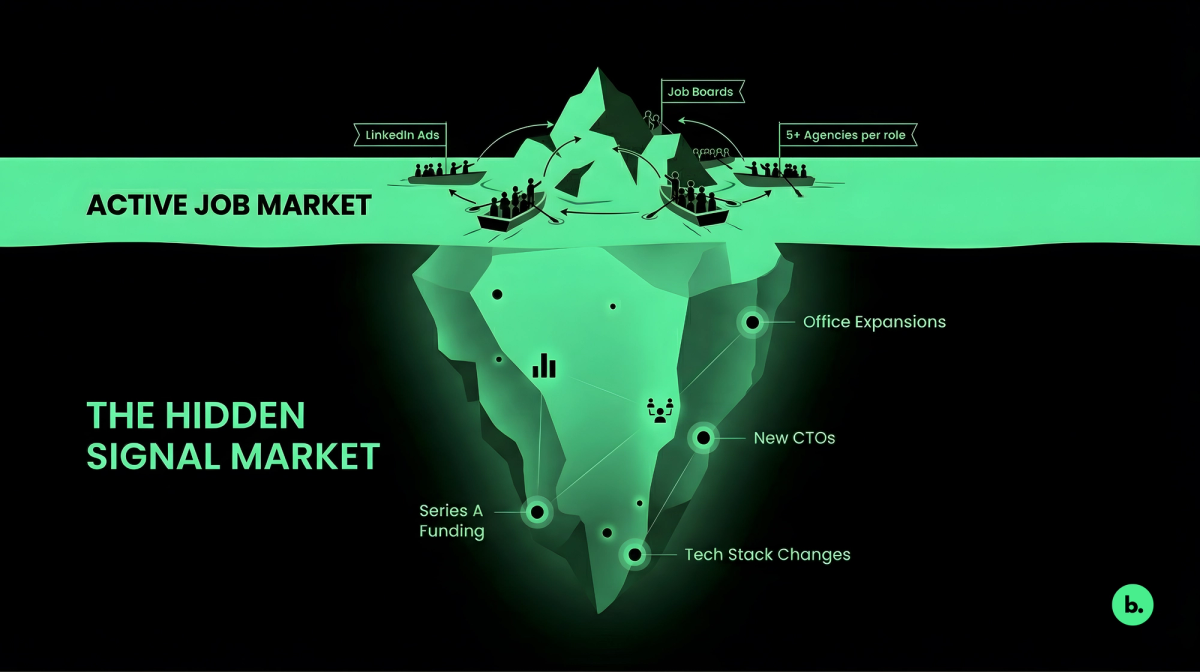
The recruitment and staffing industry currently stands at a critical inflection point, arguably the most significant since the migration from print advertising to digital job boards in the early 2000s. For nearly two decades, the dominant paradigm for business development has been reactive: a job is posted, and agencies race to fill it. This "speed-to-market" model, once a reliable engine for revenue, has degraded into a "race to the bottom," characterized by commoditized fees, shrinking margins, and fierce competition for the same visible opportunities.
By 2025, the market landscape has fundamentally altered. The proliferation of aggregator tools has democratized access to job data, meaning that finding an open requisition is no longer a competitive advantage—it is merely the table stakes for entering a crowded "Red Ocean." Furthermore, the rise of "Ghost Jobs"- vacancies posted to project growth or pool talent without immediate hiring intent - has introduced significant noise into the system, causing recruitment teams to expend valuable billable hours chasing illusions.
This comprehensive report outlines the architecture for a new, predictable lead generation engine: Signal-Based Selling. Moving beyond the limitations of reactive scraping and "post and pray" methodologies, this approach leverages advanced signal intelligence to identify hiring intent before a job description exists. By analyzing leading indicators such as venture capital funding, leadership changes, and operational expansion, agencies can secure a "First Mover Advantage," engaging decision-makers 48-72 hours before the wider market is alerted.
Drawing on extensive market data, competitor analysis (including SourceWhale, SourceBreaker, and Bullhorn), and proprietary insights into the Boilr.ai platform, this document provides a blueprint for agency leaders to construct a revenue engine that is immune to the volatility of the public job market. It argues that the future of recruitment lies not in better candidate sourcing alone, but in the intelligent prediction of client demand.
The Collapse of the Reactive Model: Why Traditional BD is Failing in 2026
To understand the necessity of a signal-based engine, one must first diagnose the structural failures of the current "reactive" model. The traditional workflow monitoring job boards, scraping career pages, and calling hiring managers about open roles - is suffering from diminishing returns due to three converging market forces: Data Saturation, The "Ghost Job" Epidemic, and the Speed Limit of Human Execution.
The "Red Ocean" of Aggregated Job Data
In the early days of online recruitment, discovering a vacancy on a niche job board or a buried career page provided a genuine information advantage. Today, that advantage has evaporated. The market is saturated with sophisticated scraping tools from SourceBreaker to generic B2B scrapers that aggregate every visible job posting into centralized feeds.
The result is instant market saturation. When a job goes live on LinkedIn or Indeed, it is simultaneously flagged to thousands of recruiters globally. Data indicates that for any given public job posting, 3-5 agencies have typically contacted the hiring manager within hours of publication. This hyper-competition commoditizes the agency's offering. When a Hiring Manager picks up the phone regarding a posted role, they are often in a defensive psychological state, besieged by identical sales pitches. The agency is forced into a conversation about price and speed (filling the slot) rather than strategy and quality (building the team).
The "Ghost Job" Phenomenon and Wasted Effort
A more insidious challenge in 2025 is the decoupling of job postings from actual hiring intent. Economic uncertainty and the desire to maintain a facade of growth have led to a surge in "Ghost Jobs" - listings that remain active despite no immediate plan to hire.
Research suggests that a significant percentage of postings on major aggregators are effectively dormant. Companies post roles to:
- Build a pipeline of talent for undefined future needs.
- Signal vitality to investors or competitors ("We are growing").
- placate overworked internal teams by appearing to seek help.
For a recruitment agency operating on a reactive model, these ghost jobs act as resource sinks. Consultants spend hours mapping candidates and crafting pitches for roles that do not exist commercially. Reactive tools that scrape these boards cannot distinguish between a genuine, budget-approved vacancy and a "ghost" listing. Signal intelligence, by contrast, validates the financial and operational drivers behind hiring (e.g., "Company X just received £10M" or "Company Y just signed a lease for 500 desks"), ensuring that business development effort is focused on companies with the means and necessity to hire.
The Limits of "Speed to Lead" in Recruitment
In general B2B sales, "Speed to Lead" is a critical metric. Responding to an inquiry within 5 minutes increases conversion probability significantly some studies cite a 21x increase in qualification rates compared to a 30-minute response.
However, in the context of outbound recruitment business development, "Speed to Lead" has a hard ceiling. If the "lead" is a public job posting, the race is already lost before it begins. The internal HR team has already drafted the description, approved the budget, and likely engaged their Preferred Supplier List (PSL). The agency is reacting to a decision that was made weeks ago.
The only way to truly accelerate "Speed to Lead" in recruitment is to move the starting line. By engaging the client during the decision-making phase when the funding hits or the new executive arrives the agency creates a monopoly on the conversation. This "Left of Job Board" approach effectively grants the agency a lead time of 48-72 hours over competitors relying on public data.
The Theoretical Framework: Signal-Based Selling and Information Asymmetry
The transition to a predictable lead generation engine requires adopting a new theoretical framework: Signal-Based Selling. Borrowed from high-velocity B2B SaaS sales, this methodology prioritizes outreach based on real-time indicators of buying intent rather than static demographic data.
Information Asymmetry as a Competitive Moat
At its core, the recruitment business is an information brokerage. Agencies arbitrage the information gap between talent (who is looking) and companies (who is hiring).
Historically, agencies focused on the candidate side of this asymmetry (Headhunting). Today, with LinkedIn Recruiter making candidate data ubiquitous, the value has shifted to the client side. The most valuable asset for a modern agency is Information Asymmetry regarding Hiring Demand.
Signal Intelligence platforms like Boilr.ai generate this asymmetry by monitoring non-obvious data sources. While the market watches job boards (lagging indicators), Boilr watches business events (leading indicators).
- Lagging Indicator: A job advert. This confirms that a hiring need existed in the past and has now been formalized.
- Leading Indicator: A Series A funding announcement. This confirms that capital has been injected, creating a future pressure to deploy that capital into headcount to meet growth targets.
The Psychology of the "Signal-Led" Approach
When a recruiter utilizes signal data, the dynamic of the sales call changes fundamentally.
The Reactive Call:
"Hi, I saw you posted a job for a Java Developer. I have some great candidates." Client Reaction: "Get in line / Send to the portal / We have a PSL."
The Signal-Led Call:
"Hi [Name], I saw the news about your £6M Series A raise and the plans to expand the engineering team in Manchester. Typically, companies at this stage struggle to scale their React teams fast enough to meet product roadmaps. We helped [Competitor] solve this last quarter..." Client Reaction: "How did you know? / You understand our context / Let's talk."
The signal provides Contextual Relevance. It demonstrates that the recruiter has done their homework and understands the business drivers, not just the job function. This elevates the recruiter from a "CV vendor" to a "Strategic Partner".
The Four Pillars of Hiring Signals
An effective engine monitors four distinct categories of signals, each with unique predictive properties:
Table Reference: Derived from Boilr.ai documentation and B2B signal literature.
The Engine Core: Boilr.ai Deep Dive
To operationalize signal-based selling, agencies require a specialized intelligence layer. Boilr.ai has emerged as a category-defining tool in this space, specifically engineered for recruitment use cases. Unlike generic business intelligence tools, Boilr filters signals through the lens of hiring intent.
The 10,000 Source Radar
Boilr.ai functions as a continuously active radar, scanning over 10,000 distinct data sources. This multi-source monitoring is critical because hiring signals are rarely centralized. They are fragmented across:
- Financial News: Crunchbase, press releases, VC newsletters.
- Social & Professional Networks: LinkedIn updates, executive moves.
- Technical Repositories: GitHub activity (indicating new coding languages being adopted).
- Government Data: Tenders, planning permissions, VMS systems.
- Employee Sentiment: Glassdoor reviews (often indicating churn or culture shifts).
The Predictive Mechanism: From Signal to Job
Boilr's proprietary algorithms do not just aggregate news; they interpret the implication of the news.
Example 1: The "Expansion Alert"
- Raw Data: A FinTech company files for a lease in Manchester.
- Boilr Insight: This is not just real estate news; it acts as a precursor to a recruitment drive for ~40 roles, likely split between Operations, Admin, and IT. Crucially, as a new location, there is likely No PSL in place, offering a rare window for new agencies to break in.
Example 2: The "Funding Round"
- Raw Data: £6M Series A investment.
- Boilr Insight: Based on historical data, a Series A of this size correlates to 15-20 hires. The breakdown is predictable: 8 Engineering, 3 Product, 5 Go-to-Market (Sales/Marketing).
Action: The agency can map the specific tech stack (React/Node/AWS) referenced in the company's technical footprint and present pre-vetted candidates matching that exact profile.
The "Time-to-Contact" Arbitrage
The most quantifiable metric of Boilr's value is the "Time-to-Contact" reduction. By detecting these signals 48-72 hours before a job is posted, Boilr allows agencies to engage stakeholders during the "Strategy Phase" of the hiring cycle.
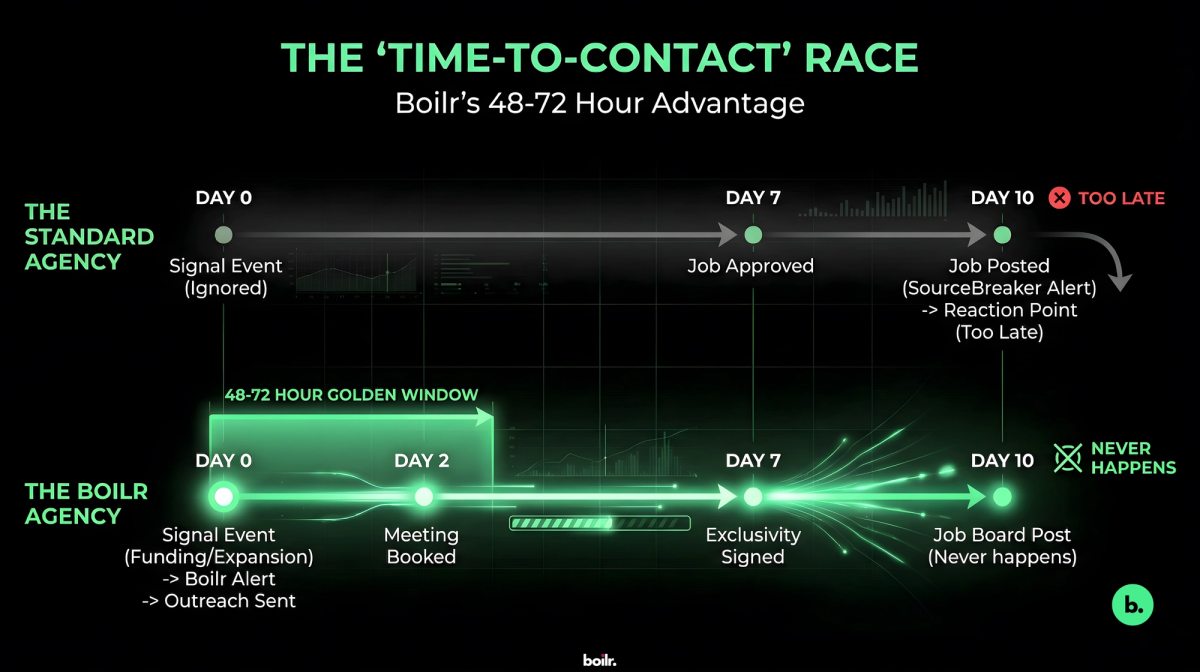
In the standard "Post and Pray" cycle, the timeline is:
- Day 0: Hiring need identified internally.
- Day 1-7: Budget approval, job description drafting.
- Day 8: Job posted on LinkedIn/Aggregators (SourceBreaker detects here).
- Day 8 (Hour 2): 5 agencies call the client.
With Boilr.ai, the timeline shifts:
- Day 0: Business Event (Funding/Expansion) occurs (Boilr detects here).
- Day 1: Agency calls Client. "Saw the funding, let's plan the hiring strategy."
- Day 2: Agency submits candidates.
- Day 8: The job is never posted because the agency has already filled it.
This pre-emptive strike capability is the only reliable way to circumvent the commoditization trap of the modern recruitment market.
Competitor Analysis: Choosing the Right Tool for the Engine
Building a predictable engine requires selecting the right technology stack. A common error among agency leaders is viewing all "recruitment tools" as interchangeable. In reality, the ecosystem is composed of distinct layers: Intelligence, Search, Outreach, and Management. The following analysis compares Boilr.ai against key market incumbents to clarify their distinct roles.
Boilr.ai vs. SourceBreaker: Prediction vs. Search
SourceBreaker is a market-leading platform for candidate sourcing and active lead generation. Its strength lies in its powerful semantic search and ability to scrape active vacancies from thousands of job boards and career sites.
- The Critical Distinction: SourceBreaker answers the question: "Who is hiring right now?" Boilr.ai answers the question: "Who is about to hire?"
- Data Source: SourceBreaker relies primarily on Job Listings. If a company hasn't posted a job, SourceBreaker won't find it. Boilr.ai relies on Business Events. It finds opportunities where no job listing exists yet.
Strategic Application:
- Use SourceBreaker to fill immediate, public vacancies and find candidates (Search & Match).
- Use Boilr.ai to find exclusive, unadvertised clients and build a business development pipeline (Signal Intelligence).
Conclusion: They are complementary. A robust agency uses SourceBreaker to map the candidate market and Boilr.ai to conquer the client market.
Boilr.ai vs. SourceWhale: Intelligence vs. Execution
SourceWhale is a premier "Business Development & Headhunting Platform" focused on engagement. It automates multi-channel outreach sequences (email, LinkedIn, phone) and integrates deeply with CRMs.
- The Critical Distinction: SourceWhale is the Delivery System (The Gun). Boilr.ai is the Targeting System (The Radar).
- The "Garbage In, Garbage Out" Problem: SourceWhale is extremely efficient at sending emails. However, if the recruiter inputs a generic list of companies that aren't hiring, SourceWhale simply allows them to spam more people faster.
- The Synergy: The "Predictable Engine" integrates these two. Boilr.ai detects a signal (e.g., "Company X raised Series A") and feeds this data into SourceWhale. SourceWhale then triggers a specific sequence tailored to Series A founders. This combination ensures high-volume outreach is also high-relevance.
Boilr.ai vs. Bullhorn/Vincere: The System of Record
Bullhorn and Vincere are the operating systems of the recruitment agency (ATS/CRM). They manage the workflow, compliance, and candidate database.
- Limitation: While these platforms have automation features (like Bullhorn Automation/Herefish), they are fundamentally repositories for internal data. They do not natively scan the external web for early-stage business signals with the granularity of a dedicated intelligence tool.
- Workflow: Boilr.ai acts as the "Top of Funnel" feeder. It finds the new lead and pushes it into Bullhorn/Vincere, where the relationship is then managed and tracked. Attempting to use an ATS for signal detection is like using a filing cabinet as a radar; it's the wrong tool for the job.
Competitor Feature Matrix
Table Reference: Synthesized from internal competitor analysis and feature reviews.
Building the Predictable Revenue Engine: The Architecture
To replicate the predictability of a SaaS revenue model in a recruitment agency, leaders must construct a tech stack where data flows seamlessly from detection to execution. This "Engine" consists of three distinct layers.
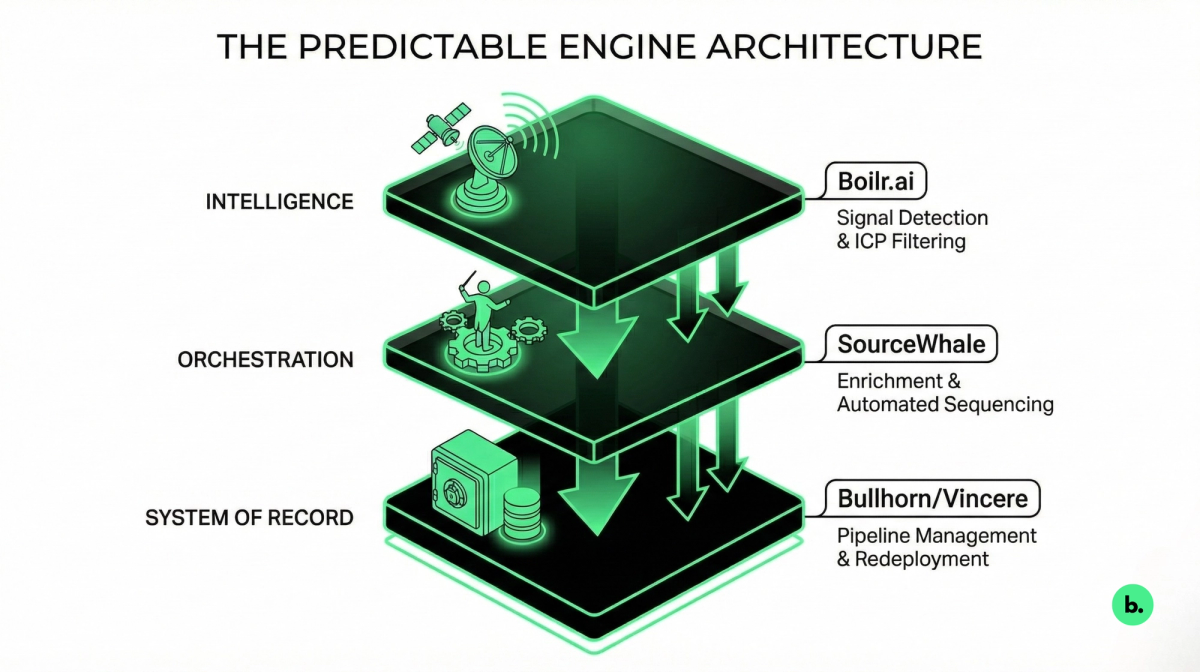
Layer 1: The Intelligence Layer (Signal Detection)
- Tool: Boilr.ai
- Function: Continuous market scanning for hiring precursors.
- Configuration: Define the "Ideal Customer Profile" (ICP). For a Tech Agency, this might be: "SaaS companies in London/Berlin, Seed to Series B, using React/Python."
- Output: A daily feed of "High Intent" accounts that match the ICP, tagged with the specific signal (e.g., "Series A - £10M").
Layer 2: The Orchestration Layer (Enrichment & Sequencing)
- Tool: SourceWhale (integrated with data providers like Apollo, ZoomInfo, Lusha).
- Function: Converting the "Company Signal" into a "Person-Level Contact."
- Process:
- Boilr identifies "Company X" has expanded.
- The recruiter (or automated workflow) uses Apollo/ZoomInfo to identify the "Head of Operations" at Company X.
- This contact is pushed to SourceWhale.
- SourceWhale triggers a "New Office Expansion" sequence.
- WhaleGPT (SourceWhale's AI) can be used to hyper-personalize the opening line based on the Boilr signal context.
Layer 3: The Execution Layer (Management & Closing)
- Tool: Bullhorn / Vincere / Loxo.
- Function: Tracking the opportunity pipeline.
- Process: When the prospect replies, the conversation syncs to the CRM. The "Source" is tagged as "Boilr - Expansion Signal." This allows management to track ROI specifically on signal-led activity versus cold calling or referrals.
- Automation: Use Bullhorn Automation to set tasks for follow-up calls if a prospect clicks a link in the SourceWhale email but doesn't reply.
Operational Playbooks: Turning Signals into Revenue
Technology is useless without a methodology. The following "Playbooks" outline exactly how a recruiter should act upon specific Boilr signals to maximize conversion.
Playbook A: The "Funding Round" Sequence
Scenario: A FinTech scale-up raises £15M Series B.
The Insight: Series B implies a shift from "Product Market Fit" to "Scale." They need middle management (VPs/Directors) and specialized ICs (DevOps, Data Science).
The Script (Email/Phone):
- Subject: Scaling the Engineering Team post-Series B
- Opening: "Hi [Name], saw the news on the £15M raise - congrats. Usually, at this stage, the pressure shifts to shipping the..."
- The Hook: "We mapped the local DevOps market last month for. I have 3 candidates who have specifically scaled infrastructure for Series B FinTechs. They are 'builders,' not 'maintainers'."
- Call to Action: "Open to a brief chat on how to structure the team for Q3?"
- Why it works: It validates the recruiter's commercial acumen. It solves a specific problem (scaling) associated with the signal.
Playbook B: The "New Executive" (First 90 Days)
Scenario: A new CTO joins a mid-sized e-commerce firm.
The Insight: New leaders have a mandate to change things. They often find the legacy team lacking or need to bring in trusted lieutenants. The "Golden Window" for outreach is Week 2 to Week 6 of their tenure.
The Script:
- Subject: Your first 90 days at [Company]
- Opening: "Hi [Name], congrats on the new CTO role. Typically, incoming leaders I work with spend the first month auditing the current tech stack and team capabilities."
- The Hook: "If you identify any gaps in the Java team during your audit, I have a 'bench' of contractors who can plug holes immediately while you build the permanent strategy."
- Why it works: It aligns with the new leader's psychological need to make an impact quickly and offers a flexible solution (contractors) to buy them time.
Playbook C: The "Ghost Job" Counter-Measure
Scenario: A company posts a job on LinkedIn that sits there for 30 days (potential Ghost Job).
The Signal Check: Check Boilr.ai. Has there been recent funding? Expansion? Leadership change?
Action:
- If YES (Signal exists): The job is likely real. Attack with confidence using the signal context.
- If NO (No signal): The job may be a ghost. Deprioritize. Send a "low friction" automated sequence to test validity but do not invest heavy research time.
- Implication: This "Triage" process saves hundreds of hours of wasted effort per year.
The Future of Signal Intelligence: AI Agents and GEO
The "Predictable Lead Generation Engine" is not static; it is evolving rapidly with the integration of Artificial Intelligence.
Generative Engine Optimization (GEO)
As agencies create content to attract inbound leads, they must adapt to Generative Engine Optimization (GEO). Unlike SEO, which targets Google's list of links, GEO targets the "answers" generated by AI models like ChatGPT and Google's AI Overviews. To ensure your agency is cited as the "expert" when a Hiring Manager asks ChatGPT "Best FinTech recruiters in London," your content must be structured for AI readability:
- Structure: Use clear H2/H3 headings.
- Format: Use tables and bullet points to present data (e.g., "Salary Benchmarks 2025").
- Authority: Cite internal proprietary data to build "E-E-A-T" (Experience, Expertise, Authoritativeness, Trustworthiness).
From "Co-Pilot" to "Agentic" AI
Currently, tools like SourceWhale and Boilr act as "Co-Pilots" - they assist the recruiter. The next frontier (2025-2030) is Agentic AI.
- Future Workflow: Boilr.ai detects a signal. An autonomous AI Agent researches the company, identifies the contact, drafts the email, sends the LinkedIn connection request, and only alerts the human recruiter when the client replies with interest.
- Implication: This will exponentially increase the volume of outreach. In this noisy world, the quality of the signal (the "Why") becomes the only differentiator. "Spam" will be filtered by AI; "Signal-Based Context" will get through.
Management and Metrics: Measuring the Engine
Transitioning to a signal-based engine requires a change in management KPIs. Tracking "Calls Made" is a vanity metric if those calls are to dead leads.
The New KPI Dashboard
Table Reference: Benchmarks derived from high-performing agency data sets.
The "Redeployment" Metric
While business development is key, the most efficient engine also maximizes Redeployment Rates (placing a contractor again after their assignment finishes). Boilr.ai can assist here by finding new opportunities for existing contractors.
Example: Contractor X finishes a project at Bank A. Boilr detects Bank B just launched a similar project. The recruiter pitches Contractor X to Bank B citing the specific project relevance.
Conclusion: The Strategic Imperative for Agency Owners
The recruitment industry of 2025 creates a binary outcome for agencies: Adapt or Commoditize.
The agencies that cling to the reactive model - relying on job board scrapers and speed-to-CV will find themselves in a "Red Ocean" of shrinking margins, fighting against internal TA teams and automated matching platforms. They will be viewed as vendors, not partners.
The agencies that build a Predictable Lead Generation Engine anchored by Signal Intelligence (Boilr.ai), Orchestration (SourceWhale), and rigorous Execution (Bullhorn) - will secure a "Blue Ocean" of exclusive opportunity. By moving "Left of Job Board," they engage clients when competition is zero, margins are protected, and the relationship is advisory.
The path forward is clear:
- Stop chasing Ghost Jobs.
- Start monitoring Business Signals.
- Use the 48-72 hour advantage to win exclusivity.
In a market defined by noise, the ultimate competitive advantage is clarity. Boilr.ai provides the radar to see through the noise; it is up to the agency leadership to build the engine that acts upon it.
References and Citations
- Market Analysis & Trends:
- Competitor & Tool Analysis:
- Sales Theory & Methodology:
- AI & Future Trends: